Editorial | Articles about Cambodia | Khmer
Big DADA is Coming, Don't Worry We Are Family
By Prak Hap
April 27, 2005
During Cold War ( not really cold as it said),Sihanouk willfully conspired and arbitrarily sheltered hundreds of thousand Viet to build hospitals, homes and warehouses to conduct war against US ally South Viet Nam that provoked US fury. He violated his own non aligned neutrality policy in hope Ho Chi Minh would make sure no more violation or returning Prey Nokor to Cambodia ownership if he conquered all Viet Nam. What's the fuzz?
Few days ago, Cambodia press headlined Mr. Hun Sen letter of intent to create a council to oversee Cambodia border problem which was not new or extraordinaire matter as it appeared on the news. People who used to work for Sihanouk when he was King, Head of State, President then King again knew problem well. Of course it is important to preserve territorial integrity and sovereignty but priority is people daily living standard too.
Khmer Republic boldly did protest and fought the Viets illegal occupation. Other hand Sihanouk rallied against and defeated it with heinous penalty on his so called Kaun Chau. At that time Mr. Hun Sen responded to Sihanouk second crusade call and joined the fight for Sihanouk return in 1975. Less than 3 years after his revered President Sihanouk forced retirement, Pol Pot and Dracula Mok led incursions and raids along Viet Nam border (old Khmer territory given to Viets by French in 1949) in the illusion to recapture its permanent control.
In 1977 President Khieu Samphan, Ph. D and his DK government demanded Viet Nam and others to respect Kampuchea 1960 border lines over the radio with severe ultimatum if not responsive. When the clashes ensued, Mr. Hun Sen responded to another call except this time from Sihanouk revered mentor, Viet Nam, to rise up and topple Sihanouk's own created murderous DK in 1978.
After that Sihanouk was not so nice and made Hun Sen his enemy with all name calling and derogative remarks about Khmeng wat Hun Sen government in 80 and 90. Surprisingly when they both met face to face in Djakarta to broker peace negotiation, Sihanouk was envious and jealous of Hun Sen ability then begged him over lavish dinner to be his adopted son with the elevated rank as Samdech afterward.
Less than three weeks ago Samdech Hun Sen responded to another crusade call from his beloved adopted father Sihanouk open letter demanding Cambodia proper boundary respect from neighboring countries especially Viet Nam. Swiftly Samdech Hun Sen sent letter to his adopted little brother King Sihamoni proposing the creation of Border Council before he and his elder brother Samdech Kom Pah RRidh president of Assembly jointly paid visit their gravely ill father who may not live past that weekend.
Upon the King return the news broke out Sihanouk was not that bad and with concurrence from elder brother Prime Minister Samdech Hun Sen, both made big DADA Sihanouk as the Chairman of such undefined role Border Supreme Council to straighten up Viet Nam government of his late Apouk chenhchem Ho Chi Minh followers once for all and for good.
This is clever but predictable politic so far. During 70's Sihanouk used DK to topple Khmer Republic then in the 80’s he used DK, Republican inclined KPLNF and monarchist to topple PRK but failed miserably and ended up dissolving his own CGC. Late Mr. Son Sann camouflaged as republican and led KPNLF to fight alongside with Sihanouk then kicked them on the shin in 1991 as he declared his allegiance to monarchy. Now Mr. Sam Rainsy who appears as rival to monarchists and DK-PRK but will appease to Sihanouk own call. Beware the present opposition behaves not far from So Sann then.
Sihanouk who was terminally ill and almost died last weekend according to his elder son RRidh but miraculously, with a new job title Mr. Sihanouk seemed in full recovery and spirit offering to physically walk miles and miles of frontier lines to search for the long gone demarcation markers. Dawn it, he is 83 year old to perform this daunting task which it should be more meaningful and suitable when he was a stud King then.
The consolation is all in Sihanouk family matter, so Cambodia people are in good hands especially those who recently lost land to Viets can relax now because Big DADA is coming. Thus Viet Nam better be ready to comply to his elderly statesman and kinship or else. He will tell his Apouk Chenhchem Zhou En Lai worshipers to repeat 1979 lesson to Viet Nam once again if Viet Nam ignored him? Best of luck big DAH!
SUBMITTED BY: Prak Hap
Email: prak....@hotmail.com
Wed, 27 Apr 2005
» Read more!
OH! YEA! OH! YEA!
PRK APRIL SELL OUT DAY
By Prak Hap
April 22,2005
How insulting to all with morality. This is the last thing that mordacious Sihanouk had done to turn society not only heartless but no soul. RGC’s just sold one of the main Killing Fields sites Choeung Ek to Japan’s profit making organization according to news today.
How this happened? Well the game began in late 60 or early 70 with maniac Sihanouk. He called upon and misled people to rise up against Khmer people who bravely fought his uncle and revered mentor Ho Chi Minh Viet Cong’s peasantry hero, the real historical enemy of Cambodia people.
Illusory Sihanouk blind believers turned murderous DK who killed off millions. Then the in fight broke ranks at the urge of Viet Cong turned Unifier of Viet Nam to split and toppled Sihanouk’s courageous DK liberation army in 1978.The turned coat DK known as PRK submitted and manned by Viet Nam former Thieu- Ky soldiers as its liberation army.
While we, the conscionable ones, demand justice for our loved ones who were killed by the living Maccu Raj Sihanouk soldiers of death 30 years ago, he at one hand overtly pardoned the DK’s killers and other caressed the compulsive PRK’s sell out.
Mr.. Kofi Annan UN Secretary just finished begging the world for funding for the Genocide Trial on Cambodia behalf and at the same time RGC’s unscrupulous Kep Chutama Governor of Phnom Penh just finished signing a selling deal of DK victims’ skulls to a profit making organization from imperial Japan. How immoral that is?
After long gone 30 years, most murderers were dead or pardoned by their ill will leader Sihanouk who is now telling people what he wants people to do with his body after he died. Outlandish son of the hell raiser, no shame, no remorse whatsoever, damn the religion he belongs to.
Just an idea since it was OK for him to pardon DK murderers and let PRK sell killing fields remains why won’t RGC strongman sell Sihanouk body after death as well. The phenomenal sell price may break Japan banks over night. Out of the deal, RGC can pay for the entire KR Trial cost and there may be a left over to buy back the Choeung Ek memorial site from humanity profiteer Japan. May be that’s why his never had son alias Iron Lips kept stalling the court process for all these times.
Now we begin to see how the game ending.
I have thought Sihanouk is more than a coward who denied own sins even knowing death is at the door step. People should never forgive his hypocrisy and curse upon his grave since how he has recklessly disgraced Cambodia. In the spirit of victims, May hell befell upon his soul eternally.
SUBMITTED BY: Prak Hap
Email: prak....@hotmail.com
Sat, 23 Apr 2005
» Read more!
April 17,1975 Sihanouk Victory Day
By Prak Hap April 12,2005
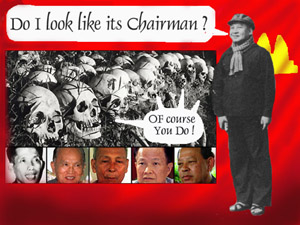
The day is here for the victims families,my heart filled with sorrows and my eyes filled with tears as I enter the morning of the gruesome day. Please look at a check list that former King memory has the responsibility to invoke this hellish day that he claimed his vengeful victory anniversary celebration.
As the result of his failures to carryout his vested duty people removed him from his office accordingly in 1970. But the dispirited Sihanouk took anger out on over 3 million peoples starting 1970 until1993.
Relatively the infamous Killing Fields was Sihanouk own diligence and ingenuity. In triumph on April 17,1975 he had punished Cambodia for its rejection of his treacherous and unethical rule in 1970. The world knew and yet he categorically denied of all accounts of his indicative heinous involvements.
Hence if April 17,1975 never happened the three million individuals would die at old age after fulfilled family obligation and duty.Cambodia might have been nearly 20 million citizen nation now. Secretive authorization for China's proxy Viet Nam sanctuary and arms conduit,
Secretive authorization for China's proxy Viet Nam sanctuary and arms conduit,
President of the Great Leap Forward Revolution after March 18,1970,
High Command position in DK liberation army communiques,
Cruel evacuation to uproot societal orders and systems,
Execution Khmer Republic army,
School closures and abolished modern functionality,
Mass enslavement, torture, stravation and forced laborous quotas,
Deprivation of fundamental human rights,
Use many temples or schools as execution centers or prisons,
Turn rice fileds to killing fields,
His actions led Pham Van Dong to reinvade Cambodia on December 25,1978,
1979 obedient mouthpiece for Pol Pot at UN,
Granted DK tyrants and murderers amnesty.
How can he sleep and live with himself by knowing he had audaciously violated the Buddhist very fundamental Panca Sila and inflicted pain and suffering upon not one individual but millions that is not only a disgrace to his children but Cambodia history and humanity altogether. People should give him the following post pothumous titles as the Kambuja king of death (Maccu Raj) ,Sangkum Reast Ningyum ingrateful prince,and royal family ever immoral example.
SUBMITTED BY: Sacrava
Email: Sacr......@aol.com
Sat, 16 Apr 2005
» Read more!
Thursday April 7, 2005
News Comment
FOCUS ON TRADE, NOT POLITICS Investment and trade possibilities do exist in Vietnam, Cambodia
Verghese Mathews
The Federation of Malaysian Manufacturers and the Singapore Manufacturers' Federation are jointly organising a trade and investment mission to Vietnam and Cambodia in May.
It is heartening to see the private sectors of the two countries cooperating meaningfully and setting the pace for their politicians.
The hard-nosed private sectors of the two countries see opportunities in both countries.
In Cambodia, the private sector, according to reports, is looking at "investment in infrastructure development, agro-business, light and medium industries, tourism-related activities, engineering, construction, public works and real estate", while Vietnam offers possibilities in "business areas such as electric and electronic, information and telecommunications, construction, agricultural, property and infrastructure development and power generation".
The visit is timely and will be warmly welcomed. There is a far greater acceptance - at the bureaucratic and business levels in the two countries - that the onus is upon them to make their countries attractive to foreign players, in particular to visiting trade and investment missions.
The two countries also realise that they play an integral role in the success or failure of these missions.
On their part, they want the opportunity to work with the Singapore and Malaysian business communities, for whom they have a healthy respect. They also see the networking advantages and the global reach of the Singapore and Malaysian partners in Asean.
Several businessmen in Singapore and Malaysia already have an understanding of doing business there.
First-timers in the mission will be impressed not only by the opportunities the two countries offer but also by some of the officials they will meet.
Cambodia, for example, has young bureaucrats who are extremely competent, dedicated and determined to play a legitimate role in the economy of the region.
They see this as an inevitable means of creating much-needed jobs and enhancing the living standards of their people. These bureaucrats are pragmatic both in their outlook and in their assessments and are deeply conscious that there are elements in their environment which remain an impediment to enhancing business confidence even though Cambodia has been successful in recent years in securing and maintaining macroeconomic stability and in having put in place an attractive and liberal investment regime.
These young bureaucrats, who have the confidence and support of Prime Minister Hun Sen, are the ones who are quietly spearheading the reforms away from the limelight.
Foreign investors, too, have confidence in them and in the direction the Cambodian government is taking, although they bemoan the slow pace of much-needed reforms.
In particular investors want to see an end to the "hidden costs", a euphemism for pervasive corruption, in their business operations and want greater transparency in the judiciary which is widely regarded as being susceptible to external influence - which could favour local partners.
To overcome this, foreign investors often include an arbitration clause in contracts for disputes between foreign and local partners to be resolved in a stated third country.
Cambodia, like Vietnam and Laos, is set to move forward. It is more democratic and has made strides but it often gets bad international press - of its own making.
What invariably makes the headlines are reports on the fractious politics and the unending politicking.
Singapore and Malaysian investors may see it as an impediment. While such concern is not without merit, they should see it in perspective.
Meanwhile, not withstanding the different political styles, Cambodia and Vietnam will become even more attractive investment destinations for our businessmen if the two governments are willing to open up their countries even further.
Our businessmen should also look at Laos, landlocked and with few viable industries, but which has potential for eco-tourism and the production of hydroelectric power.
The World Bank has just agreed to provide loans and guarantees for a $1.95 billion hydroelectric dam project designed to produce electricity for export to neighbouring Thailand. Laos needs all the help it can get.
The writer, until recently Singapore's Ambassador to Cambodia, is a Visiting Research Fellow at the Institute of Southeast Asian Studies, Singapore.
SUBMITTED BY: Verghese Mathews
Email: math...@iseas.edu.sg
Sun, 10 Apr 2005
» Read more!
ATTITUDE THAT TELLS A SAD STORY
Sun, 3 Apr 2005
Sim Sina (Mrs)
Even a die hard optimist would find it difficult not to see that Cambodia, as a nation, has sliding toward oblivion. The image of the recent visit of the secretary-general of the Communist Party of Vietnam to Phnom Penh may be a prelude confirming a relationship that extends far beyond two neigbouring souvereign nations. It is bordering on a master-servant interaction. It should not be a surprise, with an existing the laissez-faire immigration policy, if Cambodia becomes another province of Vietnam in fifty years time, if not sooner.
Overall, it seems the issue of national pride, identity, and existence does not pan out to be really of national significance to major political players in Cambodia, at least not to the extent that it would attract their undivided attention. Each of those leaders appears to have their own axe to grind in their politicking. They perhaps unwittingly forget that their focus should be primarily on national interests, which regrettably may or may not too clear to them.
The King Father would have benefited a great deal from a Khmer proverb that expounds the virtue of being silent, “silence is better than talkingâ€. He seems to believe that his undoubted love and devotion for the nation frees him from gullibility and human errors. In the latest episode, it appears he really believes his childhood friend, Roum Ritt, exists mainly to share his pain and agony for being trapped in a foxhole, from which he has neither tenacity nor audacity to get out. Worse, he seems to believe that others have taken in this imaginary childhood friend of his. Otherwise, he could have gone through a severe anguish in the past few days when the prime minister and his own son, the National Assembly president, renewed their verbal attacks on Roum Ritt. The King Father may not have been given any authority to rule Cambodia when he was King, but he appeared to have lost also the moral authority a long time ago. It is rather sad that he may not even realise the significance of this loss.
Eventhough it may not be a public knowledge that there is no love lost between National Assembly president Prince Ranariddh and his father, the King Father, the usual respect accorded by a son for his father has also disappeared. According to the prime minister, the Prince refers to his father’s friend and pen pal as “Ah Roum Rittâ€. Given his level of intellect, it is most difficult to assume the Prince would not know – what the rest of us know – that Roum Ritt is his father’s imaginary friend. Perhaps, the King Father is asking for it.
The public display of the disgraceful relationship between the father and son may have brought unlimited joy to the prime minister who has been successfully keeping them in the foxhole since the UNTAC intervention in the early 90’s. He has been gloating over his success in humiliating the two major players in Cambodia politics. He ridicules them by claiming that he is more polite than the Prince in calling Roum Ritt “uncle†when the latter prefers “Ahâ€. The prime minister could have pretended to deliberately slip his tongue to indicate that Roum Ritt was the Prince’s father. He has turned public sarcasm into an art form. And, perhaps sadly the father and son are asking for it.
Derogatory language in public forum seems to become a flavour of the month for the Khmer leaders. The prime minister seems to be a master of offensive language that would not even fit a gentleman, let alone a statesman. Yet, interestingly some western linguist argues that the prime minister’s “language faithfully represents their [Khmer] cultural heritage and expectationâ€.
It seems the Khmer cultural heritage and expectation have sunk to an all time low, and the national pride and existence can not be that far behind. Sim Sina (Mrs)
SUBMITTED BY: Mrs. Sim Sina Email: sims.....@westnet.com.au Sun, 3 Apr 2005
» Read more!
March 22,2005
How Long the Lotus Kingdom II Continues its Senseless Dances?
By Prak Hap
The eminent abuse of power and corruption are Cambodia facts of life. If we look at its political dominos in term of overly representation of 13 millions versus 20 provinces which interpreted Senatorial (3.05) or half of the Assembly (6.15) per province in performance and results. Cambodia does not safeguard millions whose life still depend on sun, moon,land free of the neighboring countries encroachment, or corporates and officials illegal take over of rightful ownership, and mercy of unpredictable disastrous climates.
According to 2003 US Department of State report “Cambodia GDP was approximately $4,000,000,000 and Khmer ( not immigrants) family income was approximately $282 annually or $0.78 per day.” Technically average Khmer works year round in order to barely live with no paid days off. The national awesome budgetary still relies on foreign donations. The extraordinaire legislative branches took a lumpsome out of its donation annual budget accordingly: Assembly $2,000 x123 x 12=$2,952,000 and Senate $2,000 x 61 x 12=$1,464,000.
Comparatively, it takes common folk 91 days to catch up with one day of an average senatorial earning based on the average less than $1 per day out of 365 days vs individual Senatorial earning $90.90 per day out of 22 work days excluding all perks and extensive privileges. Legislative session may last from 2 to 6 months per year and the remaining time the elected individuals can float and do nothing but still entitles to full $2,000 allowance likely without income tax. Most of these guys can afford abroad trips and foreign health services or education for their kids. No ethical and moral examplary in the governance from top to bottom.
Contrarily, average folk has no access to very basic health care services, or basic education for their children, or daily movement, or ability to use land without interference or inadequate constitutional guaranty of endowed rights to life,liberty, and the pursuit of happiness.
How this senate came into existence? Why exactly Cambodia needs such senate to begin with?
No one knows exactly the real reason behind this quickly put together Senate post the anarchic riot in July 1997. The present Senate is non democratic. It is comprised of appointees by dominant political parties or institution of power excluded the independent or DK cliques. Many are either the cliques or remnants of previous regimes such as Khmer Republic or DK turned royalists, Vietnamists then opportunists. These guys did not have to earn people vote but yet have the audacity to legislate laws.
If the voters determined to do away with the senate whose primary job is to obediently echo the Royalty endeavour anyway, the predicament is the current Assembly setting may have to expand from 123 to 184 in total. And at the convenience, the King and the leadership of the Assembly can adjust another or two year if the senate office 5 year term expired with technical mishap. This is the most privilege and lucrative job on Angkor land out of the labourous and systemic enslavement of simple Khmers.
It appears that Cambodia has no longer trusted its own sense of responsibility unless the foreigners said something first. This is the time the Constitutional Council does its job in reviewing what is not needed. Please for the sake of Cambodia people survival, enough extra government of no performance and let people have their say so as stately in the Constitution.
SUBMITTED BY: Prak Hap Email: prak....@hotmail.com Tue, 22 Mar 2005
» Read more!
March 14,2005
Live the Dream of Democracy
By Prak Hap
Synonymously, Cambodia is Sihanouk Killing Fields and treachery. People of Khmer descents, your land had changed from names to names but the truth remains that you are Khmer who Siam or Annam categorically wished to extinct forever. With clear conscience and pre-meditated intent, Sihanouk committed heinous crime against Khmer Republic people to fulfill his ancestral lineage dream.
Out of cowardness and servitude, the wanna-be enlightened Dhammik former King Sihanouk, has illegally spent people money to aid Khmer hereditary enemies in finishing off the braves who had stood to denounce his un-constitutional and treacherous acts in 50, 60, and 70’s. He personally plundered taxation and national treasury to bankruptcy in serving own erotic and unworthy endeavours. Furthermore his families lived off Khmer blood and toils yet claimed to be divine supreme Buddhists.
For centuries, the royalties are the pedigrees of the ruling Siam or Annam clans with French’s motto diviser peuple Khmer pour regner. In the 1930 French built houses modeled after the Siam’s Chakry dynasty grand palaces of Bangkok to make Siam emisary of Nay Duong royalty brand felt at home. French elevated cultural image of glorious Siam political and diplomatic conquest of Khmer nationalism in the heart of Phnom Penh. To balance out,French ceded more Khmer territories to Annam before colonial departure. Then French entrusted royalty of own incested lines to breathe and behave as French remnants.
After the long cruel and destructive rules of colonials, Khmer generations strive for changes. Many died to fight off the ruling and taxing of European colonials then yet submitted to the spoiled and destituted aristocratic rules which in turn shown no gratitude or credits for Khmers.
March 18,1970 was the precursor day for the courageous patriots and informed generations inspired by the self-determination and democracy vision.The unprecedent democratic process had removed the despots and corrupted god like palace occupants. But unfortunately it did not last long. Some of the braves survived or ended up living abroad or bannished from entering the birthland politic for life unless repent.
Out of personal vengeance, the self proclaimed divine former King Sihanouk of such pedigree turned worldly tyrant atheist Mao–Ho (Nguyen) worshiper who coldheartedly exterminated thousands to millions aspired idealists on April 17,1975. To this day he is profusively in denials of crimes.
No matter how you look at it, Khmer people is still under the foreign lineage and nemesis ruling anyhow as long as the Constitution did not do justice to vote out monarchy for good. Therefore the 35th anniversary of the Dream of Republic will be just another unscripted matter for Khmer history.
The lament will be, if and only if, the Khmer will need not to realize own dream of ideal democracy with self rule of justice, liberty, fraternity, amicably, national integrity, and sovereignity soon enough.
SUBMITTED BY: Prak Hap Email: prak....@hotmail.com Mon, 14 Mar 2005
» Read more!
The Straits Times, Singapore
March 5, 2005
Cambodia's continuing crisis
By Verghese Mathews
For The Straits Times
IF THERE is one lesson neighbours in the region should learn from contemporary Cambodia, it is to never ever end up as a donor-funded country. Should some outrageous fortune result in that happening, one should expect to see within that country a collective nationalistic fervour bent on quickly redressing the situation.
This is unfortunately not so in Phnom Penh where once again political infighting is preoccupying decision-makers instead of nation-building and working towards self-reliance.
Politicking, it would appear, is in the blood, bones, hair and finger nails of Cambodian politicians who practise it with great enthusiasm and blatant impunity.
The melodrama is at the expense of the poor, the weak and the marginalised who are becoming increasingly frustrated.
Worse, there is also a tiresome pattern of the political discord in Phnom Penh invariably becoming externalised, resulting in strident condemnation of the government by the usual 'democratic' sources - and, as happened not too long ago, a shrill call for a 'regime change'.
The latest upping of the political ante is essentially the continuation of inter- and intra-political party intrigues that have been going on since the last general election in July 2003 - obscenely delaying for more than a year the eventual coalition government between the dominant Cambodian People's Party (CPP) and the royalist Funcinpec party (FCP).
Tension moved up several notches on Feb 3 when the Cambodian National Assembly voted to remove the parliamentary immunity of Mr Sam Rainsy and two other members of the opposition Sam Rainsy Party (SRP) so the courts could charge them with defamation. Prime Minister Hun Sen and FCP president Prince Norodom Ranarridh, who had earlier lodged the defamation charges, argued that no parliamentarian should be allowed to malign others under cover of parliamentary immunity.
Mr Rainsy 'fled' the country the same day. He had similarly fled or sought refuge at some embassy on previous occasions.
He was soon in Washington, Brussels and Paris to externalise the problem. Here, he must be given credit - he has used his excellent outreach to identify powerful people and groups that are against Mr Hun Sen and the CPP.
Mr Rainsy scored on Feb 17 when long-time Hun Sen critic, US Senator Mitch McConnell, and Senator Sam Brownback tabled Resolution 65 at the Senate Foreign Relations Committee calling on the Cambodian National Assembly to reverse its decision to strip the three SRP members' parliamentary immunity.
It also urged donor countries to impose 'appropriate sanctions' against the Cambodian government and assembly until the decision was reversed.
The resolution further demanded that US visas not be issued to any parliamentarian who had voted in favour of the decision and all his family members.
For good measure, the resolution urged the State Department, the United Nations Secretary-General, international financial institutions and 'democrats all around the world to continue publicly to condemn the actions of the Cambodian Assembly'.
It is interesting that international financial institutions are specifically mentioned. The SRP has been highly critical of them for releasing funds to the Cambodian government for various development programmes.
Mr Rainsy also appeared on the BBC's Hardtalk. To criticisms from his detractors that he did not fare too well and was on the defensive, the SRP retorted that the interviewer, Zeinab Badawi, was overly aggressive and 'would have made an excellent interrogator at a concentration camp'!
It is now a month since Mr Rainsy has been away on his campaign. But it is unlikely that the international community will be persuaded to impose sanctions or blanket travel restrictions - there are those who are not taken in by the SRP's choreographed campaign or who argue that Mr Rainsy is no less guilty than those he has accused of authoritarian tendencies and of undermining the country's democratic credentials.
While Mr Rainsy is right that much more needs to be done - fighting endemic corruption, reforming the judiciary, promoting financial and administrative transparency, and ensuring good governance - it is important to view these in perspective.
For a post-conflict country, Cambodia has done well and it is a fair comment that for Cambodia, every year since the Paris Peace Agreement of 1991 has been better than the preceding one. In the latest Index of Economic Freedom published by the Heritage Foundation and the Wall Street Journal, Cambodia is ranked 63 out of more than 155. Cambodia was termed 'mostly free', higher than Thailand in the same category at 71, while Vietnam at 137 was 'mostly unfree' and Laos at 150 was 'repressed'.
Mr Rainsy knows that sooner or later he has to return to Phnom Penh and is now making arrangements. His latest stand is that he will return to Cambodia as soon as he receives a 'legitimate court summons with specific charges'. He has also written to the King to help resolve the crisis and ensure that the court's decisions are more consistent and equitable.
Some think Mr Rainsy overplayed his hand this time but his supporters at home remain mostly faithful and that is his plus factor.
The writer, a former Singapore ambassador to Cambodia, is a visiting fellow at the Institute of Southeast Asian Studies
SUBMITTED BY: Verghese Mathews Email: math...@iseas.edu.sg Sun, 6 Mar 2005
» Read more!
March 3,2005
TO DO vs TO DO NOT?
By Prak Hap-FLUS
The newly packaged extra size government reportedly of 300 cream of the crops was bound in agreement to abide the top 72 priorities as its plan for this term? Unfortunately, February 3,2005 event took precedence over the real hot problems. Cambodia Constitution states Assembly is the people therefore does the real people know about the real problem yet?
Framework of Constitution is farcically convenient for self-serving agenda. Executive Branch or the so called Administration is still absent of transparency and moral duty. Members of the government continue to abuse code of ethics and duly sworn accountability.
Khmer Rouge Tribunal Opening: in less than six weeks will be the 30th anniversary of the Killing Fields. It is apparent the melodramatic Democracy and Human Rights are still repressively melancholy. What are the remedies?
Territorial integrity: Viet Nam still violates Cambodia border, matters are the future and guaranty of people who live on their ancestral land. According to one of the lead citizen advocates, Mr.Sean Peng Se, on behalf of Committee of Cambodia Border based in Europe and those interested in abroad, many treaties are supposed to be rescinded by the Assembly with his Majesty seals and signatories. Therefore the government and the monarch alike duly task is to see to it promptly. What’s the progress on this?
Corruption and Poverty Reduction: World lending bodies and donors alike made insults and demands in the face of this esteemed extra extraordinaire extra large government many times over. Reported acknowledgement of the rampant corruptions including governmental self-destructive conducts are overwhelmingly present. Needless to say more upon years passed and found no evidence of corrective. Where is the Assembly good faith and responsibility to meet the obligation. Who is responsible in the corrective action to ensure friendly lending banks demands? When will it start on these?
Sympathetic countries warn to lift sanction and embargo on trade against Cambodia as a whole. Economy and Commerce are servitude of foreign unscupulous investors. Taxation vs extortion, illegal logging, and smuggling are still usual means of the low governmental posts to discover nouveau riches. Who’s accountable for the officials unscrupulous conducts?
Good sounding Education is impetus to the human resource and capital needs but
the long overdue ineptness and unaccountability still perpetuate the disparity gap of the great majority needs. No innovation,descipline, and self-reliance spirit to assure population competency to compete with world standard labor and market.It has to take responsibility to lead people to depend not the donation but own ernest resilience. Who’is to blame for uncontrolable unemployment and anti social behaviors in the real society?
List can go on and on but let just pause here momentarily and allow the worldly esteemed Assembly time to forge its altruistic nationalism.Since some of the long time top echelon officials felt there was nothing give them more ecstacy but to serve the people. Let’s all agree and re-entrust the task which is clearly conscientionable on the Assembly part now. Be mindful, there is no excuse to turn on people demands of action.We are watching and so are the donors.
Momentary as the result of ”To Do orTo Do Not” the world is impatiently working against people hence Assembly.
Khmer land withstands the snake in the grass from the west and the rancorous beast from the east.
SUBMITTED BY: Prak Hap Email: prak....@hotmail.com Thursday, 3 March 2005
» Read more!
February 24, 2005
What will Be the Future of Dissenting View
in Cambodia Parliamentarian Government?
By Prak Hap-FLUS
The Assembly of real gentlemen and ladies of the laws had made move to infringe the rare voice of opposition on February 3, 2005. The vocal critics and truth seekers as it seemed have been ousted by hand raising votes in stacking number. According to article appeared on Kohsantepheap daily 12-03-2004, it pointed out Mr. Sam Rainsy legal filing suit to seek truth in regard to the 1997 incident-grenade tossing at the demonstrators was a political motivated plot backed by Mr. Hun Sen to eliminate the oppositions.
The legal process has taken place but yet incomplete. No one knows for sure who is the real culprit? The contentious dual turned out to be misfortune for Mr. Sam Rainsy. One thing is true that, most people do not like to loose and in this case Mr. Sam Rainsy bore the brunt alone.
In this battle who is the real loser?
My opinion the whole Parliamentarian system is a loser eventually. World democracy is watching and Cambodia citizen suffers the short change all the time. In truth, it is not necessary that the opposition lost but all the voters lost their rights to be heard and expressive. Mr. Sam Rainsy and his two other colleagues were no strangers to the rest of MPs. They are Khmers who tried to do the same things for their constituency but in the Constitution in Chapter VII Article 77: states” the deputies in the Assembly shall represent the entire Khmer people, not only Khmers from their constituencies. Any imperative mandate shall be nullified.”
Therefore, what Mr. Sam Rainsy and his group did was not supposedly to be just only for Khmers from their constituencies. So it led to another argument, what was the rest of Assembly did for? Their constituencies alone or what? How the justification worked for the majority but not Mr. Sam Rainsy and colleagues?
In a sane opinion, President R. Ridh or Prime Minister Hun Sen is not the entire Khmer population and they are not so innocent either. I don’t know these two gentlemen personally, according to press they are not that Koshered. One thing about press, they are bound by journalistic ethic. They supposed to report what they see and hear with both side verification. No put down here, I may have some reservations about some Cambodia reporters whose motifs are not journalistic truth but Mr. Benjamin Franklin bills. That is another problem. People eat food not news.
Other side of the coin, if Mr.Sam Rainsy is found malicious and groundless to accuse such god-like Hun Sen and Rannaridh but the court has not done its duty to prove otherwise yet. Who says the two are crook and hellishly dishonest? Why people say that? People let’s not lose your sense because of pledge of allegiance to certain group. If you have some conscience left please use it. It is your duty to protect people. Look each of MP got $2,000 a month working in nice A/C and plush offices, let‘s not be complacent and insult voters because of affiliation with big wigs in Phnom Penh.
I like to say this un-religiously, according to natural or universe law, what goes up must come down or what goes around comes around, right? What happened to Mr. Sam Rainsy, Mr.Cheam Channy, and Mr. Chea Poch may be in violation of the constitution but I guess your guys don’t care as long as you don’t lose $2,000 per month.
The concern is why other parliamentarians are so wrapped in the partisanship not the voters’ interest. The question is the MPs for the people or each of their respective Party? If each of them allowed this to happen then the Constitution means nothing. They are next when the Party bosses do not like them.
Kohsantepheap Newspaper on 12-3-2004 said the PRK MP H.E Samrin Heng stated that such move to remove H.E Sam Rainsy from his mandated duty as people representative is in the hand of H.R.H Speaker R. Ridh. What are the unethical violations that MP Sam Rainsy committed against the parliament rules? Is it the truth that he opted to fully expose the leadership wrongdoings to the public? What are the rest of MPs from CPP /Funcipec doing? Buffing zones or rubber stamp may be both.
Let consider that each Party can voice its dissenting views but each should not disregard the Constitutional mandate and rights. Executive Branch is accountable to the Legislative Branches scrutiny. They are public servants. As private citizen, according to Article 38:”the accused shall be considered innocent until the court has judged finally on the case.” Then Article 39:” Khmer citizen shall have the right to denounce, make complaints or file claims against any breach of the law by State and social organs or by members of such organs committed during the course of their duties, The resettlements of complaints and claims shall reside under the competence of the courts.” That is one step up for such historical violent society, Cambodia.
It may be the case that MP Sam Rainsy filed suit against PM Hun Sen in the best interest of people. MP Sam Rainsy is entitled to do such as private citizen in the eyes of laws as well. But his action is on behalf of people. The leadership and the rest of MP headless body are concerned of the guilts of their beloved leaders. This reminded me a parallel in Khmer saying ”Gaur dombao khnang Khaek hour rom long romsai kontouy.”
Why the rest of MPs including the leadership did not see that? However, if the Legislative branches condone such move then the principles of true democracy is in serious jeopardy. The dilemma for Cambodia democracy and its citizen is at cross road. Are we still in tune with the stronger rules and live or let live mantra?
One citizen rights not respected is one too many.
SUBMITTED BY: Prak Hap Thursday, 24 Feb 2005
» Read more!
February 17, 2005
By Prak Hap FLUS
Subject: Luke Hunt ruffled scholars’ feathers with his book review” Cambodia after Khmer Rouge by Evan Gottesman”
Let me started with E. H Carr’s definition of history: as a body of ascertained facts. What’s a historical fact? What passes as a fact of history is in fact made into such by a historian’s conscious decision. However, for a historian attempting to write a history of the Third Indo China War the problem is more basic than that of exercising subjective judgment in choosing facts from a plethora of events. There simply may not be enough relevant information to choose from. Other than relating self-serving selections of confidential documents, the communist governments of China, Viet Nam, and Cambodia are unlikely to open their archives to independent historians,” (Enemy Brother book, by Nayan Chanda p.ix).
Historically since 1700 Viet Nam has not been a grateful neighbor to Cambodia. This letter is to voice out the conflicting history done by Non-Khmer scholars. Among few alive on the planet, Mr. Michael Vickery was recognized as an absolute authority on Khmer tragic history but Mr. Michael Vickery has not been nearly candid about the situation. There is no such thing called anti-Viets. The gentlemen had points of arguments but yet the truth remains. It is self-rule and respect. Let’s be honest, how well that Engle live with Gaelic or Scott descendants? How about people of old Palestine presently called Israel? Viets disliking anyone referring them by their ancient origin, Yuan. Apparently Mr. Vickery was bias for that matter.
I recalled Dhammasad elite University students in Bangkok (Ly Beng Long aka Nuon Chea or Loeuth old school) shared their views and reference of krieat bak ha khi kong Yuan as non-trustworthy back biting or a lot worst. Generally Thais or Laos share the same feeling toward Viets. It is blatantly irresponsible that the perceptions were laid on Khmer such as General Lon Nol heavily uneven as racist, lunatic, and inhumane. He was a good and leveled head person who believed in and defended his people. . This makes me wonder how the Mr.Vickery makes out of US present occupation in both Iraq and Afghanistan.
The reviewer, Mr. Luke Hunt a journalist attempted to provide non-bias cheering opinions and academic measured praises on the recent published book namely, Cambodia After Khmer Rouge by the young zealous author alias barrister, Mr. Evan Gottesman. Pointedly Mr. Gottesman book might have skirted up Mr. Vickery’s self-serving selections of confidential documents of the PRK government. Adversely, Mr. Vickery did not think so he categorically put Mr. Hunt book review as non-sense and discriminatory.
He went on to say in 1979 there was nothing as “elite” but I say Mr. Vickery can’t tell the difference, which is serpent or snake. The same scenario goes for those PRK or DK. There were plenty of them. Again and again in Cambodia where everything relevant to cultural root, as elite is not necessary mean in western view. It is an inheriting badge of namesake. That might have embarrassed Mr. Vickery that some one else has more courage to speak the truth.
As for “Rape or violence against women”, the absolute and gross human rights violation. Remember there was no explicit distinction between PRK and DK. So does the North and South Viet Nam. All are in the same mentality. Viet soldiers raped many young women at gunpoint whom I knew parents. I am stunned that Mr. Vickery seemed to vigorously defend such abusers. Cambodia women were bound by their traditional value and norms “face.” The victims may not speak about such disgrace openly especially if her life is in jeopardy.
Further, Mr. Vickery claimed to see voluminous literatures on the period I find that hard to accept. All books were valued as cigarette papers. Worst no one dared to write anything for publishing. As far as the Constitution matters, I don’t believe Mr. Luke Hunt needed approval from Mr. Vickery to conclude Goats-man (although Gottes-man knew it) book review as Mr. Vickery was edging his denigration. Not all Khmers were brain-dead. In a nutshell that’s proved E.H. Carr synthesis. I rest my case.
Foreign language options for students then were not French or English but Viet, Russian and elective Cuban’s Spanish verse. My relative who later admitted that medical school was no medical training but political indoctrination with Russian instructors. French-Russian-French dictionary was a rare treat for students in Faculte de Medicine then. I had no doubt my relative and others made up thing. They were there. I hope Mr. Vickery is familiar with French Fables’ Monkey vs. Goat dispute over Farmer Lunch by Mr. Lafontaine.
Pen Sovan matter- No one surprised that former Premier Pen Sovan was stripped from power. Also Mr. Pen Sovan was one of the major PRK historical facts. He knew Viet Nam true intent. But Mr. Vickery claimed to know more than the natural never mind Mr. Gottesman and the rest. In this case his claim proved he has accesses to voluminous false documents.
In Chan Si’s death warranted strong credibility of Viet Nam intent with help from its young –naïve client. This reflected Mr. Sihanouk conspiracy in 60’s claiming Khieu Samphan, Hou Nim, and Hou Youn were executed and buried at Pich Nil Pass. Is Khieu Samphan still dead yet? Mr. Vickery claimed on one of his old friend visited Chan Si in hospital. Had he not thought if that friend was a convenience? Or how long will it take for KGB and Hun Sen men to transport Chan Si to Moscow?
As the matter of facts, did Mr. Vickery know how many times that Hun Sen had flown at night by Ieng Sary nephew-a personal helicopter navigator to rendez-vous with Ieng Sary or other DK leaders? Who is Ieng Sary ? He was comparably to Hitler’s SS commander of Auschwitz extermination camp in Poland during WWII. He was boss of Kaing Kech Iev aka Duch S-21 Cambodia 20th Century Dracula. After all Ieng Sary was comrade Van who was then Pol Pot’s Deputy Premier and Foreign Affairs Minister originally from South Viet Nam with a different identity (Brother Enemy By N. Chanda). He was assigned to watch every move of Sihanouk while in abroad to campaign for DK in 1979 at UN in New York. On Hun Sen behalf, Sihanouk granted amnesty to his personal sworn enemy, Ieng Sary. Please do not insult people intelligence.
I wonder what Viet Nam provided Mr. Vickery in exchange to libelously defamed Khmers. Viet Nam liberated Cambodia? It sounded familiar, US approved Ngo Din Diem and Nguyen Van Thieu regimes to do Cambodia over and over. The North under Ho Chi Minh disciples pitted its foster children such Son Ngoc Minh and alike to undermine one another. Viet Nam set out agenda to out maneuver Saloth Sar aka Pol Pot, Ieng Sary and alike since 70’s. Viet Nam annexation of Khmer land is obvious (Wicked-ry knew it). But many scholars shamelessly slighted Khmers for what they did to protect their rightful dignity and integrity.
Khmers refused to be absorbed by French culture. French never forgave Khmers for that. They purposely labeled Khmer race as lazy, incorrigible, can’t learn anything, unreasonable, unmotivated, and literally placed Khmer as Mien (forest people, uncivil, barbaric). French purposely discounted Khmer court credibility. It cannot prosecute criminal Viets. My parents lived to see that with their own eyes. It happened again during PRK. May be that was why the rapists got away. Some scholars gave no merit to the truth and unload bias on Khmers.
Historians said French saved Khmer land from Viet Nam and Siam annexation? That was a big lie.
In contrast Emperor Napoleon family abetted Siam to carve up more territories from Khmer least most of the eastern part of present Thailand. Then during World War I Siam carved up for more past present Battambang up to Svay Daun Keo creek as its imaginary frontier. Siam subdued Khmer revolts and mutinies with forced nationalization.
Viet Nam did no less for its Nam Tien plan. Viet Nam repeated its mass killings on Khmers during the course of its expansion. In 1949 at the whimsical of oscillated monarchist, French arbitrarily ceded Khmer lowland population and territory to the neo colonial Viet Nam. Viet Nam did not stop there yet. Some modern Khmer history authorities are in such selective memory for conveniences. Did Mr. Vickery know about Canal Vinh Te massacres or Koh Tral problems? Burning rice storage houses filled with Khmer Kroms in South Viet Nam then?
It is preposterous of Mr. Vickery to belittle fellow scholar Mr. Gottesman attempts to educate the world that Viet Nam invasion of Cambodia 1978 was not a justified compassion and mercy. How it be acceptable for Viet Nam to come in and rule Cambodia against the world condemnation. Then in contrast for the China who did barge in Viet Nam in 1979. China could have swallowed Viet Nam for breakfast if it was not for Viet Nam secret appeal to US with a note U O us. Due to self interest between China and US, Viet Nam got a break. In exchange China ignored people of Canton origins appeal for help to stop Viet Nam racially mistreatments and secret elimination for those standing up to Viet authorities. That goes for Chams (Montagnards) of FULRO as well. Is that not racial for Viet Nam? How would the justification fit only Khmer situation?
South Viet Nam territory belonged to Cambodia before French arrival in 1863. Strategically Both Viet Nam played cat and mouse game to subjugate Cambodia and its people. Both took turn to raid and encroach Cambodia territorial since 1700 up to1991. It is problematic. Yet the worldly scholars scolded Cambodia as the victimizer, the bad, the cruel, and the racist toward Viets. The West down played Cambodia pain. Mr. Kissinger-President Nixon had secretly bombed Cambodia that left gruesome scars and causalities to those lived along eastern border of Cambodia. In 1975 former Presidents Bush Sr head of US Mission in China then and Ford knew dawn well about the Khmer Rouge situation but turned the other cheeks. France warned President J. Kennedy not to be so involved in Indo-China and look at what happened to France then. Libel and slander of Khmer history continues with the help from people like Mr. Vickery.
As it seems everything comes at the last stop and worst condition. Without a doubt Khmer Rouge (PRK+DK) crimes against humanity are no excuse. As human and victims of Cold War, Khmers did not get much respect and committed agenda form UN main characters as opposed to other genocidal victims. It appears bias and selective when come to needs of Cambodia.
The situation is a wakening reminder for those of us who still care and dare to defend the not daring one. There is no end result to it yet but we, Khmers, cannot allow this to go on without our voice heard. For sure, both Mr. Evan Gottesman and Luke Hunt moral characters deserve respect from all.
SUBMITTED BY: Prak Hap Sunday, 20 Feb 2005
» Read more!
By Prak Hap
February 18, 2005
FLUS HAIL DISHONORABLE HUN SEN 3rd REICH in 2008 All PRK- CPP superiors, Heng Samrin and Chea Sim, were scared the day light out of Cambodia current Prime Minster, Mr. Hun Sen who emerged as a strong grip ruler ranked number 2 in People Republic of Kampuchea ’s Cambodian People Party food chain since Democratic Kampuchea lost the game to pro Viet regime, PRK. Recently he has capriciously declared his intent to stay in the job that Viet Nam Bo Doi put him in up until 2012.He rose to this job five years or so after Viet Nam occupied and ran Cambodia through two of his predecessors who appeared to be leaning toward Khmer interests. Mr. Chan Si ended up dead and Mr. Pen Sovan was imprisoned then brandished as a PRK outcast. Viet Nam had not failed its intent in ruining Khmer national dignity.
As you can see, every of his plan worked if his every work planned. He applied his very own ways in his political aspiration. Based on his futuristic predicament†people might have to select him for the job again until 2012. His absence, due to either unexpected natural or man made incident or removal from job, would instantaneously result Cambodia government dissolution, or else†This is not from psychic crystal ball but his very own mouth. Mr. Hun Sen presented his next new 5 year plan while he just barely started this current obese government.
The rumble in Parliament on February 3, 2005 was just a warm up and sent shocking waves rumbling through Cambodia. Sam Rainsy Party very President Mr. Sam Rainsy himself was the first causality of the misfortune politic. That got the retired divine King attention but the co-conspirators R.Ridh and Hun Sen did not budge. Present King scared to say much of nothing even US Senators directly and personally insulted him. Not a finger rose to stop what happened in Parliament that day. Young King is inexperienced and intimidated by I O U deal to Mr. Hun Sen, Chea Sim, and Heng Samrin.
Surprisingly, World Bank did not keep its words. It deliberately softened its critical stances against Mr. Hun Sen administration. In plain politic that is called an endorsement of confidence. This institution sent double messages to Hun Sen’s CPP. Weeks ago, the very World Bank had criticized and threatened to withdraw all its financial aid from Cambodia. Then its President Mr. Wolfenson had just ended his tour in Cambodia last week and abruptly bowed in with his eyes closing and praising Cambodia progresses. Is this man sane or else? What are the progresses?
May be he means rampant poverty and official corruption.
The plain and simple predicament if Mr. Hun Sen will win his third Reich in 2008, Cambodia may witness premature abdication due to royal custom required King to have queen or Chief Consort to stay in throne. Since the present King seems not care about women and rather be dancing than ruling, logically R. Ridh will be finally voted in as King with his newly found young lover on his side as Chief Consort (in lay term extra sex partner) according to 2nd Constitutional package implementation. Possibly Prince Sereivuth will be automatically next President of the Parliament and Executive Deputy Premier. It will be perfect for Cambodia since these Princes never held real job in the past to begin with. For the future fate of SRP-Sam Rainsy, he may be brandished as what former King Sihanouk did to his late father ,Sam Sary, then.
Under Cambodia present condition, former King is tempting to challenge PRK-CPP rogue leader Mr. Hun Sen. But of course former King may choose to anoint a son he never had ,Hun Sen, to take after his legacy.
1989 Beijing, China Front left Chairman Sihanouk, China President Back left co-conspirators Son Sann (dec.), Vice Chr Khieu Sampan Long overdue Khmer Rouge tribunal continues to falter due to insufficient fund, witnesses are dying out, and governmental unaccountability remains unnoticed. The same breath, former GRUNK Chairman Sihanouk who must be put on stance for cross examining against his counter part Vice Chairman Khieu Samphan and DK Deputy Prime Minister Ieng Sary who had received immunity from former King Sihanouk ,himself. If the former King Sihanouk will be indicted for his crimes against humanity, but it will not happen as the new King R. Ridh will pardon his own father first. 2008 will be the ending date of Khmer Rouge trial worth $56 million.
People of Cambodia by 2012 at the end of HUN SEN’s 3rd REICH OF TOTALITARIANISM, undoubtedly, will be the absolute poorest people on earth. By that time the former King Sihanouk will ingeniously finish his future memoir†Kingship for Dummies†for his grand children.
Mr. Hun Sen who possesses such unscrupulous tactics and killer instinct fit China choice of replacing its mistress former King Sihanouk. China knew this ahead and reversed its policy in 180 degree toward PRK-Cambodia. China will arm twisted Cambodia to follow its path .You can guess what form of regime Cambodia will have then. China will build more governmental complexes, railroads, highways, may be an airport and then soon Cambodia armed forces will be trained under Chinese advisors once again. The world witnessed in 1984 what China People Liberation Army is capable of in 1984 to handle unarmed student demonstrators in Tien An Man square.
For the past 20 years Mr. Hun Sen has learned and adapted world politic from different masters including Pol Pot. People worry of what he is capable of doing to people such as in 1997 Coup d’ Etat. He does not care about the world condemnation or protest let alone what he just did to constitutional officers such Sam Rainsy, Chea Poch, and Cheam Channy. This man reminds us much of Sihanouk in 60’s. Cambodia people better watch out and wake up, history tends to repeat itself in every 20-30 years. Seemingly it is happening now.
SUBMITTED BY: Prak Hap Saturday, 19 Feb 2005
» Read more!
After narrowly escaping death, an art-school dean in Cambodia fosters a new generation.
By Noy Thrupkaew
Web Exclusive: 02.18.05
When I first came to the Royal University of Fine Arts in Phnom Penh a year ago, it was finals week -- the whole campus was heaving with the sound of last-minute practicing. Scales rippled and crashed to a halt, a flute student huffed through a troublesome measure over and over, and a young man in the garb of a royal bodyguard was up a tree, hacking off branches for his stage set. Even though I’ve returned during normal school session, the practice rooms are still full -- a violinist working through a Beethoven romance, and students rehearsing for a performance to commemorate the twenty-sixth anniversary of the fall of the Khmer Rouge.
Despite its university moniker, the school offers training in Cambodian traditional dance, music and theater, and Western drama and classical music for students as young as six all the way to the undergraduate level, which explains both the wee boy practicing his monkey-dance role and the young woman walking around with an expert application of costume makeup.
After the finals performances year ago the campus grew quiet and deserted, dripping with rain. I sat down to talk with the dean of the school, Proeung Chhieng, about his career and his work at the university. A year later, I find that little has changed. Chhieng is still marvelously expressive -- each translated bit of conversation merely fills out what he’s managed to convey in the tilt of his face, the movement of his hands. Proeung Chhieng, after all, was a dancer for many years -- one of the most promising in Cambodia, before the Pol Pot era.
Great-grandson of a legendary dance teacher, Chhieng used to attend dance rehearsals and imitate the boys practicing the monkey role -- the sole male part in classical Cambodian dance. “I loved the acrobatics of it,” he says. Chosen to train as a Royal Ballet dancer, Chhieng became the youngest Cambodian artist to perform abroad in 1958 when he began touring with the national company in Egypt, Saudi Arabia, and Yugoslavia at the age of nine.
Chhieng went on to study lighting, design and choreography in China and Korea as a young adult. But his career trajectory took a near-fatal turn in 1978, when Khmer Rouge leader Pol Pot asked young Cambodians studying abroad to return to “rebuild” their country. For most, this was a death sentence – seen as corrupt foreign elements, many of the unwitting, idealistic young people were taken straight from the Phnom Penh airport to detention centers and execution grounds. Chhieng managed to escape this fate by disguising his career as a Royal Ballet dancer. Six months later, the Vietnamese government, enraged at violent Cambodian border incursions on their territory, staged an invasion that ended Khmer Rouge rule.
The Khmer Rouge had closed down the Royal University of Fine Arts, murdered countless artists and let even more starve to death or die of disease. Despite the harrowing setbacks, the university was re-opened soon after the fall of the Khmer Rouge. Why so soon? “Art is like the soul of a country,” he says, and explains that the school welcomed in hundreds of students, many of them the orphaned children of artist parents.
Chhieng stops suddenly. He’s looking at the rain that’s tapping into a bucket in a practice hall behind us. “The buildings are so broken,” he says quietly, pointing at the worn-down steps, scarred walls and broken concrete. I find myself thinking about a theatre final-exam performance I saw, about the looting that plagues the national symbol of Cambodia, the temples of Angkor. One character cries out about his dying mother -- how can he care about a heap of rock when he cannot care for his own flesh and blood?
The professors delivered their critique at the end of the performance. “You know, you did well -- what I could hear, anyway,” said one. “The microphones in here are so bad. So I’m going to give the school money out of my own pocket for that,” the professor proclaimed, to wild cheers from the audience.
Outside the school, the problems just mount -- jobs are scarce for the university graduates. The last time Chhieng led a delegation of dancers to the United States, six ran away and defected. Chhieng’s task seems Herculean -- this work of training artists, building demand for and pride in a culture that was nearly crushed by the past, faces untold challenges from the future.
But outside his mention of the dilapidated buildings, hints of sadness breaks through Chhieng’s optimism only rarely. “Perhaps I am nearing the end of my time,” says Chhieng, who is only 56. “It is very difficult for me to talk about the end of my life, because perhaps I won’t see the fruition of this work.” He pauses, staring out at the rippling puddles. “But the students are my hope. My own teachers died, but not their souls. They taught me things I have passed on to my own students. It is like being a farmer. When you see your harvest -- it’s so fruitful, you feel your own life is longer. There’s a Cambodian saying: ‘I don’t have money, but I have rice.’”
Chhieng offers to drive me home, as there seems to be no end to the rain. “It’s like the influence of foreign culture,” he says, with a laugh. “We can’t make it stop. But -- although it can destroy the plants,” he says, extending the harvest metaphor, “it can also help the fruit grow.” I marvel out loud at his optimism . . . does he ever feel discouraged? And the fleeting sadness breaks through again. “I sacrificed my whole life for my art, my culture,” he says unexpectedly in response, his face dark and streaked with the shadows of the rain. I pause before asking -- “Was it worth it?” He nods without a word, but the sadness has drawn deeper into his face. We drive the rest of the way back in silence.
Noy Thrupkaew is a Prospect senior correspondent. She first traveled to Cambodia on a Pew International Journalism Fellowship.
SUBMITTED BY: M Preuk Fridat, 18 Feb 2005
» Read more!
For a long time, every strategic move made by Every Cambodia Poor People (ECPP) had infringed the For Unruly New Cambodia Impossible Peace Exploratory Committee (FUNCIPEC) team defense. At last none of other team from Cambodia made finalist for the 2008 Opening but the scary hulk (ECPP).
The third contentious team Conservative Self Ruin People (CSRP) had almost made it last elimination round in 2003. In its desperate attempt FUNCIPEC and CSRP made a solid pact namely Cambodia Alliance of Dreamers (CAD) with a plot “out to get ECPP†in late 2003. Unfortunately it did not last long; CSRP declared its abrupt withdrawal from CAD in 2004 before its signatory ink completely dried yet. FUNCIPEC felt vulnerable to face off the formidable ECPP team. Instead of facing contest in full sportsmanship spirit FUNCIPEC has capriciously forfeited its last chance to go to man to man in 2008 Opening.
There was an obscure team namely Under Dog Kampuchea (UDK) founded in exile by veteran Deranged Kampuchea (DK) approximately over 15 years ago. Not many people heard of this emerged UDK team except in abroad and its sponsor China. However one of the disguised founders felt for ECPP charm in 1993. The remaining coaches and founders are vigorously dodging background legal inquisition. They are ended up living under the watchful eyes of the defected coach child in Pailin now. In 1998, the ingenious DK founder was lured to death in sleep when UDK was aspired to sign up for semi final tournament in 2003. UDK was set back once again for 2008 due to the very legal investigation process of its past founders background.
China has upper handed say so and knew this ahead of time. Thus it reversed its position expeditiously in 180 degree to subdue ECPP from going back to its original tactician-sponsor Viet Nam. Realistically China still holds its bet on UDK (DK) with life long guaranty from predictably instable coach. Viet Nam is concerned and in contest with China over ECPP dominancy.
Ironically, when China in motion to embrace ECPP its other Southeast Asia Hosting members are lining up in unison goose steps even World Bank too. Abroad other major gamblers of Chinese ancestry i. e Singapore, Malaysia behalf, Taiwan, Thailand, and even nemesis Viet Nam anticipated deals from the upcoming Opening. As always, the sneaky-bookie like Thailand is in process to arrange exclusive amenity for the will be invited guests US and Euro.
If ECPP will win in 2008, Cambodia teams and people will be left with immeasurable stress and regret. Never again its people will be happy and probably swear to change all teams and rules of play altogether with the new selected teams from around the world.
Cambodia present supposedly head coach was unofficially accused over his personal sexuality orientation. That he may be in jeopardy or forced to leave duty prematurely since the FUNCIPEC Chief Player eyed the head coach title for quite some time ago. In trade off to keep FUNCIPEC Chief Player in check, the job will be offered to him since he was well over qualified with his secret sexuality curricular with a new younger consort.
For the last 60 years Cambodia main coach does thing in China way, but thereby then, the coach may assume his permanent retirement or decapitation, which left China only option to embarrassingly accept to groom the ECPP Chief Player to be in such coach position for its next tournament. With China anointment, Cambodia’s all chess teams will merge to be one and once for all that may include CSRP-UDK too. This will eliminate all competition and complication in the future.
But with sour taste in mouth, Viet Nam will head for the deep Marki jungle to find new chess prodigy.
SUBMITTED BY: Prak Hap Wed, 16 Feb 2005
» Read more!
COMMENT: Phnom Penh's political theatrics
By Verghese Mathews
Political parties are capitalising on Sam Rainsy's decision to 'flee' Cambodia. In particular, each is exploiting growing dissension within the other two parties. CAMBODIAN opposition leader Sam Rainsy made international news early this month when he "fled" Phnom Penh. This was, of course, not the first time that Rainsy had either fled the country or sought refuge in the French or the US Embassies. Nor is it likely to be the last.
In the past, such theatricals were followed predictably by messages of support for the media-savvy leader from select US congressmen, European parliamentarians and human rights groups. This is already happening and more can be expected in the coming days.
Arguably, this time round, Rainsy had greater reason to flee than on some of the previous instances - the National Assembly had revoked his parliamentary immunity making him liable for prosecution in the defamation suits he has been slapped with.
Two other party members were similarly stripped of their immunity and one has since been detained.
Essentially, Rainsy fled to prevent immediate detention for questioning by the courts and also, as a party stalwart candidly admitted, "to draw international attention to the lack of democracy in Cambodia".
One of the defamation suits was lodged by Prime Minister Hun Sen and his ruling Cambodian People's Party (CPP) following Rainsy's accusation that the premier had plotted to assassinate him.
Another was by Prince Norodom Ranariddh of the Funcinpec Party (FCP) in response to Rainsy's allegation that Ranariddh accepted bribes before his party joined Hun Sen's Government.
Hun Sen and Ranariddh, both understandably piqued by these allegations, have argued that MPs should not be allowed to use the cover of parliamentary immunity to defame others.
They have also assured the international community that the withdrawal of the immunity of the three MPs merely opened the way for the courts to question them and that the due process of law would be strictly followed.
Unfortunately, there are many detractors both in the international community and among Cambodians themselves, who are openly sceptical of the due process of law in Cambodia.
The US very quickly made it clear that the parliamentary action was "a major setback to democracy" in Cambodia and expressed deep concern that the National Assembly had chosen to occupy itself "with political activity that appears designed to silence the Opposition".
Similar concerns were voiced by the US-based Human Rights Watch and the Geneva-based Inter-Parliamentary Union.
The speed and intensity of these comments are primarily an indication of Sam Rainsy's incredible outreach.
His party's understanding and adroit use of information technology are light years ahead of the CPP and the royalist FCP.
That aside, the point to be made here is that the latest development is neither unusual nor surprising in the Cambodian political theatre where inter-party intrigues and intra-party infighting are unfortunately commonplace.
A perceptive diplomat privately noted that invariably the theatricals in Phnom Penh became more pronounced when a party had its own internal problems or when it sensed advantage in exploiting growing dissension within the other two parties. This comment reflects well the current preoccupation of the main political parties.
The dominant CPP can no longer take its party unity for granted.
Though factionalism had long existed, with Hun Sen leading one faction and party president Chea Sim the other, the differences had hitherto been well managed and equally well contained.
Initially, the two factions were fairly balanced with the Chea Sim faction acting as a sort of check of the other.
However, in the last few years the Hun Sen faction had significantly tipped the balance and the resultant unhappiness spilled uncharacteristically into the public domain a couple of months ago.
The party's immediate preoccupation is understandably to reconcile the two factions. If this fails and there is serious party disunity, it would be at the risk of political stability in the country.
Some bruising can be expected but the general expectation still is that the CPP will close ranks to remain the dominant political force for some time yet.
The FCP is in a much worse-off position and will have to do some serious soul-searching to regain the credibility and the ground it had progressively lost since the first elections in 1993 when it polled the largest number of seats.
It is now a pale shadow of its old self and this may well be its last chance to remain relevant in mainstream politics. The situation within FCP is taking time to stabilise.
The Sam Rainsy Party (SRP) has its factions as well but it is a party motivated by a clear mission - to be the Government after the 2008 elections. To this end, it has the indispensable support of its foreign allies, in particular the influential US-based International Republican Institute.
However, the SRP has a long way to go to realise its ambition and it too needs to overcome a credibility problem. While the party rightly exploits every weakness in government, it has a tendency of going overboard.
Likewise, Sam Rainsy gets carried away sometimes when projecting himself as a fearless opposition leader and a champion of the marginalised and the disadvantaged.
This is the backdrop to the current political developments. As for Sam Rainsy's present difficulties, he can be expected to deftly walk the various Western corridors to seek international condemnation of the Cambodian Government, particularly of Hun Sen and Ranariddh.
If need be, he will not hesitate to even appeal to King Sihamoni and/or former King Sihanouk.
What is certain is that when the time is right he will return to Phnom Penh - he has to.
He may or may not not have gained new converts this time round but would have earned some propaganda mileage and, more importantly, ensured the continued support of those who see him as the future "democratic" leader of a "democratic Cambodia".
* The writer, Singapore's former Ambassador to Cambodia, is presently a Visiting Research Fellow at the Institute of Southeast Asian Studies.
SUBMITTED BY: Verghese Mathews on Sat, 15 Feb 2005
» Read more!
The New Straits Times, Malaysia.
THERE is an old Vietnamese legend, widely known in Vietnam and to a lesser extent in Cambodia and Laos, which is worth repeating as it seeks to explain the existing tension in Vietnam between the lowlanders and the highlanders.
The legend goes back to a misty time in the past when the powerful Dragon King of the South fell hopelessly in love, as even powerful men do, with a gorgeous northern fairy whose beauty was known throughout the universe. The Dragon King wooed this pretty fairy and, as happens in all proper fairy tales, he soon married her. What a grand wedding it was and the badly smitten Dragon King, in a moment of total indiscretion, agreed to the dainty fairy's pleas to set up their marital home in the mountains instead of the lowlands.
Those were happy times and a year later the fairy, in true blue fairy style, laid a hundred eggs which within the prescribed time dutifully hatched into one hundred handsome little baby boys. The Dragon King and the fairy, now Fairy Queen, were indeed very happy and could have lived happily ever after.
However, as does happen, the Dragon King soon grew tired of the lofty mountains and yearned for his watery lowland home. He pined every day and every night and locked himself up in his deep sorrow. As the yearnings became stronger, as yearnings often do, he decided to part with his fairy wife and go his own way. He took along with him fifty of his children and left behind the other fifty with his erstwhile estranged wife. They were never to meet again. The hurt was never healed and some believe, not destined to be healed.
Old people will tell you, if you care to ask politely, that the Dragon King and his fifty sons were the ancestors of the main ethnic Vietnamese people.
The fifty left behind in the mountains with the fairy, who incidentally died of a broken heart, were the ancestors of the ethnic minorities, who are collectively referred to as "Montagnards" or "mountain people". Or so they say.
Legends aside, the ongoing friction between the Montagnards who live in the Central Highlands and the Vietnamese Government is no fairy tale. Various human rights and religious groups have in recent months suggested that the situation in the Central Highlands is deteriorating.
Human Rights Watch sounded alarm bells in early January and issued a report accusing Vietnam of "mass arrests, torture and increasing persecution of Christian Montagnards".
The Vietnamese Government has tersely rejected all the allegations as "total fabrication" and has wisely chosen not to go into a media debate on this issue. In this stalemate between the "highlanders and the lowlanders" the reluctant and unappreciated midwife is Cambodia which is now truly sucked into the problem - a problem not of its making. The result is that Cambodia has come under severe pressure from various Western interest groups and lobbies on the one hand and Vietnam on the other.
It cannot be dismissed that Cambodia may end up displeasing one side or the other, or both.
Ironically, Cambodia, vast numbers of whose citizens were themselves refugees in Thailand not too long ago, has presumably succumbed to Vietnamese pressure not to host any refugee camps along the common border or to facilitate the entry of the Montagnards. Cambodia's tough posture was demonstrated in December when a temporary Montagnard refugee camp in Ratanakiri province bordering Vietnam was closed down and the United Nations High Commissioner for Refugees (UNHCR) had to move the refugees to Phnom Penh.
In another show of determination, Cambodia also reinforced its northeastern borders and the various checkpoints with Vietnam in early January to stem the flow of the Montagnards, a move which immediately earned the criticism of concerned pressure groups and the UNHCR. There were also reports that Cambodian provincial police were, in the meantime, instructed to recruit more officers to maintain round-the-clock vigilance along the common border. To assist in this surveillance exercise, the Vietnamese Government "generously" donated motorcycles to the Cambodian provincial police.
The international community is aware of this festering problem but has so far been reluctant to be drawn in.
They argue that the issue is strictly an internal problem of Vietnam which they believe Hanoi is well equipped to resolve. The Montagnards and their sympathisers, aware of the international reluctance to be directly involved, are seeking ways to internationalise the problem which they continue to insist is getting worse. To this end the Montagnards have in recent months become more vocal and more determined to capture the attention of the media which they see presently as the best means of persuading the international community to become involved.
Not surprisingly, the latest group of Montagnards who escaped into Cambodia have managed to secure media attention. Unlike previous groups who highlighted religious discrimination as the main problem and were willing to be resettled in third countries, the latest groups highlight the illegal confiscation of their ancestral lands by Hanoi for coffee cultivation and other commercial purposes as the main grievance. What has captured media attention, however, is their insistence that they intend to remain in Cambodia until the UN gets back their land. They have refused all offers to be resettled in the US or elsewhere.
All involved parties are now focused on what will happen to the Montagnards in their refusal to leave Cambodia until their grievances are addressed.
Cambodia, which depends on donor assistance and is concerned about its international image, is playing it as carefully as it possibly can. It does not want to appear unhelpful or harsh in its treatment of the Montagnards. At the same time it would prefer not to unnecessarily upset Vietnam, its more powerful neighbour and old ally. All it wants is to get the problem out of its court.
In this test of wills, it is the Montagnard refugees who are at a disadvantage - they have no resources and limited support, they need funds to be fed and lodged and, worse, they can be repatriated as illegal immigrants as most, if not all, walked in through the border.
Moreover, the various interest groups who support them have limited influence over Vietnam. These pressure groups realise that Vietnam can afford to wait it out and are trying to make the wait as costly as possible.
For the moment this looks like a lost cause for the Montagnards - their grievances will fester on and media interest will decline until the next big incident concerning the group comes to the fore. Unfortunately for the Montagnards, no fairies or dragons have yet come to their help.
The writer was Singapore Ambassador to Cambodia from 2000-2004 and is presently a Visiting Research Fellow at the Institute of Southeast Asian Studies.
SUBMITTED BY: Verghese Mathews on Sat, 12 Feb 2005
» Read more!
Sunday Times, Singapore
Jan 30, 2005
At long last, a time for healing
By Verghese Mathews
For The Straits Times
CAMBODIANS have not failed to notice that while the international community rightly poured out its heart and its resources to assist victims of the tsunami disaster, the same community has been largely blind, indifferent and uncaring when it comes to victims of the Cambodian genocide.
This stark message jumps at you from the pages of a new book on Cambodia's quest for justice following the three years, eight months and 20 dark and terrifying days of the Khmer Rouge (KR).
Authored by British journalist Tom Fawthrop and Australian academic Helen Jarvis, Getting Away With Genocide? Elusive Justice And Khmer Rouge Tribunal is a detailed insider account of the tortuous process of bringing the Khmer Rouge leaders to justice.
Fawthrop has covered the region for leading newspapers, including The Straits Times, for the last 25 years. Jarvis, previously with the University of New South Wales and documentation consultant for Yale University's Cambodian Genocide Programme, has, since 1999, been an adviser to the Cambodian Task Force on the KR Trials.
The plaintive cry in the book is why, after a quarter of a century following the 1979 ouster of the Pol Pot regime by invading Vietnamese forces, none of the perpetrators has been brought to court to answer for the crimes which led to the death of an estimated 1.7 million people, a quarter of the then population of Cambodia.
Fawthrop and Jarvis, both of whom I know personally, hold very strong views on this unacceptable delay. They point to the 'abysmal record' of the United Nations, the 'bitter record of neglect' of the international community and the 'dismal record of complicity' of certain countries with the KR, all of which the authors declare delayed justice.
The writing in this book is opinionated, but this should not detract from its evident and immense scholarship and research.
My quarrel with the authors is that in their almost evangelical criticism of the attitude of the UN and the international community in preventing the then newly installed Phnom Penh government from taking over Cambodia's seat in the UN, and in their disappointment that no western country so much as sent a fact-finding mission to Phnom Penh following the ouster of Pol Pot, they have failed to give adequate _expression to the complex international and regional dynamism which drove the then bipolar world.
There is mention, in passing, that for the United States the choice was simply between moral principles and international law and that the scales weighed in favour of the latter because it served US security interests. But the brevity of the comment suggests that it was included merely to give the appearance of a balanced criticism.
That aside, the authors are right in their anger and disappointment that the KR Tribunal, when it finally takes place probably some time this year, will mark one of the longest struggles to bring genocide perpetrators to justice.
But it is a case of better late than never, though only six or seven are expected to appear in court. The legal text agreed between Cambodia and the UN states that the Tribunal is expected 'to bring to trial senior leaders of Democratic Kampuchea and those who were most responsible for the serious crimes and violations of Cambodian penal law, international humanitarian law and custom, and international conventions recognised by Cambodia that were committed during the period' from April 17, 1975 to Jan 6, 1979.
Still, there is sufficient latitude in the law for justice to be finally served. The authors rightly point out that 'one of the great expectations' of the Cambodian people is that the Tribunal will serve not only to mete out punishment, but also help to provide answers that bring collective healing and closure.
Unfortunately, some of the people who could have provided answers are gone. Pol Pot, Brother No. 1, died unceremoniously in April 1998. Son Sen, his defense minister with responsibility over the infamous Tuol Sleng Prison, is likewise dead.
Among their senior colleagues still alive, most are suffering from some ailment or another.
The fear is that these potential witnesses might die before the Tribunal. Of these, the most senior is Nuon Chea, Brother No. 2, believed to have been the most powerful official after Pol Pot. He surrendered to the government in 1998 and lives quietly in the former KR stronghold of Pailin.
Also living freely and much more comfortably is Ieng Sary, well known internationally as the deputy prime minister and minister for foreign affairs. He defected to the Hun Sen government in 1996 and brought with him several thousand guerillas, effectively breaking whatever strength there was left in the KR.
Then there is Khieu Samphan, who held several senior positions including that of PM and party president. He defected together with Nuon Chea in 1998 and lives modestly in Pailin close to Nuon Chea's house.
In prison are two notables who were captured by the security forces. One is Ta Mok, who in a leadership tussle in 1997 wrested control from Pol Pot but was forced to flee a year later when he was himself challenged. The other is the infamous Duch, who ran the secret police. Duch has just been taken from his cell to a government hospital for prostate surgery.
Ta Mok and Duch have much to tell and some commentators believe that they will. We will have to wait to see if this will come to pass, hopefully not for too long.
Fawthrop and Jarvis have contributed an extremely well-researched and fascinating book which is a welcome addition to the existing body of literature on contemporary Cambodia. With the date for the Tribunal getting closer, this work will prove to be a most useful resource.
The writer, a visiting research fellow at the Institute of Southeast Asian Studies, was Singapore's ambassador to Cambodia from June 2000 to July 2004. He served in South Africa from 1992 to 1997.
SUBMITTED BY: Verghese Mathews on Sat, 12 Feb 2005
» Read more!
10th February 2005
The UN's labour body International Labour Organisation announced Wednesday it was expanding its monitoring of Cambodian garment factories under a project aimed at improving labour standards in one of the world's poorest economies.
Currently, Cambodia exports garment to the tune of 40 percent of the economy, and faces overseas competition since expiration of textile quotas December 2004.
To gain access to foreign markets and survive in international markets, it has resorted to marketing itself as being a labour-friendly, socially responsible exporter.
The Garment Sector Project is being expanded and re-named the Better Factories Cambodia Project, with the International Labour Organisationand the Cambodian government working in partnership, the ILO said.
"Cambodia's improved compliance with international labour standards, monitored by an independent body, is offering the garment sector a competitive advantage that is lacking in other areas," ILO executive director Sally Paxton said in a statement.
"This gives consumers and companies the necessary confidence to choose Cambodian-made garments," she added.
Under the expanded project, a web-based reporting system will be launched and in the next six months information on most factories in Cambodia will be available on a website, the ILO said.
The United States, which linked its quotas for Cambodia's producers with improvements in labour standards, has been upbeat on the future of the sector, saying in December that its record should help it survive the post-MFA world.
However, US has also issued a curt warning to the country to tackle corruption and reform the legal system in order to raise investor confidence.
Today, up to 95 percent of Cambodia's 270,000 garment sector workers are women aged between 18 and 25.
http://www.fibre2fashion.com/news/NewsDetails.asp?News_id=12951
» Read more!
Japan to contribute $21.5 mil to Cambodia's Khmer Rouge trial
Thursday, February 10, 2005 at 14:20 JST
PHNOM PENH — Japan will contribute $21.5 million toward a tribunal to try former Khmer Rouge leaders, the biggest donation so far, Japanese Ambassador to Cambodia Fumiaki Takahashi said Thursday.
After six years of negotiations, Cambodia and the United Nations signed in June 2003 an agreement to set up the tribunal. They have since finalized the budget for the three-year trial, with the United Nations picking up $43 million of the cost and Cambodia covering the remaining $13 million. (Kyodo News)
http://www.japantoday.com/e/?content=news&id=327406
» Read more!
2005-02-09
One election a democracy does not make
Like in Iraq, twice in recent times, the international community has tried to introduce Western-style democracy, with a supporting rule of law, to alien political cultures. In both Afghanistan and Cambodia, political development has been painfully slow says Ronald Bruce St John.
The Iraqi people on January 30th participated in their first truly free elections in more than 50 years. Voter turnout on a relatively peaceful day of voting exceeded all expectations. At some polling places, the mood turned joyous with Iraqis celebrating newfound democratic freedoms in spontaneous street parties. The elections were a resounding success and mark an important first step in Iraq’s transition to democracy.
Political Culture of Democracy
That said, a single election, no matter how successful, does not a democracy make, in Iraq or anywhere else. A functioning democracy necessitates the development of a supportive political culture, that unique pattern of political action in which every political system is embedded.
Central elements of this political culture include a growing number of contributing citizens, an associated spread of mass participation and a heightened sensitivity to principles of equality. It also entails an increased capacity on the part of the political system to manage public affairs, control controversy and respond to popular demands. Finally, Iraqis must embrace the concept of a loyal opposition and the rule of law, including a separation of powers between the executive branch, legislature, and judiciary with the government subject to the law as interpreted by the courts.
Little of this exists today in Iraq. This is not to say it can’t be developed. But it will take time—and sustained international support. You climb a mountain one step at a time. The Iraqi people have taken an important first step. But they must be encouraged and assisted in taking the requisite next steps.
Twice in recent times, the international community has tried to introduce Western-style democracy, with a supporting rule of law, to alien political cultures. In both Afghanistan and Cambodia, political development has been painfully slow.
Lessons from Cambodia
The general elections held in Cambodia in May 1993 offer an especially thought-provoking and instructive analogy to the January 2005 elections in Iraq. After 13 years of civil war, electoral preparations in Cambodia, like in Iraq, took place in an atmosphere of threat and intimidation, primarily because the Khmer Rouge opposition refused to cooperate. Nevertheless, the actual conduct of elections was a huge success, surprisingly free of violence. Voters flocked to polling stations long before they opened, despite driving monsoon rains. In the end, more than 89% of registered voters, an estimated 97% of Cambodians eligible to vote, cast a ballot. In comparison, it would appear that only a little better than half that number of Iraqis turned out to vote. Exactly what most Cambodians voted for remains a subject of controversy. William Shawcross, a veteran Cambodia watcher, best captured the atmosphere in Cambodia at the time. “Over most of the country, people had voted for peace, for reconciliation, for [King] Sihanouk, and, perhaps above all, for change. It was a lot to hope for.”
The UN-sponsored elections in Cambodia were a unique achievement, but they failed to establish a solid foundation for democratic institutions in a still immature body politic. Instead of spawning change in the political culture of Cambodia, the elections led to the reassertion of past political practices. Power brokers continued to practice politics as usual, evidencing the corruption, narrow horizons and intolerance long dominant in Cambodian politics. And the international community sanctioned Cambodia’s failure, providing massive amounts of international aid despite bankrupt reform efforts.
One decade and $5 billion later, Prime Minister Hun Sen, often through violent and undemocratic means, has consolidated his position as the single most powerful politician in Cambodia. In so doing, he has displayed a growing intolerance for any form of political opposition or dissent, an attitude which bodes ill for the future of Cambodia’s nascent democracy. In the process, power sharing as applied to Cambodian politics has become an oxymoron with power building the operative concept. Enjoying a monopoly on political power and in control of all forms of security, Hun Sen is moving Cambodia away from a maturing democracy and toward a one-party state.
Whither Iraq?
A comparison of Cambodia after 1993 with Iraq today draws attention to the challenges and pitfalls which Iraqis face. But drawing parallels between attempts to promote democracy in the two states is not to say their ending will be the same.
In this regard, the chorus of opposition voices demanding a clear exit strategy from Iraq, if not the immediate withdrawal of American troops, totally misses the point. Whether or not one opposed the invasion and occupation of Iraq, as this writer did in the strongest terms, the overthrow of Saddam Hussein is history. Having achieved that result at considerable cost to the American people, and an even greater cost to the Iraqi people, now is not the time to cut and run.
On the contrary, attention must focus on assisting Iraqis to build a workable democracy. We simply cannot afford a failed state in the heart of the Middle East. The Iraqis in 2005, like the Cambodians in 1993, more than anything else voted for change. In nurturing this change, the United States may be called on to provide some element of security training for a good long time. At the same time, support for the growth of democratic institutions in a new political culture is clearly a job for the United Nations, in conjunction with a host of nongovernmental organizations.
In turning to the United Nations, the Bush administration must realize it lacks the moral legitimacy, in or out of Iraq, to be successful in a unilateral nation-building effort. In any case, the U.S. track record in this regard is pretty awful. Over the last century, the United States has replaced at least 18 regimes by military force, but democratic rule prevailed in only five of them—Germany, Grenada, Italy, Japan and Panama. In four of those five successes, Panama being the exception, a multilateral approach was used. The jury is still out on the 18th case—Afghanistan.
President Bush has proclaimed a broad strategy of spreading freedom and democracy throughout the world, but in Iraq the devil is in the detail. The expansion of democracy as a system and a process remains an achievable political goal in Iraq and elsewhere in the region. However, as the Cambodian case aptly demonstrates, it will take a long and costly nation-building exercise.
Ronald Bruce St John, an analyst for Foreign Policy In Focus (online at www.fpif.org) has published widely on foreign policy issues. His latest book, Revolution, Reform and Regionalism in Southeast Asia: Cambodia, Laos and Vietnam, will be published by Routledge later this year.
http://www.middle-east-online.com/english/?id=12645
» Read more!


