Editorial | Articles about Cambodia | Khmer

Thursday, September 27, 2007

China's 'long shadow' on Cambodia
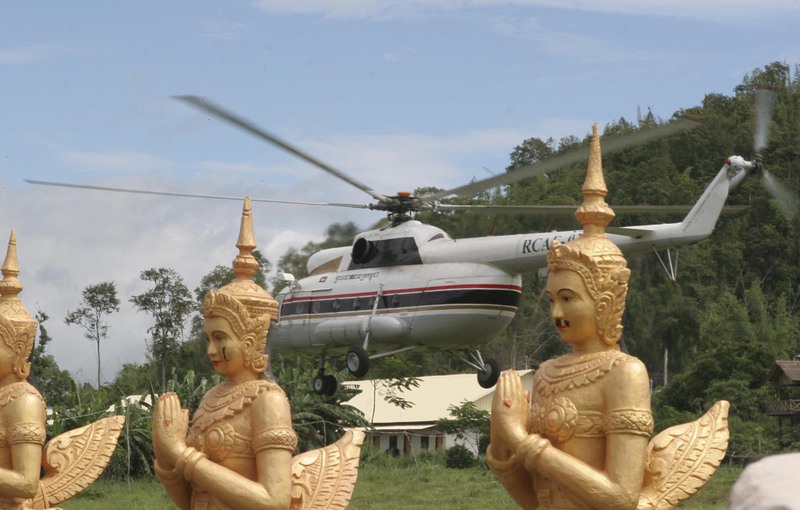

The New York Review of Books has a long article this week on China’s support of Cambodia, written by a longtime foreign correspondent for the French newspaper Le Figaro. The article by Francois Hauter is behind this pay wall, but here is the opening paragraph, an excerpt and the surprising ending:

In Phnom Penh, the capital of Cambodia, the economy is going strong, but the prime minister, Hun Sen, has organized the plunder of the nation's resources for the benefit of its powerful neighbor, China, in exchange for Beijing's protection.
….
Cambodia was on its last legs when the Vietnamese invaded in December 1978, and they installed the new government dominated by Hun Sen, who became prime minister in 1985. A consummate survivor, he is still prime minister twenty-two years later. He did everything he could to prevent the public trial of Khmer Rouge leaders demanded by the United Nations. Why? Because although he had been placed in power by the Vietnamese, he had long since transferred his allegiance to the Chinese government, which had been the chief patron of the Khmer Rouge regime, supplying it with arms, food, training, and international backing. To put the Khmer Rouge leaders on trial would have been to denounce Chinese collaboration in the Khmer genocide. It would also have compromised certain tangible interests. "China is a very great country," Hun Sen declared recently. “If 1.3 billion Chinese were all to urinate at the same time, it would unleash a major flood. But China's leaders are doing good things with their partners.... When China gives, there are no strings attached. You can do what you want with the money.”

The Cambodian leaders did not fail to take advantage of the opportunity. State assets were sold off to the highest bidder. One scholar, François Mangin, has estimated that between 1993 and 1999, the Cambodian government sold concessions to more than a third of Cambodia's most productive land, mainly to foreign companies engaged in commercial exploitation of forests, mineral resources, agriculture, fisheries, and tourism.

To cite just one example: Pheapimex and Wuzishan, two companies run by the best friend of Hun Sen's wife, were given rights to develop and exploit more than 1.26 million acres of forest with logistical support from Chinese firms.

The proceeds from land confiscation which primarily involves the pillage of Cambodian forests for Chinese exploitation have been used to finance the prime minister's party and his security force, which is the only well-equipped military unit in the country (other brigades are employed in the transport of timber). Money acquired dishonestly is laundered in nine casinos now operating in Poipet, a town near the Thai border. Western governments and international aid organizations, including the World Bank and Asian Development Bank, are well aware of this phenomenal corruption.
…..

What seems to me more singular about Beijing's attitude toward Cambodia, however, is that Chinese officials have shown themselves unable to support "good" practices rather than "bad" ones. Hun Sen and his collaborators have long held Cambodia in their grip, and that has suited the Chinese Communists just fine. Beijing has also backed the despicable military government in Burma and the paranoid North Korean dictator. Whatever mad regime might serve China's interests, regardless of the suffering inflicted on the victims of those regimes, has been accepted, tolerated, and supported by the Chinese. Western diplomats have taken much satisfaction in denouncing their "cynicism."

But is it really cynicism? It is in the name of pragmatism that the Chinese do not allow moral considerations to weigh on their minds. Without any qualms, they adapt instantly to whatever situation they find, good and bad. This absolute pragmatism is the rule in the private sphere as well as for public affairs. I am reminded of what a Chinese friend told me when I expressed my exasperation at this failure to distinguish between good and evil. She answered: "My father told me, 'Be good, but not too good, or else you will die, for your place will be in Heaven, not on earth. And don't be too bad, either, or you won't deserve your place on earth." Had the balloon seller said the same thing, it might have mitigated my rage against Hun Sen's clique.

----------------------------------------


China Rises is written by Tim Johnson, the Beijing bureau chief for McClatchy Newspapers. He covers both China and Taiwan.

More about Tim Johnson

Labels:


» Read more!

Saturday, September 15, 2007

Cambodia To Terminate Khmer Rouge Tribunal If Sihanouk Still Wanted To Testify

Then-Prince Norodom Sihanouk (R) during a meeting with
Khmer Rouge leaders in Cambodia's "so-called" liberation zone, in April 1973.


Great heroic King Norodom Sihanouk will become a confrontation between Cambodia and the United Nations in the trial process for former Khmer Rouge [KR] leaders

13 September 2007

Rasmei Kampuchea
Translated from Khmer and posted online
Source: KI-Media

"Great heroic King Norodom Sihanouk will become a confrontation between Cambodia and the United Nations in the trial process for former Khmer Rouge [KR] leaders," said an unattributed report from the 13 September edition of the pro-government Cambodian newspaper Phnom Penh Reaksmei Kampuchea posted on the Everyday.com.kh portal.

The report added that to the United Nations, no one could be above the law, and Peter Foster, the UN spokesman of the Khmer Rouge Tribunal [KRT], recently said, "It was up to the KRT judges and prosecutors to decide who should be indicted and who should be summoned as witness."

The report also said that in light of Peter Foster's remarks, the "former king could be invited to the KRT as witness, because he used to be the head of state of the Democratic Kampuchea [DK] regime, before deciding to resign from that position in 1976. Despite the reaction from the king father [Norodom Sihanouk] and from other Cambodian leaders, the United Nations was still adamant that the indictment or summons of witnesses was up to the KRT judges."

The report further said that a letter dated 6 September 2007 sent to Deputy Prime Minister and Minister of the Royal Palace, Mrs. Michelle Lee, deputy head of the KRT administration office, "continued to maintain that only the tribunal judges were competent to decide who should be the witnesses."

The report added that although the letter said "Peter Foster did not intend to affect the reputation of the great heroic king, Mrs. Michelle Lee did not guarantee that the king father would be neither indicted nor summoned to appear in the KRT."

The report said that Lao Mong Hay, former president of the Cambodian Institute for Democracy and a jurist currently in Hong Kong, wrote a controversial article entitled "No Immunity for Sihanouk." In the article he said, "A lot of Cambodian people still believe that Samdech Sihanouk was the instrument for the KR Victory. Therefore, he should be responsible for the suffering of the Cambodian people in the KR regime."

"Therefore," Lao Mong Hay added, "recently the KRT should be neither intimidated nor threatened by the Cambodian Government. This tribunal should preserve its independence. It should persistently withstand the immunity of Samdech Sihanouk and summon him to appear in the law court whenever the truth, justice and/or human rights require it to do so."

The report also said that Lao Mong Hay used strong words saying, "Samdech Sihanouk's immunity from the trial is illegal, does not conform to the Constitution, and cannot be protected. The use of immunity by Samdech Sihanouk himself or with the support from the government to shun the tribunal will only reinforce/strengthen the belief that he was part of the responsibilities for the suffering of the Cambodian people under the KR regime."

Lao Mong Hay added, "It is an obstruction of justice and destruction of the rights of the Cambodian people, who have already endured enough suffering. It will also prevent Cambodia from settling its past story through the court of justice."

"Nonetheless," the report added, "Cambodian leaders are resolutely against any efforts or intentions to bring the king father to the KRT. Political parties, including the Cambodian People's Party, the FUNCINPEC [National United Front for an Independent, Neutral, Peaceful, and Cooperative Cambodia] Party, the Norodom Ranariddh Party, and some other parties as well as the Senate, the National Assembly, and the Royal Government led by with Prime Minister Samdech Hun Sen, too, condemn the idea of wanting to have the ex-king, who is sacred to the Cambodian people, tried at the KRT."

To Cambodia, the report added, the trial of the king father was to "set all the Cambodian people's heart on roaring fire." Prime Minister Hun Sen said, "We cannot remain with our hands folded. We must destroy such an intention."

Moreover, recently Khieu Kanhnharit, information minister and government spokesman, too, warned, "Cambodia would terminate the KRT if they still nurtured the intention of bringing the king father to the KRT," the report pointed out.

As for the king father, the report said, he, too, "refused to appear in the KRT as witness." He "indirectly invited Peter Foster and other UN officials to a meeting with him in the Royal Palace scheduled for 8 September to discuss the questions regarding the KR and himself."

However, the report added, UN officials and judges "did not to and see the ex-king as scheduled, partly because the letter of invitation had not been sent to the KRT officially."

To this point, the report further said, there was "fear about a deadlock in the KRT. What would happen if the UN judges still had the intent to invite the king father to the KRT and Cambodia resolutely objected to it?"

"Will the United Nations be still imbued with the idea of inviting the king father to the law court despite Cambodia's objection? The great heroic king will become a test for the cooperation between Cambodia and the United Nations," the report concluded.

Labels: ,


» Read more!

Wednesday, September 12, 2007

Cambodia's Anti-Trafficking Efforts Still Weak, US Czar Says


11 September 2007
Source: VOANews

When the US State Department's new anti-human trafficking chief took his position in June, he found himself tasked with bringing nearly 50 countries in line with US standards for fighting the practice.

Cambodia is one of those countries, and if its efforts have not been strong enough, Mark Lagon said in a recent interview.

"Over time we've tried to get Cambodia's attention. At one point in the past it was subject to partial sanctions," Lagon said.

Cambodia remains on a US watch list for countries that are not doing enough to fight the movement of people for sex or labor. This is the second year it has been on the list, and, Lagon said, it can't stay there forever. It must either improve, or fall back onto a list of countries who are subject to US sanctions for their complicity in the practice.

The US estimates about 800,000 people are trafficked between nations each year. Most of them are women, and nearly half of them are under 18 years old. In Asia, Lagon said, that means Burmese victimized in the Thai fishing industry, sex trafficking to Malaysia, and high numbers of people shipped across China for labor in brick kilns and on farms.

In Cambodia, most of those trafficked are sex slaves.

"At a certain point, one has to ask the question, is this a matter of will, rather than a matter of lacking capacity?" Lagon said.

Cambodia has not done enough to stop corrupt officials—including the national police—that allow the slave trade to thrive.

The worst of that is child prostitution, with customers from Asia and abroad.

"Americans as tourists can be insidious consumers of sexually exploited children," he said, "and we're going to do everything we can, in partnership, to fight those bastards."

The practice is difficult to destroy at its roots. Traffickers are devious. They prey on the hopes of the rural poor, promising them a better life. They often find a ready ear.

"They say, 'Migrate to this other place, other part of the country, another neighboring state [country], there will be better economic conditions there," Lagon said. "And they often describe a different life, a life as a dancer, a life as a domestic servant, and it turns out to be something frightfully different."

Recruiters will ask to hold a passport, an obvious warning sign and an easy way for criminals to control trafficking victims. And Human trafficking is lucrative, making it difficult to stamp out.

In Cambodia, police officials, including National Police Chief Hok Lundy, have been implicated in the crime of buying and selling human beings for the sex trade.

Although some US agencies work with Hok Lundy, and he has denied involvement, Lagon, who's former boss was a strong opponent of the police chief, said he has not seen satisfactory proof from Hok Lundy to clear him of the allegations.

"The burden of proof must always lie with officials who have been corrupt and who have been part of the problem and part of dehumanization of their fellow citizens," Lagon said. "That will always be the case with Hok Lundy."

Until recently, the US State Department refused to allow Hok Lundy in the country , and Lagon said such measures may be working.

Agencies like the Federal Bureau of Investigation now work with the police, but Lagon said the US is still pushing the authorities to clean up.

"We're trying to work, region-wide, on the key to the puzzle," he said. "And the key to the puzzle is rule of law."

Without the rule of law, he said, there never be dignity for all.

Labels:


» Read more!

Thursday, September 06, 2007

The rise and rise of a Cambodian capitalist

Kith Meng (Owner of Royal Group of Companies: CTN, MobiTel-012,
the Camlot lottery company and a 45% stake venture with Australia's ANZ Bank
and the head of the Phnom Penh Chamber of Commerce)


By Shawn W Crispin
Source: Asia Time Online

PHNOM PENH – Kith Meng's is the bold new face of Cambodian capitalism. Widely considered the country's richest entrepreneur, the Sino-Khmer businessman presides over a sprawling business empire held under his Royal Group of Companies which has leveraged into and helped drive Cambodia's recent economic boom.

With impeccable political connections - including not least his role as a personal advisor to Prime Minister Hun Sen - Kith Meng, 37, has secured a growing trove of lucrative government concessions, licenses and land deals that his Royal Group has in sometimes controversial fashion translated into big business profits.

Those include his controlling stakes in CTN television, mobile telecom leader Mobitel, the Camlot lottery company and a 45% stake in a commercial banking joint venture with Australia's ANZ Bank, where he serves as board chairman and reportedly drives strategic decision-making.

Last year he purchased the swanky Cambodiana Hotel, newly established the Infinity Insurance company and accumulated extensive property holdings and development concessions in the capital Phnom Penh, in what his critics contend are often opaque deals brokered with various line ministries. (Kith Meng could not be reached through his Royal Group for comment.)

His growing service sector empire has drawn both favorable and unfavorable comparisons to neighboring Thailand's telecom tycoon-cum-prime minister Thaksin Shinawatra's commercial and political ascent. He reportedly will seek a seat on the national senate at upcoming elections and some Phnom Penh-based analysts see him one day as a potential successor to the 55-year-old Hun Sen, who they note rose to political prominence through his military prowess rather than business acumen.

A former refugee from political violence, Kith Meng's is one of Cambodia's most compelling rags to riches stories. His father, Kith Peng Ike, a Sino-Khmer businessman and landlord, was singled out as a "class enemy" during the Khmer Rouge's genocidal purges and he reportedly died from starvation in one of the radical Maoist group's labor camps.

Kith Meng and his family fled the country for Australia, where he was raised and educated. He returned to his war-torn homeland in the early 1990s to help his elder brother, Sophan Kith, to develop the resurrected family business, which upon reestablishment was first known as the Royal Cambodia Company. The enterprise started modestly, supplying furniture, food and office equipment to the United Nations authority that ushered Cambodia's rocky transition from civil war to parliamentary democracy.

In 1991 the Royal Group won the rights to distribute exclusively Canon copiers throughout the country and it quickly spun those monopoly revenues into a joint venture in 1993 with Motorola to establish one of Cambodia's first wireless communication networks. It later did a deal with Luxembourg's Millicom International Cellular, which over the years has grown into the country's leading mobile telecom outfit, Mobitel.

In 1994 Sophan Kith died under mysterious circumstances and, peculiar to cultural norms of seniority as the youngest sibling, Kith Meng took control over the family business. He now serves as both the company's chairman and chief executive officer and his cut-throat approach to business expansion has rapidly transformed the Royal Group into Cambodia's leading service sector conglomerate.

Young gun
As a Western-educated, 37-year-old entrepreneur, Kith Meng's resume stands out among the older generation of ethnic Chinese businessmen who dominate Cambodia's traditional economy. Cambodian politicians have long relied on Sino-Khmer businessmen to run crucial sectors of the national economy, similar to the ethnic-based government-business nexuses seen in Thailand and Indonesia.

In Cambodia that privilege comes with a royal title known as Okhna, which is bestowed on those who make sizable financial contributions to the royal family. Kith Meng is believed to be one of the youngest businessmen to ever receive the honorific and his meteoric commercial rise includes his recent selection as the head the Cambodian Chamber of Commerce.

As Cambodia becomes more integrated into the global economy, Kith Meng has emerged as the government's de facto spokesman for selling the country to potential foreign investors as a profitable and desirable place to do business. He is regularly seen on local television wining and dining foreign business delegations. On the Royal Group's website is a pitch to potential foreign investors to help build its proposed Royal Caesar Casino, which it's billing as "the largest and most dazzling gaming facility in the Cambodia hemisphere".

Beyond the diplomacy and hype, there is much more at play to Kith Meng's growing prominence than mere spin-doctoring. Some political analysts contend that Hun Sen has played an instrumental role in cultivating and mobilizing the young entrepreneur's modern business image in a vigorous public relations effort to shirk his and his government's notorious reputation as the "Mafia on the Mekong".

Cambodia emerged from nearly three decades of civil war only to become known as a regional hub for illicit business, including rampant money laundering, drug smuggling, human trafficking and illegal logging. Hun Sen and his Cambodia People's Party's (CPP) have been directly linked to shadowy figures reputedly involved in illicit businesses, including his established ties to businessman Theng Bunma, who has contributed millions of dollars to the premier's past election campaigns and also implicated by US authorities for alleged drug trafficking.

As Cambodia's aboveground economy booms, state concessions are no doubt providing rich new sources of legitimate revenues for Hun Sen's government. It is unknown whether Kith Meng contributes funds directly to his CPP, but his concession payments to line ministries are no doubt bolstering state coffers. One Phnom Penh-based Western businessman who spoke on condition of anonymity and claims to have personally conducted the due diligence research on the Royal Group's recent joint venture with Australia's ANZ Bank says that his in-depth investigations failed to turn up any "dirty laundry" in Kith Meng's past or present business dealings.

Reborn landed gentry
That's not to say his business practices lack for controversy. Kith Meng's style has reportedly ruffled feathers among the more established Okhna represented in the Cambodia Chamber of Commerce, whereby the older generation of Sino-Khmer businessmen have bristled at his perceived patronizing lectures about globalization and at what some of them reportedly view as his overly direct Western-style of interaction.

Whether those complaints stem from genuine pique or instead heartfelt fear of Kith Meng's expanding reach into other Okhna's once monopolized markets is unclear. One Western aid agency representative, who spoke with Asia Times Online on condition of anonymity, says that soon after launching last year’s joint venture with ANZ Bank, Kith Meng pushed to expand the bank's local branch network much faster than ANZ first planned. That aggressive strategy, it turns, has paid off handsomely through a fast growing market share of deposits and the lion's share of loans in the nascent home mortgage market.

Other times, critics say, Kith Meng's Royal Group pushes too hard. In June 2006 police armed with batons, tear gas and AK47 assault rifles evicted at least 20 families from a contested land plot worth several million dollars next to Phnom Penh's Preah Monivong Hospital which the government had controversially awarded to the Royal Group for development. The resident families were reportedly given US$500-$1,500 in compensation and trucked to a relocation site 30 kilometers outside the capital which lacked electricity and water.

Similar complaints have arisen from his plans for the landmark Bassac Theater. In 2005, the culture ministry granted the concession, which called on the Royal Group to rehabilitate the damaged structure in exchange for the rights to outfit the theater's surrounding land with new offices and a conference center. The company has since decided to demolish the historic building and evict the scores of artists who after the Khmer Rouge's "class enemy" purges took refuge in the old theater.

Those same artists have resurrected the traditional Khmer art forms that the Maoist movement aimed to destroy and after squatting at the historic site for over a decade, each has received $300 to abandon an area where land prices now top $1,000 per square meter. The irony of such deals is not lost on Kith Meng's critics, who contend that the Royal Group is capitalizing on the legal vacuum for adjudicating land ownership rights created by the Khmer Rouge's destruction of the national land registries.

On the Royal Group's website, Kith Meng says in a statement that the company's origins trace "back to the early days of the Khmer Rouge occupation" – meaning, presumably, the property and businesses his father maintained before the radical Maoist movement killed him and drove his family, including a young Kith Meng, into exile. In Cambodia's latest capitalist incarnation, government connections often trump historical claims and reassert old social class divisions, of which Kith Meng's and the Royal Group's fast expanding commercial domain is living proof.

Shawn W Crispin is Asia Times Online's Southeast Asia Editor.

=======

Cambodia's MobiTel to buy telecommunication materials from Singapore
September 05, 2007
Source: People's Daily Online

MobiTel, Cambodia's largest mobile phone service provider, signed an agreement to purchase 150 million U.S. dollars worth of telecommunication materials from the Singapore-based Alcaltel-Lucent Company, officials said on Wednesday.

"Today we signed the purchase agreement of telecommunication materials from Alcatel-Lucent Company to further advance the availability of world-class cellular phone services in Cambodia," said Kith Meng, chairman of MobiTel.

The agreement will allow a major expansion of MobiTel's rural network, increasing the access to modern communication for many more people throughout Cambodia, he said.

Pierre-Alain Cadillon, vice president and head of the South Asia regional unit of Alcatel-Lucent, said that the expansion over the next four years will bring a new range of mobile communication services, ranging from voice mail, video transmission, mobile TV to internet access, to more three million subscribers in Cambodia.

Kith Meng said that MobiTel borrowed money from banks of the United States and Australia to finish the purchase, and the Cambodian government also provided support.

Kith Meng and Pierre-Alain Cadillon signed the agreement here Wednesday in the presence of Cambodian Deputy Prime Minister Sok An.

Cambodia opened the mobile telecommunication sector to private capital in 1992. Currently, around 21 percent of the kingdom's 14 million population adopt mobile phone as their major communication solution.

Labels: , ,


» Read more!

No immunity for Sihanouk

Lao Mong Hay is currently a senior researcher at the
Asian Human Rights Commission in Hong Kong. He was previously
director of the Khmer Institute of Democracy in Phnom Penh,
Cambodia, and a visiting professor at the University of
Toronto in 2003. In 1997, he received an award from
Human Rights Watch and the Nansen Medal in 2000 from the
United Nations High Commissioner for Refugees.


Commentary: No immunity for Sihanouk
HONG KONG, Sep. 5
LAO MONG HAY
Column: Rule by Fear
Source: UPI Asia Online

Over the last two weeks, the Cambodian government has mounted vitriolic attacks against a request for former King Sihanouk, now 84, to be stripped of his immunity and face trial in the mixed Cambodian-U.N. tribunal set up to try senior Khmer Rouge leaders.

The government branded the request by the Cambodian Action Committee for Justice and Equity, a U.S.-based non-governmental organization, a "public agitation" that "could have the result of jeopardizing the peace and unity" of Cambodia "and play into the hands of those who would seek to return [the country] to its former state of war and chaos." Prime Minister Hun Sen called the request "very barbaric" and said that the top state institutions could not stand by and watch it set a fire blazing in the heart of the Cambodian people.

Other leading state institutions joined the government in "absolutely rejecting" and "condemning" the request. They glorified Sihanouk's services to the nation, which included giving Cambodia its independence, territorial integrity, unity and national reconciliation. They also claimed he had suffered when he had been overthrown by a coup in 1970 and when he had been under the rule of the Khmer Rouge between 1975 and 1979. Sihanouk "had suffered more than most rulers," Hun Sen claimed.

In line with Cambodian law and assistance agreements between the Cambodian government and the United Nations, Peter Foster, the tribunal's U.N. spokesman, in his comment on the same request, was reported as saying that it was up to the tribunal to decide whom to call as a witness and whom to indict. He added that Sihanouk could be called as a witness.

Following this statement, the government issued a warning on Aug. 31 that "Cambodia will kick out the Khmer Rouge Tribunal if it brings Great, Valorous King Sihanouk to trial." Moreover, it asserted that there should not be a summons to Sihanouk to appear in court as a witness. If the judges or prosecutors of that tribunal "issue such a summons, we shall kick out that tribunal," it added, claiming that any such summons would "humiliate" what it called the "symbol" of Cambodia.

Sihanouk became king of Cambodia in 1941 and abdicated in 1955. In 1960, he became head of state with executive power but was not crowned king at that time. In 1970, he was overthrown in a coup, which engulfed Cambodia during the Vietnam War and led to the Chinese-backed Khmer Rouge's armed struggle alongside and with support from the Vietnamese communist forces.

Sihanouk, while in China in the immediate aftermath of being overthrown, became the head of the Khmer Rouge-dominated government in exile. From China, Sihanouk used his popularity to mobilize the Cambodian people to "go into the maquis (jungle)" to join the Khmer Rouge. The latter's army then grew from strength to strength and won power in 1975, and Sihanouk remained head of state of the Khmer Rouge regime until 1976.

In 1982, Sihanouk again became head of state of the Cambodian resistance movement against the Vietnamese-installed government in Cambodia. At the end of the latter war, in 1993, he was re-crowned king. Although he abdicated again in 2004, the Cambodian Parliament named him "Great Valorous King" in recognition of his lifelong dedicated service to the country and achievements and conferred upon him the same privileges and immunities as those constitutionally conferred upon the reigning monarch, which includes immunity from prosecution.

This act of Parliament conferring immunity was unconstitutional, however, as the Constitution of Cambodia confers this immunity only upon the reigning monarch and not upon anyone else. Nor has that act any moral legitimacy, for under its Constitution, Cambodia is supposed to be governed by the rule of law under which all are equal before the law and no one is above the law.

Furthermore, many Cambodian people still believe that Sihanouk was instrumental in the Khmer Rouge's victory and was therefore also responsible for the suffering of the Cambodian people under the Khmer Rouge's rule. They also want justice and to know the truth about their horrible past history in which Sihanouk must have had a hand due to his association with the Khmer Rouge.

Sihanouk's immunity from prosecution is illegitimate, unconstitutional and indefensible. Any use of it by Sihanouk himself or with government support to evade any court action only strengthens the belief in his share of responsibility for the suffering of the Cambodian people under the Khmer Rouge's rule. It is an obstruction of justice and jeopardizes the rights of Cambodia's people, who have endured enough grief. It will prevent the Cambodian nation from addressing their past through the tribunal.

The Khmer Rouge Tribunal thus should not be intimidated by the Cambodian government's latest threat and should maintain its independence. It should challenge Sihanouk's immunity and summons him to appear whenever truth, justice and/or the rights of the people so require.

--

(Lao Mong Hay is currently a senior researcher at the Asian Human Rights Commission in Hong Kong. He was previously director of the Khmer Institute of Democracy in Phnom Penh, Cambodia, and a visiting professor at the University of Toronto in 2003. In 1997, he received an award from Human Rights Watch and the Nansen Medal in 2000 from the United Nations High Commissioner for Refugees.)

Labels: , , ,


» Read more!

Tuesday, August 28, 2007

IN SIGHT: Profile in Political Courage

Sam Rainsy, president of the Khmer Nation Party,
is carried away after a 30 March 1997 grenade attack
outside the National Assembly building.

Rainsy touring a flooded Cambodian
district several years ago. — GEORGE MCLEOD


In his turbulent political career, Cambodian opposition leader Sam Rainsy has endured assassination attempts and death threats and has seen friends and colleagues killed

GEORGE MCLEOD
Source: http://www.bangkokpost.net/260807_Perspective/26Aug2007_pers04.php

From a crumbling office in Cambodia's capital Phnom Penh, opposition party leader Sam Rainsy put on a brave face when asked about his party's future. "We have doubled the votes we have previously collected," he said, referring to Cambodia's recent commune elections.

But in Cambodia's fragile democracy, few believe that Rainsy will ever win power, regardless of the popular vote. Independent observers say the ruling Cambodian People's Party (CPP) is tightening its grip in the country, allegedly through violence and intimidation.

In his turbulent political career, Rainsy has endured assassination attempts, death threats and has seen friends and colleagues killed.

Rainsy was also convicted of defamation in 2005 for accusing Prime Minister Hun Sen of instigating violent attacks on his supporters. He returned in 2006 from self-imposed exile and is now guarded in his criticisms of the government. "My return was a result of international pressure. The CPP has changed its strategy; it relies less on violence but more on tricks, but the result is the same," he said in an interview in Phnom Penh. With elections scheduled for next year, Rainsy warns that the CPP's "tricks" may prevent a fair ballot.

Rainsy rose to prominence as finance minister after Cambodia's first democratic elections in 1993. Then a member of the royalist FUNCINPEC Party, he introduced sweeping reforms to fight corruption and introduce a modern taxation and procurement system.

The reforms ruffled the feathers of the ruling CPP, and members of FUNCINPEC, and he was expelled from his position in 1994. Refusing to abandon politics, Rainsy formed his own party, the Khmer Nation Party, later renamed the Sam Rainsy Party (SRP).

Since then, the party has seen its support grow, but has endured threats and often violent attacks, say independent observers.

Human Rights Watch's Brad Adams said that numerous human rights violations against opposition supporters have been documented since 1993.

"Since (political) pluralism was brought in by the UN, hundreds of opposition party members and activists have been killed and not one person has been brought to justice for any of those killings," he said from London. "What you have in Cambodia is a one-party quasi-dictatorship," he said.

The first major attack on Rainsy happened in 1997 at a workers rally in Phnom Penh. At 8:20 a.m. on March 30, four grenades were lobbed into the crowd, apparently aimed at Rainsy. Rainsy was thrown to the ground by his bodyguards, one of whom was killed by the blasts. According to Amnesty International, a total of 19 people were killed and more than 100 injured in the blasts.

An Amnesty International report on the attack said that police at the scene did not help the wounded, and that two people who were alive in the immediate aftermath were left out in the sun, without help, and later died at the scene.

In July of the same year, Cambodia erupted in near civil war as the CPP and FUNCINPEC fought pitched battles throughout the country, resulting in a CPP victory.

Rainsy fled Cambodia, and many of his supporters went into hiding. Armed looters broke into the SRP headquarters and into Rainsy's house, gutting the buildings. He returned to a nearly shattered party - many SRP activists dead or having fled as refugees.

With elections scheduled for July 1998, Rainsy rapidly reorganised the party, mounting an effective campaign based on fighting corruption, alleviating poverty and defending workers' rights. Despite flaws in the voting process, the SRP secured 15 parliamentary seats. Rainsy also supported the emergence of Cambodia's first independent trade union, the Free Trade Union of Cambodia. The country's booming garment industry had attracted hoardes of what Rainsy calls "cowboy capitalists," who often profited from exploitative sweatshop labour. The union's president Chea Vichea was killed in 2004 - many believe the assassination was ordered by bodyguards of a senior government official.

Since Rainsy's return from exile, he has tirelessly worked to attract voters in the impoverished country. Campaigning in a rural country with poor infrastructure and rampant illiteracy carries unique challenges. Rainsy has to visit voters face to face, and nearly every day, he travels in a small convoy on Cambodia's dirt roads speaking to the masses.

It comes down to corruption

Rainsy's message is simple: corruption and mismanagement are holding back Cambodia - it is time for a change.

"There are two main issues: one is bad governance... The second is unemployment and poverty. Most of these problems come down to corruption," he said in Phnom Penh.

The international corruption watchdog Transparency International rates Cambodia near the bottom of its international index at 153 out of 163. Thailand is rated near the middle at 63.

Much of Cambodia's corruption involves alleged embezzlement of the more than $600 million in foreign aid the Cambodian government receives each year.

"(The donor money) has gone into the pockets of corrupt government officials," says Rainsy. "Cambodia is the bad conscious of the world, and the international community has spent a lot of money relieving its conscience," he said.

The depth of Cambodia's corruption was illustrated in June when the UK-based environmental watchdog Global Witness produced a report documenting illegal logging in Cambodia. Senior government figures close to the prime minister were identified as being behind multi-million dollar illegal logging syndicates. The report entitled Cambodia's Family Trees was banned by the Cambodian government and copies were seized.

Global Witness' Eleanor Nichol said the government also threatened its staff and prohibited them from visiting Cambodia. She said that the prime minister's brother Hun Neng was quoted saying he would "break the heads of any Global Witness official travelling to Cambodia."

"The issuing of death threats by a senior Cambodian official is absolutely unacceptable from any perspective," she said from London. Nichol believes that the government's reaction is part of a broader problem of authoritarianism in Cambodia. "Over the past 10 years we have seen a steady consolidation of power in the hands of an elite few, which has attracted remarkably little attention in the international community," she said.

Nichol added that Cambodia's opposition has faced immense challenges. "The space for the (Cambodian) opposition is steadily declining... (the opposition) is doing the best they can under the circumstances."

However, prominent author and expert on Cambodia objects to what he has called anti-Vietnamese tendencies within the Sam Rainsy Party.

"When speaking in Khmer (Rainsy's) remarks about [the] Vietnamese are racist," he wrote in an emailed response.

"And during the election campaign in 1993 one speech was so bad the UN ... would not let it be broadcast, even though they were on (Rainsy's) side... That is, they hoped FUNCINPEC, not CPP, would win," he wrote. Vickery's new book Cambodia: A Political Survey, argues that western governments and NGOs such as Human Rights Watch are driven by a Cold War-rooted prejudice against the Cambodian People's Party. The CPP was installed by the Vietnamese, and was seen throughout the 1980s as a pro-Hanoi puppet regime. Rainsy maintains that his remarks about Viet Nam address border-encroachment issues, and do not contain racist undertones.

Contact: georgemcleod@gmail.com

BIO DATA

Sam Rainsy was born in 1949 in Phnom Penh.

He moved to France in 1965, where he later ran a successful accounting firm.

Rainsy was active in opposing the Vietnamese occupation of Cambodia, which lasted from 1979-1993. In 1989, he became the Royalist FUNCINPEC Party's European Representative.

After Cambodia's first democratic elections in 1993, Rainsy became Finance Minister, but was expelled from his position, and from the FUNCINPEC Party in 1994.

In 1995, Rainsy formed the Khmer Nation Party, later renamed the Sam Rainsy Party.

Rainsy has fled Cambodia twice for political reasons: once in 1997 and again in 2005.

He is married to Samura Tuolong, who is an elected Member of Parliament.

Labels: , ,


» Read more!

Exchange between the CPP and King-Father on CACJE request to remove King-Father's immunity


Translated from Khmer by Socheata

Cambodian People Party (CPP)
Central Committee

Statement of the CPP

Recently, there is a publication of a number of evil information wanting to remove the immunity of the Hero-King Norodom Sihanouk, and the annulment of Article 7 of the Cambodian Constitution during the progress of the Extraordinary Chamber in the Court of Cambodia (ECCC) in order to judge the crimes committed during the Democratic Kampuchea (DK) regime.

On this issue, the CPP publicly declared to the national and international community, the following:
  1. The CPP strongly condemns and rejects the intention described above which severely violates the constitution and the law of the Kingdom of Cambodia, with the aim of destroying the stability, the unity and the progress of the nation.
  2. The CPP always remembers the supreme good deed of Preah Karuna Preah Bat Samdech Preah Norodom Sihanouk who dedicated his body and knowledge to serve the people, the nation, and the homeland, and (the CPP) is strongly opposed to any actions that are contrary to the law to promulgate the royal title and prerogatives to the former monarch of the Kingdom of Cambodia and his wife, which the National Assembly ratified on 20 October 2004.
  3. The CPP supports the progress of the ECCC which operates under the Cambodian law to judge the criminal actions perpetrated during the DK regime based on the guarantee of peace, stability, national unity, national sovereignty, and justice for the people of Cambodia
The CPP maintains the goal of defending the Constitution, the realization of the national society for progress, and peace for the nation and the Cambodian people.

Phnom Penh, 24 August 2007

Permanent Committee

(Signed) Chea Sim

o----O----o
Norodom Sihanouk
of Cambodia

To Samdech Chea Sim,
CPP President

Highly respected and deeply loved Samdech President,

I am very moved and I am thanking you deeply for the statement dated 24 August 2007 issued by the CPP to provide justice for me in my service rendered to the nation and to the Cambodian people in front of our national history.

I am wishing Samdech President, and all the magnificent CPP members, with the five blessings.

Please Samdech President and Lok Chumteav Thom accept my highest respect, and my deepest love, as well as those from Queen-Mother.

(Signed) Norodom Sihanouk

Phnom Penh, 25 August, 2007

Labels: , ,


» Read more!

Monday, August 27, 2007

Request for a Plenary Session Meeting of the National Assembly to Remove the Immunity of the Former Monarch


Unofficial translation from Khmer by Socheata

Cambodian Action Committee for Justice & Equity (CACJE)
451 Revere Beach Blvd, Revere, MA 02151, USA
Email: cac_je@yahoo.com, Tel: 401 451 8090
Spokesman and Representative to Cambodia: Mr. Nam Tara, Tel: (855-11) 918 009

20 August 2007

To: Samdech Heng Samrin, President of the National Assembly of the Kingdom of Cambodia

Subject: Request for a plenary session meeting of the National Assembly to remove the immunity of the former Monarch, and to annul Article 7 of the Cambodian Constitution during the period of the Khmer Rouge Tribunal session.

Based on the request subject above, the Cambodian Action Committee for justice and Equity believes that the maintenance of the immunity for former Monarch, Samdech Preah Norodom Sihanouk, and the enforcement of Article 7 of the Cambodian Constitution during the progress of the joint UN-Cambodian Tribunal to judge former Khmer Rouge leaders and those responsible in the Khmer Rouge regime, constitutes an obstacle preventing the ECCC investigation judges from performing their work according to justice standards, and also, this action does not provide equity to all leaders of the Khmer Rouge regime.

Article 31 of the Cambodian Constitution stipulates: “… Every Khmer citizen shall be equal before the law, enjoying the same rights, freedom and fulfilling the same obligations regardless of race, colour, sex, language, religious belief, political tendency, birth origin, social status, wealth or other status.” Therefore, in their names as Cambodian citizens who are equal before the law, regardless of their social status, or other status, numerous documents and studies written by independent researchers have shown that Samdech Preah Norodom Sihanouk, the former President of the GRUNK, and later the President of the Democratic Kampuchea (Khmer Rouge), was an important individual among the public and secret individuals who were involved in the formation of the Khmer rouge movement, and the Khmer Rouge regime known all over the world as a genocide regime that unfairly killed more than 2 million Cambodian people.

In order to allow the freedom for the national and international co-judges to have sufficient rights, and they can use their own impartial judgments to issue warrants for suspects, witnesses, and victims to come and provide clarifications in front of the tribunal, and in order to guarantee the equity of the respective roles of the former Khmer rouge elders and those responsible, and especially, to apply the international law standards in the search for justice for the Cambodian people who were victims of the cruelty and inhuman actions (perpetrated against them), CACJE requests that the Cambodian National Assembly presided by you, Samdech President, consider the request above, and bring it up to the agenda of a plenary session of the National Assembly to discuss and approve.

I hope and trust that the importance of the provision of justice, allowing the victims to know the identity of the leaders involved in the killing of million of Cambodian people, will make the international community recognize the independence of the Cambodian National Assembly in its cooperation with the joint tribunal between the UN and Cambodia to successfully sentence the former Khmer Rouge leaders and those who bear high responsibility of this regime.

Please accept, Samdech, my respect.

(Signed) Serey Ratha Suon
CACJE Mission President

CC:
The King’s cabinet
Members of the Constitutional Council
Office of the Senate President
Office of the Prime Minister
Members of the National Assembly
National and International Media
Office of the spokesperson and representative of CACJE in Cambodia.

Labels: , , ,


» Read more!

Thursday, August 23, 2007

Commentary: Corruption surfaces in Cambodia housing fiasco


HONG KONG, Aug. 22
Column: Rule by Fear
On July 31, the Cambodian government sent a delegation of officials, ten excavators and over 100 workers under the protection of armed policemen to reclaim a site that once included Lake Kob Srov। Long Chhin (Cambodia) Investment Ltd. had filled in the lake in order to build a luxurious housing estate, called Long Chhin Resorts, 12 kilometers northwest of Phnom Penh.

The government moved to reclaim the lake site following the expiry of a deadline for the company to dismantle its construction there. The government has claimed that the filling-in of that lake was illegal and that it needed to reclaim the site as the construction work on the estate would block the water flow in the area and cause floods in the capital, Phnom Penh.

In the presence of the government delegation and the company's representative, the excavators and workers tore down and demolished all construction on the estate, turning it into rubble in three days. The demolished structures included all the brick walls around the estate, all entrance porches, seven two-story apartment blocks, 21 finished villas, eight villas that were still under construction, three guesthouses, a karaoke hall, 10 leisure kiosks, a warehouse, an office building and other amenities.

A number of Cambodians have lost all their investments in the estate, having already bought villas and apartments from the company or made deposits on them. Suppliers of construction materials have also lost the money that the company owed them. The total losses suffered by house buyers and the company's creditors are estimated to amount to around US$20 million -- a huge sum in a poverty-ridden country. Thirty-seven house buyers and creditors have now filed separate suits against the company to get their money back.

The government has promised to help repay them if the company's assets are insufficient. The chance of them getting their money back from the company is very slim, as the company's now frozen bank account has a balance of only US$4,000 in credit. The owner of the company, Zhou Shi Min, a mainland Chinese man, has "disappeared" and is believed to have fled Cambodia. Not much can be recovered from the rubble that is left on the estate. It is highly unlikely that the government, which is cash-strapped and corrupt, will ever live up to its promises and repay those who have lost money.

The house buyers and the company's creditors will have to pay for the corruption in high places that allowed Long Chhin (Cambodia) Investment Ltd. to do business in housing development in Cambodia, dupe them into buying its houses and supplying construction materials on credit, and also to defy the government's order to dismantle the estate.

In a brochure published in 2005 to attract buyers for its houses and apartments, the company claimed it had purchased the land in that area in 1993, that it had received authorization for development in the area from Prime Minister Hun Sen and the Cambodia Development Council in 2004, and that Zhu Shi Min had relations with Cambodian and Chinese leaders. As proof of these relations and the support they entailed, the brochure showed photos of Zhu shaking hands with or standing beside Cambodian leaders, as well as autographs provided by Cambodian and Chinese leaders.

The government has acknowledged that it had given authorization "in principle" for housing development on "28 hectares" in the area, "subject to a set of conditions" including the need for the company to get permission from relevant departments and for it not to affect the water flow in the area. However, the government has accused the company of filling in "hundreds of hectares" of the lake.

Just days before the demolition took place, the government sacked the governor and two deputy governors of Kandal province, as well as the governors of the two districts in which the lake is located, for their involvement in the Long Chhin Resorts project. Two weeks before the demolition, one of these district governors, Tep Sothy, was quoted by a newspaper as saying that Long Chhin Resorts "had followed the law" and had permission from the government for its construction project.

The government officials who had authorized and supported the development at the lake site, whether in principle or by giving definitive approval to the project, have violated the country's Constitution and land law, which classify lakes as being inalienable public property. Any such violation is punishable by a fine between 5 and 50 million riels (between around US$1,250 and US$12,500) and/or one to five years imprisonment. Those responsible should be prosecuted and made to repay the house buyers and creditors.

However, Zhu Shi Min's disappearance has rendered difficult any public action against the government officials in question. Zhu is the cases' key witness and is also charged with the crimes of fraud and the destruction of public property. It is quite legitimate to suspect that Zhu may have been deliberately helped to "disappear" by those seeking to avoid legal action being taken against them.

--

(Lao Mong Hay is currently a senior researcher at the Asian Human Rights Commission in Hong Kong. He was previously the director of the Khmer Institute of Democracy in Phnom Penh, Cambodia, and a visiting professor at the University of Toronto in 2003. In 1997, he received an award from Human Rights Watch and the Nansen Medal in 2000 from the United Nations High Commissioner for Refugees.)

Labels: , ,


» Read more!

Tuesday, July 31, 2007

China lagging in economic well-being

China lagging in economic well-being - ADB

(Xinhua)
Updated: 2007-07-31 16:29

MANILA -- China and India, the two economic powerhouses in developing Asia and the Pacific, are lagging in terms of economic well-being and living standards of their population, a new study undertaken by the Asian Development Bank ( ADB) showed.

China and India account for 64 percent of total real gross domestic product (GDP) of the 23 economies participating in the study, according to "the International Comparison Program (ICP) in Asia and the Pacific: Purchasing Power Parity Preliminary Report" released on Tuesday.

However, a completely different picture emerged if the size of these economies was adjusted by population, said the study. Rather than dominating the rankings, China and India droped to 10th and 18th positions, respectively, out of the 23 economies participating in the full GDP comparison.

Similarly, China ranked 15th and India ranked 17th when economies are compared based on "actual final consumption of households" (AFCH), a better measure of economic well-being of the population.

The AFCH is a measure of what households actually consume, comprising what they purchase and what they are supplied for individual use by the government (principally education and health) . The economic well-being of the population is obtained by comparing household consumption expenditure per capita.

The five economies that top the list are Chinese Hong Kong with HK$125,303 (US$16,044) per capita; Chinese Taipei with HK$109,108 (US$13,980); Singapore, HK$99,706 (US$12,766); Brunei, HK$81,744 (US$10,466), and Chinese Macao, HK$67,639 (US$8,660).

The five economies that are at the bottom of the survey are Nepal, Bangladesh, Laos, Cambodia, and Vietnam.

As for the people living in the two giant economies, a person living in China spends an average of only HK$11,502 (US$1,473) per year, while an Indian consumes an average of HK$9, 346 (US$1,197) per year.

Purchasing Power Parities (PPP) is an idea popularized by The Economist's Big Mac Index which prices hamburgers in global cities for a quick and crude comparison of living standards.

Based on the Price Level Index (PLI), which is the ratio of the PPP to the exchange rate, Fiji Islands and Chinese Hong Kong are the two costliest places to live in. They are followed by Chinese Macao, Singapore, and Chinese Taipei.

China ranked eighth, and India ranked 16th in terms of PLIs. Price levels in the Philippines, Thailand, and Indonesia are very similar and are close to the Asian average.

The cheapest places are Laos, Vietnam, Iran, Cambodia, and Nepal.

"The results provide the most comparable information on breakdown of GDP expenditures across the Asia Pacific," said ADB Chief Economist Ifzal Ali.

"Purchasing Power Parities are a more appropriate currency converter to compare living standards and the structure of economies than market exchange rates," he said.

The ICP Asia Pacific is part of a global initiative managed by the ADB in collaboration with the ICP Global Office and other regional agencies across the world. The ICP results, for the first time, enable a robust cross-country comparison of major macroeconomic indicators across diverse economies of Asia and the Pacific.


» Read more!

Poor rights record hampers ASEAN effort

Poor rights record hampers ASEAN effort

Tuesday, July 31 2007 (www.philstar.com)

MANILA (AFP) - Southeast Asian nations have struggled to find common ground on creating a new human rights body, and analysts say one reason is that many have poor rights records themselves.

The Association of Southeast Asian Nations (ASEAN) announced Monday it would form a rights body as part of its landmark charter, but the details were left vague and there was fierce disagreement from Myanmar and other member states.

"ASEAN is under a lot of pressure to improve its human rights record. And it knows that human rights has to be mentioned somewhere in its charter," said Basil Fernando of the Hong Kong-based Asian Human Rights Commission.

"A charter without it will just be another piece of meaningless paper," he told AFP.

Diplomats had hoped to outline a full-fledged rights commission in the draft of the new ASEAN charter which was presented to the bloc's foreign ministers on Monday.

But opposition from Myanmar as well as from Laos and Vietnam resulted in a watering-down of the language, and ensured that the details were left unresolved -- and up for debate at future rounds of negotiations.

The ruling generals of Myanmar, who are most opposed to an ASEAN rights body according to diplomats, have repeatedly embarrassed the bloc and snubbed calls to restore democracy and free Nobel peace laureate Aung San Suu Kyi.

"The prospect for genuine democracy in Burma (Myanmar) remains gloomy," the Free Burma Coalition said in a statement. "The junta simply flushed all these ASEAN efforts down the drain."

Malaysian Foreign Minister Syed Hamid Albar acknowledged the difficulties that lie ahead to create a viable rights commission with real enforcement power to stop abuses across the bloc.

"From the start we thought it was going to be a thorny issue," he told a news conference in Manila on the sidelines of the talks.

"The next difficult step is getting it really formed. Let us cross the bridge when we come to it," he said.

Myanmar is far from the only trouble spot, however, and across ASEAN -- from the democracy of the Philippines to autocratic states such as Vietnam and Laos -- almost all have some black marks in their books.

And while a handful of members can boast of having their own human rights commissions, those bodies tend to be toothless tigers with no real powers to bring rights abusers to justice.

In the Philippines, hundreds of activists, human rights workers, lawyers, trade unionists and journalists have been murdered since President Gloria Arroyo came to power in 2001.

Few prosecutions have taken place, and a UN investigation this year delivered a damning indictment of Arroyo's government and the military over the killings.

In Cambodia, perceived as having one of the region's worst records on human rights, opposition politicians and international watchdogs say abuses have worsened as Prime Minister Hun Sen has slowly tightened his grip on power.

"The problem is getting bigger and bigger but there is no effective solution," said Thun Saray, director of the Cambodian rights group Adhoc. "Also, corruption makes it more difficult for people to find justice."

Human rights groups say that in Thailand, where a military coup last year ousted elected prime minister Thaksin Shinawatra, at least 2,500 people were killed in 2003 and 2004 during Thaksin's get-tough campaign against drugs.

"One of the most prominent human rights abuses in Thailand is the culture of impunity," said Sunai Phasuk, a Thai consultant for Human Rights Watch.

"It's a legacy from the Thaksin government, in which government officials, particularly security forces and police, violated human rights and walked away from legal and criminal accountability," Sunai said.

Rights experts say one bright spot is Indonesia, where they say abuses have greatly decreased since the downfall of strongman president Suharto in 1998.

"The main remaining human rights abuses are those left over from the past," said Asmara Nababan, executive director of the private Institute for Democracy and Human Rights Studies in that country.

"At present, human rights violations continue to occur, but not on the scale and intensity of the past," he said.

Even if fears that the eventual ASEAN rights body will turn out to be less effective than hoped, some analysts say, just the mention of a plan for one is a significant step.

"ASEAN's human rights record is not good but there are signs that countries within the bloc are pushing hard to clean up their image," Timothy Parritt of rights watchdog Amnesty International told AFP.

"It is a small step and an important step for ASEAN," he said.

Labels:


» Read more!

Thursday, July 19, 2007

Commentary: Cambodia's extremist political culture

Lao Mong Hay is currently a senior researcher
at the Asian Human Rights Commission in Hong Kong.

HONG KONG, Jul. 18
LAO MONG HAY
Column: Rule by Fear

At the end of May this year, the London-based environmental organization Global Witness published a report in which it held a "kleptocratic elite" close to Cambodian Prime Minister Hun Sen responsible for illegal logging. A week later, instead of addressing the issues that had been raised, the Cambodian government simply banned all national media from publishing any extract from the report, and Hun Neng, Hun Sen's brother and provincial governor, was quoted as saying that "if (Global Witness staff) come to Cambodia I will hit them until their heads are broken."

Almost at the same time Supreme Buddhist Patriarch Tep Vong defrocked Tim Sakhorn, the abbot of a monastery, without due process as required in the Buddhist monastic code for disciplining monks. According to the code, an accused monk can defend himself before a community or committee of his peers. Without citing any evidence, Tep claimed that Sakhorn's "conduct was contrary to Buddhist discipline" and his misconduct impaired relations between Cambodia and Vietnam. He alleged that Sakhorn had been using the monastery for "propaganda" against Vietnam, a country with which the Cambodian government has close links.

Upon his defrocking, Sakhorn was taken away in an unmarked car and deported to Vietnam, his country of origin. He was deported without due process of law to investigate his alleged wrongdoings, in flagrant violation of his rights as a Cambodian citizen. Since this incident, the abbot has disappeared.

The drastic and arbitrary measures against Global Witness and Tim Sakhorn are but the latest developments in the history of extremism that runs deep in the political culture of present and past regimes in Cambodia. In 2006, Hun Sen refused to see Prof. Yash Ghai, the U.N. special representative for human rights in Cambodia, following the latter's negative report on human rights in the country. Instead, Hun Sen requested that the U.N. secretary-general dismiss Ghai. In June of this year, without denying the veracity of yet another negative report by Ghai, Hun Sen, who had refused yet again to see him to discuss the issues Ghai had raised, simply decided not to accept any longer his mandate in Cambodia and called on the U.N. Human Rights Council to review Ghai's appointment.

A few months earlier, alarmed by the extent of land-grabbing and the prospect of a "peasant revolution," Hun Sen declared a "war against land-grabbers." This issue could have been addressed through due process of law if the courts and other competent institutions were independent and functional.

Hun Sen in 2004 introduced an "iron fist" policy, allegedly aimed at ridding the judiciary of corruption, and a few judges and other judicial officers were tried. However, they were acquitted for lack of evidence. This drastic measure followed his 1999 order to rearrest people released by the courts in defiance of the principle of res judicata, i.e., double jeopardy. No remedies have been proposed to correct this arbitrary use of the justice system.

In March 1997, Sam Rainsy, currently the opposition leader, and his followers staged a peaceful demonstration against the "communist judiciary." The government did not like their action, and four grenades were thrown at the demonstrators, killing 19 protestors and injuring more than 100. In July of the same year, the two ruling coalition parties at the time, the Cambodian People's Party and FUNCINPEC, whose relations had been tenuous over sharing power, resorted to arms to fight each other in the streets of Phnom Penh, resulting in the annihilation of FUNCINPEC as a political force, despite their pledge under oath not to resort to force to settle disputes.

Extremism was also the hallmark of previous regimes. Prince Sihanouk, when he was head of state in the 1960s, suddenly decided, without prior planning, to nationalize the banking and other important sectors of the economy following a private bank scandal in which the government lost a substantial deposit. At the same time, he alleged that U.S. aid and the "dollar god" were corrupting influences and, as a measure to end that corruption, refused to receive substantial U.S. aid. He also cut off diplomatic ties with the United States. All these measures and others eventually led the country into turmoil and to Sihanouk's downfall.

In 1970, Gen. Lon Nol resorted to force, instead of peaceful means, to rid the country of the sanctuaries and bases of communist Vietnamese forces in the border regions, thereby engulfing the country in the Vietnam War. He also made a drastic decision to overthrow Sihanouk and the monarchy.

The Khmer Rouge emerged as the victors of that war in 1975, communist rulers who went to even much greater extremes. They were not happy, for example, with Cambodia's feudal, corrupt and unjust society at the time and rushed to destroy it. They were not happy with townsfolk and were not able to feed them. They thus forced them to the countryside at gunpoint to till the land and grow their own food until their death. They also alleged that money was corrupting. They therefore just abolished it. Furthermore, if they were not happy with someone, they simply killed him.

Now Cambodia has swung from extreme communism to capitalism which, in the absence of the rule of law, has gone to the opposite extreme. In the society destroyed by the Khmer Rouge, the biggest landholding was 132 hectares, and large landholdings were rare. Now Cambodian society has quickly become a feudal society ruled by a corrupt oligarchy under a democratic cloak in which the powerful and their cronies own up to tens, or even hundreds of thousands, of hectares of land during a time when the population has doubled and landlessness has increased. Cambodia's countryside very much resembles the English countryside during the period of enclosure.

Ironically, even Nuon Chea, the Khmer Rouge ideologue now about to face trial for the Killing Field atrocities, has said that the society he and his comrades destroyed was better than the present one.

--

(Lao Mong Hay is currently a senior researcher at the Asian Human Rights Commission in Hong Kong. He was previously director of the Khmer Institute of Democracy in Phnom Penh, Cambodia, and a visiting professor at the University of Toronto in 2003. In 1997, he received an award from Human Rights Watch and the Nansen Medal in 2000 from the United Nations High Commissioner for Refugees.)

Labels: , ,


» Read more!

Thach Setha: The struggle of Khmer Kampuchea Krom to preserve their culture, identity, religious beliefs


Click here to read Thach Setha speech in Khmer (PDF format)
Right click to save the speech to your computer


This speech was given by Mr. Thach Setha on the occasion of the 58th Annual Memorial Service, the saddest day in Khmer history, to honor past Khmer heroic Buddhist monks, heroic kings, heroes and leaders of Cambodia, especially Kampuchea Krom, who bravely sacrificed their lives to defend, protect, guard and preserve Kampuchea Krom, Khmer identity, Theravada Buddhism, language, culture, custom, tradition, and way of life in their own territories before, and during the time of hero Oknha Son Kuy through the present time.

For additional information about the Khmer Kampuchea Krom Community, please click here.

» Read more!

Wednesday, July 18, 2007

European Parliament Calls for Halt Human Rights Violations Vietnam

2007-07-17

The European Parliament has adopted two resolutions; one on human rights in Vietnam and one on human rights in Iraq. In doing so, it has uttered support for the marginalized minorities in these countries.

Below are extracts from resolutions adopted and published by the European Parliament:

European Parliament resolution of 12 July 2007 on human rights in Vietnam

The European Parliament,

[…]

G. whereas, in February 2007, a demonstration by 200 Khmer Krom Buddhist leaders in support of religious freedom was suppressed by force in the province of Soc Trang; whereas five of these leaders were sentenced on 10 May 2007 to between two and four years' imprisonment for 'public order offences' and the religious persecution suffered by the Khmer Krom is accompanied by forced assimilation,

H. whereas the ethnic minorities of the Northern and Central Highlands are still subjected to discrimination, confiscation of their land and violation of their religious freedom, and only 38 religious groups have been recognised in the north-east; whereas neither independent NGOs nor journalists have free access to the Highlands in order to assess the real situation of the Montagnards repatriated from Cambodia,

[…]

3. Calls on the Vietnamese Government to put an end to all forms of repression of people exercising their right to freedom of expression, freedom of thought and freedom of assembly, in line with international law on human rights; repeats its call to the authorities to reform, as a matter of urgency, national security provisions, either by revoking them or by bringing them into line with international law;

4. Calls on Vietnam to carry out political and institutional reforms in order to establish democracy and the genuine rule of law, beginning with the introduction of a multi-party system, a free press and free trade unions;

5. Calls on the Vietnamese Government to respect religious freedom and to restore the legal status of all religious communities, including the Unified Buddhist Church of Vietnam;

6. Asks the Vietnamese Government to put an end to discrimination against the Montagnard community;

[…]

Full text of 'European Parliament resolution of 12 July 2007 on human rights in Vietnam' available by clicking here.

Labels:


» Read more!

Friday, July 13, 2007

Cambodia's cowboy capitalism

Prime Minister of Cambodia


ASIA HAND
Cambodia's cowboy capitalism
By Shawn W Crispin

BANGKOK - Despite his rough and ready reputation, Cambodian Prime Minister Hun Sen has presided over an extraordinary transformation of the country's once war-torn, now booming local economy, marking Southeast Asia's latest successful transition from a centrally planned to market-driven economy.

But as Cambodia's capitalist reforms enter a crucial new phase - one where multilateral organization economists say that to sustain fast growth, economic benefits must be more equitably

distributed - it's altogether unclear whether Hun Sen and his Cambodian People's Party-led government are up to the egalitarian task.

Over the past three years, Cambodia's gross domestic product has expanded at double-digit growth rates, averaging a breakneck 11.4% per annum. Garment exports, the economy's top foreign-currency earner, accounting for nearly 14% of total GDP, grew by 20% last year, despite predictions that Cambodian producers would start to lose a substantial market share to China and Vietnam.

Foreign direct investment touched a record high US$475 million last year and, in a show of fiscal confidence last weekend, the government unveiled a new $26 million parliament building, which is about 10 times the size of the previous complex. Meanwhile, hopes are running high that recent discoveries of big new oil and gas deposits will translate into a multibillion-dollar boon and by as early as 2010 transform the country into a net fuel exporter - potentially one of Asia's largest.

Monetary authorities have successfully reined in inflation, which on average galloped well over 50% per annum throughout the 1990s, to less than 3% last year, and policymakers are now feeling emboldened enough to talk about "de-dollarizing" the economy in a nationalistic bid to shore up the local currency, the riel. International credit-rating agencies, including Standard & Poor's and Moody's, recently issued their first sovereign ratings for the country, in anticipation of new stock- and bond-market launches in 2009.

Hun Sen, a former communist guerrilla and currently Southeast Asia's longest-serving elected leader, deserves a fair measure of credit for the progress. In the state-sanctioned press, he's frequently seen presiding over the opening of new roads, bridges and schools, putting his personal populist mark on public-funded investments.

His deputies have recently taken to portraying him as one of the region's vanguard economic reformers, who began dumping communism for capitalism through limited land-ownership reforms in the mid-1980s. In advance of the 1991 Paris Peace Agreement, which ushered in United Nations-sponsored elections and a new power-sharing government, Hun Sen introduced full-scale land reforms, slashed price controls, privatized state enterprises and, to a degree, liberalized foreign investments.

More recently, Hun Sen has in the main stayed the course of a World Bank-designed market-reform strategy, which aims to boost the private sector and move the economy away from its age-old reliance on subsistence agriculture. That has included substantial policy reforms aimed at improving the investment climate and trade facilitation, including recent automation of traditionally corruption-prone customs-related services.

Rich man, poor man
Still, there are contrary indicators that Cambodia's emerging brand of wild and wooly capitalism is unevenly - and in instances perhaps illegally - benefiting the politically connected few at the great expense of the indigent masses.

A recent World Bank research report shows that robust economic growth over the past decade has helped to reduce the national poverty rate from 47% to 35% over the 10-year period spanning 1994-2004. Over that same period, however, average consumption per capita rose a mere 8% for the bottom fifth of the wage-earning population, while rising a whopping 45% for the top tier.

Where land ownership was seen as equitable after the 1989 land reforms, now levels of inequality in landholding and landlessness are among the highest in Asia, due to recent government policies in favor of large-scale land concessions - not to mention increasing state-backed land grabs from the poor. Lightly populated Cambodia, remarkably, now ranks worse than Malthusian dread-ridden India in this category.

The World Bank report also warned that, in general, high levels of inequality contribute to market failures and reduced investment, give rise to institutions that favor the rich over the poor and, over prolonged periods, often result in social and political instability. Those dire predictions are arguably already coming due, seen in the recent rash of land grabbling, where international rights groups such as Human Rights Watch estimate that tens of thousands of people have been forcibly evicted to make way for state projects and big plantation agriculture.

More damaging, however, were the allegations in a recent investigative report titled "Cambodia's Family Trees" issued by UK-based environmental watchdog Global Witness. The globally respected outfit alleged that senior army, police and government officials, many close to Hun Sen, including the head of his personal bodyguard unit, had profited hugely from illegal logging activities.

The report also claimed that a "kleptocratic elite" - including members of Hun Sen's direct family - were complicit in exploiting large swaths of officially protected forest lands. The report notably mentioned by name Hun Sen's wife as benefiting from the alleged illicit trade. For its part, the government banned the publication, issued a blanket denial, and threatened journalists who followed up the allegations.

One Radio Free Asia reporter was forced to flee the country after he received an anonymous death threat related to his reports, which corroborated some of Global Witness' findings. He was the second RFA reporter to flee the country this year because of concerns about possible government reprisals over critical news coverage. Further, Hun Sen refused in May to meet with the UN special representative on human rights for Cambodia, Yash Ghai, who had conducted investigations into allegations of state-backed land grabs.

Such statistical and investigative findings explain why - despite Hun Sen's recent consolidation of political power and his pivotal role in accelerating economic growth - foreign and local observers still have big doubts about his style of governance. For instance, last year international corruption monitoring group Transparency International rated Cambodia 151 out of 163 nations it ranked in its global government corruption index.

A more recent Indochina Research Limited public-opinion poll found that 88% of Cambodians feel that growing inequality in wealth is a pressing issue, while a World Bank survey released this week found that perceptions of Cambodia's government effectiveness, regulatory quality and control of corruption all declined from 2005 to 2006. Cambodia is no doubt growing, and growing fast, but increasingly the perception is that the benefits are only gushing up and not trickling down.

Shawn W Crispin is Asia Times Online's Southeast Asia editor. He may be reached at swcrispin@atimes.com.

Labels:


» Read more!

Thursday, July 12, 2007

Preah Vihear: The border was already settled by The Hague International Court of Justice


Preah Vihear:

The border was already settled by The Hague International Court of Justice

Near the end of June 2007, following Thailand’s reservations, UNESCO decided to “suspend” Cambodia’s request for the protection of the Preah Vihear Temple as a World Heritage site, and the UN body asked the two countries “to quickly resolve the issue of border demarcation at this location.”

In Bangkok, according to the news published on June 29, 2007, Thailand’s Ministry of Foreign Affairs issued the following statement: “In principle, Thailand totally agrees that the Preah Vihear Temple should be listed as a UNESCO World Heritage site, under the reservation that the differences on the site’s joint management and the problems of border demarcation are resolved first.” Immediately after this statement, Thailand sent its “black-clad uniformed” troops to prevent the access to the temple from the Thai side, and to close the border. These actions effectively created unease and excitation on Cambodia’s side.

The action taken by the Thai troops is nothing new when it comes to the Cambodian Preah Vihear Temple. Two years ago, in May 2005, “black-clad” Thai soldiers undertook the same action towards the temple. At the time, Thammarak Isarangura, the Thai Minister of Defense, declared that “Thai troops would remain (there) to assure that there will not be any crossings into the territories in conflict, until the two countries complete their demarcation work.” In Phnom Penh, Thailand’s ambassador to Cambodia declared that Thailand intends to respect the decision of The Hague International Court of Justice which gave the ownership of the Preah Vihear Temple to Cambodia in 1962. “However, the decision concerned the temple only and it did not precise the border delineation … That’s why this problem persists until nowadays.” On July 06, 2007, Viraphand Vacharathit, Thailand’s ambassador in Phnom Penh, implicitly placed the blame on Hun Sen’s government when he declared to the news media that “Cambodia knew very well that UNESCO would suspend this decision on Preah Vihear … because of the absence of the border demarcation line…”

In 2005, Hun Sen’s government promised to “resolve this problem of border delineation as soon as possible.” Now, Khieu Kanharith, the Minister of Information and spokesman of the government, vaguely said that “some small technical problems still remain to be resolved, regarding the new housing constructions, radio [broadcast] towers, irrigation canals, etc…” On the other hand, Va Kim Hong, the government minister in charge of border issues who is even more confused that his ministry of information colleague, let it be known that there would not be “any problem left for anyone, (because) the local authorities, the Preah Vihear provincial authorities, and our local people just have to present to us their problems, and we will resolve them together.”

The issue questioned by UNESCO involves the resolution of the so-called “white zone” located in front of Preah Vihear, a zone which Hun Sen’s government admitted its existence in the past few years to the great satisfaction of Thailand, this in spite of the historical stipulations of treaties recognized by both countries since 1907, and in spite of the irrevocable decision rendered by The Hague International Court of Justice in 1962 regarding this temple. In fact The Hague Court’s decision dated June 15, 1962, clearly indicated the prior existence of a border delineation between Thailand and Cambodia at this location, BEFORE the court issued its decision to hand the ownership of the temple to Cambodia (please read the court decision attached). There was no “white zone” and there is nothing to “negotiate” again on the border demarcation in front of the Preah Vihear temple. All that remain are the reference to the maps retained by The Hague International Court of Justice, and the building of the corresponding border demarcation posts. Such operation would be completed within a few weeks.

However, we recall that the existence of these “white zones” was adopted by Hun Sen and his party, the PRPK-CPP (PRPK is the acronym for the People's Revolutionary Party of Kampuchea which was later rechristened to the Cambodian People Party or CPP), following their conclusions on illegal treaties and agreements with Hanoi in the 80s on Cambodia’s new borders. These illegal treaties and agreements, which are perfidiously put into application, have de facto rejected or made obsolete all or part of other international treaties of Cambodia with respect to her territorial integrity. For example, the agreement of the cession by the PRPK-CPP to Hanoi of the islands of Koh Tral and Koh Krachak Seh, and of the so-called “Historical Waters” (a maritime “white zone”) between Vietnam and the People’s Republic of Kampuchea in July 1982, changed the delimitation of the maritime border between Cambodia and Vietnam, and subsequently, the one between Cambodia and Thailand, and it created “white zones” at sea between the two latter countries also. Obviously, these “white zones” later became conflict zones, zones where the law of jungle and instability prevail, and where the first victims are the defenseless and unprotected Cambodian population, this in spite of the confused and irresponsible assurances given by Hun Sen’s government (1).

The note by UNESCO on the imprecision of the border in front of the Preah Vihear Temple – an imprecision based on Thailand’s reservations which completely ignores the decision handed by the International Court of Justice on June 15, 1962 – is a dangerous precedent on the historical rights of Cambodia’s territorial integrity: it is the UNESCO, a UN institution, which accepts, at this location, the existence of a so-called “white zone” between the two countries. What will become of the other “white zones” which were recognized by the Hun Sen’s regime and by his party with Cambodia’s neighbors? By following this path, the entire Cambodia will soon become a “white zone” for Thailand and Vietnam – if it is not one now already – just as it was 200 years ago.

----

(1) During the 1954 Geneva conference, a 1:100,000-scale map produced and kept in France (latest edition­) was submitted to the International Control Commission (which was later presided by India under the leadership of Mr. K.L. Bindra), as well as a smaller scale map for ease of use under the circumstance.

On the other hand, between 1968 and 1971, France provided help to Cambodia to establish a 1:200,000-scale geologic map with the participation of 8 French geologists and engineers, as well as 20 other Khmer engineers who performed the works and the research under the direction Mr. Sean Pengse.

At the time, there was no “white zone”.

Paris, July 9, 2007

Vice-President, Cambodia's Border Committee

DY Kareth

Labels:


» Read more!
October 1997
January 2005
February 2005
March 2005
April 2005
May 2005
June 2005
July 2005
August 2005
September 2005
October 2005
November 2005
January 2006
February 2006
March 2006
April 2006
May 2006
June 2006
July 2006
August 2006
September 2006
October 2006
November 2006
December 2006
January 2007
February 2007
March 2007
April 2007
May 2007
June 2007
July 2007
August 2007
September 2007
October 2007
November 2007
December 2007
January 2008
February 2008
March 2008
April 2008
May 2008
June 2008
July 2008
August 2008
September 2008
October 2008
November 2008
December 2008
January 2009
February 2009
March 2009
April 2009
May 2009
June 2009
September 2009
October 2009
November 2009
December 2009
January 2010
February 2010
March 2010
April 2010
May 2010
June 2010
July 2010
August 2010
September 2010
October 2010
November 2010
January 2011
February 2011
March 2011
April 2011
May 2011
June 2011
July 2011
August 2011
September 2011
October 2011
November 2011
December 2011
July 2012
August 2012
September 2012
October 2012
November 2012
November 2013
December 2013
January 2014
March 2014
April 2014
May 2014
July 2014
September 2014
January 2015
February 2015
September 2015
October 2015
August 2016
September 2016
March 2018

Subscribe to
Posts [Atom]

Powered by Blogger


 Home   |   About Us   |   Submit URL or Your Company Address First Launched: 08/15/95 - Copyright © 2010 Cambodian Information Center. All rights reserved.