Editorial | Articles about Cambodia | Khmer

Wednesday, December 31, 2008

Cambodia no country for Islamist movements

Why Al Qaeda Isn't Gaining a Foothold in Cambodia

The post-Khmer Rouge nation is a portrait of tolerance for Muslims, but the US worries that this could change.


Village Elder: Yousuf Bin Abetalip, one of Cambodia's 400,000 Muslims.
David Montero

By David Montero | Correspondent of The Christian Science Monitor
from the December 30, 2008 edition

CHROYAMONTREY, Cambodia - In this village, and others like it throughout Cambodia, Muslims and non-Muslims live side by side in harmony, their existences unmarred by the toxic cocktail of government repression, separatist ambitions, and growing radicalism characteristic of many neighboring countries.

"I've been living with Muslim neighbors since I was young," says resident Ouk Ros. "When there's a marriage, we join together in the party."

Still, as money and influence from the Persian Gulf pours into Cambodia, many fear that pockets of the 400,000 strong Muslim community could fall into the orbit of a less-tolerant form of Islam.

"There are some organizations here from the Middle East that are very radical and that are very intolerant, and they are trying very hard to change the attitude and the atmosphere of the Muslim population here," the outgoing US Ambassador, Joseph Mussomeli warned in August.

A unique confluence of modern history, geography, and government initiative have combined to foster tolerance in Cambodia, many observers here say.

In Thailand and the Philippines, Muslim communities are concentrated in separate – and often disadvantaged – territories, which are byproducts of ancient kingdoms to which Muslims once belonged. Separatists in Thailand's south have been fighting for greater autonomy since 2004 and in the Mindanao area of the Philippines since the 1970s.

But Cambodia's Muslims, sometimes referred to as Chams – a reference to an ancient empire of warriors, the Kingdom of Champa – have always lived dispersed throughout the country.

"We don't have any separate lands, and we don't want any separate lands," says Osman Ysa, the author of two books on Cambodia's Cham population. "We consider this country as our own."

To date, Muslims here have also eschewed radical politics, although not without exception. In 2003, authorities arrested a Cambodian citizen, as well as an Egyptian and two Thai nationals, all suspected of ties to Jemaah Islamiyah, an Al-Qaeda affiliate based in South Asia.

Cambodia's unique and dark modern history helps explain why the dominant form of Islam remains both peaceful and accommodating, Muslim leaders say. When the ultra-Communist Khmer Rouge seized power in 1975, they outlawed religion and set about decimating the Muslim population. By 1979, when the Khmer Rouge fell, about 500,000 Muslims had been killed – nearly 70 percent – according to one of Mr. Ysa's studies.

As a result, the violence of Al Qaeda today reminds Muslim leaders of the Khmer Rouge of yesterday.

"When Cambodia was controlled by Pol Pot, the Khmer Rouge look liked Al Qaeda," says Sley Ry, the director of religious education at the Cambodian Islamic center, Cambodia's largest Islamic school, located near Phnom Penh.

"We've already suffered a lot.... We are very disappointed by Al Qaeda because God tells: 'Don't kill people,' " adds Yousuf Bin Abetalip, an elder of Choy Changua, a village just outside of Phnom Penh, where about 300 Muslim families live.

Buddhism is the state religion in this country of 14 million, but the country's constitution enshrines freedom of worship. Unlike in China, where the Communist government has been accused of limiting the freedom of Muslims to worship, the government of Prime Minister Hun Sen has built large mosques and provided free radio airtime for Muslim programming.

Beyond such overtures, Muslims enjoy real political power. About a dozen serve in top political offices. Mr. Sen even has his own advisor on Muslim affairs.

But there are fears that Cambodia's moderate form of Islam could be contested. In recent months, ties between Cambodia and the Persian Gulf have grown as the Gulf States look to Cambodia as a potential buyer of oil and supplier of food. In September, the government of Kuwait pledged $546 million in soft loans, while Qatar pledged $200 million. Kuwait has also earmarked $5 million to refurbish a mosque in Phnom Penh.

There are fears that the money could open the door to private individuals and foundations who seek to influence the Muslim community here. Whether founded or not, in January, the Federal Bureau of Investigation (FBI) opened its first office in Cambodia, citing the potential for terrorism.

"Cambodia is an important country to us for the potential of persons transiting Cambodia – using Cambodia as a spot for utilizing terrorism," FBI director Robert Mueller said, inaugurating the new office.

In September, the prime minister announced a new law to more tightly control nongovernmental organizations. Sen's reasoning: "Terrorists might come to the Royal Government of Cambodia and hide themselves under the banners of nongovernment organizations."

Some critics contend the law is not aimed at terrorists, but nongovernmental organizations (NGOs) that routinely criticize Sen's administration.

"It's not only to control the terrorists groups, but also to control NGOs in general," says Thun Saray, the director of Adhoc, a human rights organization based in Phnom Penh.

As concern over terrorism grows, Muslims here, including Mr. Abetalip, say they will be the first to prevent it. "If there's any Cambodian people who want to follow Al Qaeda, we will straight away arrest them and bring them to the government."

Labels: ,


» Read more!

Monday, December 29, 2008

Supreme Court Tested by Labor Leader’s Murder Case

Cambodia: Supreme Court Tested by Labor Leader’s Murder Case

Lack of Justice Leaves Unionists in Fear for Their Lives

The Cambodian Supreme Court should rely on the evidence and not give in to government pressure when it reviews the case. Born Samang and Sok Sam Oeun have already spent five years behind bars for a crime they did not commit, and it is time for justice to be done in this case.
Sara Colm, senior researcher for Human Rights Watch

December 28, 2008

(New York, December 28, 2008) - Cambodian authorities should exonerate and free Born Samnang and Sok Sam Oeun, who were unfairly sentenced to 20 years in prison in 2005 for the murder of labor leader Chea Vichea, said three international human rights organizations and the world's largest trade union confederation in a joint statement released today.

The Cambodia Supreme Court will hear the case on appeal on December 31, 2008.

The joint statement was issued by Human Rights Watch, the International Trade Union Confederation, and the Observatory for the Protection of Human Rights Defenders (a joint program of the International Federation for Human Rights and the World Organization Against Torture), which have all closely followed the case since Vichea's murder.

"The Cambodian Supreme Court should rely on the evidence and not give in to government pressure when it reviews the case," said Sara Colm, senior researcher for Human Rights Watch. "Born Samang and Sok Sam Oeun have already spent five years behind bars for a crime they did not commit, and it is time for justice to be done in this case."

Chea Vichea, 36, was the founder and president of the Free Trade Union of Workers of the Kingdom of Cambodia (FTUWKC) and a vocal supporter of the opposition Sam Rainsy Party. He was shot and killed in broad daylight in front of a newsstand in Phnom Penh on January 22, 2004. Vichea was well known for his outspoken efforts to organize garment workers and to fight for improved working conditions in Cambodia, work he continued in spite of death threats.

The investigation into the high profile murder was marred by alleged police brutality and forced confession by one of the suspects, intimidation of witnesses, and political interference in the judicial process. The prosecution and conviction of Born Samnang and Sok Sam Oeun have drawn extensive criticism from Cambodian and international human rights activists, union advocates, lawyers, and United Nations officials.

The International Labour Organization (ILO), which sent a fact-finding mission to Cambodia in April 2008 to investigate the murders of trade unionists, has repeatedly expressed strong concerns about the convictions of the two men and called for a fresh investigation into Chea Vichea's murder.

"The lack of justice in this case leaves trade unionists in fear for their lives," said Guy Ryder, general secretary of the International Trade Union Confederation, whose 311 affiliates represent 168 million workers worldwide. "Even ILO leaders who were on an official ILO mission to Cambodia earlier this year were subject to intimidation."

In a report released in November 2008, the ILO sharply criticized the Cambodian government for not effectively stemming a series of violent and deadly attacks against trade unionists. At the core of the problem, the report said, is Cambodia's lack of an independent judiciary, which allows the real perpetrators of such attacks to evade justice. The atmosphere of impunity in Cambodia reinforces the climate of violence and insecurity, the report said, which in turn "is extremely damaging to the exercise of trade union rights."

The ILO report's findings, which could affect the future of Cambodia's important garment industry, noted that during the ILO mission in April, the government "demonstrated an unwillingness to engage in fully frank discussions" and "provided no concrete indications" that it would act upon any of the ILO's recommendations.

In addition to the murder of Chea Vichea, there has been an ongoing pattern of violence against trade union activists in Cambodia. This includes the murders of FTUWKC official Hy Vuthy in February 2007 and FTUWKC Steering Committee member Ros Sovannarith in 2004, and a series of threats and physical assaults against FTUWKC representatives and other trade unionists.

The four organizations urged the Cambodian government to launch a full and impartial investigation into Chea Vichea's murder, as well as an independent and public inquiry into the handling of the prosecution of Born Samnang and Sok Sam Oeun.

"If the Supreme Court fails to provide long-overdue justice by releasing these two innocent men, it will only further highlight the lack of progress toward rule of law in Cambodia," said Souhayr Belhassen, president of the International Federation for Human Rights.

The organizations also urged the Cambodian government to take prompt action to address the key issues highlighted by this case: Cambodia's endemic impunity and lack of rule of law, government interference in the judiciary, intimidation and violence faced by trade union members and leaders, and widespread torture by the police.

"It's time for the Cambodian authorities to finally deliver justice to Born Samnang and Sok Sam Oeun, and stop the widespread practice of torture by Cambodian police to force confessions out of criminal suspects," said Eric Sottas, secretary-general of the World Organisation Against Torture.

Background

The police and court investigations into Vichea's killing were marred by a series of procedural flaws and violations of international legal standards. The police allegedly tortured Born Samnang to obtain a confession. A judge who initially dropped the charges against the two men for lack of evidence was swiftly removed from his position, and the charges were reinstated. The subsequent trial of the two men was conducted in a manner that flagrantly violated Cambodian law and international fair trial standards. In April 2007, the country's Appeal Court upheld their convictions despite the state prosecutor acknowledging that there was insufficient evidence.

Chea Vichea's family members say they believe Born Samnang and Sok Sam Oeun are not responsible for the crime, as has Var Sothy, the newsstand proprietor who was the key eyewitness to the killing. She subsequently fled Cambodia in fear for her life.

As an example of the politicization of the Cambodian judiciary, the Chief Justice of the Supreme Court, Dith Munthy, is a member of the Standing Committee of the ruling Cambodian People's Party. The lack of judicial independence has been cited in successive UN human rights reports for the past 15 years and is a major concern in the ongoing attempts to bring Khmer Rouge leaders to justice. The Cambodian government has long acknowledged weaknesses in the judiciary and made commitments to address this, but has taken no meaningful steps to do so.

For background on Chea Vichea's murder and the prosecution of Born Samnang and Sok Sam Oeun, please see:


Further background documents, at: http://www.hrw.org/english/docs/2006/10/03/cambod14314.htm.

Send this News to: *
Please enter email addresses separated by commas.
Personal message: Anonymous sent you this article from Human Rights Watch http://www.hrw.org/


http://www.hrw.org/en/news/2008/12/27/cambodia-supreme-court-tested-labor-leader-s-murder-case

Labels: , , ,


» Read more!

Wednesday, December 17, 2008

The Mekong's Hidden Treasures

The Mekong's Hidden Treasures

More than 1,000 has been discovered including 519 types of plants

This is spiny new species discovered in Thailand in 2007 (Copyright: Somsak Panha)


This is known as Cyrtodactylus phongnhakebangensis discovered in Vietnam in 2002
Cnemaaspis caudanivea discovered in Vietnam in 2007 (copyright: L. Lee Grismer)

This is flying frog, thhe blue-spotted tree frog known as Rhacophorus Cynaopunctatus discovered in Thailand in 1998 (Copyright: Chan Kin Onn)

Rhacohorid frog known as Chiromantis samkosensis discovered in Cambodia in 2007 (copyright: L. Le Grismer)

This is smooth-skinned wart frog known as Theloderma discovered in Thailand in 2007 (Copyright: Daicus Blabut)

This is rock rat known as Laonastes aenigamus discovered in Laos in 2005 (Copyright: David Redfiled)

This is rat known as Tonkinomys daovantieni discovered in Vietnam in 2006 (Copyright: Darrin Lunde)

This is Naung Mung Scimitar babbler discovered in Myanmar in 2005 (Copyright: Christopher)

This is called, Lygosoma boehmei (Lizards) discovered in 2007 (Copyright: Thomas Ziegler)

This is Woollyy bat known as Kerivoula titania discovered in Cambodia's Seima Biodiversity Conservation Area in 2007 (Copyright: Gabor Csorba)

This is nocturnal spider known as Heteropoda dagmarae discovered in Laos in 2005 (Copyright: Peter Jager)

Ellopostoma mystax, which is inhabits Thailand's Tapi Basin (Photo: Kampol Udomrittiruj)

Palm-sized wolf snake known as Lycodon cardamomensis discovered in Cambodia, Cardamom Mountains, in 2002 (Photo: Jenny Daltry)
Vogel's green pitviper discovered in Thailand (Photo: Montri Sumontha)
Gumprecht's green pitviper known as Trimersurus gumprechti discovered (2002) in Thailand, Laos, Vietnam, China, and Myanmar (Photo: Rene Ries)

This is Gentiana khammousanensis discovered in Lao (Photo: Royal Botanic garden Edinburgh).

This is beautiful Aeschynanthus mendumiae flower was discovered in Laos, Khammouan province (Photo: Royal Botanic garden Edinburgh)

Source: MSNBC

A new report crowns Southeast Asia's Greater Mekong region as one of the world's hottest spots for biodiversity, with more than 1,000 previously undocumented species discovered over the past decade. But it’s also a hot spot for economic development, which sets up a race to protect what is clearly a biological bonanza.

In all, roughly 25,000 species call the Mekong River basin home. On a species-per-mile basis, the region's waterways are richer in biodiversity than the Amazon, according to "First Contact in the Greater Mekong," a report released today by WWF International.

"This region is like what I read about as a child in the stories of Charles Darwin," Thomas Ziegler, curator at the Cologne Zoo in Germany, said in a news release. "It is a great feeling being in an unexplored area and to document its biodiversity for the first time ... both enigmatic and beautiful."

Nicole Frisina, communications officer for WWF's Greater Mekong Program, told me that "the rate of species discovery is quite prolific as you compare it with other areas of the world." The average works out to two new species every week - and if anything, the pace is accelerating.

From war to wonder
The Greater Mekong Program's director, Stuart Chapman, told me there are a couple of reasons for that quickening pace.

The colored areas represent different parts of Southeast Asia's Greater Mekong region, draining into Cambodia's Mekong Delta.


First, the Greater Mekong region - which takes in areas of China's Yunnan Province as well as Cambodia, Laos, Myanmar, Thailand and Vietnam - includes some incredibly remote areas, such as the Annamite Mountains on the Lao-Vietnamese border.

Under the best of circumstances, traveling to these frontiers is difficult and expensive. And during the region's decades of conflict (including, of course, the Vietnam War and Cambodia's wars), scientific exploration was nearly unthinkable.

"In some regions, there haven't been a lot of scientific expeditions purely because there's been a lot of [unexploded] ordnance around," Chapman said.

That's all changing now: Many parts of Southeast Asia are undergoing intense economic development. Just to cite one example, more than 150 large hydroelectric dams are being planned in the region. And that raises a huge challenge for scientists scrambling to explore the Mekong's lost world.

The 'race against time'
"This poorly understood biodiversity is facing unprecedented pressure ... for scientists, this means that almost every field survey yields new diversity, but documenting it is a race against time," Raoul Bain, a biodiversity specialist from New York's American Museum of Natural History, said in today's news release.

Rising populations and greater economic development are putting wildlife habitat in danger. The World Conservation Union has already added 10 species from Vietnam to its extinction list, and another 900 species are considered threatened.

The WWF (fomerly known as the World Wildlife Fund) issued today's report as part of its effort to preserve the region's biological riches even as the 320 million people living there reach for new economic riches. "You don't have to have people choose between the two," Chapman said. "You can have both, with careful planning."

The organization called on the region's six governments to work together on a conservation and management plan for 230,000 square miles (600,000 square kilometers) of transboundary and freshwater habitats. Chapman said the governments already have identified corridors of land in need of cross-border conservation.

However, he said, "having them identified on the map hasn't resulted in transboundary planning. ... That kind of thinking hasn't really taken hold yet."

Coming attractions
The biological riches could eventually yield new medicines and sustainable food sources for the region's needy populations - or perhaps new attractions for the world's eco-tourists. And for scientists at least, there are plenty of attractions out there, hiding in plain sight.

For example, a new rat species was discovered as a delicacy in a Laotian food market - and scientists traced its evolutionary lineage back to a group of rodents that were thought to have gone totally extinct 11 million years ago. It turned out that the Laotian rock rat (listed as Kha-nyou on the menu) was the sole survivor of that ancient group.

Another previously unknown species of pit viper was first seen by scientists as it slithered through the rafters of a restaurant in Thailand's Khao Yai National Park.

"These are the kinds of surprises that illustrate the diversity of this region," Chapman said.

Labels: ,


» Read more!

Thursday, December 11, 2008

Hor Namhong Versus Sam Rainsy

Hor Namhong Versus Sam Rainsy:
Hearing at the French Court on December 9, 2008

December 11, 2008 (By Sam Rainsy Party Blog)

Deputy Prime Minister and Foreign Affairs Minister Hor Namhong has filed a defamation lawsuit against Sam Rainsy before the French Court following the publication this year in France of a book by the opposition leader titled "Des racines dans la pierre" (Rooted in Stone).

The hearing which took place at Le Palais de Justice in Paris started at 4:50 pm and ended at 8:30 pm.

Hor Namhong was there with five lawyers. They brought Raoul Jennar, a Belgian "expert on Cambodia", as a witness. Sam Rainsy was there too but with only one lawyer and no witness.

Hor Namhong's arguments

1- Former King Norodom Sihanouk was condemned by the French Court on January 23, 1991 after being quoted as saying in the French newspaper Le Journal du Dimanche dated July 23, 1989:

"L'équipe de Monsieur Hun Sen est composée d'anciens Khmers rouges archi-criminels. Par exemple, Hor Nam Hong, ex-commandant d'un camp de concentration Khmer rouge, est responsable de la mort après d'atroces tortures de beaucoup d'anciens membres de la résistance anti-américaine, tels mon cousin le prince Sisowath Méthavi et son épouse, sœur aînée de ma femme… "

"Mr. Hun Sen's team is made up of former arch-criminal Khmer Rouge officials. For instance, Hor Nam Hong, ex-commander of a Khmer Rouge concentration camp, is responsible for the death, after atrocious tortures, of many former members of the anti-American resistance, such as my cousin Prince Sisowath Methavy and his spouse, who was my wife's elder sister…"

According to Hor Namhong, Sam Rainsy in his book made against him the same allegations as the ones Norodom Sihanouk made nearly twenty years ago; Sam Rainsy should then be condemned in the same way as the former King was condemned by the same Court.

2- Hor Namhong lost many relatives under the Khmer Rouge regime. Therefore, he could not have cooperated in any way with the Khmer Rouge.

Sam Rainsy's arguments

1- In his book Sam Rainsy actually wrote:

"Hun Sen n'était pas seul dans son cas: la plupart des supplétifs du régime vietnamien avaient frayé avec les Khmers rouges. Quand Ranariddh et Hun Sen eurent définitivement scellé mon compte, ils ne trouvèrent pas mieux que de nommer à la tête de mon ministère Keat Chhon, celui qui, pendant tant d'années, fut le principal conseiller de Pol Pot. Et quelques années plus tard, le Ministre des Affaires Etrangères serait un ancien collaborateur du pouvoir khmer rouge soupçonné d'avoir causé la mort de nombreuses personnes dont des membres de la famille royale".

"Hun Sen was not alone in his case: most of the Vietnamese regime's auxiliary staff had cooperated in one way or another with the Khmer Rouge. When Ranariddh and Hun Sen had definitively decided on my fate, they did not find anything better than appointing at the head of my ministry Keat Chhon, the man who, for so many years had been the main adviser to Pol Pot. And several years later, the Foreign Affairs Minister could be a former collaborator of the Khmer Rouge regime suspected of having caused the death of many people including members of the royal family."

Sam Rainsy points to the fact that what he wrote is not exactly the same, in the content and in the form, as what former King Norodom Sihanouk had reportedly said.

2- There have been new developments and new evidence against Hor Namhong since 1991 when the former King lost the first lawsuit filed by Hor Namhong before the French Court. Sam Rainsy refers to The Cambodia Daily report "Clouded History" published on July 1-2, 2000, the interview of Senator Keo Bunthouk (Mrs. Ieng Kounsaky) titled "A camp called Boeng Trabek" published in The Phnom Penh Post dated January 19 - February 1, 2001 and the book by Ong Thong Hoeung "J'ai cru aux Khmers Rouges" (I believed in the Khmer Rouge) published in Europe in 2003. Related documents at http://tinyurl.com/56czqh

Hor Namhong said that he had filed a defamation lawsuit in Phnom Penh against The Cambodia Daily for the above-mentioned report and that he won the case. Out of the two authors of the report, only the Cambodian reporter [Thet Sambath] was condemned by the Cambodian Court because the other one, who is an American national [Kelly McEvers], "ran away." He said that all the defamation cases initiated by him in Cambodia have been closed because all the concerned journalists [including Dam Sith, the editor of Moneaksekar Khmer (Khmer Conscience) who was jailed for one week this summer], have apologized to him.

Raoul Jennar said that he has been hired by the Khmer Rouge Tribunal in Phnom Penh (ECCC) as an "independent expert." To defend Hor Namhong he said that the genocide perpetrated by the Khmer Rouge was "centralized" in such a way that "only six persons in the Khmer Rouge top leadership could make the decision to kill any person." He also said that the Cambodian government is in no way responsible for any delay in the judicial proceedings at the ECCC.

The French Court will decide on the case on January 27, 2009.

Labels: , ,


» Read more!

Monday, December 01, 2008

Can HIV Infection Be Prevented?

Can HIV Infection Be Prevented with a Once-Daily Pill?

Once the bane of global activists and politicians in developing nations, pre-exposure HIV preventatives are being tested in AIDS-stricken Africa

By Nicole Itano
Scientific American

JOHANNESBURG, SOUTH AFRICA—Nearly four years after political pressure shut down two trials that would have tested whether a once-a-day pill could prevent high-risk HIV-negative people from catching the AIDS-causing virus, there’s a surge of renewed interest in the concept, known as Pre-Exposure Prophylaxis, or PrEP.

Western doctors and organizations that funded the halted trials of the anti-HIV drug tenofovir in Cameroon and Cambodia say they've learned their lesson from the debacle in 2004 and 2005, when activist groups questioned the quality of medical care impoverished study participants would receive if they suffered side effects or the became infected by HIV. Today, with at least seven U.S.-funded PrEP trials underway at a cost of $39.5 million, researchers are working with local advocates, who have traditionally been distrustful of Big Pharma, to push the studies forward.

"The whole prevention community really had a wake-up call," says Linda-Gail Bekker, an infectious disease researcher at the University of Cape Town’s Desmond Tutu HIV Center, who is running the South African study site for a new PrEP trial that will eventually involve at least 3,000 gay men in South Africa, Asia, South America and the U.S. The study, which is enrolling trial participants now, is being funded by the U.S. National Institutes of Health (NIH) and the Bill & Melinda Gates Foundation. Its first results are expected in 2010.

In August 2004, Cambodian Prime Minister Hun Sen stopped a trial of PrEP on prostitutes in his country under pressure from activists who said the study was exploiting vulnerable trial participants. Cameroon, which was to be part of a larger, three-country western Africa PrEP trial, shut the trial there down in early 2005 after questions were raised about the trial’s health care provisions for participants.

PrEP researchers now acknowledge they made a mistake by not involving local advocates from the start. After years of being told that antiretroviral drugs were toxic, the idea of using them in uninfected people seemed reckless to many. Local activists, along with their international supporters, believed the trials were being run by profit-hungry pharmaceutical companies who were coming to poor countries to do dangerous research that would later pad their own pockets and only end up benefiting people in the developed world.

In fact, the trials were being conducted by university and nonprofit researchers, and funded by the U.S. government and the Bill & Melinda Gates Foundation. Gilead Sciences, Inc., tenofovir's maker, provided the drugs for free but was otherwise not involved in the trial. And the drug's safety had already been proved in previous HIV treatment trials—many of them conducted in the U.S.

“I don’t think there was some wild, unethical conduct,” said Mitchell Warren, executive director of the AIDS Vaccine Advocacy Coalition, which has helped facilitate dialogue on PrEP issues. “But there was a little defensiveness and a lot that got lost in translation.”

ACT UP/Paris, which is part of the international AIDS awareness activist coalition and was involved in the Cameroon controversy, and the Treatment Action Campaign (TAC), South Africa's largest organization of people with AIDS, have been involved in new trials from their earliest stages. New guidelines have also been written setting standards for community involvement in prevention trials, which recommend, for example, that researchers hold meetings with communities prior to the beginning of new trials to address what health care will be provided to participants.

The renewed interest in PrEP comes after two high-profile trials of a vaccine candidate produced by Merck were stopped early in 2007. At least 2.7 million people around the world are HIV-positive, according to the United Nations. Public health experts believe an arsenal of effective prevention tools against HIV is needed to curb its spread, because not everyone will practice existing methods known to work, such as condom use, monogamy between uninfected partners, and abstinence. Trials of potential microbicides, a woman-controlled prevention method that would work similarly to spermicides and other topical birth control methods by blocking or killing HIV during sex, have also been disappointing so far and may not be practical for all women to use. PrEP would offer an alternative.

The trials are investigating whether a daily dose of one of two antiretroviral drugs—either tenofovir disoproxil fumarate (TDF), commercially known as Viread, or Truvada (TDF combined with emtricitabine) can protect people at high risk of HIV from becoming infected.

Antiretroviral drugs, which stop retroviruses like HIV from replicating, are used to treat HIV-positive people. In certain cases they are also employed as a prophylactic to prevent the transmission of the virus from a mother to her newborn or to reduce the chance that someone who has been exposed to the virus, such as through rape or a needle prick, becomes infected.

TDF and emtricitabine are being tested for use as PrEP because they are known to cause low levels of resistance and fewer side effects, and because they remain in the bloodstream for a long time.

Results from studies in gay American men and injecting drug users in Thailand may be available next year. But the first full study testing whether PrEP stops the transmission of HIV through heterosexual sex (the main driver of the epidemic in Africa), which is being carried out in Botswana with plans to expand into South Africa, is not expected to yield results until 2011. And the three biggest trials, involving a total of 12,000 people across Africa, will not be complete until at least 2012.

Researchers are already looking forward to the potential issues that will arise if PrEP is found to be effective, such as whether the use of antiretroviral drugs as preventives will lead to increased resistance or how it could affect the future treatment options of people who later become infected.

If it does work, the public health community will also have to grapple with the tough question of when and how to use PrEP as well as how to balance the need to keep drug-resistant strains of HIV from thriving in the population while saving lives in the short term.

"PrEP has to be implemented as part of a formal program with guidelines and a funding stream. We have to start planning for that," says Lynn Paxton, a PrEP researcher at the U.S. Centers for Disease Control and Prevention.

Labels: ,


» Read more!

Saturday, November 29, 2008

Indian forces kill last gunmen in Mumbai

Indian forces kill last gunmen in Mumbai


Map locating Islamist attacks in Mumbai (AFP Graphic)
Indian soldiers take cover on the water front as they surround the Taj Mahal hotel during gun battles between Indian military and militants inside the hotel in Mumbai, India, Saturday, Nov.29, 2008. Indian commandos killed the last remaining gunmen holed up at the luxury Mumbai hotel Saturday, ending a 60-hour rampage through India's financial capital by suspected Islamic militants that killed people and rocked the nation. (AP Photo/Altaf Qadri)

The Taj Mahal hotel is seen engulfed in smoke during a gun battle in Mumbai November 29, 2008. Maharashtra state chief minister said on Saturday that there was no evidence of British citizens being involved in the attacks in Mumbai.
REUTERS/Arko Datta

A suspected gunman walks outside the premises of the Chhatrapati Shivaji Terminus or Victoria Terminus railway station in Mumbai November 26, 2008. Elite Indian commandos fought room-to-room battles with Islamist militants inside two luxury hotels to save scores of people trapped or taken hostage, as the country's prime minister blamed neighbouring countries. The gunmen attacked the hotels, a landmark cafe, hospitals and the railway station, killing 107 people and wounding 315 so far. Picture taken November 26, 2008.
(The Times of India/Reuters)


By JENNY BARCHFIELD and RAMOLA TALWAR BADAM,
Associated Press Writers

MUMBAI, India – A 60-hour terror rampage that killed at least 195 people across India's financial capital ended Saturday when commandos killed the last three gunmen inside a luxury hotel while it was engulfed in flames.

Authorities searched for any remaining captives hiding in their rooms and began to shift their focus to who was behind the attacks, which killed 18 foreigners including six Americans.

A previously unknown Muslim group with a name suggesting origins inside India claimed responsibility for the attack, but Indian officials said the sole surviving gunman was from Pakistan and pointed a finger of blame at their neighbor and rival.

Islamabad denied involvement and promised to help in the investigation. A team of FBI agents also was on its way to India to lend assistance.

Some 295 people also were wounded in the violence that started when heavily armed assailants attacked 10 sites across Mumbai on Wednesday night. At least 20 soldiers and police were among the dead.

Orange flames and black smoke engulfed the landmark 565-room Taj Mahal hotel after dawn Saturday as Indian forces ended the siege there in a hail of gunfire, just hours after elite commandos stormed a Jewish center and found at least eight hostages dead.

"There were three terrorists, we have killed them," said J.K. Dutt, director general of India's elite National Security Guard commando unit.

Later, adoring crowds surrounded six buses carrying weary, unshaven commandos, shaking their hands and giving them flowers. The commandos, dressed in black fatigues, said they had been ordered not to talk about the operation, but said they had not slept since the ordeal began. One sat sipping a bottle of water and holding a pink rose.

With the end of one of the most brazen terror attacks in India's history, attention turned from the military operation to questions of who was behind the attack and the heavy toll on human life.

The bodies of New York Rabbi Gavriel Noach Holtzberg and his wife, Rivkah, were found at the Jewish center. Their son, Moshe, who turned 2 on Saturday, was scooped up by an employee Thursday as she fled the building. Two Israelis and another American were also killed in the house, said Rabbi Zalman Schmotkin, a spokesman for the Chabad Lubavitch movement, which ran the center.

In Jerusalem, Israeli Foreign Ministry spokesman Yigal Palmor said eight bodies had been discovered in the Jewish center and that officials were investigating the possibility of there being a ninth.

Among the foreigners killed in the attacks were six Americans, according to the U.S. Embassy. The dead also included Germans, Canadians, Israelis and nationals from Britain, Italy, Japan, China, Thailand, Australia and Singapore.

By Saturday morning the death toll was at 195, the deadliest attack in India since 1993 serial bombings in Mumbai killed 257 people. But officials said the toll from the three days of carnage was likely to rise as more bodies were brought out of the hotels.

"There is a limit a city can take. This is a very, very different kind of fear. It will be some time before things get back to normal," said Ayesha Dar, a 33-year-old homemaker.

Indians began cremating their dead, many of them security force members killed fighting the gunmen. In the southern city of Bangalore, black clad commandos formed an honor guard for the flag-draped coffin of Maj. Sandeep Unnikrishnan, who was killed in the fighting at the Taj Mahal hotel.

"He gave up his own life to save the others," Dutt said from Mumbai.

A group called Deccan Mujahideen, which alludes to a region in southern India traditionally ruled by Muslim kings, claimed responsibility for the attack, but Indian officials pointed the finger at neighboring Pakistan.

On Saturday, officials said they believed that just 10 gunmen had taken part in the attack. "Nine were killed and one was captured," Maharshta state Chief Minister Vilasrao Deshmukh told reporters. "We are interrogating him."

Deshmukh's deputy, R.R. Patil, identified the gunman as a Pakistani national, Mohammad Ajmal Qasam.

The gunmen had sophisticated equipment and used "GPS, mobile and satellite phones to communicate," Patil said. "They were constantly in touch with a foreign country," he said, refusing to give further details.

On Friday, India's foreign minister, Pranab Mukherjee, told reporters that evidence indicated "some elements in Pakistan are responsible for the Mumbai terror attacks."

Pakistani Prime Minister Yousuf Raza Gilani insisted his country was not involved. His government was sending an intelligence official to assist in the probe.

Deshmukh said the attackers arrived by sea.

On Saturday the Indian navy said it was investigating whether a trawler found drifting off the coast of Mumbai, with a bound corpse on board, was used in the attack.

Navy spokesman Capt. Manohar Nambiar said the trawler, named Kuber, had been found Thursday and was brought to Mumbai. Officials said they believe the boat had sailed from a port in the neighboring state of Gujarat.

Indian security officers believe many of the gunmen may have reached the city using a black and yellow rubber dinghy found near the site of the attacks.

In the U.S., President-elect Barack Obama said he was closely monitoring the situation. "These terrorists who targeted innocent civilians will not defeat India's great democracy, nor shake the will of a global coalition to defeat them," he said in a statement.

On Friday, commandos killed the last two gunmen inside the luxury Oberoi hotel, where 24 bodies had been found, authorities said.

But in the most dramatic of the counterstrikes Friday, masked Indian commandos rappelled from a helicopter to the rooftop of the Chabad Lubavitch Jewish center.

For nearly 12 hours, explosions and gunfire erupted from the five-story building as the commandos fought their way downward, while thousands of people gathered behind barricades in the streets to watch. At one point, Indian forces fired a rocket at the building.

Israeli Defense Minister Ehud Barak told Israel's Channel 1 TV that some of the victims found at the center had been bound.

The attackers were well-prepared, carrying large bags of almonds to keep up their energy during a long siege. One backpack found contained 400 rounds of ammunition.

India has been shaken repeatedly by terror attacks blamed on Muslim militants in recent years, but most were bombings striking crowded places: markets, street corners, parks. Mumbai — one of the most highly populated cities in the world with some 18 million people — was hit by a series of bombings in July 2006 that killed 187 people.

The latest attacks began Wednesday at about 9:20 p.m. with shooters spraying gunfire across the Chhatrapati Shivaji railroad station. For the next two hours, there was an attack roughly every 15 minutes — the Jewish center, a tourist restaurant, one hotel, then another, and two attacks on hospitals.

___

Associated Press writers Ravi Nessman, Erika Kinetz and Anita Chang contributed to this report from Mumbai, and Foster Klug and Lara Jakes Jordan contributed from Washington.

Labels: , ,


» Read more!
Friday, November 28, 2008

Doctors on Stage

Doctors on Stage
The Lake Clinic Cambodia

Serving the Underserved

The Lake Clinic is a project dedicated to bringing basic healthcare, as well as disease surveillance and proper medical referrals to a severely isolated and underserved region of Cambodia -- the Tonle Sap.
Dr. Mette and Dr. Hal set up their respective areas while dental nurse, Phaly, provides oral health education to the early crowd.
Hal described his experience as "dental aerobics".

By Drs. Stein and Mette

Having passed the midway point in our two month mission to the floating villages of Tonle Sap, it is time for a first, brief summary and some reflection.

Being G.P.’s from a city-doctor-practice-in a well-developed country like Norway, we were well aware of the fact that not everything would be exactly like back home. Furthermore, we had been given valuable briefing and information by Jon and other informants prior to our first mission. The talks had been about the already existing health care system in Cambodia, which is not absent, but to the remote villages of Tonle Sap it is not easily accessible - it had been about a medical culture and thinking that is very different from the one in Norway , about illiteracy and ignorance, about TLC’s aims and goals and about our own expectations.
We thought we were to some extent prepared for the first mission.
Well, we were not really.

By the time we at lunch-time, reached the first village, Moat Klas, after a three hour ride in the village chief’s taxi boat, starting to unload our stuff, we already found ourselves surrounded by some fifty-odd villagers/patients wanting to see us. Within a few minutes we were having the first consultations, mediated by the young translator, Sothat. The patient waiting room was about 20 cm away, 50 pairs of eyes following every word and move we made, while discussing themselves in between in Khmer. Add to this a huge machine for fish-chopping in full action abut 4 meters away, and an on-going boat race on the river lake, producing a cacophony of sound rising to unbelievable peaks. We found ourselves in the middle of an absurd theater, playing the main parts.

With the help of our crew, we slowly got better organized, and we were able to communicate , understand or not understand, consider and give medication, and even to distinguish a few really sick patients whom without our presence would have been worse off.
Exhausted, excited, happy, overwhelmed and inspired we closed down the Lake Clinic at sunset the first day. An excellent Khmer dinner cooked by our midwife, Kim, finished the day, and by eight thirty, the batteries, and consequently the light (except for a spare battery serving the chief’s TV set transmitting a Cambodian Karaoke show!) went out, everybody turning to their hammock or mattress with mosquito-net, and with the help of modern pharmacy, we had a few hours’ well deserved sleep.

At this time we have completed 3 missions, whereof the last 2 on the restored TLC-1. You can imagine that the comfort is a little closer to our usual standards on the TLC-1 than on the chief’s fleet – and I have deliberately omitted the most private part of it – the TLC1 offers possibility for a cool shower and even a toilet.

Following the Hippocratic motto: Sometimes cure, often relieve, and always comfort, we realize that there is a long way to go for The lake Clinic. But everything has a beginning, and as we learn more about what is possible to obtain and what is not, as we learn better to understand and interpret the villager’s expression of health problems, and as doctors learn to live side by side with the ghosts, spirits and ancestors, we will slowly get better both in the here-and now situation, and hopefully also in contributing to basic health needs such as better nutrition, better hygiene, birth control, etcetera et cetera, the list is long.

We both feel privileged to have this unique opportunity to participate as pioneers from the very beginning in this ambitious project, - SERVING THE UNDERSERVED.

=====

Jon Morgan is executive director of the Lake Clinic Cambodia.

From 1998 to 2007, Jon was the first executive director of the Angkor Hospital for Children, in Siem Reap, Cambodia. More about John Morgan

Labels: ,


» Read more!

Wednesday, November 26, 2008

Thailand Protesters Shut Down Bangkok Airport

Thailand Protesters Shut Down Bangkok Airport

Members of the People’s Alliance for Democracy swarm a departure area at Suvarnabhumi Airport in Bangkok, temporarily halting all outbound flights. The protesters are seeking the ouster of Thai Prime Minister Somchai Wongsawat.

Hundreds seeking to oust the prime minister occupy the terminal, prompting officials to cancel all flights. Protest sympathizers and government supporters clash on the streets; 11 are injured.

By Paul Watson
November 26, 2008 (Los Angeles Times)

Reporting from Jakarta, Indonesia -- Hundreds of protesters seeking to topple Thailand's prime minister seized Bangkok's international airport terminal Tuesday, forcing cancellation of all flights.

Members and supporters of the People's Alliance for Democracy stormed through police lines at Suvarnabhumi Airport and into the fourth-floor departure area, according to reports from Bangkok. They were armed with metal rods, sticks and golf clubs.

That forced officials initially to suspend outbound flights. Before they canceled all air traffic, some arriving flights were rerouted to the northern city of Chiang Mai or the southern resort island of Phuket.

Images of angry tourists stranded in an airport terminal besieged by demonstrators were being broadcast around the world just as struggling resorts and hotels prepare for the peak vacation season. The multibillion-dollar tourism industry is a crucial component of the Thai economy.

Protesters demanded that airlines get their permission to use the airport, and they briefly entered the control tower.

Earlier Tuesday, Thai television showed alliance supporters firing pistols and slingshots at government supporters who had pelted the protesters with rocks as they rode in a truck from a demonstration at Don Muang airport, Bangkok's older and smaller airfield.

Eleven people were reported injured, most of them government supporters. One was in critical condition with a gunshot wound to the chest.

Prime Minister Somchai Wongsawat set up temporary offices at Don Muang after thousands of alliance supporters ringed the parliament building last month. Somchai escaped then by climbing over a back fence.

The six-month standoff pits the alliance, drawn mainly from urban Thailand, against Somchai's more numerous rural backers. He is due to return today from a summit of Asia Pacific Economic Cooperation leaders in Peru.

Somchai is the brother-in-law of exiled former Prime Minister Thaksin Shinawatra, who was forced from power by a bloodless military coup in 2006. The opposition regards Somchai as a puppet of Thaksin, a mobile-phone tycoon.

Last month, the Supreme Court found the former leader guilty of corruption for having violated conflict-of-interest rules in helping his wife buy land from a government agency at cut-rate prices.

The 2006 coup was sparked by widespread protests, and the People's Alliance for Democracy appears to hope it can provoke military intervention again. But military commanders repeatedly have said they will not step in.

Analysts have suggested the alliance is losing support from its main backers in business and among the middle class as they feel the effect of the worsening global economy.

The anti-government alliance launched what it called "the last battle" on Monday, but failed to bring 100,000 supporters into the streets as it had predicted. Police said one-tenth that number demonstrated outside Don Muang airport. Calls for a national strike have also gone largely unheeded.

"The PAD needs to increase the level of the demonstration and use nonviolent protest and close Suvarnabhumi Airport to send a final word" to Somchai and his government, the alliance said in a statement. It called on the prime minister to "resign immediately and without conditions."

Watson is a Times staff writer.

paul.watson@latimes.com

Labels:


» Read more!

Thursday, November 20, 2008

Rebuilding Cambodia (Video)

Rebuilding Cambodia: Cultivating a New Generation of Women Leaders


ABSTRACT

In the 1970s, essentially all of the educated population of Cambodia were murdered in the brutal regime of the Khmer Rouge. Cambodia today, despite its rich culture and stunning temples, remains a devastated country, suffering from poverty, lack of education, and corruption. The best hope for Cambodia lies in improved education and new leadership. To that end, Lightman and Smead have been working to empower a new generation of women leaders in Cambodia. (Studies by the U.N. and World Bank have repeatedly shown that the most effective method of helping third world countries is through education of its women.) The critical obstacle to higher education for women in Cambodia , remarkably enough, is housing. Universities in Cambodia do not provide housing for their students. Male students can live in the Buddhist temples but not females. Seizing upon this weak link in the chain, in 2006, Lightman and Smead's nonprofit organization built the first dormitory for female college students in the country. The Harpswell Foundation Dormitory and Leadership Center for College Women in Phnom Penh not only provides free room and board and medical coverage to its 36, carefully selected residents. The facility also gives them English and computer classes, leadership training, and critical discussions of national and international events. After two years of operations, these young women are at the tops of their classes at the 7 different universities they attend and are committed to leading their country into a new era of hope and transformation. In another two years, a new crop of 36 outstanding young women will enter the mentorship and cultivation of the Harpswell facility, and in ten years, we will have a powerful force of over a hundred women dedicated to revolutionizing their country. This is a story of how a small, highly-targeted nonprofit organization can potentially change an entire country.

In this illustrated lecture, Chenda Smead, who escaped Cambodia in 1979 at the age of 18, will describe her family's experience living under the Khmer Rouge. Alan Lightman, founding director of the Harpswell Foundation, will discuss the work of the Foundation, the strategy of leadership training and maximum social impact for minimum investment, and the challenges facing modern Cambodia.

Speaker: Alan Lightman
A physicist and novelist, graduated from Princeton University and received a PhD in physics from the California Institute of Technology. Lightman has served on the faculties of Harvard and MIT, where he was the first person to receive a joint appointment in the sciences and the humanities. Lightmans novel Einsteins Dreams was an international bestseller, and his novel The Diagnosis was a finalist for the National Book Award. After a life-changing trip to Cambodia in 2003, Lightman founded the nonprofit organization The Harpswell Foundation, which has been working to empower a new generation of leaders in Cambodia.

Speaker: Chenda Smead
Chenda Smead is a Khmer Rouge genocide survivor who escaped Cambodia in 1979 as a refugee to the U.S. and later graduated from the University of Nebraska in Lincoln with degrees in computer science and mathematics.

She has helped build a school in Siem Reap and a Learning Center near Phnom Penh, as well as contributed significantly to the Harpswell Foundation Dormitory and Leadership Center for College Women in Phnom Penh. Ms. Smead is on the Board of Advisors of the Harpswell Foundation.

Labels: , ,


» Read more!

Wednesday, November 19, 2008

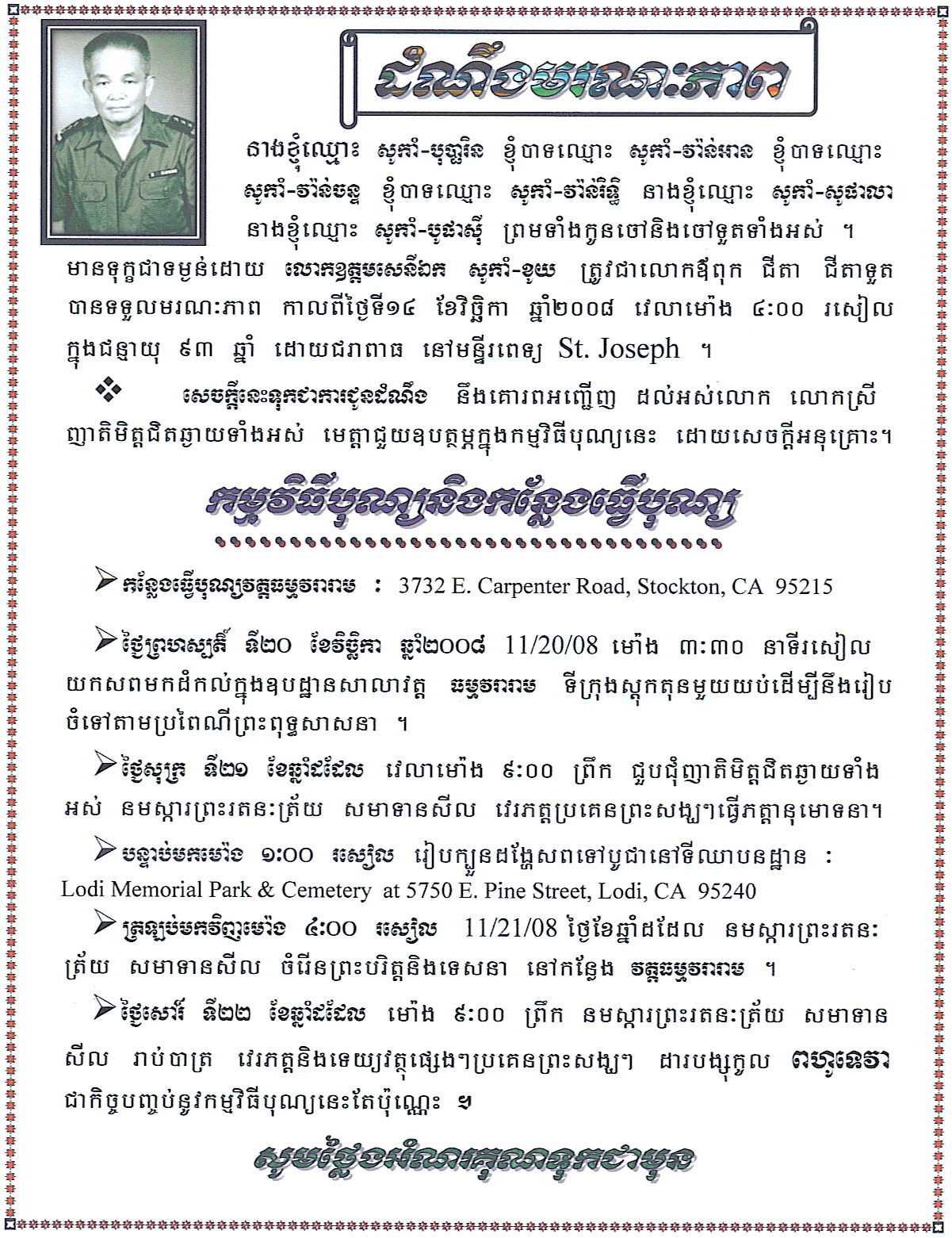
Funeral Schedule - Mr. Peter Khoy Saukam

Funeral Schedule
Mr. Peter Khoy Saukam

Friends and relatives,

With a heavy heart, I am sad to communicate the death of Mr... Peter Khoy Saukam, who passed on Friday November 14, 2008 due to natural causes. He was 94 years old and a beloved member of the Cambodian community. Father and grandfather figure to many, he touched many lives and will continue to do so through his legacy. He will be deeply missed by family and friends. Funeral services will take place November 20-22, 2008. The details are provided as below.

Regards,
Yukluy Sar (North California - Bay Area)

Mr. Saukam was born in Cambodia on February 2, 1915 to the parents of Kam Siv and Uy Sinn Loeung. When Mr. Saukam was 25 years old, he enlisted in the Royal Khmer Army. Mr. Saukam served in the Cambodian Military for 35 years. In 1953, Mr. Saukam achieved the rank of Lt. Colonel, and then went on to become Lt. General. Mr. Saukam served as President of the Senate of the Khmer Republic in 1972. From April 1 to April 12, 1975, Mr. Saukam served as acting President of the Khmer Republic.

In 1975, Mr. Saukam moved his family to the United States, where he originally settled in Houston, Texas. Then, in 1984, he moved to Stockton where he has resided for the past 24 years.

Mr. Saukam is survived by his children Bopharin Saukam of France, Vanan Saukam, Vanchan Saukam, and Vanrith Saukam all of Houston, Texas, Sophala Saukam of France, and Bophasy Saukam of Stockton. Mr. Saukam is also survived by 21 grandchildren, three of whom live in Stockton, Sytana Dany Khloth, Bonaka Dean Khloth and Boramy Tina Khloth. Mr. Saukam is preceded in death by his wife Mrs. Vom Tep Saukam, his son Vanroeun Saukam, his daughter-in-laws Chantharin Saukam and Bunthoeun Saukam, his parents Kam Siv and Uy Sinn Loeung, and 2 siblings.

=============


Mr. Peter Khoy Saukam
Funeral Schedule
11/20/08 - 11/22/08

Thursday 11/20/08
10:00 AM Visitation at Warren Wallace Funeral Home at 520 N. Sutter St to 3:00 PM Stockton, CA 95202 – Tel (209) 466-6993

3:00-3:30 PM Mr. Saukam is taken to Wat Dharmawararam Cambodian Temple at 3732 E. Carpenter Rd – Stockton, CA 95205 at (209) 943-2883

4:00 PM Buddhist Ceremony at the Cambodian Temple


Friday 11/21/08
7:30-8:30 AM Buddhist monks prepare Dany and Dino for monkhood for that day

9:00 AM to Noon Buddhist Ceremony at the Cambodian Temple followed by lunch offering to the Buddhist monks, and then followed by lunch buffet for friends and family

1:00 PM Escorted funeral procession from the Cambodian Temple to Lodi Memorial Park & Cemetery at 5750 E. Pine St – Lodi, CA 95240 Tel (209) 333-7171

1:30 PM Witness Cremation at Lodi Memorial Park & Cemetery

4:00 PM Buddhist Ceremony at the Cambodian Temple

Saturday 11/22/08
9:00 AM to Noon Buddhist Ceremony at the Cambodian Temple followed by lunch offering to the Buddhist monks, and then followed by lunch buffet for friends and family

Labels: ,


» Read more!

Monday, November 17, 2008

Siem Reap Airways Blacklisted

Siem Reap Airways Blacklisted


STRAITS TIMES

PHNOM PENH - THE European Commission has added Cambodia's Siem Reap Airways to a safety blacklist that bars carriers from flying to the 27-nation bloc, a statement said on Monday.

The executive branch of the European Union issues periodic lists of airlines from around the world that it says do not meet its safety standards and cannot travel to EU countries.

'The commission has imposed an operating ban on the main air carrier from Cambodia, Siem Reap Airways International', the EC said in a statement on its website.

'The airline does not operate in compliance with the Cambodian safety regulations nor does it meet the standards of the International Civil Aviation Organisation (ICAO),' it said.

'Significant concerns have also been expressed by ICAO with regard to the ability of the Cambodian civil aviation authorities to implement and enforce the international safety standards', said the commission.

Siem Reap Airways and Cambodian aviation officials could not immediately be reached for comment.

Siem Ream Airways is a subsidiary of Bangkok Airways International.

It is licensed by the Cambodian government to operate domestic services between Phnom Penh and the tourist hub Siem Reap - gateway to the Angkor Wat temples - but does not operate directly to Europe. -- AFP

Labels: , , , ,


» Read more!

General Hok Lundy Was Widely Feared

General Hok Lundy, Cambodia's Notorious and Brutal Police Chief, He Was Widely Feared


By Tom Fawthrop
The Guardian, Wednesday November 12 2008

General Hok Lundy, Cambodia's notorious police chief and close ally of prime minister Hun Sen, has died at the age of 58 in a helicopter crash. He was travelling from the capital, Phnom Penh, to the south-eastern province of Svay Rieng. None of the helicopter's other occupants - General Sok Saem, deputy commander of the Cambodian infantry, the pilot and co-pilot - survived the crash.

A four-star general and member of the politburo of the ruling CPP (Cambodian People's party), Hok Lundy was a man who inspired fear not only in opposition ranks, but also in members of his own party. Born in Svay Rieng, he first rose to prominence as the governor of Phnom Penh in 1990. Four years later, Hun Sen appointed him national police chief, reporting directly to the prime minister. He never took orders from Sar Kheng, his nominal boss as minister for the interior.

In the aftermath of a bloody power struggle in 1997 between partners in the coalition government, many royalist generals were captured and killed in cold blood. Hok Lundy played a key part in these mopping-up operations and extrajudicial executions. A Funcinpec (royalist) party minister, Ho Sok, was detained at the interior ministry and shot dead by a police unit there. It is known that Sar Kheng had ordered the police to ensure Ho Sok's safety, but Hok Lundy chose to handle things his own way, according to high-ranking sources close to the minister.

This was later confirmed by Heng Pov, the former Phnom Penh police chief, after he fell out with Hok Lundy. While he was on the run from criminal charges stacked against him, Heng Pov accused Cambodia's police supremo and security chief not only of murdering Ho Sok, but also the union leader Chea Vichea and film star Piseth Pilika, in revelations to the French magazine L'Express.

Diplomats in Phnom Penh routinely referred to Hok Lundy as a "thug". This reputation was further enhanced by his role in the burning of the Thai embassy in January 2003. The police chief, who was normally no fan of demonstrators, had permitted anti-Thai protestors to run riot, attacking Thai-owned properties all over Phnom Penh. In the aftermath of this violence he persuaded the prime minister to sack the capital's popular governor, his arch-rival Chea Sophara, as a scapegoat.

That Hun Sen sided with his police chief was no surprise, as Hok Lundy had already married his daughter off to one of Hun Sen's sons, thus consolidating close family ties among Cambodia's clannish ruling elite.

Lundy was also implicated in drug trafficking, the return of refugees to countries where they faced persecution and human trafficking. Two US Drug Enforcement Agency officials and a former unnamed US ambassador to Cambodia confirmed to Human Rights Watch that the US government was aware of Hok Lundy's involvement in drug trafficking. In February 2006, the US State Department's human trafficking office specifically cited Hok Lundy's alleged involvement in human trafficking as grounds for denying him a visa. That decision was linked to a brothel raid in December 2004, after which Hok Lundy reportedly ordered the release within hours of several traffickers, before an investigation could be conducted.

However, after 9/11 the Cambodian government had become cooperative in the war on terrorism. In March 2006, the month after the refusal of a visa, the FBI nonetheless awarded Hok Lundy a medal for his support for the US global war on terrorism, and the US ambassador to Cambodia, Joseph Mussomeli, praised Lundy's cooperation with the US in drug trafficking and human smuggling. State Department officials confirmed at the time that Hok Lundy had been invited to visit the FBI specifically because of his purported cooperation in counterterrorism. When, in April 2007, the FBI invited him to Washington for such discussions, Brad Adams, Human Rights Watch's Asia director, commented: "Hok Lundy's alleged involvement in political violence and organised crime in Cambodia means that the FBI should be investigating him, not hosting him."

The sudden death of a man who had made many enemies has sparked much speculation in Cambodia that the helicopter crash may not have been an accident, despite reports of bad weather. The helicopter caught fire, and the government has promised an investigation. Many people would have cause to celebrate the death of Cambodia's Mr Untouchable.

A French online agency, K-Set, has reported that Chea Mony, the brother
of the slain trade unionist and presidentof the Free Trade Union of Workers in the Kingdom of Cambodia, has said that the death of the top policeman means that the number of murders of politicians, entertainers and Cambodian reporters will undoubtedly be reduced, but regrets that he was never brought to justice.

Hok Lundy, soldier and police chief, born 1950; died November 9 2008

Labels: , , , , , , , , ,


» Read more!

Tuesday, November 11, 2008

Government Mourns Police Chief's Death

Cambodian Government Mourns Police Chief's Death


Hok Lundy's funeral (Photo: Pring Samrang, Cambodge Soir Hebdo)

Click on the photo to zoom in (Photo: Koh Santepheap newspaper)
Published: November 10, 2008
The Associated Press

PHNOM PENH, Cambodia: Cambodia's government began preparations Monday for the funeral of the country's controversial national police chief, a close ally of Prime Minister Hun Sen who was killed in a helicopter crash.

Police Commissioner-General Hok Lundy, 51, died Sunday night when the helicopter he was traveling in crashed in Svay Rieng province in southeastern Cambodia, apparently because of bad weather.

Hok Lundy had a reputation for ruthlessness as well as loyalty to Hun Sen, whose son is married to the late police chief's daughter.

"His death is bound to be a significant loss to Prime Minister Hun Sen" with whom he had both good working and personal relationships, said Lao Monghay, a senior researcher of Hong Kong-based Asian Human Rights Commission.

Police Lt. Gen. Khieu Sopheak, spokesman for the Interior Ministry, which oversees the police force, described Hok Lundy's death as "a great national loss and a profound sorrow for the police force."

Last year, the New York-based group Human Rights Watch urged the U.S. government to cancel a visa issued to Hok Lundy to attend an FBI-sponsored conference on human trafficking, accusing him of having ordered an extrajudicial killing and involvement in drug smuggling and human trafficking.

Cambodian government officials dismissed the Human Rights Watch allegations as nonsense.

Hok Lundy attended the conference, though the U.S. had denied him a visa in early 2006 for reasons never made public.

Hok Lundy's helicopter lost contact with air controllers about 15 minutes after it took off from the capital, Phnom Penh, on Sunday, Khieu Sopheak said. He said bad weather was likely responsible, but an investigation is under way.

Labels: ,


» Read more!

Sunday, November 09, 2008

General Hok Lundy, dies in helicopter crash

Cambodian police chief, General Hok Lundy, dies in helicopter crash


09 Nov 2008
Source: Reuters
PHNOM PENH, Nov 9 (Reuters) - Cambodia's national police chief, a close ally of Prime Minister Hun Sen, was killed with three other people in a helicopter crash on Sunday evening, the information minister said.

General Hok Lundy was on his way from the capital, Phnom Penh, to his native province of Svay Rieng accompanied by a military general and two pilots.

"According to the information I received, no one survived the crash," Information Minister Khieu Kanharith told Reuters.

The cause of the crash was unclear. The private helicopter came down in Romduol district, about 80 km (50 miles) southeast of Phnom Penh, officials said. (Reporting by Ek Madra; Editing by Alan Raybould)

Labels:


» Read more!

Tuol Krasaing's Gallery

Tuol Krasaing's Gallery


Sacravatoons no 1209: "Tuol Krasaing's Gallery"
(By Pen Bona Cambodge Soir Hebdo)
....
Several popular singers and actresses have been abused in recent years. It is believed to Piseth Pilika murdered in 1999, Touch Srey Nic, wounded by bullets in 2003 - it has followed intensive care in Bangkok and the United States. The last such case of early 2007, with the aggression of Pov Panh Pitch, treated in Vietnam. Common denominators of these murders and attempted murders: revenge wives from powerful families, and the impunity of gunmen, none have been prosecuted so far.
Piseth Pilika

Labels: ,


» Read more!

Saturday, November 08, 2008

Little hope for DJ Ano to survive

Rumor mills: Little hope for DJ Ano to survive from the razor blades attack

07 Nov 2008
Rasmei Kampuchea (by Ki-Media)

Even though sources from the Cambodian police and from the court claimed that there is no information and no complaint about the razor blade torture perpetrated on TV presenter DJ Ano, several artists confirmed that “violence on DJ Ano did occur and she is currently in serious condition.”

Information about the razor blade attack on the entire body of DJ Ano was reported by the Sophorn and Procheaprey (Popular) magazines.

DJ Ano, whose birth name is Suon Pheakdei, is a well known presenter of TV3 station in Phnom Penh. She is not a very young star anymore, as she is now 27-year-old.

In its 16th edition published for the period of 02-15 November 2008, the Sophorn magazine reported that the wife of a high ranking official kidnapped her, had her head shaved and her face cut with razor blades because this wife was angry that DJ Ano had an affair with her husband. The magazine claimed that DJ Ano was sent to Vietnam and that there is little hope that she will survive the attack. The report did not provide details about where and when the almost fatal assault took place.

Chuon Narin, chief of the serious crimes in Phnom Penh, told Rasmei Kampuchea in the afternoon of 06 November that: “I heard this information also. My force went to do research on it, but there is no sure source that could confirm it up to now, and there is no complaint brought up about this case either.”

General Touch Naroth, Phnom Penh police commissioner, made the same statement also, and the Phnom Penh court claimed that there was no complaint about DJ Ano’s case.

Nevertheless, some artists claimed that DJ Ano who was attacked by razor blades has only about 20% chance of survival because she lost too much blood from the attack. However, these sources asked to remain anonymous.

Special artists from TV3 channel claimed that the attack on DJ Ano was perpetrated by the wife of high ranking official who ordered 3-4 of her bodyguards to kidnap DJ Ano and threw her in a car. At first, the bodyguards used razor blades to shave DJ Ano hair, they then proceeded to cut her face with the blades also. Later on, they cut her entire body from top to bottom with razor blades and even her genital part was not spared. The source added that DJ Ano was very seriously injured and her family rushed her out of the country for medical care.

All the sources consulted by Rasmei Kampuchea claimed that the razor attack on DJ Ano is 100% true, and some even gave the name of the country where DJ Ano was sent to for medical care. According to one group of sources, she would be sent to Malaysia, while a second group claimed that she was sent to Vietnam instead. It appears that information from the second group is more accurate because Rasmei Kampuchea received the news on 06 November that she was sent to Vietnam.

The source consulted by Rasmei Kampuchea indicated that, as of now, there is only 20% chance that DJ Ano will survive because she lost too much blood during the attack.

DJ Ano was born as Suon Pheakei, she used to have a love relationship with a Filipino man and a Thai man. After her breakup from her Filipino boyfriend, she was asked for marriage by a Cambodian expat living in the US. Following her breakup with her fiancé from the US, DJ Ano received a warning from a woman telling her to be careful because she may be splashed with acid. The Sophorn magazine claimed that prior to her liaison with the high ranking government official, she was linked to the owner of massage parlor.

DJ Ano did not have any relatives in Phnom Penh, and her house is Phnom Penh is unknown. But, a number of sources indicated that she had an adopted elder sister, and that this sister would be an important witness in this attack case.

Up to now, TV3 does not the whereabout of DJ Ano. Kong Socheat from TV3 claimed that DJ Ano did not come to the station for the past 2-3 weeks.

Liaison with a married man is believed to be the source of this violent attack case.

Labels:


» Read more!

Another attack against the star, DJ Ano


Another attack against the star, DJ Ano


Friday, November 07, 2008
Dear Editor,

I would like to provide my opinion in the assault case against DJ Ano!

It is true that all human beings are hurt when their loved-one is being taken away from them. However, the savage violence which took place and that was used to resolve this case brings shame to Cambodia honor: not only was Khmer pride being destroyed by this act, but also Buddhist Ahimsa (non-violence) has been cheapened shamelessly.

I am begging all our compatriots to resolve their disputes peacefully in order to preserve the honor of Cambodia which used to be a famous empire in Asia.

Thank you,

Ana Nov

07 Nov 2008
By Pen Bona
Cambodge Soir Hebdo (Translated by translate.google.com)

The Cambodian press echoes, for several days of a case of aggression which would have been the victim DJ Ano, an actress and television presenter, particularly popular among young people.

Soun Pheakdei, known as DJ Ano, has disappeared from the screens of the municipal television channel TV3 for several days. This surprising absence has raised a stir among viewers. However, some newspapers and magazine gave one DJ Ano aggression which would have been a victim. The merits of the case would be a revenge by a jealous wife, probably a member of a powerful family. Based on the facts reported by the media, the young woman of 27 years had shaved heads and the disfigured face off with razor blades by male hands of the wife of "lok thom." In serious condition, she was sent to Vietnam for treatment.

This case is not based on time on anonymous sources. Neither the police nor the managers of the chain of TV3 have confirmed this. There is no direct testimony, no photograph circulated of aggression. No complaint has been filed by the family of the actress, who has not provided statements to the press. The rumor was however among the media like wildfire ...

Several popular singers and actresses have been abused in recent years. It is believed to Piseth Pilika murdered in 1999, Touch Srey Nic, wounded by bullets in 2003 - it has followed intensive care in Bangkok and the United States. The last such case of early 2007, with the aggression of Pov Panh Pitch, treated in Vietnam. Common denominators of these murders and attempted murders: revenge wives from powerful families, and the impunity of gunmen, none have been prosecuted so far.

Labels:


» Read more!

South-East Asian countries seek economic integration

South-East Asian countries seek economic integration


(lefrt-right) Prime Ministers Thein Sein from Myanmar, Samchai Wongsawat from Thailand, Nguyen Tan Dung from Vietnam, Hun Sen from Cambodia and Bouasone Bouphavanh from Laos at a summit summit in Hanoi (AFP/Hoang Dinh Nam)


Business News (monstersandcritics.com)
Nov 7, 2008

Hanoi - The global financial crisis might bring economic benefits for countries in South-East Asia, Cambodian Prime Minister Hun Sen said Friday at a regional summit in Hanoi.

'The rich people in Europe, the buyers in America will not buy expensive clothes produced in Europe anymore but the cheaper goods produced in Cambodia and Vietnam,' Sen said.

Most of the other businessmen and political leaders at the summit focused on the need to integrate South-East Asian economies to create a larger market more resilient to economic shocks.

They met at the Arrawaddy-Chao Phraya-Mekong Economic Cooperation Strategy summit, which brings together Cambodia, Laos, Myanmar, Thailand and Vietnam in a rivers-related regional development forum initiated by former Thai prime minister Thaksin Shinawatra in 2003.

The vice chairman of the Vietnam Chamber of Commerce, Hoang Van Dung, said the five countries should focus on harmonizing regulations, eliminating duplicate customs inspections and creating a single regional travel card to promote tourism.

Oknha Kith Meng, president of the Cambodian Chamber of Commerce, said the region should expect severe economic challenges as reduced demand in their wealthy export markets made itself felt.

'These problems that we face are not of our making,' Meng said. 'However, we have to expect that our economies will be buffeted by this global storm.'

Myanmar Prime Minister Thein Sein hailed the establishment of an East-West transit corridor to link his country's Indian Ocean coastline with Vietnam's ports on the South China Sea. Sein also said the regional development forum had played a role in encouraging Thai investment in Myanmar, which reached 4 billion dollars in the past fiscal year, which ended in March.

Thai Prime Minister Somchai Wongsawat said the regional road network constructed under a framework called GMS was nearly complete but said better customs coordination and more industrial zones along the transit network were still needed.

Somchai called on forum members to enhance 'self-reliance' within the region, to create more intraregional trade and cushion the impact of the global financial crisis.

More than 350 business representatives from South-East Asia and the region's trading partners, including Japan, the United States, Russia and South Korea attended the conference.

Labels: , , , , , ,


» Read more!
October 1997
January 2005
February 2005
March 2005
April 2005
May 2005
June 2005
July 2005
August 2005
September 2005
October 2005
November 2005
January 2006
February 2006
March 2006
April 2006
May 2006
June 2006
July 2006
August 2006
September 2006
October 2006
November 2006
December 2006
January 2007
February 2007
March 2007
April 2007
May 2007
June 2007
July 2007
August 2007
September 2007
October 2007
November 2007
December 2007
January 2008
February 2008
March 2008
April 2008
May 2008
June 2008
July 2008
August 2008
September 2008
October 2008
November 2008
December 2008
January 2009
February 2009
March 2009
April 2009
May 2009
June 2009
September 2009
October 2009
November 2009
December 2009
January 2010
February 2010
March 2010
April 2010
May 2010
June 2010
July 2010
August 2010
September 2010
October 2010
November 2010
January 2011
February 2011
March 2011
April 2011
May 2011
June 2011
July 2011
August 2011
September 2011
October 2011
November 2011
December 2011
July 2012
August 2012
September 2012
October 2012
November 2012
November 2013
December 2013
January 2014
March 2014
April 2014
May 2014
July 2014
September 2014
January 2015
February 2015
September 2015
October 2015
August 2016
September 2016
March 2018

Subscribe to
Posts [Atom]

Powered by Blogger


 Home   |   About Us   |   Submit URL or Your Company Address First Launched: 08/15/95 - Copyright © 2010 Cambodian Information Center. All rights reserved.