Editorial | Articles about Cambodia | Khmer

Friday, October 23, 2009

Paris Peace Agreement, Paris, October 23, 1991

Paris, October 23, 1991

Annex 1 UNTAC Mandate

Section A General Procedures

  1. In accordance with Article 6 of the Agreement, UNTAC will exercise the powers necessary to ensure the implementation of this Agreement, including those relating to the organisation and conduct of free and fair elections and the relevant aspects of the administration of Cambodia.
  2. The following mechanism will be used to resolve all issues relating to the implementation of this Agreement which may arise between the Secretary-General's Special Representative and the Supreme National Council (SNC):

    a) The SNC offers advice to UNTAC, which will comply with this advice provided there is a consensus among the members of the SNC and provided this advice is consistent with the objectives of the present Agreement;

    b) If there is no consensus among the members of the SNC despite every endeavour of its President, H.R.H. Samdech Norodom Sihanouk, the President will be entitled to make the decision on what advice to offer to UNTAC, taking fully into account the views expressed in the SNC. UNTAC will comply with the advice provided it is consistent with the objectives of the present Agreement;

    c) If H.R.H. Samdech Norodom Sihanouk, President of the SNC, the legitimate representative of Cambodian sovereignty, is not, for whatever reason, in a position to make such a decision, his power of decision will transfer to the Secretary-General's Special Representative. The Special Representative will make the final decision, taking fully into account the views expressed in the SNC;

    d) Any power to act regarding the implementation of this Agreement conferred upon the SNC by the Agreement will be exercised by consensus or, failing such consensus, by its President in accordance with the procedure set out above. In the event that H.R.H. Samdech Norodom Sihanouk, President of the SNC, the legitimate representative of Cambodian sovereignty, is not, for whatever reason, in a position to act, his power to act will transfer to the Secretary-General's Special Representative, who may take the necessary action;

    e) In all cases, the Secretary-General's Special Representative will determine whether advice or action of the SNC is consistent with the present Agreement.
  3. The Secretary-General's Special Representative or his delegate will attend the meetings of the SNC and of any subsidiary body which might be established by it and give its members all necessary information on the decisions taken by UNTAC.


Section B Civil Administration

  1. In accordance with Article 6 of the Agreement, all administrative agencies, bodies and offices acting in the field of foreign affairs, national defence, finance, public security and information will be placed under the direct control of UNTAC, which will exercise it as necessary to ensure strict neutrality. In this respect, the Secretary-General's Special Representative will determine what is necessary and may issue directives to the above-mentioned administrative agencies, bodies and offices. Such directives may be issued to and will bind all Cambodian Parties.
  2. In accordance with Article 6 of the Agreement, the Secretary-General's Special Representative, in consultation with the SNC, will determine which other administrative agencies, bodies and offices could directly influence the outcome of elections. These administrative agencies, bodies and offices will be placed under direct supervision or control of UNTAC and will comply with any guidance provided by it.
  3. In accordance with Article 6 of the Agreement, the Secretary-General's Special Representative, in consultation with the SNC, will identify which administrative agencies, bodies and offices could continue to operate in order to ensure normal day-to-day life in Cambodia, if necessary, under such supervision by UNTAC as it considers necessary.
  4. In accordance with Article 6 of the Agreement, the authority of the Secretary-General's Special Representative will include the power to:

    a) Install in administrative agencies, bodies and offices of all the Cambodian Parties United Nations personnel, who will have unrestricted access to all administrative operations and information;

    b) Require the reassignment or removal of any personnel of such administrative agencies, bodies and offices.
  5. a) On the basis of the information provided in Article I, paragraph 3, of annex 2, the Special Representative of the Secretary-General will determine, after consultation with the Cambodian Parties, those civil police necessary to perform law enforcement in Cambodia. All Cambodian Parties hereby undertake to comply with the determination made by the Special Representative in this regard;

    b) All civil police will operate under UNTAC supervision or control, in order to ensure that law and order are maintained effectively and impartially, and that human rights and fundamental freedoms are fully protected. In consultation with the SNC, UNTAC will supervise other law enforcement and judicial processes throughout Cambodia to the extent necessary to ensure the attainment of these objectives.
  6. If the Secretary-General's Special Representative deems it necessary, UNTAC, in consultation with the SNC, will undertake investigations of complaints and allegations regarding actions by the existing administrative structures in Cambodia that are inconsistent with or work against the objectives of this comprehensive political settlement. UNTAC will also be empowered to undertake such investigation on its own initiative. UNTAC will take, when necessary, appropriate corrective steps.


Section C Military Functions

  1. UNTAC will supervise, monitor and verify the withdrawal of foreign forces, the ceasefire and related measures in accordance with annex 2, including:

    a) Verification of the withdrawal from Cambodia of all categories of foreign forces, advisers and military personnel and their weapons, ammunition and equipment, and their non-return to Cambodia

    b) Liaison with neighbouring Governments over any developments in or near their territory that could endanger the implementation of this Agreement;

    c) Monitoring the cessation of outside military assistance to all Cambodian Parties;

    d) Locating and confiscating caches of weapons and military supplies throughout the country;

    e) Assisting with clearing mines and undertaking training programmes in mine clearance and a mine awareness programme among the Cambodian people.
  2. UNTAC will supervise the regrouping and relocating of all forces to specifically designated cantonment areas on the basis of an operational timetable to be agreed upon, in accordance with annex 2.
  3. As the forces enter the cantonments, UNTAC will initiate the process of arms control and reduction specified in annex 2.
  4. UNTAC will take necessary steps regarding the phased process of demobilisation of the military forces of the parties, in accordance with annex 2.
  5. UNTAC will assist, as necessary, the International Committee of the Red Cross in the release of all prisoners of war and civilian internees.


Section D Elections

  1. UNTAC will organise and conduct the election referred to in Part II of this Agreement in accordance with this section and annex 3.
  2. UNTAC may consult with the SNC regarding the organisation and conduct of the electoral process.
  3. In the exercise of its responsibilities in relation to the electoral process, the specific authority of UNTAC will include the following:

    a) The establishment, in consultation with the SNC, of a system of laws, procedures and administrative measures necessary for the holding of a free and fair election in Cambodia, including the adoption of an electoral law and of a code of conduct regulating participation in the election in a manner consistent with respect for human rights and prohibiting coercion or financial inducement in order to influence voter preference;

    b) The suspension or abrogation, in consultation with the SNC, of provisions of existing laws which could defeat the objects and purposes of this Agreement;

    c) The design and implementation of a voter education programme, covering all aspects of the election, to support the election process;

    d) The design and implementation of a system of voter registration, as a first phase of the electoral process, to ensure that eligible voters have the opportunity to register, and the subsequent preparation of verified voter registration lists;

    e) The design and implementation of a system of registration of political parties and lists of candidates;

    f) Ensuring fair access to the media, including press, television and radio, for all political parties contesting in the election;

    g) The adoption and implementation of measures to monitor and facilitate the participation of Cambodians in the elections, the political campaign and the balloting procedures;

    h) The design and implementation of a system of balloting and polling, to ensure that registered voters have the opportunity to vote;

    i) The establishment, in consultation with the SNC, of co-ordinated arrangements to facilitate the presence of foreign observers wishing to observe the campaign and voting;

    j) Overall direction of polling and the vote count;

    k) The identification and investigation of complaints of electoral irregularities, and the taking of appropriate corrective action;

    l) Determining whether or not the election was free and fair and, if so, certification of the list of persons duly elected.
  4. In carrying out its responsibilities under the present section, UNTAC will establish a system of safeguards to assist it in ensuring the absence of fraud during the electoral process, including arrangements for Cambodian representatives to observe the registration and polling procedures and the provision of an UNTAC mechanism for hearing and deciding complaints.
  5. The timetable for the various phases of the electoral process will be determined by UNTAC, in consultation with the SNC as provided in paragraph 2 of this section. The duration of the electoral process will not exceed nine months from the commencement of voter registration.
  6. In organising and conducting the electoral process, UNTAC will make every effort to ensure that the system and procedures adopted are absolutely impartial, while the operational arrangements are as administratively simple and efficient as possible.


Section E Human Rights

In accordance with Article 16, UNTAC will make provisions for:

a) The development and implementation of a programme of human rights education to promote respect for and understanding of human rights;

b) General human rights oversight during the transitional period;

c) The investigation of human rights complaints, and, where appropriate, corrective action.

Annex 2 Withdrawal, Ceasefire and Related Measures

Article I Ceasefire

  1. All Cambodian Parties (hereinafter referred to as “the Parties”) agree to observe a comprehensive ceasefire on land and water and in the air. This ceasefire will be implemented in two phases. During the first phase, the ceasefire will be observed with the assistance of the Secretary-General of the United Nations through his good offices. During the second phase, which should commence as soon as possible, the ceasefire will be supervised, monitored and verified by UNTAC. The Commander of the military component of UNTAC, in consultation with the Parties, shall determine the exact time and date at which the second phase will commence. This date will be set at least four weeks in advance of its coming into effect.
  2. The Parties undertake that, upon the signing of this Agreement, they will observe a ceasefire and will order their armed forces immediately to disengage and refrain from all hostilities and any deployment, movement or action that would extend the territory they control or that might lead to a resumption of fighting, pending the commencement of the second phase. “Forces” are agreed to include all regular, provincial, district, paramilitary and other auxiliary forces.

    During the first phase, the Secretary-General of the United Nations will provide his good offices to the Parties to assist them in its observance. The Parties undertake to co-operate with the Secretary-General or his representatives in the exercise of his good offices in this regard.
  3. The Parties agree that, immediately upon the signing of this Agreement, the following information will be provided to the United Nations:

    a) Total strength of their forces, organisation, precise number and location of deployments inside and outside Cambodia. The deployment will be depicted on a map marked with locations of all troop positions, occupied or unoccupied, including staging camps, supply bases and supply routes;

    b) Comprehensive lists of arms, ammunition and equipment held by their forces, and the exact locations at which those arms, ammunition and equipment are deployed;

    c) Detailed record of their minefields, including types and characteristics of mines laid and information of booby traps used by them together with any information available to them about minefields laid or booby traps used by the other Parties;

    d) Total strength of their police forces, organisation, precise numbers and locations of deployments as well as comprehensive lists of their arms, ammunition and equipment and the exact locations at which those arms, ammunition and equipment are deployed.
  4. Immediately upon his arrival in Cambodia, and not later than four weeks before the beginning of the second phase, the Commander of the military component of UNTAC will, in consultation with the Parties, finalise UNTAC's plan for the regroupment and cantonment of the forces of the Parties and for the storage of their arms, ammunition and equipment, in accordance with Article Ill of this annex. This plan will include the designation of regroupment and cantonment areas, as well as an agreed timetable. The cantonment areas will be established at battalion size or larger.
  5. The Parties agree to take steps to inform their forces at least two weeks before the beginning of the second phase, using all possible means of communication, about the agreed date and time of the beginning of the second phase, about the agreed plan for the regroupment and cantonment of their forces and for the storage of their arms, ammunition and equipment and, in particular, about the exact locations of the regroupment areas to which their forces are to report. Such information will continue to be disseminated for a period of four weeks after the beginning of the second phase.
  6. The Parties shall scrupulously observe the ceasefire and will not resume any hostilities by land, water or air. The commanders of their armed forces will ensure that all troops under their command remain on their respective positions, pending their movement to the designated regroupment areas, and refrain from all hostilities and from any deployment or movement or action which would extend the territory they control or which might lead to a resumption of fighting.


Article II Liaison System and Mixed Military Working Group

A Mixed Military Working Group (MMWG) will be established with a view to resolving any problems that may arise in the observance of the ceasefire. It will be chaired by the most senior United Nations military officer in Cambodia or his representative. Each Party agrees to designate an officer of the rank of brigadier or equivalent to serve on the MMWG. Its composition, method of operation and meeting places will be determined by the most senior United Nations military officer in consultation with the Parties. Similar liaison arrangements will be made at lower military command levels to resolve practical problems on the ground.


Article III Regroupment and cantonment of the forces of the Parties and storage of their arms, ammunition and equipment

  1. In accordance with the operational timetable referred to in paragraph 4 of Article I of the present annex, all forces of the Parties that are not already in designated cantonment areas will report to designated regroupment areas, which will be established and operated by the military component of UNTAC. These regroupment areas will be established and operational not later than one week prior to the date of the beginning of the second phase. The Parties agree to arrange for all their forces, with all their arms, ammunition and equipment, to report to regroupment areas within two weeks after the beginning of the second phase. All personnel who have reported to the regroupment areas will thereafter be escorted by personnel of the military component of UNTAC, with their arms, ammunition and equipment, to designated cantonment areas. All Parties agree to ensure that personnel reporting to the regroupment areas will be able to do so in full safety and without any hindrance.
  2. On the basis of the information provided in accordance with paragraph 3 of Article I of the present annex, UNTAC will confirm that the regroupment and cantonment processes have been completed in accordance with the plan referred to in paragraph 4 of Article I of this annex. UNTAC will endeavour to complete these processes within four weeks from the date of the beginning of the second phase. On the completion of regroupment of all forces and of their movement to cantonment areas, respectively, the Commander of the military component of UNTAC will so inform each of the four Parties.
  3. The Parties agree that, as their forces enter the designated cantonment areas, their personnel will be instructed by their commanders to immediately hand over all their arms, ammunition and equipment to UNTAC for storage in the custody of UNTAC.
  4. UNTAC will check the arms, ammunition and equipment handed over to it against the lists referred to in paragraph 3. b) of Article I of this annex, in order to verify that all the arms, ammunition and equipment in the possession of the Parties have been placed under its custody.


Article IV Resupply of forces during cantonment

The military component of UNTAC will supervise the resupply of all forces of the Parties during the regroupment and cantonment processes. Such resupply will be confined to items of a non-lethal nature such as food, water, clothing and medical supplies as well as provision of medical care.


Article V Ultimate disposition of the forces of the Parties and of their arms, ammunition and equipment

  1. In order to reinforce the objectives of a comprehensive political settlement, minimise the risks of a return to warfare, stabilise the security situation and build confidence among the Parties to the conflict, all Parties agree to undertake a phased and balanced process of demobilisation of at least 70 per cent of their military forces. This process shall be undertaken in accordance with a detailed plan to be drawn up by UNTAC on the basis of the information provided under Article I of this annex and in consultation with the Parties. It should be completed prior to the end of the process of registration for the elections and on a date to be determined by the Special Representative of the Secretary-General.
  2. The Cambodian Parties hereby commit themselves to demobilise all their remaining forces before or shortly after the elections and, to the extent that full demobilisation is unattainable, to respect and abide by whatever decision the newly elected government that emerges in accordance with Article 12 of this Agreement takes with regard to the incorporation of parts or all of those forces into a new national army. Upon completion of the demobilisation referred to in paragraph 1, the Cambodian Parties and the Special Representative of the Secretary-General shall undertake a review regarding the final disposition of the forces remaining in the cantonments, with a view to determining which of the following shall apply:

    a) If the Parties agree to proceed with the demobilisation of all or some of the forces remaining in the cantonments, preferably prior to or otherwise shortly after the elections, the Special Representative shall prepare a timetable for so doing, in consultation with them;

    b) Should total demobilisation of all of the residual forces before or shortly after the elections not be possible, the Parties hereby undertake to make available all of their forces remaining in cantonments to the newly elected government that emerges in accordance with Article 12 of this Agreement, for consideration for incorporation into a new national army. They further agree that any such forces which are not incorporated into the new national army will be demobilised forthwith according to a plan to be prepared by the Special Representative. With regard to the ultimate disposition of the remaining forces and all the arms, ammunition and equipment, UNTAC, as it withdraws from Cambodia, shall retain such authority as is necessary to ensure an orderly transfer to the newly elected government of those responsibilities it has exercised during the transitional period.
  3. UNTAC will assist, as required, with the reintegration into civilian life of the forces demobilised prior to the elections.
  4. a) UNTAC will control and guard all the arms, ammunition and equipment of the Parties throughout the transitional period;

    b) As the cantoned forces are demobilised in accordance with paragraph 1 above, there will be a parallel reduction by UNTAC of the arms, ammunition and equipment stored on site in the cantonment areas. For the forces remaining in the cantonment areas, access to their arms, ammunition and equipment shall only be on the basis of the explicit authorisation of the Special Representative of the Secretary-General;

    c) If there is a further demobilisation of the military forces in accordance with paragraph 2. a) above, there will be a commensurate reduction by UNTAC of the arms, ammunition and equipment stored on site in the cantonment areas;

    d) The ultimate disposition of all arms, ammunition and equipment will be determined by the government that emerges through the free and fair elections in accordance with Article 12 of this Agreement.


Article VI Verification of withdrawal from Cambodia and non-return of all categories of foreign forces

  1. UNTAC shall be provided, no later than two weeks before the commencement of the second phase of the ceasefire, with detailed information in writing regarding the withdrawal of foreign forces. This information shall include the following elements:

    a) Total strength of these forces and their organisation and deployment;

    b) Comprehensive lists of arms, ammunition and equipment held by these forces, and their exact locations;

    c) Withdrawal plan (already implemented or to be implemented), including withdrawal routes, border crossing points and time of departure from Cambodia.
  2. On the basis of the information provided in accordance with paragraph 1 above, UNTAC will undertake an investigation in the manner it deems appropriate. The Party providing the information will be required to make personnel available to accompany UNTAC investigators.
  3. Upon confirmation of the presence of any foreign forces, UNTAC will immediately deploy military personnel with the foreign forces and accompany them until they have withdrawn from Cambodian territory. UNTAC will also establish checkpoints on withdrawal routes, border crossing points and airfields to verify the withdrawal and ensure the non-return of all categories of foreign forces.
  4. The Mixed Military Working Group (MMWG) provided for in Article II of this annex will assist UNTAC in fulfilling the above-mentioned tasks.


Article VII Cessation of outside military assistance to all Cambodian Parties

  1. All Parties undertake, from the time of the signing of this Agreement, not to obtain or seek any outside military assistance, including weapons, ammunition and military equipment from outside sources.
  2. The Signatories whose territory is adjacent to Cambodia, namely, the Governments of the Lao People's Democratic Republic, the Kingdom of Thailand and the Socialist Republic of Viet Nam, undertake to:

    a) Prevent the territories of their respective States, including land territory, territorial sea and air space, from being used for the purpose of providing any form of military assistance to any of the Cambodian Parties. Resupply of such items as food, water, clothing and medical supplies through their territories will be allowed, but shall, without prejudice to the provisions of sub-paragraph c) below, be subject to UNTAC supervision upon arrival in Cambodia;

    b) Provide written confirmation to the Commander of the military component of UNTAC, not later than four weeks after the second phase of the ceasefire begins, that no forces, arms, ammunition or military equipment of any of the Cambodian Parties are present on their territories;

    c) Receive an UNTAC liaison officer in each of their capitals and designate an officer of the rank of colonel or equivalent, not later than four weeks after the beginning of the second phase of the ceasefire, in order to assist UNTAC in investigating, with due respect for their sovereignty, any complaints that activities are taking place on their territories that are contrary to the provisions of the comprehensive political settlement.
  3. To enable UNTAC to monitor the cessation of outside assistance to all Cambodian Parties, the Parties agree that, upon signature of this Agreement, they will provide to UNTAC any information available to them about the routes and means by which military assistance, including weapons, ammunition and military equipment, have been supplied to any of the Parties. Immediately after the second phase of the ceasefire begins, UNTAC will take the following practical measures:

    a) Establish checkpoints along the routes and at selected locations along the Cambodian side of the border and at airfields inside Cambodia;

    b) Patrol the coastal and inland waterways of Cambodia;

    c) Maintain mobile teams at strategic locations within Cambodia to patrol and investigate allegations of supply of arms to any of the Parties.


Article VIII Caches of weapons and military supplies

  1. In order to stabilise the security situation, build confidence and reduce arms and military supplies throughout Cambodia, each Party agrees to provide to the Commander of the military component of UNTAC, before a date to be determined by him, all information at its disposal, including marked maps, about known or Suspected caches of weapons and military supplies throughout Cambodia.
  2. On the basis of information received, the military component of UNTAC shall, after the date referred to in paragraph 1, deploy verification teams to investigate each report and destroy each cache found.


Article IX Unexploded ordnance devices

  1. Soon after arrival in Cambodia, the military component of UNTAC shall ensure, as a first step, that all known minefields are clearly marked.
  2. The Parties agree that, after completion of the regroupment and cantonment processes in accordance with Article Ill of the present annex, they will make available mine-clearing teams which, under the supervision and control of UNTAC military personnel, will leave the cantonment areas in order to assist in removing, disarming or deactivating remaining unexploded ordnance devices. Those mines or objects which cannot be removed, disarmed or deactivated will be clearly marked in accordance with a system to be devised by the military component of UNTAC.
  3. UNTAC shall:

    a) Conduct a mass public education programme in the recognition and avoidance of explosive devices;

    b) Train Cambodian volunteers to dispose of unexploded ordnance devices;

    c) Provide emergency first-aid training to Cambodian volunteers.


Article X Investigation of violations

  1. After the beginning of the second phase, upon receipt of any information or complaint from one of the Parties relating to a possible case of non-compliance with any of the provisions of the present annex or related provisions, UNTAC will undertake an investigation in the manner which it deems appropriate. Where the investigation takes place in response to a complaint by one of the Parties, that Party will be required to make personnel available to accompany the UNTAC investigators. The results of such investigation will be conveyed by UNTAC to the complaining Party and the Party complained against, and if necessary to the SNC.
  2. UNTAC will also carry out investigations on its own initiative in other cases when it has reason to believe or suspect that a violation of this annex or related provisions may be taking place.


Article XI Release of prisoners of war

The military component of UNTAC will provide assistance as required to the International Committee of the Red Cross in the latter's discharge of its functions relating to the release of prisoners of war.


Article XII Repatriation and resettlement of displaced Cambodians

The military component of UNTAC will provide assistance as necessary in the repatriation of Cambodian refugees and displaced persons carried out in accordance with Articles 19 and 20 of this Agreement, in particular in the clearing of mines from repatriation routes, reception centres and resettlement areas, as well as in the protection of the reception centres.

Annex 3 Elections

  1. The constituent assembly referred to in Article 12 of the Agreement shall consist of 120 members. Within three months from the date of the election, it shall complete its tasks of drafting and adopting a new Cambodian Constitution and transform itself into a legislative assembly which will form a new Cambodian Government.
  2. The election referred to in Article 12 of the Agreement will be held throughout Cambodia on a provincial basis in accordance with a system of proportional representation on the basis of lists of candidates put forward by political parties.
  3. All Cambodians, including those who at the time of signature of this Agreement are Cambodian refugees and displaced persons, will have the same rights, freedoms and opportunities to take part in the electoral process.
  4. Every person who has reached the age of eighteen at the time of application to register; or who turns eighteen during the registration period, and who either was born in Cambodia or is the child of a person born in Cambodia, will be eligible to vote in the election.
  5. Political parties may be formed by any group of five thousand registered voters. Party platforms shall be consistent with the principles and objectives of the Agreement on a comprehensive political settlement.
  6. Party affiliation will be required in order to stand for election to the constituent assembly. Political parties will present lists of candidates standing for election on their behalf, who will be registered voters.
  7. Political parties and candidates will be registered in order to stand for election. UNTAC will confirm that political parties and candidates meet the established criteria in order to qualify for participation in the election. Adherence to a Code of Conduct established by UNTAC in consultation with the SNC will be a condition for such participation.
  8. Voting will be by secret ballot, with provision made to assist those who are disabled or who cannot read or write.
  9. The freedoms of speech, assembly and movement will be fully respected. All registered political parties will enjoy fair access to the media, including the press, television and radio.

Annex 4 Repatriation of Cambodian Refugees and Displaced Persons

Part I Introduction

  1. As part of the comprehensive political settlement, every assistance will need to be given to Cambodian refugees and displaced persons as well as to countries of temporary refuge and the country of origin in order to facilitate the voluntary return of all Cambodian refugees and displaced persons in a peaceful and orderly manner. It must also be ensured that there would be no residual problems for the countries of temporary refuge. The country of origin with responsibility towards its own people will accept their return as conditions become conducive.


Part II Conditions Conducive to the Return of Refugees and Displaced Persons

  • The task of rebuilding the Cambodian nation will require the harnessing of all its human and natural resources. To this end, the return to the place of their choice of Cambodians from their temporary refuge and elsewhere outside their country of origin will make a major contribution.
  • Every effort should be made to ensure that the conditions which have led to a large number of Cambodian refugees and displaced persons seeking refuge in other countries should not recur. Nevertheless, some Cambodian refugees and displaced persons will wish and be able to return spontaneously to their homeland.
  • There must be full respect for the human rights and fundamental freedoms of all Cambodians, including those of the repatriated refugees and displaced persons, in recognition of their entitlement to live in peace and security, free from intimidation and coercion of any kind. These rights would include, inter alia, freedom of movement within Cambodia, the choice of domicile and employment, and the right to property.
  • In accordance with the comprehensive political settlement, every effort should be made to create concurrently in Cambodia political, economic and social conditions conducive to the return and harmonious integration of the Cambodian refugees and displaced persons.
  • With a view to ensuring that refugees and displaced persons participate in the elections, mass repatriation should commence and be completed as soon as possible, taking into account all the political, humanitarian, logistical, technical and socio-economic factors involved, and with the co-operation of the SNC.
  • Repatriation of Cambodian refugees and displaced persons should be voluntary and their decision should be taken in full possession of the facts. Choice of destination within Cambodia should be that of the individual. The unity of the family must be preserved.


Part III Operational Factors

  1. Consistent with respect for principles of national sovereignty in the countries of temporary refuge and origin, and in close co-operation with the countries of temporary refuge and origin, full access by the Office of the United Nations High Commissioner for Refugees (UNHCR), CRC and other relevant international agencies should be guaranteed to all Cambodian refugees and displaced persons, with a view to the agencies undertaking the census, tracing, medical assistance, food distribution and other activities vital to the discharge of their mandate and operational responsibilities; such access should also be provided in Cambodia to enable the relevant international organisations to carry out their traditional monitoring as well as operational responsibilities.
  2. In the context of the comprehensive political settlement, the Signatories note with satisfaction that the Secretary-General of the United Nations has entrusted UNHCR with the role of leadership and co-ordination among intergovernmental agencies assisting with the repatriation and relief of Cambodian refugees and displaced persons. The Signatories look to all non-governmental organisations to co-ordinate as much as possible their work for the Cambodian refugees and displaced persons with that of UNHCR.
  3. The SNC, the Governments of the countries in which the Cambodian refugees and displaced persons have sought temporary refuge, and the countries which contribute to the repatriation and integration effort will wish to monitor closely and facilitate the repatriation of the returnees. An ad hoc consultative body should be established for a limited term for these purposes. The UNHCR, the ICRC, and other international agencies as appropriate, as well as UNTAC, would be invited to join as full participants.
  4. Adequately monitored short-term repatriation assistance should be provided on an impartial basis to enable the families and individuals returning to Cambodia to establish their lives and livelihoods harmoniously in their society. These interim measures would be phased out and replaced in the longer term by the reconstruction programme.
  5. Those responsible for organising and supervising the repatriation operation will need to ensure that conditions of security are created for the movement of the refugees and displaced persons. In this respect, it is imperative that appropriate border crossing points and routes be designated and cleared of mines and other hazards.
  6. The international community should contribute generously to the financial requirements of the repatriation operation.

Annex 5 Principles for a New Constitution for Cambodia

  1. The constitution will be the supreme law of the land. It may be amended only by a designated process involving legislative approval, popular referendum, or both.
  2. Cambodia's tragic recent history requires special measures to assure protection of human rights. Therefore, the constitution will contain a declaration of fundamental rights, including the rights to life, personal liberty, security, freedom of movement, freedom of religion, assembly and association including political parties and trade unions, due process and equality before the law, protection from arbitrary deprivation of property or deprivation of private property without just compensation, and freedom from racial, ethnic, religious or sexual discrimination. It will prohibit the retroactive application of criminal law. The declaration will be consistent with the provisions of the Universal Declaration of Human Rights and other relevant international instruments. Aggrieved individuals will be entitled to have the courts adjudicate and enforce these rights.
  3. The constitution will declare Cambodia's status as a sovereign, independent and neutral State, and the national unity of Cambodian people.
  4. The constitution will state that Cambodia will follow a system of liberal democracy, on the basis of pluralism. It will provide for periodic and genuine elections. It will provide for the right to vote and to be elected by universal and equal suffrage. It will provide for voting by secret ballot, with a requirement that electoral procedures provide a full and fair opportunity to organise and participate in the electoral process.
  5. An independent judiciary will be established, empowered to enforce the rights provided under the constitution.
  6. The constitution will be adopted by a two-thirds majority of the members of the constituent assembly.

Labels: ,


» Read more!

Seoul, Phnom Penh sign agreements

Korean President Lee Myung-bak, left, talks with Cambodian King Norodom Sihamoni, right, yesterday at the Royal Palace in Phnom Penh. [YONHAP]

Southeast Asian country to use Korea as a role model

By Ser Myo-ja (joongangdaily.joins.com)

PHNOM PENH - Leaders of South Korea and Cambodia yesterday signed a series of economic cooperation agreements that include a large-scale forestation project and a mineral resources development program.

President Lee Myung-bak arrived here yesterday morning, beginning a two-day visit. Shortly after arrival, Lee and his wife, Kim Yoon-ok, attended a welcoming ceremony hosted at the Royal Palace by King Norodom Sihamoni of Cambodia and discussed ties between the two nations.

In the afternoon, Lee held a summit with Cambodian Prime Minister Hun Sen, discussing a wide range of cooperation programs to further the two nations’ steadily developing relations. Following normalization of diplomatic ties in 1997, Korea has become Cambodia’s second largest foreign investor and seventh largest trade partner.

Cambodia had first tied the diplomatic knot with South Korea in 1970, but relations were severed in 1975. That’s when the country’s then-communist government formed diplomatic relations with North Korea.

Lee and Hun Sen agreed yesterday that Korea will help Cambodia create a national economic development plan. “Starting next year, a program will be launched for Korea to share its development experience with Cambodia,” said Kim Eun-hye, Lee’s spokeswoman. “As a part of the program, we will provide consulting services for Cambodia to establish its economic policies. It’s like Cambodia will use Korea’s model as its standard to create a national development plan.”

Kim said Korea will play the role of incubator for the Southeast Asian country’s development. Korea will help Cambodia open a stock exchange by the end of next year, while Cambodia’s real estate system research team has already visited Korea, she said.

The two leaders have maintained a close personal relationship. In 2000, the Cambodian prime minister made Lee his foreign economic adviser following a series of development consultations. Lee kept the post until he took the presidential office last year.

Lee and Hun Sen also witnessed the signing of a series of bilateral agreements. The two countries’ forestry authorities signed a memorandum of understanding in which Cambodia will provide 200,000 hectares of land for Korea’s forestation project. The planned site is slightly larger than Jeju Island.

“The program will restore forests and create jobs in Cambodia,” Kim said. “And Korean companies investing in the program will secure carbon dioxide emission rights and lumber.”

Kim said the government aims at securing a million hectares of forestation sites around the world by 2050. Including yesterday’s agreement, about 90 percent of that goal has been achieved, she noted.

The Korea Institute of Geoscience and Mineral Resources and Cambodia’s Ministry of Industry Mines and Energy also signed an agreement for a joint research and development program. “This gives Korean companies

Labels: , ,


» Read more!

SKorean president visits Cambodia to boost ties


Source: MSN News

South Korean president Lee Myung-bak arrived in Cambodia Thursday for a two-day official visit to boost ties and develop economic relations between the two countries.

Lee descended from his airplane to a red carpet at Phnom Penh International Airport, and then received an audience with King Norodom Sihamoni at the capital's royal palace and held talks with premier Hun Sen later in the day.

"Cooperation and relations between Cambodia and South Korea have been growing through many projects," Hun Sen said.

During their meeting, Lee and Hun Sen agreed to form a "strategic and cooperative partnership" between their countries, Cambodian Foreign Minister Hor Namhong told reporters.

Lee also promised South Korea would provide 200 million dollars in soft loans to Cambodia between 2009 and 2013, Hor Namhong said.

In the lunchtime speech distributed to reporters, the South Korean president promised to help develop Cambodia's agricultural sector by providing new technology and training.

Over 500 South Korean companies were currently investing in Cambodia, Lee added.

The two countries also signed an extradition agreement and a deal for an initiative in which Cambodia would issue South Korean tourists multiple entry year-long visas, officials said.

"The visit by the South Korean president is very important. It will boost economic relations between the two countries," government spokesman Khieu Kanharith told reporters.

The Yonhap news agency has reported that South Korean investment in Cambodia increased to nearly 2.5 billion dollars last year from 30 million dollars in 1997.

Labels: ,


» Read more!

Tuesday, October 20, 2009

Cambodian couple arrested for torturing young girl


PHNOM PENH, Cambodia (AP) - A Cambodian schoolteacher and her husband have been charged for repeatedly torturing an 11-year-old girl they bought to be their domestic helper and held captive for more than a year, a court official said Monday.  Prosecutor Heung Bunchea said Meas Neary, a high school teacher in Phnom Penh, and her husband, Va Sarouen, a retired Ministry of Education official, were charged with torture and human trafficking in Phnom Penh Municipal Court.  If convicted, they could face 25 years in prison, he said.  Acting on a tip from the couple's neighbors, police arrested them Friday while they were fleeing in a car with the girl, said Major Mok Hong, of the Sen Sok district.  The girl's body was covered with more than 200 wounds, which were allegedly inflicted by the suspects, he said.  "The couple said that they beat the girl with coat hangers, brooms, electric wires, and sometimes used pliers to pull her flesh," Mok Hong said.  The couple paid $400 to the girl's 62-year-old guardian in early 2008 for the girl to help with domestic chores, Mok Hong said, adding that the girl's parents were both deceased.  Heung Bunchea said the girl's former guardian, Thoeng Reth, was also charged with human trafficking for selling the girl to the couple.  The girl is now in the care of a Swiss-based Christian organization, Hagar International, which provides assistance to victims of trafficking and exploitation.

» Read more!

Friday, October 16, 2009

1,000 Cambodian schools still closed after storm

1,000 Cambodian schools still closed after storm http://m.apnews.com/ap/db_15826/contentdetail.htm?contentguid=41XG540r

» Read more!

Thursday, October 15, 2009

South Korean president to visit Cambodia next week

South Korean president to visit Cambodia next week

PHNOM PENH, Cambodia (AP) - South Korean president Lee Myung-bak will pay an official visit to Cambodia next week to promote ties and develop economic relations.  A statement issued Wednesday by Cambodia's Foreign Ministry said Lee will hold talks with Prime Minister Hun Sen during his Oct. 22-23 visit, and the two countries will sign agreements on extradition and the framework for loans from Seoul.  Foreign Ministry spokesman Koy Kuong said South Korea is the second-biggest investor in Cambodia after China, mainly in agriculture, real estate and construction.  The Yonhap news agency says South Korean investment in Cambodia increased to nearly $2.5 billion last year from $30 million in 1997. The report cited the president's office in Seoul.


» Read more!

Monday, October 12, 2009

Bi-partisan US Congress Resolution 820 Condemning the pervasive corruption of the Kingdom of Cambodia


Monday, October 12, 2009

Bi-partisan US Congress Resolution 820 Condemning the pervasive corruption of the Kingdom of Cambodia

Left to right: Rep. Ed Royce (R-California), Rep. Frank Wolf (R-Virginia), Rep. Jim Moran (D-Virginia), Rep. Joseph Cao (R-Louisiana)


[Congressional Bills 111th Congress]
[From the U.S. Government Printing Office]
[H. Res. 820 Introduced in House (IH)]


111th CONGRESS
1st Session
H. RES. 820

Condemning the pervasive corruption of the Kingdom of Cambodia.


________________


IN THE HOUSE OF REPRESENTATIVES

October 8, 2009

Mr. Royce (for himself, Mr. Wolf, Mr. Moran of Virginia, and Mr. Cao)
submitted the following resolution; which was referred to the Committee on Foreign Affairs

________________

RESOLUTION

Condemning the pervasive corruption of the Kingdom of Cambodia.

Whereas the Government of the Kingdom of Cambodia temploys threatening tactics, including the murder of opposition candidates, to curb political dissent;

Whereas according to Human Rights Watch, Khim Sambo, a reporter for Moneaksekar Khmer, a newspaper affiliated with the opposition Sam Rainsy Party, was shot and killed and his son was fired upon numerous times in a drive by shooting in central Phnom Penh on July 11, 2008;

Whereas
according to Human Rights Watch, ``this killing appears to be intended to send a message not to engage in opposition politics'';

Whereas
the Cambodian judicial system is fraught with corruption and is used as a tool by the ruling party to silence opposition;

Whereas
Freedom House has consistently rated Cambodia as ``Not Free'', in its rankings of world freedom;

Whereas
according to the NGO Global Witness, ``Cambodia is run by a kleptocratic elite that generates much of its wealth via the seizure of public assets, particularly natural resources'';

Whereas
, Yash Ghai, Special Representative of the United Nations Secretary-General on Human Rights in Cambodia issued the following statement to the United Nations Human Rights Council, ``One does not need expertise in human rights to recognize that many policies of the government have subverted the essential principles of democracy and due process, deprived people of their economic resources and means of livelihood, and denied them their dignity'';

Whereas
Parliamentarian Mu Sochua, a member of the opposition Sam Rainsy Party, was stripped of her parliamentary immunity and given a criminal conviction for openly criticizing Prime Minister Hun Sen;

Whereas
Ms. Sochua testified before the Tom Lantos Human Rights Commission on September 10, 2009, ``I am one of thousands of innocent journalists, trade union leaders, teachers, and villagers who are tried by a judicial system that is well know for corruption, for incompetence and for acting under the control of the government and those who have political influence and money'';

Whereas
the Cambodian Government is often complicit in the sex trade industry and endemic corruption has exacerbated the problem of human trafficking;

Whereas
according to the U.S. Department of State 2009 Trafficking in Persons Report, ``Corruption is pervasive in Cambodia and it is widely believed that many individuals, including police and judicial officials, are both directly and indirectly involved in trafficking''; and

Whereas
local police and governmental officials commonly accept bribes and extort money to allow brothels to stay in business: Now, therefore, be it

Resolved, That the House of Representatives--
  1. condemns the repression of opposition candidates by the ruling Cambodian People's Party in Cambodia; and
  2. calls on the Government of the Kingdom of Cambodia and international organizations to take concrete steps to combat the worsening problem of human trafficking in Cambodia.

» Read more!

Sunday, October 11, 2009

Protest in Bangkok calls for Thai PM to step down


BANGKOK (AP) - Thousands of supporters of deposed Prime Minister Thaksin Shinawatra, all in red shirts, rallied Sunday in Bangkok to demand the government step down and call fresh elections.  Supporters of Thaksin have been staging sporadic protests that have threatened to rekindle the political turmoil that has gripped the country since before the former leader was ousted in a 2006 military coup.  Sunday's protesters called for Parliament to reinstate the 1997 constitution that was abolished after the coup in addition to their demands that the government be dissolved.  "If the government is sincere, why not return to the old constitution, which was written by the people and for the people, and return the power to the public?" asked one of the protest leaders, Nattawut Sai-kua, adding that the protesters are collecting signatures to call for the removal of Prime Minister Abhisit Vejjajiva.  "Let's see who the majority vote for. I am sure it will not be this government," he said.  At least 2,000 people had flocked to a square in the historic heart of the capital by late afternoon with more expected to arrive later in the evening. About 1,000 policemen were deployed in the area, said Deputy Metropolitan Police Commissioner Worasak Nopsittiporn.  The protesters said they would disperse peacefully by midnight.  The popularly dubbed "people's constitution" - which was written with extensive public consultation and debate - was abolished by the coup makers in 2006 and replaced with a military-backed charter approved in a national referendum in 2007.  Critics say the 2007 constitution weakened political parties and shifted several responsibilities to the judiciary from the executive branch.  But anti-Thaksin activists say his supporters are only calling for the old charter - and the strong executive it creates - to rehabilitate the reputation of Thaksin who some accuse of installing a parliamentary dictatorship during his time in power.  Although Abhisit has said his government is willing to support amendments to the constitution, parliamentarians have not been able to reach agreement on the issue.  Few expect the protests to bring about immediate political changes, but the sporadic campaign has threatened to re-ignite tension between the pro- and anti-Thaksin factions.  Rival political groups have staged several rounds of sometimes violent protests. The turmoil began more than three years ago with rallies by those who oppose Thaksin - the "yellow shirts" - that paved the way for his ouster. But when his allies were voted back into power, the yellow shirts protested again - eventually occupying the seat of government and shutting down the capital's two airports.  When court rulings did in two governments made up of Thaksin allies, Abhisit came to power. But now the "red shirts" periodically hold demonstrations.  Thaksin was accused of corruption and abuse of power during his time in office, but he remains popular among the urban and rural poor. Last year, the billionaire politician was convicted in absentia of violating a conflict-of-interest law and sentenced to two years in prison.  Much of his fortune remains frozen in Thai banks, his Thai passport has been revoked, and he has been barred from several countries following diplomatic pressure from Thailand.


Chanthoeun To

» Read more!

17 die as river ferry sinks in Cambodia

17 die as river ferry sinks in Cambodia

PHNOM PENH, Cambodia (AP) - An overloaded river ferry capsized on its way to a Buddhist ceremony in Cambodia, killing 17 passengers in a tributary of the Mekong River, an official said Sunday.  The boat was crammed with 30 passengers when it capsized in midstream in northeastern Kratie province, said Police Maj. Leng Sarum.  He said 13 passengers were rescued after the accident, which happened while the boat was headed to a ceremony at a Buddhist temple Saturday night.  "There was no storm or heavy rain when the boat sank. The accident happened because it was overloaded with passengers," the officer said, speaking by telephone near the site of the incident.  Kham Phoeun, governor of Kratie province, said the bodies of 17 dead, which included 14 women and two children under the age 5, were being given to relatives.  Late last month, Typhoon Ketsana swept into central Cambodia and toppled dozens of rickety homes, killing at least 18 people and injuring some 100 others.  Saturday's accident happened about 100 miles (160 kilometers) northeast of the capital Phnom Penh

» Read more!

Fwd: "Prince Damrong accepted that Preah Vihear belonged to French Indochina,"


The Prince and Preah Vihear

Prince Damrong visiting Preah Vihear temple (2nd from right)

October 7, 2009
SUBHATRA BHUMIPRABHAS
SPECIAL TO THE NATION


Nationalism has clouded our view of the temple's ownership, argues one academic. But history has the simple answer

On 30 January 1929, Prince Damrong Rajanupab arrived at Preah Vihear as head of an official expedition from the Siamese court of King Prajadhipok (Rama VII). There to welcome him was the French commissioner for the Cambodian province along with the archaeologist Henri Parmentier, who was to act as guide for the expedition's trip up Panom Dongrek mountain to see its famed centuries-old Hindu temple.

The prince and the commissioner exchanged speeches of friendship at a cheerful reception attended by the entourage of high-ranking Siamese noblemen, before listening to a lecture on Preah Vihear Temple given by the French archaeologist. Fluttering above this happy scene was the flag of France.

"This is recorded history - a history that must not be forgotten by Thai students," said historian Charnvit Kasetsiri, at a talk titled "The Contested Temple" given recently at the Foreign Correspondents' Club of Thailand.

"Prince Damrong accepted that Preah Vihear belonged to French Indochina," noted Charnvit, as he showed photographs of the prince and French commissioner posing together beneath the French flag. But the history that most Thai students are taught focuses on the loss of territory, he added, citing a Thai textbook for Grade 6 students.

"It asks us to remember the loss of territories beginning with Penang and ending with Preah Vihear Temple. But by ignoring Prince Damrong's visit in 1929, it effectively tells us to forget about the truth.

"This is history infected with nationalism."

Charnvit went on to show how the "infection" reaches beyond schoolbooks and into tourism - a brochure welcoming tourists to Chiang Mai and Chiang Rai talks about the "Losses of Territories and Survival of Siam", while Samut Prakan's Muang Boran [Ancient City] contains a replica of Preah Vihear.

Nationalism and tourism go together, he concluded. 

The current case of Preah Vihear reflects the kind of "selective history" that stirs nationalistic feeling and leads to war-mongering threats to take back "lost territory", he said.

Following Prince Damrong's visit, Preah Vihear was left in peace for over a decade. Then, in 1940 the government of Field Marshal Plaek Pibulsongkram added the Hindu temple to its list of Thai archaeological sites.

Though the addition was announced in the pages of the Royal Gazette, there is no evidence that Cambodia's French rulers noticed it. In 1954, the year after Cambodia won independence, Pibul sent Thai troops to occupy the area around the Preah Vihear site. But Thai history tends to ignore this event, preferring to focus on the claim made by King Sihanouk at the International Court of Justice in 1959, which in 1962 awarded the temple to Cambodia.

Charnvit, now 67, recalled how nationalism was working on him the day he heard of the "loss of territory" brought by the court's judgement.

"It was a shock because all the news, all the PR from the military government, told us we were winning for sure," he said.

"We believed that Preah Vihear belonged to us. I was a 21-year-old student. I was so angry. I marched with about a hundred Thammasat University students up Rajdamnoen Avenue. I had a photo of King Sihanouk, which I tore apart, threw down on the street and trampled."

Finally, Field Marshal Sarit Thanarat, leader of the military government at the time, made an appearance on television to say the government had no choice but to accept the ruling of the court.

Now, after almost half a century, the version of history that tells of the "loss" of Preah Vihear has been brought up to stir nationalism in Thailand once again, with nationalists saying they refuse to accept the International Court's 1962 judgement.

Bad history creates false perceptions and false perceptions lead to conflict between neighbours, the historian said.

"Our history texts must be revised and corrected to reflect the truth. Only that way will we be able to live together peacefully in this age of regionalism and globalisation."

--~--~---------~--~----~------------~-------~--~----~
You received this message because you are subscribed to the Google Groups "Cambodia News (CAMNEWS) - www.cambodia.org" group.
To post to this group, send email to camnews@googlegroups.com
To unsubscribe from this group, send email to camnews+unsubscribe@googlegroups.com
For more options, visit this group at http://groups.google.com/group/camnews?hl=en
-~----------~----~----~----~------~----~------~--~---


» Read more!

Friday, October 09, 2009

Cambodian minister stalls on genocide tribunal

Cambodian minister stalls on genocide tribunal
PHNOM PENH, Cambodia (AP) - Cambodia's foreign minister says he first wants to check his schedule before deciding whether to testify at a tribunal for Khmer Rouge leaders accused of genocide.  Foreign Affairs Minister Hor Namhong is one of the six senior members of Prime Minister Hun Sen's Cambodian People's Party summoned before the U.N.-backed court.  All of them also exercised some authority during the Khmer Rouge reign of terror in the mid-1970s and appear reluctant to become involved with the tribunal.  The tribunal is seeking justice for the estimated 1.7 million people who died in Cambodia from execution, overwork, disease and malnutrition as a result of the communist Khmer Rouge's radical policies.


» Read more!

Thursday, October 08, 2009

Khmer Rouge tribunal summons gov't party officials

The tribunal released copies of letters summoning the six to testify to the investigating judges of the court. They are top members of Hun Sen's Cambodian People's party: Foreign Minister Hor Namhong, Finance Minister Keat Chhon, National Assembly president Heng Samrin, Senate president Chea Sim and two other senators, Ouk Bunchhoeun and Sim Ka.

Khmer Rouge tribunal summons gov't party officials http://m.apnews.com/ap/db_15826/contentdetail.htm?contentguid=NJajE5sO


» Read more!

Friday, September 25, 2009

Clarification - Response


Translation from Khmer by Socheata

Council of Ministers
Press and Quick Reaction Unit

Clarification

According to the broadcast by Voice of America in the morning of 23 September 2009, H.E. Sam Rainsy, President of the Sam Rainsy Party, used a forum organized by the club of Thai journalists in Bangkok to criticize and attack the leadership of the Royal Government of Cambodia (RGC), in particular, Samdach Akkok Moha Sena Bat Dey Dek Cho (SAMSBDDC) Hun Sen, calling him a former Khmer Rouge leader, and the [the latter is] using all means to silence the opposition voice. Regarding this unjust accusation, the Press and Quick Reaction Unit of the Council of Ministers is providing the following clarifications to the national and international opinion:

The [reason] Cambodian people is alive and receives everything as they are today is due to the gratefulness of the 07 January 1979, under the highest leadership of VIPs, such as Samdach Akkok Moha Ponhea Chak Krey Heng Xamrin, Samdach Moha Thormok Pothisal Chea Xim and SAMSBDDC Hun Sen who are currently the top leaders of the Senate, the National Assembly and the RGC, and they are also the top leaders of the CPP as well.

Under the genocidal Pol Pot regime, SAMSBDDC Hun Sen was a victim at that time, he fled the pursuit by the Khmer Rouge to kill him, and he joined with other VIPs to form the 02 December front to help liberate the people of Cambodia out of the killing fields, this is contrary to the accusations made by the opposition leader. Besides leading the liberation of the people from the genocidal regime, SAMSBDDC Hun Sen applied the win-win policy to successfully destroy the political and military Khmer Rouge organizations, and he cooperated with the UN to form the Khmer Rouge tribunal to currently judge the Khmer Rouge leaders as well.

After the 1993 election, the Cambodian kingdom No.2 upholds a plural democratic regime, and the constitution, which is the supreme law of the state, guarantees and protects the freedom of expression rights, the freedom for journalists, [the freedom] to form associations, to gather, etc… In fact, currently, we have newspapers, bulletins, magazines, radio stations, television stations, associations of journalists, for a total of 660 units, as well 2,800 NGOs, and other organizations that are conducting their activities freely in the kingdom of Cambodia and overseas, this is contrary to the accusations made by a group of immoral people. Currently, when the nation is filled with total safety throughout the country, the application of the rule of law is the primary goal of the government led by SAMSBDDC Hun Sen, only peace and the rule of law can lead the country to development according the national development policy and the rectangular strategy. The RGC respects the freedom of expression by the people, in particular that of journalists who have expert training, but they cannot use their journalist title to affect the honor of others. Therefore, any action that incites, divides the national society, causes anarchy in the society, violates the rights of others, they must absolutely be curbed through the administration of a country that is civilized, i.e. through the use of the legal system under the rule of law.

In summary, the Press and Quick Reaction unit believes that H.E. Sam Rainsy cannot maintain his dignity as politician. He always uses his personal freedom to select a foreign location to criticize and attack the country leaders, calling them dictators. H.E. Sam Rainsy never dares criticize the political goals of the government, such as criticizing the rectangular strategy and the various reforms brought up by the government, but he is turning to attack individuals instead. The criticism on individuals is universally considered as total political immorality. The lack of morality by H.E. Sam Rainsy led him to shamefully lose to H.E. Hor 5 Hong, the vice-PM and minister of Foreign Affairs and International Cooperation, [in the latter’s lawsuit] at the Paris court recently. To preserve dignity, we hope that this opposition leader will act with common sense, without seeking revenge [in order] to unite in the building and development of the country, in order to help alleviate poverty for the Cambodian people.

Done in Phnom Penh, 23 September 2009
Press and Quick Reaction Unit

Labels: , ,


» Read more!

Tuesday, September 22, 2009

Video Clip: Mu Sochua's US Human Rights Commission Testimony 09/10/2009

Cambodian Parliamentarian Mu Sochua Testifies Before U.S. House of
Representatives Tom Lantos Human Rights Commission - Meets with U.S.
Secretary of State Hillary Clinton

YouTube Link: http://www.youtube.com/watch?v=akkqkMUtIjw


Presenting testimony before members of Congress during the Tom Lantos Human Rights Commission hearing ‘Human Rights and the Rule of Law in Cambodia’ on September 10, Parliamentarian and advocate for the Cambodian people Mu Sochua called attention to rights abuses and corruption in her native nation. A Vital Voices Global Leadership Award Honoree for her work on sex trafficking, Sochua was recognized for her courage and activism by Commission Co-Chairmen and U.S. Representatives James McGovern and Frank Wolf. Representative Jim Moran, who requested that the hearing be held, was in attendance alongside Representatives Ed Royce, Joseph Cao, and Niki Tsongas.

Labels: , ,


» Read more!

Human Rights Watch Testimony provided to the Tom Lantos Human Rights Commission

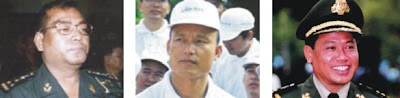
Left to Right: Hing Bun Heang, Sao Sokha and Mol Roeup (Photos: Global Witness)

Source: Human Rights Watch

I. Summary

Relations between the US and Cambodia have warmed considerably since the US withdrew direct aid to the Cambodian government in 1997, after a coup by the Cambodian People's Party (CPP) of Prime Minister Hun Sen against their coalition government partner, the FUNCINPEC party.

In addition to deeply entrenched impunity for human rights violators, other key human rights issues include the lack of integrity and independence within Cambodia's court system, attacks on freedom of expression and pluralism, and the government's chronic inaction on legal reform. Those who speak out to defend their homes, their jobs, and their rights increasingly face threats and physical attacks, including trade union leaders, opposition party members, journalists, activist Buddhist monks, and community activists defending their land and natural resources.

In addition, the gap has widened between wealthy city dwellers and impoverished farmers in the countryside, exacerbated by large-scale forced evictions of tens of thousands of urban poor, illegal confiscation of farmers' land, and pillaging of the natural resources on which people in the countryside depend for their livelihood. Military units are often wrongfully deployed to carry out forced and violent evictions of villagers whose ownership claims to the land have never been properly or fairly dealt with by a court.

To make matters worse, the Cambodian government announced this week that it is terminating the World Bank's $24 million land titling program after the Bank and key donors, including the United States, called on the government to stop forced evictions until fair and transparent land dispute and resettlement policies are in place.

While Cambodia has experienced significant economic growth during the past 16 years, the government has rejected a rights-based approach to development. Economic growth would have been much greater if the rule of law would have been established and voracious corruption by Prime Minister Hun Sen and those around him had not drained so many resources from the country.

In October 2008 the US announced that it would be making its first financial contribution (US$1.8 million) to the hybrid trial of former Khmer Rouge leaders (the Extraordinary Chambers in the Courts of Cambodia), which has been plagued by credible reports of corruption and government interference and manipulation. Ongoing statements by Prime Minister Hun Sen calling for the court not to engage in additional prosecutions seriously undermine the court's integrity, independence, and credibility. In helping Cambodia to address legacy issues lingering from the Indochinese wars, the US should be at the forefront of advocacy with the UN, other donors, and the Cambodian government itself in insisting that Cambodians deserve the highest standards of justice for the crimes committed by the Khmer Rouge.

With the resumption of direct government aid, the US has begun to send mixed signals as to how seriously it takes Cambodia's legacy of impunity, political violence, and high-level involvement of government officials in human trafficking and other rights violations. US funding currently includes training and material assistance to members and units of the Royal Cambodian Armed Forces that have been implicated in gross human rights abuses. It has strong counter-terror cooperation with some of the same individuals. The FBI has even given awards to some of the most notorious human rights abusers in the country, making many Cambodians wonder which side the US is on.

As one of the signatories to the 1991 Paris Peace Accords, one of Cambodia's biggest donors, and with great influence in Cambodia, the US should play a consistent role in insisting that Cambodia address its poor human rights record. The US government has to remember that its first priority is to stand with the Cambodian people. Good relations with the Cambodian government are a secondary priority.

II. The US and the Cambodian Security Forces - Impunity and Vetting

The US has provided training, material assistance and even awards to military, police, counter-terror units or related individuals with track records of serious human rights abuses. Since 2006, the US has provided approximately US $4.5 million worth of military equipment and training to Cambodia through the Foreign Military Financing program.

Training has been offered to elite units that are notorious for the impunity enjoyed by their members, as well as to personnel from Prime Minister's Hun Sen's bodyguard unit, which has been implicated in countless rights abuses including a political massacre, under the cover of a newly-created special anti-terrorist unit. The US has given the impression that it has forgotten or lost interest in the human rights record of some of these units or individuals.

While the US may have policy reasons to work with the Cambodian security forces on subjects such as counter-terror, it should work just as hard on holding abusers accountable and ending the culture of impunity that exists for high ranking members of the security services and those close to Hun Sen.

a) Prime Minister's Bodyguard Unit/Brigade 70 and New Counter-Terrorism Special Forces

Hun Sen's Bodyguard Unit, also known as Brigade 70, has a long history of impunity for its personnel who commit crimes, and well-documented involvement in smuggling and environmental crimes. Soldiers from Hun Sen's Bodyguard Unit, Brigade 70, were implicated in the March 30, 1997 grenade attack against the opposition Khmer Nation Party (now the Sam Rainsy Party), protecting the grenade throwers and allowing them to escape. At least 16 people were killed and more than 100 others (including an American) were wounded. The results of an FBI investigation into the attack found that the Bodyguard Unit was complicit in it, but the full results of the investigation have never been made public.

Outside of the normal RCAF chain-of-command, Brigade 70 is controlled directly by the Prime Minister. Reportedly comprising some 2,000 or more soldiers, the Bodyguard Unit was long commanded by General Hing Bun Heang, who is now deputy chief of the Prime Minister's Cabinet and reportedly remains in de facto control. The Bodyguard Unit has been implicated in political violence, most notably in a 1997 grenade attack on an opposition party rally. The Bodyguard Unit, mobilized outside of the normal chain-of-command of RCAF, also played a key role in fighting FUNCINPEC troops on the streets of Phnom Penh during CPP's July 1997 coup. In subsequent years, UN and NGO rights workers investigated several cases of individuals being unlawfully detained and tortured at the Bodyguard Unit's headquarters inside the Prime Minister's heavily-fortified residential compound. On or off duty, Brigade 70 personnel enjoy virtually unlimited impunity to commit.

Brigade 70 has an atrocious human rights record. Impunity enjoyed by its members is highlighted in the US State Department's annual human rights reports. In addition to the grenade attack, there are countless examples over recent years. A few examples include:
  • In July 2008, Brigade 70 soldier Dy Sothearith, moonlighting as a security guard at a factory, shot an unarmed factory worker over a minor dispute. The victim was paid $1,000 in compensation, on the condition he not pursue a criminal complaint. Dy Sothearith, who reportedly went into hiding at B-70's HQ, was not prosecuted.
  • In April 2006, Brigade 70 members Major Phat Sophal and Captain Sim Ry opened fire and shot a waitress whom they complained had brought them ice too slowly. Arrested by military police, the two were released hours later when their commander Mao Sophann intervened. The general subsequently said he punished the two officers by shaving their heads. No legal action was taken against them.
  • In July 2005, Brigade 70 member Sen Kok Heang, a former in-law to Prime Minister Hun Sen, attempted to kill two forestry activists in Kampong Thom's Sandan district. Brigade 70 soldiers were mobilized in that area to give protection to a Cambodian logging syndicate in the area.
  • In addition, B-70 has long been implicated in smuggling and the pillaging of Cambodia's environment; there is considerable evidence that cargo trucks belonging to the unit have systematically been used to transport illegally-felled logs and smuggled goods. In 2007, environmental watchdog Global Witness estimated B-70 was making between $2 million and $2.7 million from these operations, with a large cut of the proceeds given to Bodyguard Unit commander Hing Bun Heang.
b) Special Airborne Brigade 911

Brigade 911 has been implicated in gross human rights violations (including murder and torture) allegedly committed by brigade soldiers in the past. Paratroopers from 911, under the command of Major-General Chap Pheakdey, have been accused of gross human rights violations. In 1997, 911 personnel were implicated by UN investigators in the executions of FUNCINPEC military commanders captured during the CPP's coup, and the torture of other prisoners. No-one was brought to justice for these crimes. 911 members, disguised in civilian clothes, were also allegedly used to break up peaceful post-election demonstrations by the opposition in 1998. Subsequently, 911's commander Chap Pheakdey has maintained his reputation for acting with impunity. In 2006, he unlawfully detained one of his soldiers for more than a month, allegedly over a property dispute; no prosecution or other sanctions were taken against the general.

c) Brigade 31

Some material assistance has gone to military units with abysmal rights records. The commander of Brigade 31, for example, has confirmed that his unit used US-donated trucks to move villagers forcibly evicted by soldiers under his command in Kampot Province in 2008.

Brigade 31 (formerly known as Division 44 and then Battalion 44), under its long-time commander Brigadier-General Srun Saroeun, has an abysmal rights record. Its soldiers are alleged to have executed FUNCINPEC soldiers during the 1997 coup and fired gunshots over the heads of UN human rights officials investigating the killings. Headquartered in Kampong Speu province, the brigade has also long been accused of involvement in illegal logging throughout southern Cambodia. In recent years, its commanders have also been implicated in grabbing land from poor villagers. This raises serious questions about the quality of vetting done by the State and Defense Departments.

Brigade 31 assumed a "maritime security" mandate in late 2006 or early 2007 - the same time as an October 2006 joint defence assessment by RCAF and the US Pacific Command which identified maritime security as one of the areas for US support. This raises the question of whether RCAF deliberately gave the brigade a naval mandate in order to obtain US assistance. If so, this is a clear case of a military unit with a poor human rights record (but a record of loyalty to the ruling party) being rewarded and legitimized by US aid. Although US military aid is intended to improve the professionalism of RCAF forces, there are disturbing signs that RCAF is becoming more politicized and less professional, and that known human rights abusers are gaining increasing power within the RCAF structure. For example, General Huy Piseth, now an Undersecretary of State in the Ministry of Defense, is former commander of Brigade 70. In January 2009 the government announced the appointment of seven new deputy RCAF commanders-in-chief, including military intelligence chief Mol Roeup; military police chief Sao Sokha; and Hing Bunheang, Brigade 70 deputy commander at the time of the 1997 grenade attack. All of these men have clear records as human rights abusers.

Labels: , , ,


» Read more!

US Representatives' letter to Defense Secretary Robert Gates questioning the US military assistance to Cambodian "human rights VIOLATORS"

Congress of the United States
Washington DC 20515
September 18, 2009

The Honorable Robert M. Gates
Secretary of Defense
The Pentagon Room 3E 880
Washington DC 20301

Dear Secretary Gates:

We write today to bring to your attention concerns regarding U.S. assistance in the form of Foreign Military Financing (FMF) to the Kingdom of Cambodia. As you know, the United States has provided approximately $4.5 million in FMF used for training and material assistance to Cambodian military, police, and counterterror units since 2006. According to testimony from Human Rights Watch at a Tom Lantos Human Rights Commission hearing on September 10, such training and assistance "has been offered to elite units that are notorious for the impunity enjoyed by their members, as well as to personnel from Prime Minister Hun Sen's bodyguard unit which has been implicated in countless rights abuses including a political massacre, under the cover of a newly created special anti-terrorism unit."

While the United States should work with foreign governments to professionalize and train security forces to respect human rights and the rule of law, we must ensure that such assistance and training is not awarded to members of the security forces that have committed serious human rights violations and continue to operate with impunity.

Enclosed please find the testimony of Human Rights Watch which was submitted for the record and details serious abuses by members of the Prime Minister's Bodyguard Unit, Brigade 70, Special Airborne Brigade 911 and Brigade 31 of the Royal Cambodian Armed Forces (RCAF).

Given the nature of the abuses detailed in the enclosed testimony, we ask that the Department of Defense please provide answers to the following questions:

* What U.S.-funded training has been provided to RCAF's Special Airborne 911, RCAF's Brigade 70 and the Prime Minister's Bodyguard Unit?
* Have members ofRCAF's Special Airborne Brigade 911, Brigade 70, or members of the Prime Minister's Bodyguard Unit traveled to the United States to receive U.S.-government funded training or on other official business? If so, what was the purpose of the travel? What vetting procedures were used before they traveled?
* What equipment or other material support has been provided by the U.S. government to Special Airborne Brigade 911, Brigade 70, the Counter-Terrorism Task Force, the Prime Minister's Bodyguard Unit, or any other security services?
* What U.S.-funded training has been provided to Cambodia's National CounterTerrorism Committee, the National Counter Terrorism Task Force and the Counter-Terrorism Special Forces Unit?
* How many members of the Counter-Terrorism Special Forces unit come from the Prime Minister's Bodyguard Unit? Do they retain their positions at the Bodyguard unit?
* What actions have been taken to establish the identities of the Bodyguard unit personnel who were present during the March 30, 1997, grenade attack against the opposition Khmer Nation Party, and to ensure that these individuals are not included in any U.S.-sponsored training of RCAF forces?

Thank you for your attention to this important matter. We look forward to receiving your response.

Best wishes.

Sincerely,

Signatures of the following US Members of Congress:

Frank R. Wolf
James P. Moran
Edward R. Royce
Maurice D. Hinchey
Tammy Baldwin
Mark E. Souder
Christopher H. Smith
Niki Tsongas

---Original Attached

Labels: , ,


» Read more!

Thursday, September 17, 2009

Cambodia deploys police for Thai border protest


Source: AFP

PHNOM PENH — Cambodia deployed riot police Thursday at an ancient temple on the disputed border with Thailand where Thai protesters are due to hold a protest at the weekend, the defence ministry said.

Thailand's royalist "Yellow Shirt" movement says it will rally on Saturday near the 11th century Preah Vihear temple to demand that the government push Cambodian forces out of the area.

The disputed frontier around the temple has been the scene of several deadly clashes between Thai and Cambodian forces since the ruins were granted UN World Heritage status in July 2008.

Cambodian defence ministry spokesman Chhum Socheat said at least 50 police with dogs, batons, and tear gas have been deployed at the temple ahead of the demonstration.

More...

Labels:


» Read more!

Testimony finishes at Cambodian Khmer Rouge trial

Testimony finishes at Cambodian Khmer Rouge trial


PHNOM PENH, Cambodia — Testimony concluded Thursday in the first U.N.-backed trial of a high-ranking member of Cambodia's former Khmer Rouge regime.

The tribunal is trying Kaing Guek Eav, also known as Duch, who commanded S-21 prison in Phnom Penh, where up to 16,000 people were tortured and then taken away to be killed. He is charged with crimes against humanity, war crimes, murder and torture.

Four other senior Khmer Rouge leaders are in custody awaiting trial.

The tribunal is seeking justice for an estimated 1.7 million people who died from execution, overwork, disease and malnutrition as a result of the ultra-communist group's policies while in power in 1975-79.


More...

Labels:


» Read more!

Tuesday, June 23, 2009

Cambodian opposition MPs stripped of parliamentary immunity

Cambodian opposition MPs stripped of parliamentary immunity

Cambodia's opposition says it's under attack because of what it describes as a new round of politically motivated lawsuits and a vote by the National Assembly which has resulted in two opposition MPs being stripped of their parliamentary immunity.

Mu Sochua, former Cambodian minister of women's affairs, and Ho Vann, a Phnom Penh municipality representative, had their immunity lifted after a single show-of-hands vote by the National Assembly. They both face defamation lawsuits in Cambodia's notoriously corrupt courts.

Presenter: Liam Cochrane
Speaker: Mu Sochua, Cambodian opposition MP

COCHRANE: High profile opposition MP Mu Sochua has been locked in a battle of lawsuits with Cambodia's Prime Minister Hun Sen for some weeks now.

But, now that the National Assembly has voted to remove the Parliamentary immunity from Mu Sochua and her fellow party member Ho Vann, effectively, the gloves are off...

SOCHUA: The procedures where the most undemocratic because we were not allowed a chance to speak at all and there was a vote by raising of hands, lifting immunity of two members of parliament at the same time in one vote.

COCHRANE: Let's deal with them separately, why was your immunity lifted?

SOCHUA: My case is from a lawsuit by the Prime Minister against me for defamation. The Prime Minister pointed very clearly at me when he went to my constituency and talked about a number of parliament, a women from the opposition party and called me by a name that is not acceptable to call me, he called me a hustler. Second he said that I went and grabbed men and thirdly it was related to meetings that I went to and I was not allowed to go in, and he said that I had a very thick skin. And fourth, which is very, very serious is that I incite my constituents and people against the government.

COCHRANE: And can you tell me about the other member of parliament whose immunity was lifted? Who was that and why was the immunity lifted?

SOCHUA: My colleague, Mr Ho Vann is a member of parliament elected in the municipality of Phnom Penh. He made a comment by responding to the media about honorary degrees that were received by some military officials. His comment was that he didn't think that these degrees were valuable, but if they were valuable then the quality of degrees should allow the numbers of the armed forces to help and then to protect the nation.

COCHRANE: Without parliamentary immunity you face the court as an ordinary citizen, what chances do you think you'll have of finding justice at the court?

SOCHUA: The chance of me getting justice is very close to zero.

COCHRANE: Mu Sochua you've said previously that you would rather go to jail rather than pay a fine if you are found guilty of this defamation charge. Are you still feeling that same way?

SOCHUA: Definitely I am very determined to face the court and I will not be surprised if the court finds me guilty. My stance will not change, I am ready, my conscience is clear about wanting justice, wanting a judicial system that can protect citizens of Cambodia. So I am ready, I am preparing to go to jail.

COCHRANE: There are rumours around at the moment that you are about to flee the country or you may have already fled the country. Is there any truth to those rumours?

SOCHUA: I have always been very transparent that I am not fleeing the country. I came back to Cambodia in 1989, I have never gone back to America to live. My country is Cambodia, I said from the very beginning that I will not flee, I will come back to face the courts.

COCHRANE: Mu Sochua, just finally, this is not the first time this sort of thing has happened. In the past opposition leader Sam Rainsy and Cheam Channy and others have had their immunity stripped, and in Cheam Channy's case gone to jail. Do you think this is a political action against you.

SOCHUA: Yes it's a political action against the opposition. Cambodia is walking more than one step backwards, democracy in Cambodia is in real jeopardy. I think the world community cannot ignore this and especially the government of Australia. What is Australia doing when democracy in Cambodia is facing such a serious set of going back to dictatorship?

COCHRANE: A representative from Cambodia's National Assembly was not available for comment on the issue.

Labels: , , ,


» Read more!

Saturday, June 20, 2009

Cambodia rebukes Thailand

Cambodia rebukes Thailand


Minister Hor Namhong (left) gestures with repeated comments made by top Thai government officials over the complaint to withdraw Preah Vihear temple from World Heritage site. --PHOTO: AP

PHNOM PENH - CAMBODIA on Saturday rebuked Thailand for reopening a debate over an ancient temple on their disputed border that has led to seven soldiers being killed.

High-ranking Thai officials this week asked world heritage body Unesco to reconsider its decision to formally list the 11th century Preah Vihear temple, as ownership of land surrounding the ruins is still in dispute.

Soldiers from Cambodia and Thailand continue to patrol the area and occasional outbreaks of violence between them have triggered gunbattles that have killed seven troops in the past year.

But Cambodian Foreign Minister Hor Namhong told reporters that soldiers would be ready to defend their land again if necessary.

'Cambodia welcomes Thailand militarily, diplomatically, internationally or through peaceful negotiations,' Hor Namhong said.

'(But) it (border fighting) has happened twice... (so) if they want to send their troops to Cambodia a third time, we will welcome them too,' he said.

Thai Prime Minister Abhisit Vejjajiva made a one-day visit to Cambodia last week in an attempt to push forward border talks, but his subsequent comments only appear to have reignited the dispute.

'I heard that the second Thai commander on the border put his troops on alert and I'd like to tell them that Cambodian soldiers are also on alert,' Mr Hor Namhong added.

Cambodia and Thailand have been at loggerheads over the land around the Preah Vihear temple for decades, but tensions spilled over into violence last July when the temple was granted UN World Heritage status.

The border between the two countries has never been fully demarcated, in part because it is littered with landmines left over from decades of war in Cambodia. -- AFP

Labels: , , , ,


» Read more!

SRP WILL NOT REPLACE MU SOCHUA

SRP WILL NOT REPLACE MU SOCHUA


June 20, 2009

While pushing for the lifting of Mu Sochua’s parliamentary immunity, Prime Minister Hun Sen has been suggesting that she be replaced as a National Assembly member at the initiative of the opposition Sam Rainsy Party.

On behalf of the SRP, I can assure the Cambodian people and all Cambodia’s friends that Mu Sochua’s seat at the National Assembly will remain hers until the end of her legal term and that no replacement will be appointed.

Mu Sochua is the victim of an injustice. Hun Sen wants to eliminate her from Cambodia’s political landscape. It is a blatant abuse of power that is only possible with a subservient judiciary and a rubber-stamp parliament.

Replacing Mu Sochua would be like politically burying her alive and complying with Hun Sen’s insane desire.

When, in 2005, Cheam Channy, another SRP National Assembly member, was stripped of his parliamentary immunity and subsequently put in jail following a trumped-up criminal charge, there were also suggestions that he be replaced. But it was clear to us that replacing Cheam Channy would mean that we would accept the injustice done to him, let our colleague down, contribute to his political elimination and compound a personal tragedy. We proudly accepted to temporarily and practically lose a seat, a voice and a vote at the National Assembly.

We were right to stick to our principles. In 2006, Cheam Channy was released from prison, his immunity restored, and he recovered his seat at the National Assembly.

We are confident that adopting a similar position in the case of Mu Socha now is the right thing to do.

The same observations apply to the case of countless SRP-affiliated elected commune councilors, including commune chiefs, who have been arrested and sent to jail for politically-motivated charges. For instance, Mu Sochua’s case cannot be dissociated from the case of Tuot Saron, the SRP-affiliated elected chief of Pong Ro commune in Kampong Thom province’s Barai district. Tuot Saron is currently and unjustly in jail. But he will not be replaced. We will do all we can to help free him and to re-install him as commune chief as we are fighting to render justice to Mu Sochua.

Sam Rainsy
Member of Parliament
SRP President

Labels: , , ,


» Read more!
October 1997
January 2005
February 2005
March 2005
April 2005
May 2005
June 2005
July 2005
August 2005
September 2005
October 2005
November 2005
January 2006
February 2006
March 2006
April 2006
May 2006
June 2006
July 2006
August 2006
September 2006
October 2006
November 2006
December 2006
January 2007
February 2007
March 2007
April 2007
May 2007
June 2007
July 2007
August 2007
September 2007
October 2007
November 2007
December 2007
January 2008
February 2008
March 2008
April 2008
May 2008
June 2008
July 2008
August 2008
September 2008
October 2008
November 2008
December 2008
January 2009
February 2009
March 2009
April 2009
May 2009
June 2009
September 2009
October 2009
November 2009
December 2009
January 2010
February 2010
March 2010
April 2010
May 2010
June 2010
July 2010
August 2010
September 2010
October 2010
November 2010
January 2011
February 2011
March 2011
April 2011
May 2011
June 2011
July 2011
August 2011
September 2011
October 2011
November 2011
December 2011
July 2012
August 2012
September 2012
October 2012
November 2012
November 2013
December 2013
January 2014
March 2014
April 2014
May 2014
July 2014
September 2014
January 2015
February 2015
September 2015
October 2015
August 2016
September 2016
March 2018

Subscribe to
Posts [Atom]

Powered by Blogger


 Home   |   About Us   |   Submit URL or Your Company Address First Launched: 08/15/95 - Copyright © 2010 Cambodian Information Center. All rights reserved.