Editorial | Articles about Cambodia | Khmer

Wednesday, June 11, 2008

Statement form the Cambodian Club of Journalists condemning Dam Sith's arrest

Dam Sith (in blue shirt), Moneaksekar Khmer Editor, seen escorted by military police officers at the Phnom Penh municipal court
Dam Sith brought to the Phnom Penh municipal court by plainclothed and unirformed military police officers
Large contingent of military police presence in front of the Phnom Penh municipal court
Scene in front of the Phnom Penh municipal court
Several SRP MPs (Saumura Tioulong, Eng Chhay Eang) were also seen in front of the Phnom Penh municipal court

Statement form the Cambodian Club of Journalists condemning Dam Sith's arrest

09 June 2008
By Sopheak
Moneaksekar Khmer

Translated from Khmer by KI-Media
Source: KI-Media

Civil society, journalist Associations, as well as SRP MPs have all criticized the Phnom Penh municipal court for issuing a warrant to the military police force to arrest Dam Sith, the editor of Moneaksekar Khmer newspaper, at around 11:00 AM on 08 June while the latter was washing his car. Dam Sith’s arrest is a serious threat on the freedom of the press, and it is also a political threat during the approaching general election.

Eng Chhay Eang, SRP Secretary-general and SRP MP from Battambang province, told reporters that, according to the press law, this should not be a criminal arrest.

Eng Chhay Eang said that Dam Sith’s arrest was done to silence and threaten those who dare criticize the ruling CPP party, and that this act is a serious violation of the freedom of expression, just before the upcoming election.

Eng Chhay Eang added that, by what he understood, several CPP hot shots tried to attract Dam Sith and buy him out, but Dam Sith refused to sell himself, his conscience, and Dam Sith is still devoted his own conscience and will, this is why the ruling CPP party uses the pretext of defamation and disinformation charges to arrest him.

Eng Chhay Eang said that Dam Sith’s arrest was done based on a arrest warrant issued by Judge Chhay Kong from the Phnom Penh municipal court, and the warrant was served by the military police with Dam Sith’s arrest on 08 June, however, this arrest is a violation of the law.

Eng Chhay Eang told reporters that, by what he knows, Dam Sith was arrested under the charge of defamation, cursing and disinformation. He said that the ruling CPP party is using the court as its tool to fight its competitors, and that this constitutes a psychological threat against Dam Sith after CPP hot shots were not able to pull him over to the CPP, in spite of their promise to provide him a (high) position in the government in exchange for his defection.

Eang Chhay Eang said that Dam Sith’s arrest under the defamation and disinformation charges is a psychological threat because the National Assembly brought an amendment to the law to eliminate these cases from the criminal law, and no journalist should be jailed for writing articles construed as defamation and disinformation. The maximum such charges can bring is a fine on journalists whom the court found guilty.

Eng Chhay Eang said that the arrest warrant against Dam Sith is a violation of the law, and that Judge Chhay Kong violates the law and threatens the freedom of the press. Eng Chhay Eang asked that the Phnom Penh municipal court to release Dam Sith and to properly pursue the legal case, the court should not issue a warrant to arrest Dam Sith. Furthermore, the police should return back Dam Sith’s confiscated Toyota Highlander SUV bearing the license plate PP 2I-1899 to his family, because this is not a criminal case or a robbery case at all, it is only a defamation case. However, Sao Sokha, the military police chief, said that this decision is up to the court.

Eng Chhay Eang indicated that Dam Sith’s arrest affect the voters for the upcoming election because Dam Sith supports the SRP and he is also a SRP MP candidate for the city of Phnom Penh as well.

Chan Soveth, an investigating official for the Adhoc human rights organization, regrets to see Dam Sith being arrested, and he said that the arrest does not look regular at all. Chan Soveth added that Dam Sith was charged with defamation and disinformation based on Hor Namhong’s lawsuit, and he was arrested on a Sunday, therefore, this is a threat on the freedom of journalists.

Chan Soveth said that Dam Sith’s arrest is a serious violation on human rights, and it poorly reflects on the freedom of journalists. He added that Dam Sith was coaxed by a number of CPP officials to join the CPP, and he said that Dam Sith’s arrest may be politically motivated because the Moneaksekar Khmer newspaper supports the SRP.

Chan Soveth also said that if Dam Sith was arrested because he refused to join the CPP, his arrest would be very unfair and it would constitute a political threat.

Immediately after Dam Sith’s arrest at 11:00 AM on 08 June 2008, 2 journalist associations: the Association of Journalists Watchdog and the Association of Democratic Journalists of Cambodia, issued a joint statement saying that they regret seeing the military police force arresting Dam Sith based on the warrant issued by Judge Chhay Kong.

The two associations indicated in its joint statement that the arrest warrant against Dam Sith violates the law because the National Assembly amended the law to remove defamation cases from the criminal law, therefore, no journalist should be arrested for defamation, cursing or disinformation. The 2 journalist associations called Dam Sith’s arrest a serious threat on the freedom of the press, and they call on Judge Chhay Kong to review the case in order to release Dam Sith back. On Sunday evening, the Phnom Penh municipal court decided to detain Dam Sith temporarily even though the court was being heavily criticized by local and international observers for this serious violation of the law. On Monday 09 June, most likely, several embassy officials from major countries will intervene on behalf of Dam Sith because the SRP had already informed a number of donor countries about this case. Dam Sith’s arrest and detention is political as he is the editor of an opposition newspaper and also a SRP MP candidate for the city of Phnom Penh.

Kom Sam On, Dam Sith’s defense lawyer said that the detention of Dam Sith for defamation and disinformation stems from the fact that he was quoting opposition leader Sam Rainsy who said that Hor Namhong was the former Boeng Trabek jail chief under Pol Pot’s regime. The disinformation charge still leads to imprisonment according to the law, but he said that in his defendant case, just under the prosecutor charges, Dam Sith was immediately sent to jail. As for the defamation charge, no one indicated which sentence in the article touched upon the defamation case, nobody provided any clarification at all.

Dam Sith’s defense lawyer Chung Choungy claimed that the charges brought against his defendant stem from the accusation raised by Ka Savuth, Hor Namhong’s lawyer. However, Chung Choungy said that his defendant detention is not correct because, according to his study of this case, there is no disinformation reported at all, the article was merely quoting Sam Rainsy’s words.

Labels: , ,


» Read more!

Wednesday, June 04, 2008

Obama Closes in on Democratic Nomination

CNN


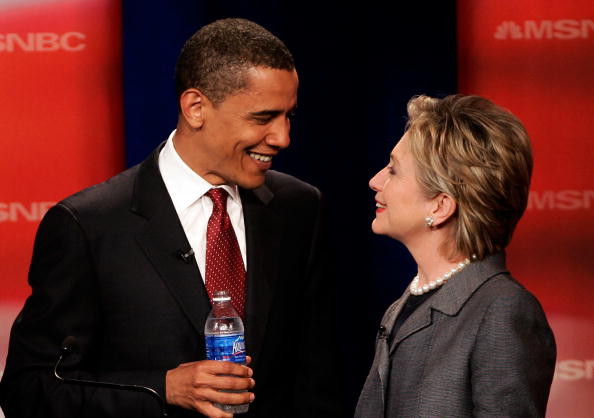
WASHINGTON (CNN) -- Sen. Barack Obama inched closer to the Democratic nomination Tuesday as endorsements from superdelegates trickled in.

Thirty one delegates are at stake in the final contests under way in South Dakota and Montana. Obama is now six delegates short of the 2,118 needed to clinch the Democratic presidential nomination, according to CNN's count.

Obama would become the first African-American to lead a U.S. major-party ticket.

His remaining rival, Sen. Hillary Clinton, does not plan to concede the race Tuesday night, campaign chairman Terry McAuliffe told CNN -- but one of her leading supporters said "a moment of truth" was at hand.

"I think a decision has to be made about whether keeping this nomination wide open is in the best interest of winning in November," said Sen. Dianne Feinstein, D-California.

"I do not believe that it is, and I'm a very strong supporter of Hillary being placed on ticket as a vice presidential candidate."

Two New York lawmakers told CNN on Tuesday that Clinton expressed willingness during a conference call to serve as Obama's running mate in November.

One of the lawmakers said Clinton's husband, former President Bill Clinton, has been pushing the idea privately for several weeks. And earlier, Rep. Charles Rangel, D-New York, told CNN, "I have reason to believe she is open to the V.P. slot."

But in a statement issued Tuesday afternoon, her campaign said there was nothing new in her remarks.

"Today on a conference call with New York legislators, Sen. Clinton was asked whether she was open to the idea of running as vice president and repeated what she has said before: She would do whatever she could to ensure that Democrats take the White House back and defeat John McCain," the former first lady's campaign said in a written statement Tuesday afternoon.

Even though she discussed being Obama's running mate, McAuliffe earlier in the day said Clinton was "absolutely not" prepared to concede the race after the polls close tonight in Montana and South Dakota, the final two contests on the primary calendar.

McAuliffe rejected as "100 percent" incorrect an Associated Press report that Clinton is preparing to acknowledge Obama has the delegates to win the nomination Tuesday night as the five-month Democratic primary process comes to a close.

Obama "doesn't have the numbers today, and until someone has the numbers the race goes on," McAuliffe told CNN.

Superdelegates are the approximately 800 Democratic party leaders and officials who vote in the delegate nominating process. Around 200 of them have yet to endorse either Obama or Clinton.

Former President Jimmy Carter and Rep. James Clyburn, the No. 3 Democrat in the House and the highest ranking African-American in Congress, were two of the most prominent superdelegate endorsements that Obama picked up. Video Watch Clyburn endorse Obama »

"I came to that decision because I do believe that he has elevated this campaign," Clyburn said. "He has energized our constituents. He is redrawing an electoral map for Democrats."

Obama is holding a rally at the Xcel Energy Center in Saint Paul, Minnesota, the same arena which will house the 2008 Republican National Convention in September. Clinton will spend the evening at a campaign event in New York City. iReport.com: See what cartoonists think of the interminable race

Obama is looking more and more toward a likely general election matchup with John McCain, the presumptive GOP presidential nominee. And while not taking anything for granted, it appears he's starting to look at Clinton as less of a rival and more as an important ally who can help him win in November.

"We're getting very close to the number that will, that will give us the nomination and if we've hit that number on Tuesday night, then we will. We will announce that and I think even if we don't, this is the end of the primary season, and I think it's very important for us to focus on the clear contrast that's going to exist between Democrats and Republicans in this election," Obama said this weekend while campaigning in South Dakota.

"Sen. Clinton is an outstanding public servant, she has worked tirelessly on this campaign, she has been a great senator for the state of New York and she is going to be a great asset when we go into November to make sure that we defeat the Republicans," Obama said on the campaign trail Sunday in South Dakota, adding Monday in Michigan that "she and I will be working together."

Labels:


» Read more!

Tuesday, June 03, 2008

Real Estate Boom in Cambodia's Capital

Real Estate Boom in Cambodia's Capital

A decade ago, Phnom Penh didn't even have a traffic light. Now, high-rise condos and offices are in development and land speculators are raking in profits

At a construction site in the middle of the city, a yellow backhoe levels rubble left from the previous building, an old hospital, while dozens of workmen in hard hats and rubber boots scrape away at the dirt. Nothing that noteworthy about this scene—until you consider the location: the intersection of Monivong and Sihanouk Boulevards, in downtown Phnom Penh.

After spending most of the past three decades struggling to recover from the legacy of the Khmer Rouge's genocidal rule, Cambodia is in the midst of a real estate boom. If all goes as planned, the dirt at Monivong and Sihanouk will soon sprout the country's first skyscraper, a 42-story residential building funded by money from South Korea. A few kilometers away, near the river, workers are clearing a lot for another skyscraper, also Korean and even bigger, with 52 stories.

A decade ago, Phnom Penh lacked even a single traffic light. Today, as land speculators rake in profits and new developments lure tenants, the dilapidated capital, which until recently was dotted with dangling electric wires and garbage-strewn lots, is getting a makeover. All over the city, shanty towns and old villas are being sold for land value and razed to make way for high-rise apartments, office buildings, shopping malls, and new villas.

Other parts of the country are seeing development, too. Developers are targeting Siem Reap (BusinessWeek.com, 4/21/08), near the ancient temples of Angkor Wat, for new hotels.

Does Cambodia Need Skyscrapers?

The Phnom Penh skyscrapers, which will be more than three times higher than the tallest existing building in Cambodia, are the most dazzling projects. And the most controversial. The developer of the $240 million Gold Tower 42, Yonwoo Co., expects construction to take three and a half years to complete. Already, says Teng Rithy, sales manager for Gold Tower 42, "high-ranking Cambodians and some foreigners from other Asian countries" are plunking down deposits. "We are 80% sold out," he boasts.

Not everyone is convinced the skyscrapers make sense. Many lawyers, bankers, and real estate brokers in the Cambodian capital are wondering whether the skyscrapers will really go up and whether there is demand for new construction. So far, new buildings are not having trouble leasing, since the city suffers from a shortage of modern office space. Tenants like the World Bank lease space in rabbit-warren-like villas with odd hallways leading in all directions.

But residential skyscrapers are a new concept in a country that not too long ago was still giving away property, not trying to market a 40th-floor condo for $1.6 million. "I feel it's a little bit early for that," says Sung Bonna, head of Bonna Realty, one of the leading real estate firms in Cambodia. "They said it's going to be a success. But I don't know. If it doesn't happen, it is not good for us."

Bonna says the whole idea of a real estate market in Cambodia is so new that no one can predict how it will turn. "We used to share property, not sell it. After the Pol Pot regime, however many properties you want, you can take all of them." He says there is a need for more modern restaurants, office buildings, and commercial centers, but the supply and demand for residential properties is in balance.

Korean Connection

For now, though, there are promising signs. Prime Minister Hun Sen—whose government at one point or another signs off on the big development deals—likes the skyscrapers and he wants more of them, according to his aide, Sry Thamarong. And land prices are hot. A traditional shop house—4 meters wide by 18 meters deep and going up four to five floors—along the river that sold in 2006 for $300,000 is now going for $600,000 to $700,000. But this is still much cheaper than Ho Chi Minh City in Vietnam, the real estate agents say.

Since Cambodia is still a very poor country that has never seen so much investment capital flying around, the trend is unnerving some observers. "Where is the money coming from? Cash coming out from under the mattresses, cash coming from overseas," says John Brisden, vice-chairman of Acleda Bank, the largest bank in Cambodia. He calls the real estate boom "very unusual" because much of it is not being financed by bank loans. Are there signs that the boom may be running its course? Brisden doesn't see a sudden popping of the bubble. Instead, he says, "people envision a slowdown. The scenario is a lot of empty high-rise properties but no forced sales."

Most of the big new projects are coming from Korea. Financing the Gold Tower 42 skyscraper is Korea's DaeHan Real Estate Investment Trust. Yonwoo is the developer. A director at Yonwoo in Seoul, who asked not to be named, says his company began exploring real estate development opportunities in emerging economies three years ago, when Korea's domestic construction market began cooling. "In view of a number of wealthy Cambodians and a growing number of foreign investors arriving in Cambodia, we are confident Gold Tower 42 will be a success," the director says. Phnom Penh-based salesman Rithy says there are "high-ranking Cambodians" involved in the project, but he won't say who.

Investors Face Legal Hurdles

The 52-story skyscraper announced in January is a project of Korea's GS Engineering & Construction. The Seoul company plans to start construction in June and finish in 2012. A 34-story project near the Russian embassy will have serviced residences for 280 households and several floors of apartment blocks on top, as well as shopping and an international school, according to GS spokesman Choi Byoung Geun. "Cambodia really needs this kind of Class A facility," says the business development chief in Cambodia, Mu-Hion Woo, who figures by the time the $1.2 billion project is built, the demand will be there.

A Korean developer is also behind Camko City, a new suburb northwest of Phnom Penh with a $2 billion price tag that is in the early stages of development. World City, the property developer, began construction last June and is scheduled to complete the first phase by November, 2009, according to Korean contractor Hanil Engineering & Construction, the Seoul-based company that is also the contractor for Gold Tower 42.

There are some legal hurdles for potential investors to overcome. For instance, foreigners are not allowed to own real estate outright in Cambodia. But there are plenty of ways to get around the law. Foreign investors can set up a joint venture with Cambodian partners, use long-term leases, or put the land in the name of Cambodian partners. There's even the possibility of becoming Cambodian. "With an investment of a certain size, you can get citizenship. It's a contribution to the country," says Matthew Rendall, a lawyer with Sciaroni & Associates, a law firm in Phnom Penh.

Evictions in the Name of Development

National Assembly lawmaker Sam Rainsy, a former Finance Minister and leader of the largest opposition party, calls many of the real estate deals "shady." He argues that Cambodia is awash in illegal cash plundered from the sale of national assets, including illegal logging and the sale of public lands, where land titles are easily changed and the sales revenues never get accounted for in the state budget.

And there has been a social cost to all the new development. The scramble for prime land has led to widespread evictions of people without clear land titles to the properties. A report by human-rights group Adhoc in Phnom Penh says in 2006 and 2007 more than 50,000 people were evicted for development. Chan Soveth, program officer at Adhoc, says he expects 4,252 families in Phnom Penh to be evicted from villages surrounding Boeng Kak, a lake in the city where a developer wants to build a new township that will have condos, a hotel, and shopping. "It is very bad and getting worse," says Soveth. Adds human-rights lawyer Am Sam Ath of the nongovernmental organization Licadho: "There is no balance between the big development and the rights of the people."

But with land prices continuing to skyrocket, regardless of what happens with the skyscrapers, there is no indication that the land speculation boom will stop. "No one can predict," says Bonna, but he thinks it could run "maybe five years more."

With Moon Ihlwan in Seoul.

Postlewaite is a reporter for BusinessWeek in Phnom Penh.

Labels: , , ,


» Read more!

Hun Sen eyes extension of long-running rule in Cambodia with opposition divided


(AP Photo by Heng Sinith)

Hun Sen eyes extension of long-running rule in Cambodia with opposition divided

The Associated Press
Published: June 1, 2008
Source: the International Herald Tribune

PHNOM PENH, Cambodia: Although 11 parties are geared to fight it out in Cambodia's upcoming national elections, the contest is all but certain to be a one-horse race.

No one seems to have any doubt that Prime Minister Hun Sen, who at age 57 is Asia's longest-serving head of government, will retain his stranglehold over the country's politics. Least of all himself.

"I wish to state it very clearly this way: No one can defeat Hun Sen. Only Hun Sen alone can defeat Hun Sen," he said in a speech earlier this year.

Hun Sen's Cambodian People's Party began almost three decades ago as a communist party that headed a single-party state. But as Cambodia changed into a multiparty democracy, so did the party evolve, and proved itself the master of the field.

Today Hun Sen — once a member of the ultra-leftist Khmer Rouge — is crowing that he will bring the country boundless riches thanks to offshore oil discovered by an ultra-capitalist American oil company, Chevron.

In an hour-long speech at a recent development conference, he unequivocally told the audience he'll remain in power long enough to manage the expected windfall from the black gold, sometime in the next decade.

He spoke as if he had already won a new five-year term in office, though balloting won't be held until July 27. More than 8 million out of Cambodia's 14 million people are eligible to vote, according the elections committee.

An oil bonanza would further bolster Hun Sen's already unchallenged stature at the expense of the country's democratic freedoms, analysts say.

Once oil production starts, Hun Sen will find it easier to ignore the pressures to liberalize from foreign aid donors — on which the country is now still heavily reliant — and will instead curb freedom of expression, assembly and the press, said Lao Mong Hay, a senior researcher at the Hong Kong-based Asian Human Rights Commission.

Elections have become a "veneer of democracy," he said, adding that Hun Sen's expected victory would further empower "the present oligarchy composed of people in power and tycoons."

Through guile and threat, Hun Sen has run Cambodia since 1985, when he became prime minister of a Vietnamese-installed communist government.

A peasant's son, he has intimidated, outsmarted and co-opted his rivals, including those who have spent decades being versed in Western education and democracy.

For years, Cambodia was wracked by civil war between the government and the Khmer Rouge guerrillas, whose 1975-79 "killing fields" regime left some 1.7 million Cambodians dead.

A U.N.-sponsored peace process led to 1993 elections that Hun Sen's party lost — but he managed to muscle his way into the government anyway as co-prime minister.

Less than four years later, he ousted his coalition partner when their rivalry turned violent and his forces emerged victorious after a few days of bloody fighting in and around the capital. His party easily won elections in 1998 over a divided opposition and hasn't lost a poll since. It now holds 73 of the 123 seats in the lower house of parliament.

Hun Sen has also presided over the fast growth of the economy, which remains small by international standards.

Having run the country for three decades, his party has built a firm grass-roots apparatus and can draw on financial wealth unmatched by its opponents. Supporters include some of the country's wealthiest tycoons, who regularly dole out cash to finance rural projects such as schools and roads, often named after Hun Sen.

The party has just three credible rivals, one named after and led by opposition leader Sam Rainsy.

The two other main parties are led by Kem Sokha, a former human rights activist, and Prince Norodom Ranariddh, whose former party booted him out for alleged incompetence — in part because of some political shenanigans orchestrated by Hun Sen's side.

But because the three parties lack a united strategy and instead pursue their own separate agendas for votes, they are unlikely to loosen the grip of Hun Sen's party, said Kuol Panha, director of Comfrel, an independent Cambodian election monitoring group.

"The imbalance will weigh heavier toward the ruling party. It can prevail at whim with its great strength due to the divided voices among the non-ruling parties," he said.

He said Cambodia's electoral environment is still far from free and fair, with the ruling party enjoying unfettered access to state resources and the tightly controlled broadcast media.

During the past few months, TV and radio stations have flooded the airwaves with coverage of Hun Sen and party colleagues inaugurating rural roads, schools and Buddhist pagodas — financed by cronies — and welcoming deserters from the Sam Rainsy Party.

Sam Rainsy acknowledges that Hun Sen's advantage of controlling the levers of state power make it "very difficult" for opposition parties.

"There's no strong kid on the block," to challenge Hun Sen's grip, said Chea Vannath, an independent analyst and former director of the Center for Social Development, a nonprofit social study group.

"I'm sure the ruling party will stay in power for quite awhile — with or without the oil money," she said.

Labels: ,


» Read more!

U.N. Must try BurmeseLeaders for Genocide

Burma's ruling generals - including Than Shwe, Maung Aye and Thura Shwe Mann [Reuters]

U.N. must try Burmese leaders for genocide

JOEL BRINKLEY
Sunday, June 1, 2008
Source: San Francisco Chronicle

Almost 30 years ago, my editor dispatched me to Cambodia to cover the fall of the Khmer Rouge regime and the resulting refugee holocaust. The images of babies with swollen bellies and only a few days left to live, emaciated and lethargic adults dying from typhoid, cholera or worse have hung with me to this day.

Now, three decades later, the United Nations and the Cambodian government are staging a genocide tribunal for several surviving Khmer Rouge leaders. Nearly 2 million Cambodians died during the Khmer Rouge reign - most of them from disease and starvation.

One country away, in Burma, more than 1 million survivors of Cyclone Nargis have now gone without food, medicine, clean water or sanitation services for more than four weeks. Though Burma's military dictators won't allow anyone to see, babies' bellies are beginning to swell, and listless adults are slipping away, victims of cholera, dysentery or worse. Tens of thousands are likely to die - most of them from disease and starvation.

The fault for all of this lies squarely on Gen. Than Shwe's shoulders. It's past time that the United Nations started planning a genocide tribunal for Shwe, the Burmese leader, and his fellow thugs. The case is clear, the verdict already known.

In Cambodia, prosecutors are digging through musty, incomplete records and relying on testimony from feeble, octogenarian witnesses. In Burma, all the evidence prosecutors would need is in the newspapers and on TV. Put together, it displays a callous disregard for human life so stunning that it would probably embarrass Kim Jung Il, Robert Mugabe - perhaps even Omar al-Bashir, the president of Sudan.

Here's the dossier: On May 20, Shwe promised Ban Ki-moon, the U.N. secretary-general, he would finally allow aid workers to deliver food and medicine to cyclone victims - three weeks after the storm.

The next day, Shwe ordered his troops to sweep through the Irrawaddy Delta and evict cyclone victims from the few buildings that remained standing so they could be used as polling places. Then soldiers pushed and prodded hungry and sick Burmese to vote in a sham referendum intended to extend Shwe's time in office - and sometimes filled in their ballots for them.

Last Sunday, soldiers ordered cyclone victims to dismantle makeshift shelters they had put up near main roads to escape the floodwaters. The soldiers said they were unsightly.

Meanwhile, the International Red Cross reported that rivers and ponds in the delta remained clotted with corpses. On Tuesday, UNICEF noted that Burmese children were drinking from these fetid ponds. They had no other source of water. Even before the storm, Save the Children said it had identified 30,000 malnourished children in the affected areas. Many of them, the group said a few days ago, "may already be dying for lack of food."

In Rangoon, meanwhile, when Ban proposed a donors conference for reconstruction aid, Shwe's government suddenly perked up and said Burma would be delighted to host it. Save our people, no; give us money - sure!

Representatives from more than 50 countries attended the conference last Sunday. Gen. Thein Sein, the Burmese prime minister, told them he would happily take their money. As for finally allowing aid workers in, he said, "we will consider allowing them in if they wish to engage in rehabilitation and reconstruction work."

The government's relief operations have come to an end, he insisted. Burma is shifting its focus to rebuilding and reconstruction. So much for Shwe's promise to Ban. So much for 100,000 sick and dying people. Last week, Burma admitted about 40 more aid workers - while throwing up onerous restrictions on their work.

For weeks, Shwe had refused even to take Ban's phone calls. Finally, Ban decided simply to show up. So the military set up a Potemkin refugee camp complete with crisp green tents and shiny new cookware. When Sein took Ban there a week later, reporters noticed that cooking oil jars remained sealed and store labels were still affixed to the frying pans.

The New York Times reported that soldiers had used dynamite to rid the streams of unsightly corpses in the areas Ban visited.

Now, a month after the storm, the United Nations estimates that fewer than half of the sick and starving cyclone victims have received even the first dollop of aid, while the generals insist that it's time to give up on the victims and start putting up new buildings.

If the world were a just place, then the first building project would be a prison to hold Shwe and his fellow thugs - after their genocide trial.

Joel Brinkley is a professor of journalism at Stanford University and a former foreign policy correspondent for the New York Times. E-mail him at brinkley@foreign-matters.com. Contact us at insight@sfchronicle.com.

This article appeared on page G - 8 of the San Francisco Chronicle

Labels: , ,


» Read more!

Saturday, May 31, 2008

Saving children from Cambodia's trash heap

Phymean Noun is helping give Cambodian children a chance at a better life


PHNOM PENH, Cambodia (CNN) -- Walking down a street in Cambodia's capital city, Phymean Noun finished her lunch and tossed her chicken bones into the trash. Seconds later, she watched in horror as several children fought to reclaim her discarded food.

Watch Video

Noun stopped to talk with them. After hearing their stories of hardship, she knew she couldn't ignore their plight.

"I must do something to help these children get an education," she recalls thinking. "Even though they don't have money and live on the sidewalk, they deserve to go to school."

Six years after that incident, Noun is helping many of Phnom Penh's poorest children do just that.

Within weeks, she quit her job and started an organization to give underprivileged children an education. Noun spent $30,000 of her own money to get her first school off the ground.

In 2004, her organization -- the People Improvement Organization (PIO) -- opened a school at Phnom Penh's largest municipal trash dump, where children are a large source of labor.

Today, Noun provides 240 kids from the trash dump a free education, food, health services and an opportunity to be a child in a safe environment.

It is no easy task. Hundreds of them risk their lives every day working to support themselves and their families.

"I have seen a lot of kids killed by the garbage trucks," she recalls. Children as young as 7 scavenge hours at a time for recyclable materials. They make cents a day selling cans, metals and plastic bags.

Noun recruits the children at the dump to attend her organization because, she says, "I don't want them to continue picking trash and living in the dump. I want them to have an opportunity to learn."

Growing up during the Pol Pot regime, Noun faced unimaginable challenges.

"There were no schools during Pol Pot's regime," she recalls. "Everyone had to work in the fields. My mother was very smart. She told them that she didn't have an education. That was how she survived. If they knew she was educated, they would have killed her."

Noun's mother died of cancer when Phymean was 15. Phymean's sister fled to a refugee camp, leaving her young daughter in Phymean's care.

"When my mom passed away, my life was horrible, " says Noun. "It was very sad because there was only my niece who was 3 years old at that time." Yet Noun was determined to finish high school. Video Watch Noun decscibe the hardships of life during the Pol Pot regime »

That dedication paid off, and after graduating she spent the next decade working with various aid organizations.

"I tell the children my story and about the importance of education," she said. "I'm their role model."

Some of the children who attend her school continue to work in the dump to support themselves and their families. Without an education, she said, these children would be vulnerable to traffickers or continue to be caught in the cycle of poverty.

"We are trying to provide them skills that they can use in the future," Noun said. "Even though we are poor and struggling and don't have money, we can go to school. I tell them not to give up hope."

Noun has even bigger plans for them. "These children are our next generation and our country depends on them. They are our future leaders."

Labels:


» Read more!

Thursday, May 29, 2008

Hun Sen’s Broken Promises And His Government of National Disunity

Wednesday, May 28, 2008

Hun Sen’s Broken Promises And His Government of National Disunity

Editorial by Khmerization

“Mr. Hun Sen’s declaration of a solo government and running the parliamentary commissions by his own party alone is an attempt to lead Cambodia away from democracy toward dictatorship. In reality, Mr Hun Sen is advocating a government of national disunity instead of a government of national unity.”
The Prime Minister of Cambodia, Mr. Hun Sen, is notorious for his bullying character and a thuggish behaviour and, to a certain extent, his profanity. His other notoriety, hidden from public view, has been his namesake of ‘a boss from hell’.

All these notorieties notwithstanding, his famous trademarks have been his broken promises. The promises of resignations had never been materialised. The PM had made promises on numerous occasions to resign if he could not stop illegal loggings, could not curb corruption and tackle land-grabbing from powerful people serving in his government. These abuses are still rampant and we have yet to see the PM resign.

A few days ago, he had made a surprised announcement of another of his broken promises- that he had decided to cut ties with his long-term ally, the Funcinpec Party. The PM announced that his marriage of convenience with the Funcinpec Party is no longer needed. This means that his Cambodian People’s Party (CPP) will go solo without a coalition partner. The PM has back-flipped on his earlier repeated promises of forming a coalition government with the Funcinpec Party no matter what. So what changed his mind? The only explanation would be that Mr. Hun Sen is 100% sure, and has been assured by the National Election Committee, that his CPP will win the upcoming election with a comfortable margin. So, after having been used and abused by Mr. Hun Sen for his own political gains for more than 15 years, should Funcinpec invest its trusts in Hun Sen’s empty and broken promises anymore?

Another of Mr. Hun Sen’s worrying declaration has been his decision to govern the National Assembly by himself. Currently the positions for the parliamentary commissions have been shared among the parties that won seats in the election. It would be a travesty of democracy if the parliamentary commissions are not distributed proportionately to the seats won by the individual parties. Mr. Hun Sen’s declaration of a solo government and running the parliamentary commissions by his own party alone is an attempt to lead Cambodia away from democracy toward dictatorship. In reality, Mr Hun Sen is advocating a government of national disunity instead of a government of national unity. Mr. Hun Sen had declared that he had already appointed the people to head the nine parliamentary commissions. To seasoned political observers, Mr. Hun Sen is behaving like he is winning the election already. And to experienced political observers, this sort of behaviour seemed to reinforce the suggestions that Mr. Hun Sen has no intention of relinquishing power should he loses the election.

Seeing the tense political atmosphere at present, one cannot avoid touching on the issues of defections. While people are free to join any party they like, tactics employed by a certain political party to coerce defections are worrisome. Defections from the oppositions to the ruling CPP are not spontaneous but coerced and bribed. The defectors have been unnecessarily appointed to the highly paid positions inside the already inflated bureaucracy. By any standard of government, this is corruptly squandering public money for one’s own political gains, and it is morally wrong. The money that have been paid to these defectors, who won’t have any real jobs to perform inside the bureaucracy, should be diverted to fund the pay increases for public servants like the teachers, the police, the army and administrative bureaucrats in order to assist in reducing corruption.

Coming to this point, one cannot help but mention the issue of corruption. Mr Sam Rainsy was right when he said that political buyouts are Mr. Hun Sen’s attempts to whitewash and divert public attention from the real issues of corruption and economic problems. Mr Hun Sen’s inability and, to a certain extent, his reluctant to deal with the current soaring prices of goods reflect on his conflict of interests. His daughter’s owned Tela Petroleum Company has a monopolistic right of imports of refined petrol to Cambodia. News coming out of Cambodia recently is that Tela has received government subsidy in the form of tax reduction to the tune of around $100 million dollars per year. And due to monopolistic rights given to Tela, all the petrol companies like Total, Shell and others must buy their petrol from Tela. Only Sokimex has its own imported petrol but must set retail prices commensurate with Hun Sen’s Tela. And the result is that it is a price collusion between Tela and Sokimex which kept the petrol prices very high.

The soaring prices of goods at present are related to the costs of petrol. While the petrol prices remain high, the prices of other commodities will always remain high. In order to curb the food prices, petrol prices have to be brought down. Hun Sen doesn’t have the will to resolve the current price hikes because it would affect his daughter’s petrol business. Hun Sen was just paying lip service when he said that he will do what he can to curb the current high food prices. The fact is, he will not do it because he has a conflict of interests. So, his promises for the solutions to the food prices have become another statistics of his many broken promises

Labels:


» Read more!

Where is Cambodia’s anti-corruption law?

Delivery of Anti-corruption petition (Photo: AP)
Wednesday, May 28, 2008
By LAO MONG HAY
UPI Asia Online


Column: Rule by Fear


Hong Kong, China — On May 16, 2006, a petition with over 1 million signatures and thumbprints was presented to the National Assembly in Phnom Penh, Cambodia, calling on the assembly to urgently enact an anti-corruption law. The sheer number of people –one out of every 14 Cambodians – who supported the petition campaign with their signature or thumbprint in a period of just over five months, revealed the gravity of corruption in the country and the urgent need for government leaders and lawmakers to take action.

Corruption in Cambodia was already rife, affecting every walk of life, toward the end of the communist regime in the late 1980s. It was and still is prevalent in every public institution everywhere and at every level: in schools, hospitals, fire services, the police, the army, the civil service, the judiciary, the government and the Parliament. It has also ravaged foreign aid given to the country.

In the early 1990s when the communist regime ended, the public called on the government to tackle the problem. In the mid-1990s, civil society began to organize seminars to highlight the issue and urge the government to enact an anti-corruption law. Many national seminars were held, at times presided over by prime ministers or their colleagues, not to mention many smaller meetings.

There were study tours for concerned senior government officials and lawmakers to countries in the region, including Singapore and Hong Kong, both of which are renowned for their effective anti-corruption laws and agencies. In 1998, the newly elected government promised to fight corruption and enact a law against it.

For their part, international donors began to feel the gravity of corruption and its negative impact on the aid they had given to Cambodia, to the tune of some US$500 million a year since the early 1990s. In 2002, together with the Cambodian government, they made the fight against corruption and the enactment of an anti-corruption law one of the benchmarks for the flow of aid.

Under such pressure the government finally submitted to the National Assembly an anti-corruption bill – which had been drafted and redrafted many times, well before the adoption of the U.N. Convention against Corruption in 2003.

Shortly after, this bill was withdrawn, to be redrafted again to bring it up to the convention’s standards. Meanwhile, deadlines set for the enactment of that law have repeatedly passed and the final draft has not yet seen the light of day.

In parallel with the pressure on the government to enact an anti-corruption law, successive studies were undertaken to look into corruption in Cambodia. A 2004 study conducted by the U.S. Agency for International Development in Cambodia showed that corruption cost the government between US$300 million and $500 million in revenue every year, an enormous sum for a poor country.

Another survey conducted two years later by the Economic Institute of Cambodia in Phnom Penh showed that in 2005 the private sector paid “unofficial fees”—that is, bribes – to public officials amounting to US$330 million, an amount it said was “2.5 times higher than that of official payment” and “represented also about 50 percent of the total government budget revenue in 2005.”

A more recent survey conducted by Transparency International showed that 72 percent of Cambodians reported paying a bribe to receive a public service in 2007, a percentage which was then the highest in the Asia-Pacific region and second only to Cameroon (79 percent) internationally. The same survey also showed that the judiciary and the police were viewed as the most corrupt institutions in the country. It should be added that in 2007 Cambodia ranked 162 out 179 countries in the TI Corruption Perceptions Index.

Corruption has affected not only the Cambodian people but also foreign donors on whom Cambodia very much depends. In 1999 there was a corruption scandal at the Cambodian Mine Action Center, an internationally funded government landmine clearance organization. That scandal led to the suspension of foreign aid to CMAC for some time.

In 2003, the World Bank discovered the misuse of funds in a project to demobilize 30,000 soldiers, and forced the Cambodian government to repay the missing money. In 2004, the World Food Program found that US$1.2 million of its aid had gone missing, and forced the Cambodian government to make up for it. In 2006, the World Bank discovered fraud and corruption in three of the projects it was funding. It suspended its funding for these three projects and requested the Cambodian government to make prompt repayment of the missing funds.

In early 2007, within six months after its creation, the internationally funded Khmer Rouge Tribunal encountered allegations of corruption in its human resource management. These allegations led to the introduction of corrective measures for better management.

These are a few of the cases known to the public and acknowledged by the government. Yet in all corruption cases very few, if any, suspected government officials have been brought to justice and made accountable for their corruption. Generally, they have simply been disciplined and removed from office and then, when their cases are no longer in the public mind, they have been reappointed to other, sometimes higher, positions.

Enacting an anti-corruption law and setting up an anti-corruption body may not end what is a common practice in Cambodia. It is nevertheless a significant step toward that end. The Cambodian government must not let its officials indulge in corruption with impunity. It must not continue to break its promises to its people and its foreign donors. It must heed the petition presented to the National Assembly and submit the long promised anti-corruption bill for adoption without further delay.
--
(Lao Mong Hay is a senior researcher at the Asian Human Rights Commission in Hong Kong. He was previously director of the Khmer Institute of Democracy in Phnom Penh, Cambodia, and a visiting professor at the University of Toronto in 2003. In 1997, he received an award from Human Rights Watch and the Nansen Medal in 2000 from the United Nations High Commissioner for Refugees.)

Labels: ,


» Read more!

Wednesday, May 28, 2008

Transitional Cambodia Politics: July, 2008 Election of Segregation

Monday, May 26, 2008
Op-Ed By Khmer Young
On the web at http://cambodianbrightfuture.blogspot.com


I call this coming July 2008 national election of Cambodia as the Election of Segregation because the wealthiest and strongest CPP party has been keeping its Segregating Win-win Strategy forever. Regardless of how CPP has generated the capital resources to win the vote, this party has been tremendously trying to segregate the largest opposition party, the SRP. Hun Sen's win-win strategy is maintaining the same tactic: to weaken internal bond of opposition party, the SRP. There are many faces of that tactic, but the one current significant ongoing operation is to keep welcoming and appointing higher position to all those defectors from the SRP.

Generally speaking and fairly judgment, the sound policy of SRP towards some sensitive issues in Cambodian society surely make CPP's headache such as corruption, land grabbing, kleptocracy, illegal immigrants, commodities inflation, and biased judiciary system etc In responding to this SRP's key campaign, CPP under Hun Sen leadership is subverting the attention of Cambodian peoples and take advantage over SRP by building internal division and breaking inside SRP. Many defectors are increasing from SRP. As a genuine democratic party, SRP has hardship to stop those walking away in hope of finding new opportunity. The opportunists are existing in every party. But when CPP has been targeting SRP, it is surely incomprehensible. But CPP's tactic relating this internal breaking task-force is surely become double-edged sword. However, as an independent observer of Cambodia politics, why no one from CPP has been defected or walked away? Is this because of CPP is good and perfect? Or this is because of CPP is communist party that the defectors expect only to lose their life and invisible suffering?

Not only this internal operation of CPP that we should pay attention, the critical issues of Cambodian nation are neglected by CPP in correcting themselves for genuine development and sustainability of Cambodia. But in order to continue their position and power, CPP has to divide and eliminate any strong opposition party. It seems like CPP has not concerned and paid attention in collective actions and collaboration with the criticism of opposition parties, but CPP has concerned the abolishing anyone who has criticized their misbehavior.

In developed countries, with their professional political task-force, government regards the suggestions and criticism of opponents as the key proponents for their success and to improve the disadvantages of their nations. In contrast, Cambodia more sound criticisms made by opponents more divisive and marginalized will inevitably occur inside that opposition party.

In this matter, who are we going to blame? The political parties? The individual immature political leadership? Or the culture that has long time ingrained in Cambodian society?

The current interaction between government party and opposition parties are likely not basing on professional political career at all. Particularly, the government party (CPP) who is handing the largest social capital absolutely oversee the situation and perpetuate all opportunities to gain and maintain its power regardless of that power surely distracts the interests of Cambodian peoples.

In current transitional Cambodia politics, I can say politics is about the politics, politics is not about the investment of social good for Cambodia and the whole collective interests for them. Who is going to win is about your political party effective strategy, how good you understand the psychological traits of Cambodian peoples? How good you comprehend the collective behavior of Cambodian peoples when they think about politics? And how effective of your public speech in introducing your key policy precisely to be widespread tempted by the peoples to win their heart and mind?

However, to be fair the mechanism that can stimulate the Cambodian peoples and compete on the above perspective is absolutely excellent. But if the election procedure has already been projected to manipulate Cambodian peoples through the biased National Election Committees (NEC), it is a grave and ugly strategy. It is comparing like the winner pervasively robe and rape their own citizens!

Labels:


» Read more!

Tuesday, May 27, 2008

Report Says Cambodia Media Subject to Political Pressures, Bias

Mr. Soy Sophea & H. E. Chum Kosal - CTN-Reporters (pictured by Kong Siev)

Report Says Cambodia Media Subject to Political Pressures, Bias

By Rory Byrne
Voice of America
Phnom Penh
27 May 2008

With just two months to go before a general election in Cambodia, a report on the news media says that local journalists regularly face interference from the business and political elite. It says journalists work in a climate of fear in Cambodia and that there is impunity for those who threaten or kill them, allegations the government rejects. Rory Byrne has more from Phnom Penh.

The report found that over half of Cambodian journalists live in fear of physical or legal attack. Most say they are pressured to cover stories with a political bias.

"They have political bias because the conditions that they work push them to do that, you know, because their newspaper were supported by one political party, but mostly the ruling party," said Kek Galabru, the president of Licadho, the Cambodian rights group that produced the report.

All of Cambodia's television stations, and the bulk of its radio stations, are owned by people close to the ruling Cambodian People's Party. Galabru says the owners use those outlets to gain political advantage.

"Concerning the electronic media - the government controls (it) very tightly," Galabru noted. "They know that it makes a big impact on the public opinion. There is no single one - concerning television - that belongs to (an) independent voice."

With the election in July, campaign observers complain about what they call excessive pro-government content on the airwaves. Koul Panha is heads the Committee for Free and Fair Elections.

"The election process in Cambodia [does] not reach to international standard [for a] free and fair election," Panha said. "The key measure of importance is the media - equal access to the media. But in the Cambodian context it's not like that - you can see the TV - 84 percent of political coverage is still in favor to the ruling party."

The minister of information, Khieu Kanharith, denies that the media favors the government.

"You know the people criticizing this, or assert these allegations, most of the time they are not really journalists," Kanharith said. "They don't understand the job or sometimes they didn't listen to the radio or watch the TV. And if everyone can read Khmer, or listen [to] Khmer, they know well that we have real freedom here."

The Licadho report also says there is little risk for those who threaten or kill journalists.

"We found at least nine that were killed for their work and none of the perpetrators was brought to justice so it sends a very strong message that there is impunity for the one that wants to attack the journalists," Galabru said.

The government disputes the number of journalists killed and denies that killers go unpunished.

"They say nine were killed - are you sure they got killed? Two or three - traffic accident," Kanharith said. "When you are a journalist killed it doesn't mean politically killed. When [Prime Minister] Hun Sen's brother was killed, until now also we couldn't find the murderer. Nobody says 'Why don't you go to find Hun Sen's brothers killer?'"

The minister says journalists can, and do, write and say what they want, including attacking Prime Minister Hun Sen.

"If you [are] scared you cannot accuse Hun Sen of being a Vietnamese puppet, as a thief, as the most corrupt family or anything. Read the newspaper, listen to the radio - you can see it. If they [are] really scared, how you can put it?" Kanharith asked.

Rights activists, however, say that critical voices find it hard to get heard in Cambodia. Koul Panha of the Committee for Free and Fair Elections says the authorities should do more to ensure fair access to the media.

"The Cambodian government, and the National Electoral Commission must make more effort to encourage the state media and the private media [to] open [themselves] to all political parties," said Panha. "If they can do that they will contribute a lot to the improved election environment and electoral process in Cambodia."

The Licadho report calls on the government to pass a law guaranteeing the electronic media's independence. It also calls for abolishing prison sentences for defamation, misinformation and incitement, and for media owners to increase salaries for journalists to make them less susceptible to bribery.

Labels: , ,


» Read more!

Monday, May 26, 2008

Vintage photos of King Norodom Sihanouk

Receiving surrendering weapons from Dap Chhuon Khmer Issarak group
Crowning in 1941
Crowning 1941
In French army uniform
Inspecting local villagers armed with wooden weapons

Labels:


» Read more!

Friday, May 23, 2008

What the parties spend for the general election

What the parties spend for the general election
22 May 2008
By Ros Sokhet
Cambodge Soir Hebdo
Translated from French by Tola Ek

The five major political parties are gearing up financially for the July election. Between voluntary contribution by party members and rank buying on the candidate lists, the situation remains murky.

At the CPP, each provincial team is responsible for its budget during the election campaign. If they lack funds, the provincial teams can ask for an advance form the party headquarters which owns a special fund for this type of need, explained Cheam Yeap, CPP member and chairman of the Finance and Bank committee of the National Assembly. “We cannot tally up the total amount of expenses for the time being. Each of our working groups must first set up a report of the financial status. It’s only after that that we can decide to grant them more means or not,” Cheam Yeap said.

Cheam Yeap added that the CPP does not have the habit of cashing in for positions of the list of candidates for the election, “unlike the SRP. Those who want a position do not have to pay a contribution to the CPP.” Nevertheless, he recognizes that his party received financial supports from some okhnas in the kingdom. “But we have the rights to be subsidized (by these okhnas),” Cheam Yeap said.

At the SRP, the budget for the July election comes “only from contribution of each candidate registered in the various (election) conscriptions,” Eng Chhay Eang, SRP Secretary-general, said. He declined to get into the detail of this funding, declaring that this is an “internal SRP” issue.

According to some anonymous party officials, the candidates would contribute according to the rank they wish to appear on the candidate list. They would contribute $20,000 to $50,000 to be on top of a list, and this would increase their chance of being elected. “All depend on the importance of their electoral zone and its geographic location. If a province has few candidates at the National Assembly, and it is located in a faraway zone, this contribution will be much less. On the contrary, this contribution will increase in Phnom Penh, Siem Reap, Battambang, or in the provinces of Kandal and Kampong Cham.”

Eng Chhay Eang did not deny this information: “It’s a voluntary contribution from each candidate, and also the sole funding source of the SRP. Oknhas and other millionaires do not help us and our party is not corrupt.” He was not able to provide the total funding for the SRP election campaign. “However, in Battambang, where I am a candidate. It will be $110,000,” he revealed.

Keo Remy, deputy chief of the HRP, also said that the total budget of his party for the election comes from contributions from each candidate. He added that no amount was fixed, and that the donations remain at the discretion of the candidate. “When they are rich, they give more money. When a member has no means, but if he is very active within the party, he does not need to contribute to become a candidate.”

Keo Remy also indicated that the oknhas are not helping his party. Nevertheless, Keo Remy, whose name appear on the HRP candidate list in Phnom Penh, confided that, in the capital, a budget of $120,000 to $150,00 will be used. “The HRP does not spend money on gifts for the villagers in exchange for vote. We buy T-shirts and hats with party logo printed on them, we make banners, signs, and we rent cars and microphones. We also pay the observers. In no case are we buying votes.”

Muth Chantha, NRP spokesman, said that the NRP executive committee in each province and municipality is responsible for their own expenses. “They are autonomous,” he said. This is why Muth Chantha cannot provide in advance an estimate of the amount of money that the NRP will spend.

Nevertheless, Muth Chantha declared that this money came in part from contributions by party members in Cambodia and overseas. These funds will be used to buy signs, T-shirts and banners. He also guaranteed that the NRP did not require its candidates to pay to be on the candidate list.

The Funcinpec said the same thing as the NRP: “The main source of our budget come from voluntary contributions from our members,” Nhiek Bun Chhay, the party secretary-general, assured. Like Muth Chantha, Nhiek Bun Chhay cannot yet estimate the budget allocated for the July election, “the funding plan is still being discussed,” he said(1).
------
CS Note: (1) Behind these speeches which are supposed to display the integrity of the parties, these contributions are not made without an exchange in return, in particular, they are nothing more than actual position buying.

Labels:


» Read more!

Saturday, May 17, 2008

Buddhism and the Party Line in Cambodia


An interview with a disillusioned monk
By Prah Sokha (with Antonio Graceffo)

Prah Sokha has been a Khmer monk, off and on, for more than ten years. He once left the monkhood because he felt the Cambodian monks had strayed from a pure form of Buddhism, in order to follow the mandates of the Cambodian government (CPP).

He feels that the influence of politics, greed and the modern world have perverted the religion. He complains about the lack of discipline among the monks and stringent government controls on the temples' teachings. Finally, he fears that as the people move further and further away from Buddhist values, the social order of the country could collapse. He sees the monks as being the only ones who could save the people, bringing them back to their core beliefs. But he asks the question, how can corrupt monks be expected to save the Cambodian people?

According to Prah Sokha:

Theravada Buddhism has played an important role in Khmer society for centuries. Khmer people decided to adhere to Buddhism since it was a religion that required the followers to observe strict principles and follow rigid precepts. They paid the highest respect to the people who became Buddhist monks.

Historically, Khmer people have taken the monastery as their refuge, as well as their training centre, where they could develop both their mind and their spirit. Buddhism is one of the strongest influences on Khmer culture and tradition.

In the past, monks fulfilled essential roles in traditional Khmer society, such as teachers and healers. In ancient times, they were the practitioners whose role was closest to that of modern psychiatrists. The monks provided kindly counseling and encouragement to the laity. They helped develop the country, resolving problems that occurred in Khmer society and interceding between the government and the people. A god example is Prah Samdach Song Chhuan Nat, who was the top hierarchical monk and an advisor to King Sihannuk during the 1950s and 1960s.

The Present: Cambodian Buddhism is in Decline

After the Khmer Rouge regime was finished, Buddhism was reborn, and started developing from day to day. But the development came only from outside forms of Buddhism. They new influences focused only on the constructions. They didn't know what the core of Buddhism was. The roles played by the Khmer Buddhist monks in Khmer society were greatly decreased. The Grand Patriarch, the ranking Buddhist monk, who has traditionally been an advisor to the king, lost most if not all of his influence and power. The monks themselves lost their focus and became selfish. They don't dare to share what they have in order to help Buddhism.

Why Khmer Buddhism is in decline:

Practitioners, Buddhist Monks, novices and laity, are not strict in Vinaya, monastic discipline. They are only attracted to modern materialism such as motorcycles, cars, phones, televisions, and electronic entertainment. They concentrate on earning money in anyway way possible, even engaging in illegal or immoral behavior. They are crazy with money at the moment. They don't spend money in the right way.

"Some monks in PP are gambling; betting on football matches. CamboSix centers have opened nationwide, allowing laity and monks to gamble on football matches around the world." says Phra Nhean, living in Thailand 8 years.

The monks suffer from a limited belief system, because they don't study and find out the deep core of Buddhism. So, they are reluctant to commit to the discipline of the religion. Monks don't have enough knowledge to explain Buddha's teaching to the laity.

The Monk Educational System in Cambodia is not up to standard, and the qualifications are not accepted by any university. Even if you complete your monk education, you must study again from beginning. I, Prah Sokha, was also forced to do this. I completed secondary school, then I became a monk and studied the same grade again. It takes us a long time to complete our studies because we have to do everything twice.

Recently, a monk decree was issued, stating that monks who have completed their studies in a foreign country will not be allowed to work in the government or monk hierarchy. I don't understand why they are so crazy.

"They don't want us to grab their power," says Phra Minh, a Khmer monk who recently went to Thailand for education. "They are afraid because they are ignorant, unlearned, and belligerent."

Some monks who need power, try to have a secrete relationship with government officers of the CPP. The monks bow their heads down to the government and flatter them. Some even dare to kneel down to receive money from Hun Sen. Some agree to work as servants. This is all wrong for Buddhist monks!

Outside Threats to Khmer Buddhism

Other religions, Islam, and Christianity, are penetrating into Cambodia everyday. They are trying to use money to buy the people to practice their religions by offering gifts or cash to the poor and then force them, behind the scenes covert. Buddhist monks have not shown any interest in this situation.

I think if All of Cambodian monks are still sleeping in ignorance don't look at the neighboring countries, don't upgrade their thought or idea, Buddhism will possibly vanish or disappear in the nearest future. And there will be a religious war in Cambodia, no longer, no sooner

Antonio Graceffo has been embedded with the Shan State Army inside of Burma. This article is part of the "In Shanland" project. To raise awareness about the plight of the Shan people Antonio will release one print article and one video per week for a year. He is giving these media away for free to ensure that they will reach the largest audience. You can watch all of the Shan videos released to date on Antonion on YouTube.

Antonio is self-funded. If you wish to contribute to the "In Shanland" film project, you can do so through paypal, through the Burma page of his website.

You can contact Antonio: Antonio@speakingadventure.com
Currently, Antonio is attending paramedic training in Manila, while waiting for word that he can return to Burma as part of a medical aid mission.

Labels: ,


» Read more!

Thursday, May 15, 2008

King Sihamoni Celebrates 55th Birthday


14th May 2008
By San Suwith (Radio Free Asia)
Reported in English by Khmerization

King Sihamoni is celebrating his birthday outside of the Royal Palace, this time in Kampong Cham province where his subjects organized a Buddhist ceremony at a local temple in his honour. The king also planned to fly to celebrate his birthday in a location near the historic temple of Preah Vihear on the Khmer-Thai border.

But in Phnom Penh, despite no grand parade and pompous celebration, the king’s pictures were placed along the roads and boulevards everywhere in his honour.

King Sihamoni was born to ex-king Sihanouk and Queen Monique on the 14th of May 1953. He was educated in Beijing and later completed his doctorate degree in classical dance from Prague, Czechoslovakia in 1971.

Between 1975-1976, he studied cinematography in North Korea. From 1975-1979 he lived under house arrest with his parents and his brother, Prince Norindrapong, at Khmamarin Palace in Phnom Penh.

From 1979-1980, he served as a private secretary to the then Prince Sihanouk. And from 1981 onward he served as a permanent representative of the Cambodian resistance to the United Nations, Cambodian Extraordinary Ambassador to the Unesco and also as the president of the Association of Khmer Artists in France.

King Sihamoni is conversant in many languages. Other than his native Khmer, he can speak French, Czech and English very proficiently.

He ascended to the throne on 14th October 2004, succeeding his father, King Sihanouk who had abdicated a second time a few weeks earlier.

Many political leaders hailed King Sihamoni as having a unique and special character.
Mr Ciem Yeap, MP from the Cambodian People’s Party, credited the king as having helped the country moving toward economic prosperity, judicial improvements and have helped solved political issues in the country.

Mr Keo Puth Rasmy, president of Funcinpec Party, said that the king has helped maintain national unity and peace in the country, despite acknowledging the king not being able to fulfill all his constitutional duties.

Mr Son Chhay, MP from the Sam Rainsy Party, said that the current king resides in the country more than the ex-king and therefore helped to ensure political stability. But he also said that the king is still unable to fulfill all his constitutional duties such as ensuring the independence of the judiciary and the army. Despite the king’s shortcomings, MP Son Chhay said that he does not blame the king for not fulfilling all his constitutional duties, but blames the government for not transferring all his constitutional powers to him.

Mr You Hockry, Secretary-General of the Norodom Ranariddh Party, said that the king is a symbol of national unity who can guarantee national independence, sovereignty and the territorial integrity of Cambodia.

Mr Kem Sokha, president of the Human Right Party, wish the king a long life, but also wish to see the king using all his constitutional powers to fulfill all his constitutional obligations. He believed that the king have not been able to fulfill all his duties. The case in point is that the king is a Commander-in-Chief but was and is still unable to ensure the neutrality of the army. Another example is that the king is presently the chairperson of the Council of Magistracy, but he is powerless to ensure the independence of the judiciary.

All civil societies as well as ordinary people have wished His Majesty good health and longevity.

Labels: ,


» Read more!

Friday, May 09, 2008

Stanford students try writing a graphic novel


Thursday, May 8, 2008
Justin Berton
San Francisco Chronicle Staff Writer (California, USA)

Novel - Shake Girl

Tom Kealey has taught a lot of writing classes at Stanford University, but never one that asked students to consider the dramatic pause provided by the "page flip."

Or how wide to draw "the gutter."

Kealey and co-instructor Adam Johnson taught a winter course titled The Graphic Novel, and assigned their students to write, edit and illustrate a collaborative final project. The result is a 224-page graphic novel titled "Shake Girl," based on the true story of a Cambodian karaoke performer named Tat Marina who was the target of an "acid attack" after she had an affair with a married man.

"In a normal writing class, you'd write a poem or finish a chapter and you'd own it," Kealey said. "In this class, we had to collaborate every step of the way, every idea, and make compromises. It was the most difficult and rewarding class I ever taught."

While the study of comics and graphic novels has steadily become an acceptable part of college curricula - "Maus" creator Art Spiegelman taught a course at Columbia University last year - the project-based graphic novel class offered at Stanford appears to be the first of its kind.

Karen Green, a librarian at Columbia who has been acquiring graphic novels for three years, said Yale and Cornell have growing graphic novel collections, and Michigan State, Ohio State and Duke all have archived comic strips and books that span decades.

Yet for the graphic novel, the leap from archived material to in-class study and production at a major university marks an upgrade in status.

"It's a different way to tell a story that has specific rules," Green said. "And to have somebody teaching those rules, that's impressive."

Kealey and Johnson accepted 40 applications from undergrads and graduates in the English and art departments, and accepted 14.

Kealey said most of the students were already familiar with the works of Spiegelman and Marjane Satrapi's "Persepolis," set in post-revolution Iran, and were aiming to tell a complex, serious narrative.

Eric Pape, a journalist studying at Stanford on a Knight Fellowship, offered the class his nonfiction piece published in 2006 by Open City magazine about the phenomenon of acid attacks against women in Cambodia.

"It was clear from the outset while we were discussing ideas that the class wanted to do some sort of good with this project," Pape said, "not make it just a vanity project."

Pape said even though the basis of "Shake Girl" is rooted in actual events, the graphic novel genre gave the story more dramatic energy, while maintaining the theme of love gone horribly wrong. He said he wanted to see out the adaptation in part to attract readers who prefer visual to text-only stories.

"Young people read graphic novels," Pape said. "The newspaper industry is struggling, and it's looking for new models to tell stories. Journalistically speaking, this is a domain worth exploring."

One reason graphic novels are being read in university classrooms is that the term sounds more academic than comic books, said Ivan Brunetti, a lecturer at Columbia College in Chicago and the University of Chicago, who has taught the course Writing the Graphic Novel on both campuses for the past three years.

Brunetti says the phrase "comic book" still rings childish to administrators; "graphic novel" is more acceptable when pitching a class.

"Graphic novels are really comic books wrapped in book covers with spines," Brunetti said. "But for some reason, 'graphic novel' sounds more lofty and people have bought into it. The term has helped to create a distinction in people's minds that there's an important art movement occurring that is more concerned about long and serious work; and that's partially true."

The U.S. retail market for graphic novels has grown precipitously over the past decade, reaching $375 million in 2007, up 12 percent from 2006, according to a report last month from ICv2, a trade company that tracks pop culture industry trends. Much of the growth is due to the mainstreaming of the genre by specialty publishing houses, such as Drawn and Quarterly in Montreal and Fantagraphics Books in Seattle, and more recently to traditional houses like Pantheon, which has a graphic novel imprint that publishes Spiegelman, Satrapi and Daniel Clowes, among others.

Thomas LeBien, publisher of Hill and Wang, an imprint of Farrar, Straus, and Giroux, who oversees the company's 2-year-old graphic novels division, attributes rising sales to the medium's growing storytelling capabilities. He refers to Hill and Wang's "The 9/11 Report: a Graphic Adaptation" by Sid Jacobson and Ernie Colon, a controversial work he said forced mainstream book reviewers to ditch the "graphic novel" term for "graphic nonfiction" and "sequential art narration."

"There's an audience out there that doesn't view this as 'comic books,' but as sophisticated storytelling," said LeBien. "The reason professors and universities are so interested in teaching it is the form is so versatile. It does very particular things just like movies do, and just like books of prose do."

At Stanford, Kealey and Johnson knew asking 14 students to collaborate to produce one book was an ambitious task. And their class had six weeks to do it.

"Co-writing with one person is difficult," student Pape said. "Co-writing with 14 was extremely difficult."

After the writing, students cut the story into five acts, and the art students created storyboards from a rough draft. The illustrators mulled over the "page flips" - the kapow-y action sequences often found on the right-hand panels. When the flips are done to maximum effect, the time it takes the reader to turn the page can serve as a dramatic pause.

Kealey said, "That's not something a novelist normally has a chance to do."

"Shake Girl" can be viewed at shakegirl.stanford.edu.
E-mail Justin Berton at jberton@sfchronicle.com.

Labels:


» Read more!

Thursday, May 08, 2008

Misuse of courts mars Cambodian election

May 07, 2008
By LAO MONG HAY
UPI Asia Online

Column: Rule by Fear

It is widely known that courts in Cambodia are politically controlled and almost all judges and prosecutors belong to the CPP, the ruling party. The president of the Supreme Court, or chief justice, is a member of the party's standing and central committees.

HONG KONG, China - The courts mar the election in Cambodia

Cambodia will hold its next general election on July 27. According to the electoral law, campaigning will not begin until 30 days prior to the polls. Yet leaders of major political parties seem to have already started campaigning, with speeches attacking one another to score points and win votes. As in previous elections, party signs, especially those of non-ruling parties, have been damaged or destroyed, and non-ruling party activists have received threats and intimidation, or have even been killed.

There are now concerns that two court cases involving the leaders of two opposition parties will create more serious trouble, marring the whole electoral process. The first and latest one is a criminal lawsuit against Sam Rainsy, leader of the self-named Sam Rainsy Party, a more established opposition party, for defamation and disinformation against Hor Nam Hong, deputy prime minister and minister of foreign affairs. This minister is also a leading member of the ruling Cambodian People's Party.

Hor Nam Hong filed this lawsuit on April 22 at the court of Phnom Penh, after Sam Rainsy made a public speech that Hor alleges defamed him. On April 17, at a ceremony to commemorate the seizure of power by the Khmer Rouge and the beginning of their massacres of the Cambodian people on that day in 1975, Sam made a speech in which he said, without naming any names, that two ministers of the current government had been Khmer Rouge cadres. He mentioned that one minister, the senior minister for economics and finance, had been Khmer Rouge Leader Pol Pot's secretary and translator, and the other minister, the deputy prime minister and minister of foreign affairs, had been chief of the Khmer Rouge prison at Boeung Trabek in Phnom Penh.

The court has acted promptly on this lawsuit and has summoned Sam to appear before it on May 22 -- while it has not acted with the same promptness on cases of violence against opposition parties and their activists. This has prompted further doubts about not only this particular court's but also all Cambodian courts' lack of independence and impartiality. If convicted, Sam could be sentenced to between six months and three years in prison for disinformation, and also fined for each count. Any such imprisonment would cripple his party, which is the second largest after the CPP.

The other court case is an on-going one and involves Prince Norodom Ranariddh, former leader of the FUNCINPEC party, CPP's current coalition partner in the government, and leader of a newly formed party, also self-named the Norodom Ranariddh Party. His former party has filed a criminal lawsuit against him for breach of trust in the handling, while he was leader of that party, of the sale of the party's land when he was alleged to have misappropriated the proceeds from it.

Fearing a negative outcome, Ranariddh has fled the country and is now living in exile in Malaysia. In March 2007 the Court of First Instance in Phnom Penh tried him in absentia, and as widely expected, he was sentenced to 18 months in prison and ordered to pay damages to FUNCINPEC. He appealed this court ruling, but in October the Court of Appeal ruled against his appeal. He then appealed the ruling of the Court of Appeal to the Supreme Court. This Supreme Court has now started its proceedings, and it is expected that his appeal would be heard sometime in July, around the time of the election. Ranariddh cannot return to Cambodia to directly lead his party and its electoral campaign lest he is arrested and put in jail.

It is widely known that courts in Cambodia are politically controlled and almost all judges and prosecutors belong to the CPP, the ruling party. The president of the Supreme Court, or chief justice, is a member of the party's standing and central committees. As a local human rights group called LICADHO put it in its report, "Human Rights in Cambodia: The Charade of Justice," published in December 2007, a primary function of the courts in Cambodia is "to persecute political opponents and other critics of the government." Prof. Yash Ghai, the U.N. special envoy for human rights in Cambodia, totally agreed with this assessment in a report which he presented to the U.N. Human Rights Council in March 2008.

Sam Rainsy is Prime Minister Hun Sen's long-time political opponent, and the Sam Rainsy Party is the major contender against Hun Sen's CPP. Nordom Ranariddh and Hun Sen have had a love-hate relationship, but over the last several years the two have fallen out and Hun Sen has made continuous efforts to marginalize this prince from Cambodian politics.

It seems that the courts are again being used to cripple political opponents. It is hard for both Sam Rainsy and Norodom Ranariddh to expect any prompt or fair trial, so they might win their cases and freely and fully lead their respective parties to compete in the election. This use of courts as instruments of political oppression could mar the whole of the electoral process. It could impair the fairness of the forthcoming election and undermine the legitimacy of the new government.
--
(Lao Mong Hay is a senior researcher at the Asian Human Rights Commission in Hong Kong. He was previously director of the Khmer Institute of Democracy in Phnom Penh, Cambodia, and a visiting professor at the University of Toronto in 2003. In 1997, he received an award from Human Rights Watch and the Nansen Medal in 2000 from the United Nations High Commissioner for Refugees.)

Labels: ,


» Read more!
October 1997
January 2005
February 2005
March 2005
April 2005
May 2005
June 2005
July 2005
August 2005
September 2005
October 2005
November 2005
January 2006
February 2006
March 2006
April 2006
May 2006
June 2006
July 2006
August 2006
September 2006
October 2006
November 2006
December 2006
January 2007
February 2007
March 2007
April 2007
May 2007
June 2007
July 2007
August 2007
September 2007
October 2007
November 2007
December 2007
January 2008
February 2008
March 2008
April 2008
May 2008
June 2008
July 2008
August 2008
September 2008
October 2008
November 2008
December 2008
January 2009
February 2009
March 2009
April 2009
May 2009
June 2009
September 2009
October 2009
November 2009
December 2009
January 2010
February 2010
March 2010
April 2010
May 2010
June 2010
July 2010
August 2010
September 2010
October 2010
November 2010
January 2011
February 2011
March 2011
April 2011
May 2011
June 2011
July 2011
August 2011
September 2011
October 2011
November 2011
December 2011
July 2012
August 2012
September 2012
October 2012
November 2012
November 2013
December 2013
January 2014
March 2014
April 2014
May 2014
July 2014
September 2014
January 2015
February 2015
September 2015
October 2015
August 2016
September 2016
March 2018

Subscribe to
Posts [Atom]

Powered by Blogger


 Home   |   About Us   |   Submit URL or Your Company Address First Launched: 08/15/95 - Copyright © 2010 Cambodian Information Center. All rights reserved.