Editorial | Articles about Cambodia | Khmer

Sunday, October 11, 2009

17 die as river ferry sinks in Cambodia

17 die as river ferry sinks in Cambodia

PHNOM PENH, Cambodia (AP) - An overloaded river ferry capsized on its way to a Buddhist ceremony in Cambodia, killing 17 passengers in a tributary of the Mekong River, an official said Sunday.  The boat was crammed with 30 passengers when it capsized in midstream in northeastern Kratie province, said Police Maj. Leng Sarum.  He said 13 passengers were rescued after the accident, which happened while the boat was headed to a ceremony at a Buddhist temple Saturday night.  "There was no storm or heavy rain when the boat sank. The accident happened because it was overloaded with passengers," the officer said, speaking by telephone near the site of the incident.  Kham Phoeun, governor of Kratie province, said the bodies of 17 dead, which included 14 women and two children under the age 5, were being given to relatives.  Late last month, Typhoon Ketsana swept into central Cambodia and toppled dozens of rickety homes, killing at least 18 people and injuring some 100 others.  Saturday's accident happened about 100 miles (160 kilometers) northeast of the capital Phnom Penh

» Read more!

Fwd: "Prince Damrong accepted that Preah Vihear belonged to French Indochina,"


The Prince and Preah Vihear

Prince Damrong visiting Preah Vihear temple (2nd from right)

October 7, 2009
SUBHATRA BHUMIPRABHAS
SPECIAL TO THE NATION


Nationalism has clouded our view of the temple's ownership, argues one academic. But history has the simple answer

On 30 January 1929, Prince Damrong Rajanupab arrived at Preah Vihear as head of an official expedition from the Siamese court of King Prajadhipok (Rama VII). There to welcome him was the French commissioner for the Cambodian province along with the archaeologist Henri Parmentier, who was to act as guide for the expedition's trip up Panom Dongrek mountain to see its famed centuries-old Hindu temple.

The prince and the commissioner exchanged speeches of friendship at a cheerful reception attended by the entourage of high-ranking Siamese noblemen, before listening to a lecture on Preah Vihear Temple given by the French archaeologist. Fluttering above this happy scene was the flag of France.

"This is recorded history - a history that must not be forgotten by Thai students," said historian Charnvit Kasetsiri, at a talk titled "The Contested Temple" given recently at the Foreign Correspondents' Club of Thailand.

"Prince Damrong accepted that Preah Vihear belonged to French Indochina," noted Charnvit, as he showed photographs of the prince and French commissioner posing together beneath the French flag. But the history that most Thai students are taught focuses on the loss of territory, he added, citing a Thai textbook for Grade 6 students.

"It asks us to remember the loss of territories beginning with Penang and ending with Preah Vihear Temple. But by ignoring Prince Damrong's visit in 1929, it effectively tells us to forget about the truth.

"This is history infected with nationalism."

Charnvit went on to show how the "infection" reaches beyond schoolbooks and into tourism - a brochure welcoming tourists to Chiang Mai and Chiang Rai talks about the "Losses of Territories and Survival of Siam", while Samut Prakan's Muang Boran [Ancient City] contains a replica of Preah Vihear.

Nationalism and tourism go together, he concluded. 

The current case of Preah Vihear reflects the kind of "selective history" that stirs nationalistic feeling and leads to war-mongering threats to take back "lost territory", he said.

Following Prince Damrong's visit, Preah Vihear was left in peace for over a decade. Then, in 1940 the government of Field Marshal Plaek Pibulsongkram added the Hindu temple to its list of Thai archaeological sites.

Though the addition was announced in the pages of the Royal Gazette, there is no evidence that Cambodia's French rulers noticed it. In 1954, the year after Cambodia won independence, Pibul sent Thai troops to occupy the area around the Preah Vihear site. But Thai history tends to ignore this event, preferring to focus on the claim made by King Sihanouk at the International Court of Justice in 1959, which in 1962 awarded the temple to Cambodia.

Charnvit, now 67, recalled how nationalism was working on him the day he heard of the "loss of territory" brought by the court's judgement.

"It was a shock because all the news, all the PR from the military government, told us we were winning for sure," he said.

"We believed that Preah Vihear belonged to us. I was a 21-year-old student. I was so angry. I marched with about a hundred Thammasat University students up Rajdamnoen Avenue. I had a photo of King Sihanouk, which I tore apart, threw down on the street and trampled."

Finally, Field Marshal Sarit Thanarat, leader of the military government at the time, made an appearance on television to say the government had no choice but to accept the ruling of the court.

Now, after almost half a century, the version of history that tells of the "loss" of Preah Vihear has been brought up to stir nationalism in Thailand once again, with nationalists saying they refuse to accept the International Court's 1962 judgement.

Bad history creates false perceptions and false perceptions lead to conflict between neighbours, the historian said.

"Our history texts must be revised and corrected to reflect the truth. Only that way will we be able to live together peacefully in this age of regionalism and globalisation."

--~--~---------~--~----~------------~-------~--~----~
You received this message because you are subscribed to the Google Groups "Cambodia News (CAMNEWS) - www.cambodia.org" group.
To post to this group, send email to camnews@googlegroups.com
To unsubscribe from this group, send email to camnews+unsubscribe@googlegroups.com
For more options, visit this group at http://groups.google.com/group/camnews?hl=en
-~----------~----~----~----~------~----~------~--~---


» Read more!

Friday, October 09, 2009

Cambodian minister stalls on genocide tribunal

Cambodian minister stalls on genocide tribunal
PHNOM PENH, Cambodia (AP) - Cambodia's foreign minister says he first wants to check his schedule before deciding whether to testify at a tribunal for Khmer Rouge leaders accused of genocide.  Foreign Affairs Minister Hor Namhong is one of the six senior members of Prime Minister Hun Sen's Cambodian People's Party summoned before the U.N.-backed court.  All of them also exercised some authority during the Khmer Rouge reign of terror in the mid-1970s and appear reluctant to become involved with the tribunal.  The tribunal is seeking justice for the estimated 1.7 million people who died in Cambodia from execution, overwork, disease and malnutrition as a result of the communist Khmer Rouge's radical policies.


» Read more!

Thursday, October 08, 2009

Khmer Rouge tribunal summons gov't party officials

The tribunal released copies of letters summoning the six to testify to the investigating judges of the court. They are top members of Hun Sen's Cambodian People's party: Foreign Minister Hor Namhong, Finance Minister Keat Chhon, National Assembly president Heng Samrin, Senate president Chea Sim and two other senators, Ouk Bunchhoeun and Sim Ka.

Khmer Rouge tribunal summons gov't party officials http://m.apnews.com/ap/db_15826/contentdetail.htm?contentguid=NJajE5sO


» Read more!

Friday, September 25, 2009

Clarification - Response


Translation from Khmer by Socheata

Council of Ministers
Press and Quick Reaction Unit

Clarification

According to the broadcast by Voice of America in the morning of 23 September 2009, H.E. Sam Rainsy, President of the Sam Rainsy Party, used a forum organized by the club of Thai journalists in Bangkok to criticize and attack the leadership of the Royal Government of Cambodia (RGC), in particular, Samdach Akkok Moha Sena Bat Dey Dek Cho (SAMSBDDC) Hun Sen, calling him a former Khmer Rouge leader, and the [the latter is] using all means to silence the opposition voice. Regarding this unjust accusation, the Press and Quick Reaction Unit of the Council of Ministers is providing the following clarifications to the national and international opinion:

The [reason] Cambodian people is alive and receives everything as they are today is due to the gratefulness of the 07 January 1979, under the highest leadership of VIPs, such as Samdach Akkok Moha Ponhea Chak Krey Heng Xamrin, Samdach Moha Thormok Pothisal Chea Xim and SAMSBDDC Hun Sen who are currently the top leaders of the Senate, the National Assembly and the RGC, and they are also the top leaders of the CPP as well.

Under the genocidal Pol Pot regime, SAMSBDDC Hun Sen was a victim at that time, he fled the pursuit by the Khmer Rouge to kill him, and he joined with other VIPs to form the 02 December front to help liberate the people of Cambodia out of the killing fields, this is contrary to the accusations made by the opposition leader. Besides leading the liberation of the people from the genocidal regime, SAMSBDDC Hun Sen applied the win-win policy to successfully destroy the political and military Khmer Rouge organizations, and he cooperated with the UN to form the Khmer Rouge tribunal to currently judge the Khmer Rouge leaders as well.

After the 1993 election, the Cambodian kingdom No.2 upholds a plural democratic regime, and the constitution, which is the supreme law of the state, guarantees and protects the freedom of expression rights, the freedom for journalists, [the freedom] to form associations, to gather, etc… In fact, currently, we have newspapers, bulletins, magazines, radio stations, television stations, associations of journalists, for a total of 660 units, as well 2,800 NGOs, and other organizations that are conducting their activities freely in the kingdom of Cambodia and overseas, this is contrary to the accusations made by a group of immoral people. Currently, when the nation is filled with total safety throughout the country, the application of the rule of law is the primary goal of the government led by SAMSBDDC Hun Sen, only peace and the rule of law can lead the country to development according the national development policy and the rectangular strategy. The RGC respects the freedom of expression by the people, in particular that of journalists who have expert training, but they cannot use their journalist title to affect the honor of others. Therefore, any action that incites, divides the national society, causes anarchy in the society, violates the rights of others, they must absolutely be curbed through the administration of a country that is civilized, i.e. through the use of the legal system under the rule of law.

In summary, the Press and Quick Reaction unit believes that H.E. Sam Rainsy cannot maintain his dignity as politician. He always uses his personal freedom to select a foreign location to criticize and attack the country leaders, calling them dictators. H.E. Sam Rainsy never dares criticize the political goals of the government, such as criticizing the rectangular strategy and the various reforms brought up by the government, but he is turning to attack individuals instead. The criticism on individuals is universally considered as total political immorality. The lack of morality by H.E. Sam Rainsy led him to shamefully lose to H.E. Hor 5 Hong, the vice-PM and minister of Foreign Affairs and International Cooperation, [in the latter’s lawsuit] at the Paris court recently. To preserve dignity, we hope that this opposition leader will act with common sense, without seeking revenge [in order] to unite in the building and development of the country, in order to help alleviate poverty for the Cambodian people.

Done in Phnom Penh, 23 September 2009
Press and Quick Reaction Unit

Labels: , ,


» Read more!

Tuesday, September 22, 2009

Video Clip: Mu Sochua's US Human Rights Commission Testimony 09/10/2009

Cambodian Parliamentarian Mu Sochua Testifies Before U.S. House of
Representatives Tom Lantos Human Rights Commission - Meets with U.S.
Secretary of State Hillary Clinton

YouTube Link: http://www.youtube.com/watch?v=akkqkMUtIjw


Presenting testimony before members of Congress during the Tom Lantos Human Rights Commission hearing ‘Human Rights and the Rule of Law in Cambodia’ on September 10, Parliamentarian and advocate for the Cambodian people Mu Sochua called attention to rights abuses and corruption in her native nation. A Vital Voices Global Leadership Award Honoree for her work on sex trafficking, Sochua was recognized for her courage and activism by Commission Co-Chairmen and U.S. Representatives James McGovern and Frank Wolf. Representative Jim Moran, who requested that the hearing be held, was in attendance alongside Representatives Ed Royce, Joseph Cao, and Niki Tsongas.

Labels: , ,


» Read more!

Human Rights Watch Testimony provided to the Tom Lantos Human Rights Commission

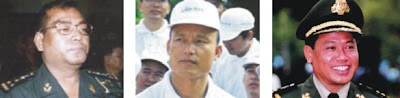
Left to Right: Hing Bun Heang, Sao Sokha and Mol Roeup (Photos: Global Witness)

Source: Human Rights Watch

I. Summary

Relations between the US and Cambodia have warmed considerably since the US withdrew direct aid to the Cambodian government in 1997, after a coup by the Cambodian People's Party (CPP) of Prime Minister Hun Sen against their coalition government partner, the FUNCINPEC party.

In addition to deeply entrenched impunity for human rights violators, other key human rights issues include the lack of integrity and independence within Cambodia's court system, attacks on freedom of expression and pluralism, and the government's chronic inaction on legal reform. Those who speak out to defend their homes, their jobs, and their rights increasingly face threats and physical attacks, including trade union leaders, opposition party members, journalists, activist Buddhist monks, and community activists defending their land and natural resources.

In addition, the gap has widened between wealthy city dwellers and impoverished farmers in the countryside, exacerbated by large-scale forced evictions of tens of thousands of urban poor, illegal confiscation of farmers' land, and pillaging of the natural resources on which people in the countryside depend for their livelihood. Military units are often wrongfully deployed to carry out forced and violent evictions of villagers whose ownership claims to the land have never been properly or fairly dealt with by a court.

To make matters worse, the Cambodian government announced this week that it is terminating the World Bank's $24 million land titling program after the Bank and key donors, including the United States, called on the government to stop forced evictions until fair and transparent land dispute and resettlement policies are in place.

While Cambodia has experienced significant economic growth during the past 16 years, the government has rejected a rights-based approach to development. Economic growth would have been much greater if the rule of law would have been established and voracious corruption by Prime Minister Hun Sen and those around him had not drained so many resources from the country.

In October 2008 the US announced that it would be making its first financial contribution (US$1.8 million) to the hybrid trial of former Khmer Rouge leaders (the Extraordinary Chambers in the Courts of Cambodia), which has been plagued by credible reports of corruption and government interference and manipulation. Ongoing statements by Prime Minister Hun Sen calling for the court not to engage in additional prosecutions seriously undermine the court's integrity, independence, and credibility. In helping Cambodia to address legacy issues lingering from the Indochinese wars, the US should be at the forefront of advocacy with the UN, other donors, and the Cambodian government itself in insisting that Cambodians deserve the highest standards of justice for the crimes committed by the Khmer Rouge.

With the resumption of direct government aid, the US has begun to send mixed signals as to how seriously it takes Cambodia's legacy of impunity, political violence, and high-level involvement of government officials in human trafficking and other rights violations. US funding currently includes training and material assistance to members and units of the Royal Cambodian Armed Forces that have been implicated in gross human rights abuses. It has strong counter-terror cooperation with some of the same individuals. The FBI has even given awards to some of the most notorious human rights abusers in the country, making many Cambodians wonder which side the US is on.

As one of the signatories to the 1991 Paris Peace Accords, one of Cambodia's biggest donors, and with great influence in Cambodia, the US should play a consistent role in insisting that Cambodia address its poor human rights record. The US government has to remember that its first priority is to stand with the Cambodian people. Good relations with the Cambodian government are a secondary priority.

II. The US and the Cambodian Security Forces - Impunity and Vetting

The US has provided training, material assistance and even awards to military, police, counter-terror units or related individuals with track records of serious human rights abuses. Since 2006, the US has provided approximately US $4.5 million worth of military equipment and training to Cambodia through the Foreign Military Financing program.

Training has been offered to elite units that are notorious for the impunity enjoyed by their members, as well as to personnel from Prime Minister's Hun Sen's bodyguard unit, which has been implicated in countless rights abuses including a political massacre, under the cover of a newly-created special anti-terrorist unit. The US has given the impression that it has forgotten or lost interest in the human rights record of some of these units or individuals.

While the US may have policy reasons to work with the Cambodian security forces on subjects such as counter-terror, it should work just as hard on holding abusers accountable and ending the culture of impunity that exists for high ranking members of the security services and those close to Hun Sen.

a) Prime Minister's Bodyguard Unit/Brigade 70 and New Counter-Terrorism Special Forces

Hun Sen's Bodyguard Unit, also known as Brigade 70, has a long history of impunity for its personnel who commit crimes, and well-documented involvement in smuggling and environmental crimes. Soldiers from Hun Sen's Bodyguard Unit, Brigade 70, were implicated in the March 30, 1997 grenade attack against the opposition Khmer Nation Party (now the Sam Rainsy Party), protecting the grenade throwers and allowing them to escape. At least 16 people were killed and more than 100 others (including an American) were wounded. The results of an FBI investigation into the attack found that the Bodyguard Unit was complicit in it, but the full results of the investigation have never been made public.

Outside of the normal RCAF chain-of-command, Brigade 70 is controlled directly by the Prime Minister. Reportedly comprising some 2,000 or more soldiers, the Bodyguard Unit was long commanded by General Hing Bun Heang, who is now deputy chief of the Prime Minister's Cabinet and reportedly remains in de facto control. The Bodyguard Unit has been implicated in political violence, most notably in a 1997 grenade attack on an opposition party rally. The Bodyguard Unit, mobilized outside of the normal chain-of-command of RCAF, also played a key role in fighting FUNCINPEC troops on the streets of Phnom Penh during CPP's July 1997 coup. In subsequent years, UN and NGO rights workers investigated several cases of individuals being unlawfully detained and tortured at the Bodyguard Unit's headquarters inside the Prime Minister's heavily-fortified residential compound. On or off duty, Brigade 70 personnel enjoy virtually unlimited impunity to commit.

Brigade 70 has an atrocious human rights record. Impunity enjoyed by its members is highlighted in the US State Department's annual human rights reports. In addition to the grenade attack, there are countless examples over recent years. A few examples include:
  • In July 2008, Brigade 70 soldier Dy Sothearith, moonlighting as a security guard at a factory, shot an unarmed factory worker over a minor dispute. The victim was paid $1,000 in compensation, on the condition he not pursue a criminal complaint. Dy Sothearith, who reportedly went into hiding at B-70's HQ, was not prosecuted.
  • In April 2006, Brigade 70 members Major Phat Sophal and Captain Sim Ry opened fire and shot a waitress whom they complained had brought them ice too slowly. Arrested by military police, the two were released hours later when their commander Mao Sophann intervened. The general subsequently said he punished the two officers by shaving their heads. No legal action was taken against them.
  • In July 2005, Brigade 70 member Sen Kok Heang, a former in-law to Prime Minister Hun Sen, attempted to kill two forestry activists in Kampong Thom's Sandan district. Brigade 70 soldiers were mobilized in that area to give protection to a Cambodian logging syndicate in the area.
  • In addition, B-70 has long been implicated in smuggling and the pillaging of Cambodia's environment; there is considerable evidence that cargo trucks belonging to the unit have systematically been used to transport illegally-felled logs and smuggled goods. In 2007, environmental watchdog Global Witness estimated B-70 was making between $2 million and $2.7 million from these operations, with a large cut of the proceeds given to Bodyguard Unit commander Hing Bun Heang.
b) Special Airborne Brigade 911

Brigade 911 has been implicated in gross human rights violations (including murder and torture) allegedly committed by brigade soldiers in the past. Paratroopers from 911, under the command of Major-General Chap Pheakdey, have been accused of gross human rights violations. In 1997, 911 personnel were implicated by UN investigators in the executions of FUNCINPEC military commanders captured during the CPP's coup, and the torture of other prisoners. No-one was brought to justice for these crimes. 911 members, disguised in civilian clothes, were also allegedly used to break up peaceful post-election demonstrations by the opposition in 1998. Subsequently, 911's commander Chap Pheakdey has maintained his reputation for acting with impunity. In 2006, he unlawfully detained one of his soldiers for more than a month, allegedly over a property dispute; no prosecution or other sanctions were taken against the general.

c) Brigade 31

Some material assistance has gone to military units with abysmal rights records. The commander of Brigade 31, for example, has confirmed that his unit used US-donated trucks to move villagers forcibly evicted by soldiers under his command in Kampot Province in 2008.

Brigade 31 (formerly known as Division 44 and then Battalion 44), under its long-time commander Brigadier-General Srun Saroeun, has an abysmal rights record. Its soldiers are alleged to have executed FUNCINPEC soldiers during the 1997 coup and fired gunshots over the heads of UN human rights officials investigating the killings. Headquartered in Kampong Speu province, the brigade has also long been accused of involvement in illegal logging throughout southern Cambodia. In recent years, its commanders have also been implicated in grabbing land from poor villagers. This raises serious questions about the quality of vetting done by the State and Defense Departments.

Brigade 31 assumed a "maritime security" mandate in late 2006 or early 2007 - the same time as an October 2006 joint defence assessment by RCAF and the US Pacific Command which identified maritime security as one of the areas for US support. This raises the question of whether RCAF deliberately gave the brigade a naval mandate in order to obtain US assistance. If so, this is a clear case of a military unit with a poor human rights record (but a record of loyalty to the ruling party) being rewarded and legitimized by US aid. Although US military aid is intended to improve the professionalism of RCAF forces, there are disturbing signs that RCAF is becoming more politicized and less professional, and that known human rights abusers are gaining increasing power within the RCAF structure. For example, General Huy Piseth, now an Undersecretary of State in the Ministry of Defense, is former commander of Brigade 70. In January 2009 the government announced the appointment of seven new deputy RCAF commanders-in-chief, including military intelligence chief Mol Roeup; military police chief Sao Sokha; and Hing Bunheang, Brigade 70 deputy commander at the time of the 1997 grenade attack. All of these men have clear records as human rights abusers.

Labels: , , ,


» Read more!

US Representatives' letter to Defense Secretary Robert Gates questioning the US military assistance to Cambodian "human rights VIOLATORS"

Congress of the United States
Washington DC 20515
September 18, 2009

The Honorable Robert M. Gates
Secretary of Defense
The Pentagon Room 3E 880
Washington DC 20301

Dear Secretary Gates:

We write today to bring to your attention concerns regarding U.S. assistance in the form of Foreign Military Financing (FMF) to the Kingdom of Cambodia. As you know, the United States has provided approximately $4.5 million in FMF used for training and material assistance to Cambodian military, police, and counterterror units since 2006. According to testimony from Human Rights Watch at a Tom Lantos Human Rights Commission hearing on September 10, such training and assistance "has been offered to elite units that are notorious for the impunity enjoyed by their members, as well as to personnel from Prime Minister Hun Sen's bodyguard unit which has been implicated in countless rights abuses including a political massacre, under the cover of a newly created special anti-terrorism unit."

While the United States should work with foreign governments to professionalize and train security forces to respect human rights and the rule of law, we must ensure that such assistance and training is not awarded to members of the security forces that have committed serious human rights violations and continue to operate with impunity.

Enclosed please find the testimony of Human Rights Watch which was submitted for the record and details serious abuses by members of the Prime Minister's Bodyguard Unit, Brigade 70, Special Airborne Brigade 911 and Brigade 31 of the Royal Cambodian Armed Forces (RCAF).

Given the nature of the abuses detailed in the enclosed testimony, we ask that the Department of Defense please provide answers to the following questions:

* What U.S.-funded training has been provided to RCAF's Special Airborne 911, RCAF's Brigade 70 and the Prime Minister's Bodyguard Unit?
* Have members ofRCAF's Special Airborne Brigade 911, Brigade 70, or members of the Prime Minister's Bodyguard Unit traveled to the United States to receive U.S.-government funded training or on other official business? If so, what was the purpose of the travel? What vetting procedures were used before they traveled?
* What equipment or other material support has been provided by the U.S. government to Special Airborne Brigade 911, Brigade 70, the Counter-Terrorism Task Force, the Prime Minister's Bodyguard Unit, or any other security services?
* What U.S.-funded training has been provided to Cambodia's National CounterTerrorism Committee, the National Counter Terrorism Task Force and the Counter-Terrorism Special Forces Unit?
* How many members of the Counter-Terrorism Special Forces unit come from the Prime Minister's Bodyguard Unit? Do they retain their positions at the Bodyguard unit?
* What actions have been taken to establish the identities of the Bodyguard unit personnel who were present during the March 30, 1997, grenade attack against the opposition Khmer Nation Party, and to ensure that these individuals are not included in any U.S.-sponsored training of RCAF forces?

Thank you for your attention to this important matter. We look forward to receiving your response.

Best wishes.

Sincerely,

Signatures of the following US Members of Congress:

Frank R. Wolf
James P. Moran
Edward R. Royce
Maurice D. Hinchey
Tammy Baldwin
Mark E. Souder
Christopher H. Smith
Niki Tsongas

---Original Attached

Labels: , ,


» Read more!

Thursday, September 17, 2009

Cambodia deploys police for Thai border protest


Source: AFP

PHNOM PENH — Cambodia deployed riot police Thursday at an ancient temple on the disputed border with Thailand where Thai protesters are due to hold a protest at the weekend, the defence ministry said.

Thailand's royalist "Yellow Shirt" movement says it will rally on Saturday near the 11th century Preah Vihear temple to demand that the government push Cambodian forces out of the area.

The disputed frontier around the temple has been the scene of several deadly clashes between Thai and Cambodian forces since the ruins were granted UN World Heritage status in July 2008.

Cambodian defence ministry spokesman Chhum Socheat said at least 50 police with dogs, batons, and tear gas have been deployed at the temple ahead of the demonstration.

More...

Labels:


» Read more!

Testimony finishes at Cambodian Khmer Rouge trial

Testimony finishes at Cambodian Khmer Rouge trial


PHNOM PENH, Cambodia — Testimony concluded Thursday in the first U.N.-backed trial of a high-ranking member of Cambodia's former Khmer Rouge regime.

The tribunal is trying Kaing Guek Eav, also known as Duch, who commanded S-21 prison in Phnom Penh, where up to 16,000 people were tortured and then taken away to be killed. He is charged with crimes against humanity, war crimes, murder and torture.

Four other senior Khmer Rouge leaders are in custody awaiting trial.

The tribunal is seeking justice for an estimated 1.7 million people who died from execution, overwork, disease and malnutrition as a result of the ultra-communist group's policies while in power in 1975-79.


More...

Labels:


» Read more!

Tuesday, June 23, 2009

Cambodian opposition MPs stripped of parliamentary immunity

Cambodian opposition MPs stripped of parliamentary immunity

Cambodia's opposition says it's under attack because of what it describes as a new round of politically motivated lawsuits and a vote by the National Assembly which has resulted in two opposition MPs being stripped of their parliamentary immunity.

Mu Sochua, former Cambodian minister of women's affairs, and Ho Vann, a Phnom Penh municipality representative, had their immunity lifted after a single show-of-hands vote by the National Assembly. They both face defamation lawsuits in Cambodia's notoriously corrupt courts.

Presenter: Liam Cochrane
Speaker: Mu Sochua, Cambodian opposition MP

COCHRANE: High profile opposition MP Mu Sochua has been locked in a battle of lawsuits with Cambodia's Prime Minister Hun Sen for some weeks now.

But, now that the National Assembly has voted to remove the Parliamentary immunity from Mu Sochua and her fellow party member Ho Vann, effectively, the gloves are off...

SOCHUA: The procedures where the most undemocratic because we were not allowed a chance to speak at all and there was a vote by raising of hands, lifting immunity of two members of parliament at the same time in one vote.

COCHRANE: Let's deal with them separately, why was your immunity lifted?

SOCHUA: My case is from a lawsuit by the Prime Minister against me for defamation. The Prime Minister pointed very clearly at me when he went to my constituency and talked about a number of parliament, a women from the opposition party and called me by a name that is not acceptable to call me, he called me a hustler. Second he said that I went and grabbed men and thirdly it was related to meetings that I went to and I was not allowed to go in, and he said that I had a very thick skin. And fourth, which is very, very serious is that I incite my constituents and people against the government.

COCHRANE: And can you tell me about the other member of parliament whose immunity was lifted? Who was that and why was the immunity lifted?

SOCHUA: My colleague, Mr Ho Vann is a member of parliament elected in the municipality of Phnom Penh. He made a comment by responding to the media about honorary degrees that were received by some military officials. His comment was that he didn't think that these degrees were valuable, but if they were valuable then the quality of degrees should allow the numbers of the armed forces to help and then to protect the nation.

COCHRANE: Without parliamentary immunity you face the court as an ordinary citizen, what chances do you think you'll have of finding justice at the court?

SOCHUA: The chance of me getting justice is very close to zero.

COCHRANE: Mu Sochua you've said previously that you would rather go to jail rather than pay a fine if you are found guilty of this defamation charge. Are you still feeling that same way?

SOCHUA: Definitely I am very determined to face the court and I will not be surprised if the court finds me guilty. My stance will not change, I am ready, my conscience is clear about wanting justice, wanting a judicial system that can protect citizens of Cambodia. So I am ready, I am preparing to go to jail.

COCHRANE: There are rumours around at the moment that you are about to flee the country or you may have already fled the country. Is there any truth to those rumours?

SOCHUA: I have always been very transparent that I am not fleeing the country. I came back to Cambodia in 1989, I have never gone back to America to live. My country is Cambodia, I said from the very beginning that I will not flee, I will come back to face the courts.

COCHRANE: Mu Sochua, just finally, this is not the first time this sort of thing has happened. In the past opposition leader Sam Rainsy and Cheam Channy and others have had their immunity stripped, and in Cheam Channy's case gone to jail. Do you think this is a political action against you.

SOCHUA: Yes it's a political action against the opposition. Cambodia is walking more than one step backwards, democracy in Cambodia is in real jeopardy. I think the world community cannot ignore this and especially the government of Australia. What is Australia doing when democracy in Cambodia is facing such a serious set of going back to dictatorship?

COCHRANE: A representative from Cambodia's National Assembly was not available for comment on the issue.

Labels: , , ,


» Read more!

Saturday, June 20, 2009

Cambodia rebukes Thailand

Cambodia rebukes Thailand


Minister Hor Namhong (left) gestures with repeated comments made by top Thai government officials over the complaint to withdraw Preah Vihear temple from World Heritage site. --PHOTO: AP

PHNOM PENH - CAMBODIA on Saturday rebuked Thailand for reopening a debate over an ancient temple on their disputed border that has led to seven soldiers being killed.

High-ranking Thai officials this week asked world heritage body Unesco to reconsider its decision to formally list the 11th century Preah Vihear temple, as ownership of land surrounding the ruins is still in dispute.

Soldiers from Cambodia and Thailand continue to patrol the area and occasional outbreaks of violence between them have triggered gunbattles that have killed seven troops in the past year.

But Cambodian Foreign Minister Hor Namhong told reporters that soldiers would be ready to defend their land again if necessary.

'Cambodia welcomes Thailand militarily, diplomatically, internationally or through peaceful negotiations,' Hor Namhong said.

'(But) it (border fighting) has happened twice... (so) if they want to send their troops to Cambodia a third time, we will welcome them too,' he said.

Thai Prime Minister Abhisit Vejjajiva made a one-day visit to Cambodia last week in an attempt to push forward border talks, but his subsequent comments only appear to have reignited the dispute.

'I heard that the second Thai commander on the border put his troops on alert and I'd like to tell them that Cambodian soldiers are also on alert,' Mr Hor Namhong added.

Cambodia and Thailand have been at loggerheads over the land around the Preah Vihear temple for decades, but tensions spilled over into violence last July when the temple was granted UN World Heritage status.

The border between the two countries has never been fully demarcated, in part because it is littered with landmines left over from decades of war in Cambodia. -- AFP

Labels: , , , ,


» Read more!

SRP WILL NOT REPLACE MU SOCHUA

SRP WILL NOT REPLACE MU SOCHUA


June 20, 2009

While pushing for the lifting of Mu Sochua’s parliamentary immunity, Prime Minister Hun Sen has been suggesting that she be replaced as a National Assembly member at the initiative of the opposition Sam Rainsy Party.

On behalf of the SRP, I can assure the Cambodian people and all Cambodia’s friends that Mu Sochua’s seat at the National Assembly will remain hers until the end of her legal term and that no replacement will be appointed.

Mu Sochua is the victim of an injustice. Hun Sen wants to eliminate her from Cambodia’s political landscape. It is a blatant abuse of power that is only possible with a subservient judiciary and a rubber-stamp parliament.

Replacing Mu Sochua would be like politically burying her alive and complying with Hun Sen’s insane desire.

When, in 2005, Cheam Channy, another SRP National Assembly member, was stripped of his parliamentary immunity and subsequently put in jail following a trumped-up criminal charge, there were also suggestions that he be replaced. But it was clear to us that replacing Cheam Channy would mean that we would accept the injustice done to him, let our colleague down, contribute to his political elimination and compound a personal tragedy. We proudly accepted to temporarily and practically lose a seat, a voice and a vote at the National Assembly.

We were right to stick to our principles. In 2006, Cheam Channy was released from prison, his immunity restored, and he recovered his seat at the National Assembly.

We are confident that adopting a similar position in the case of Mu Socha now is the right thing to do.

The same observations apply to the case of countless SRP-affiliated elected commune councilors, including commune chiefs, who have been arrested and sent to jail for politically-motivated charges. For instance, Mu Sochua’s case cannot be dissociated from the case of Tuot Saron, the SRP-affiliated elected chief of Pong Ro commune in Kampong Thom province’s Barai district. Tuot Saron is currently and unjustly in jail. But he will not be replaced. We will do all we can to help free him and to re-install him as commune chief as we are fighting to render justice to Mu Sochua.

Sam Rainsy
Member of Parliament
SRP President

Labels: , , ,


» Read more!

Monday, May 25, 2009

Cambodia quarantines Japanese couple suspected of having swine flu

Cambodia quarantines Japanese couple suspected of having swine flu


Source: EarthTimes.org
Phnom Penh - Cambodian health authorities said Monday they were waiting on test results for a Japanese couple who showed symptoms of swine flu after travelling by air from Vietnam to the northern town of Siem Reap. Bun Artha, director of civil aviation at Siem Reap International Airport, said the couple, a 24-year-old man and a 25-year-old woman, was taken to hospital after thermal imaging equipment detected both had high temperatures as they exited a flight from Ho Chi Minh City.

"They arrived in Siem Reap on Sunday evening after spending four days in Vietnam and both were taken immediately to Siem Reap hospital," he said.

Em Bun, director of Siem Reap hospital, said the couple was placed in voluntary quarantine and doctors were waiting on test results to return from a pathology lab in the capital Phnom Penh.

"The couple reported that they had suffered food poisoning in Vietnam and had recovered from ordinary flu just before they left Japan," he said. "Phnom Penh is several hundred kilometers away, so it will take some time for the results to be confirmed and for us to know whether they have the H1N1 virus."

Health authorities on Sunday confirmed there were no cases of swine flu in Cambodia after test results came back negative for three US citizens exposed to the potentially deadly virus during a flight from the US to South Korea.

Labels: ,


» Read more!

Swine flu tests are negative

Swine flu tests are negative
Written by Christopher shay And Cheang Sokha (The Phnom Penh Post)
Monday, 25 May 2009

Three tourists exposed on plane to influenza A(H1N1) not infected.

THREE Cambodian-Americans who shared a flight with a woman confirmed to have been infected with influenza A(H1N1), commonly known as swine flu, have been located by the Ministry of Health and tested negative for the virus, Dr Sok Touch, director of the Communicable Diseases Control Department, said Sunday.

"There are still no confirmed cases of the A(H1N1) in Cambodia," he told the Post.

Sok Touch credited new health declaration forms at the airport for being able to rapidly locate two of the three passengers.

He said that increased monitoring at the country's points of entry has proven to be an effective tool in preventing the introduction of the swine flu virus.

The World Health Organisation, however, has expressed doubts over the use of health declaration forms and thermal imaging scanning to slow the spread of the flu.

"The World Health Organisation, on a global scale, has said that airport measures aren't effective at stopping influenza. [The virus] spreads fairly quickly and easily, and there could be people who have no symptoms," Michael O'Leary, Cambodia's WHO representative, said on Sunday.

At the moment, O'Leary said, the symptoms of H1N1 are "generally mild, like normal influenza", emphasising that "this is not a panic situation".

But he added that the influenza virus is unpredictable, and in the past, a more deadly second wave of the virus has hit a few months later.

"And because it's a new virus, everyone in the world is susceptible," he said.

Since last month, all passengers from international flights have been required to fill out a health declaration form on the plane and receive a yellow health notice when they turn it in, warning them about the A(H1N1) influenza virus and giving them phone numbers if they develop flulike symptoms, Sok Touch said.

Colum Murphy, author of Flu Action Plan: A Business Survival Guide, said, "Anything that helps to identify early cases and psychologically reassure people is worth considering."

But he said strategies that are executed only to ease people's minds will not be successful.

"There's no point in health declaration forms if they are just going to pile up unread," he said, "There really has to be an appropriate sense of urgency that's communicated to the front line implementers."

Passengers from Sunday's AirAsia flight 274 to Phnom Penh from Kuala Lumpur, Malaysia, were impressed by steps taken by the Cambodian government and said the airport officials looked carefully at their health declaration forms before letting them into the country.

If tourists do not know what their physical address in Cambodia will be, they are encouraged to write down their email address, according to one passenger who arrived in Phnom Penh on Friday.

Tourists feel safer
David Khem, a Malaysian tourist from flight 274, said the health monitoring in Phnom Penh was tighter than it was in Malaysia. Olga Makarewicz, a Polish tourist, told the Post, "It is good that they make people aware [of A(H1N1)] and remind them."

A joint statement from the Ministry of Health and the World Health Organisation on Sunday told the public to cover their coughs, sneeze with a tissue, wash their hands and refrain from spitting in public.

Murphy said, "There's a chance of feeling overwhelmed, but it's not so bleak, the simple things are the most effective", emphasising frequent communication about the virus and personal hygiene.

The latest WHO statistics show that 43 countries have reported 12,022 confirmed cases of the virus, with 86 deaths.

Labels: ,


» Read more!

Promoting human rights by protecting those who defend them

NGO in Special Consultative Status with the Economic and Social Council of the United Nations
3220 West 13th Avenue, Vancouver, B.C. CANADA V6K 2V5
Tel: +1-604-738-0338 Fax: +1-604-736-1175
lrwc@portal.ca www.lrwc.org

Promoting human rights by protecting those who defend them

21 May 2009
Chiv Song Hak, President, Bar Council
Members of the Bar Council
Bar Association of the Kingdom of Cambodia
Nº. 1011Eo, Croix Rouge Khmere (St. 180)
12211 Phnom Penh Cambodia
Fax 023 213 658
Email to: cilf@online.com.kh, wengkaly@yahoo.com, hbslawfirm@hotmail.com, ntrbno@online.com.kh, mathoeung_sok@online.com.kh

Dear Mr. Chiv Song Hak and Members of the Bar Council,

RE: Independence of the Bar in Cambodia

I am writing on behalf of Lawyers' Rights Watch Canada (LRWC), a committee of Canadian lawyers who promote human rights and the rule of law internationally by providing support to lawyers and other human rights defenders in danger because of their advocacy.

We wish to offer our moral support to the Bar Association of the Kingdom of Cambodia in fulfilling its function to uphold and defend the independence of the legal profession from interference by those acting on behalf of members of the executive branch of government.

As you know, the independence of the Bar is protected by Article 1 of the Law on the Bar, which states: “The lawyer’s profession is an independent and autonomous profession involved in serving justice and may only be pursued from within the framework of the Bar Association.” In addition, Article 1 of the Code of Ethics for Lawyers Licensed with the Bar Association of the Kingdom of Cambodia states in paragraph 3: “Professional installations must assure the respect for the principles of dignity and independence and guaranty professional confidentiality.” These provisions are consistent with the UN Basic Principles on the Role of Lawyers (1990), which uphold the basic purpose of the principle of the independence of the bar, which is to protect clients' legal rights, particularly their human rights, which are also specifically upheld by Cambodia’s Constitution. The UN Rules and all other international principles concerning lawyers and the rule of law insist that lawyers must be free to accept cases and represent clients regardless of the political causes or affiliations of the client. Lawyers must be free to take cases to independent courts for impartial adjudication without interference from politicians or other embers of the executive.

It has been drawn to our attention that Mr. Ky Tech, a lawyer who we understand represents Prime Minister Hun Sen, has made a complaint of professional misconduct against a lawyer, Mr. Kong Sam Onn. We understand that Mr. Kong has been retained by Ms. Mu Suchua, an opposition Member of Parliament, to represent her in a case of defamation she has instructed to be filed against Prime Minister Hun Sen regarding defamatory statements Ms. Mu alleges Mr. Hun Sen made against her. We understand that Prime Minister Hun Sen has made a counter claim of defamation against Ms. Mu Suchua, as well as her lawyer, Mr. Kong Sam Onn. The particular facts of this case in the Cambodian context provide us with significant concern that the complaint against Mr. Kong Sam Onn may be based not on any legitimate concern about Mr. Kong’s professional conduct. Rather we are concerned by allegations and an appearance that the allegations against Mr. Kong are intended to influence the course of the defamation case.

We understand that the BAKC has commenced an investigation into Mr. Kong Sam Onn’s conduct, which could lead to serious disciplinary actions including Mr. Kong Sam Onn's debarment. We understand that the matter is now before the BAKC Disciplinary Council.

We sincerely and respectfully hope that the BAKC and its Disciplinary Council will not be used inappropriately in any attempt by the executive branch of government to harass or influence a lawyer who is performing his professional duties on behalf of his client. We also hope that the BAKC will not be subject to any undue influence in its own deliberations or findings. We join with others concerned about the independence of the bar and the rule of law in Cambodia in urging the BAKC to ensure that it does everything possible to uphold its independence and withstands any and all external pressure. Since the complaint to the BAKC appears to be interconnected with the defamation counterclaim that has been lodged against Mr. Kong Sam Onn, we respectfully suggest that the BAKC consider holding any investigation in abeyance until the court has made its findings in the defamation case. We also urge the BAKC to take all possible steps to ensure that Mr. Kong receives a fair and impartial trial.

As lawyers, we wish to offer our support to Members of the BAKC Bar Council in their important work to uphold the dignity and independence of the legal profession. Please feel free to contact us at any time.

Yours sincerely,
Gail Davidson

Executive Director
Lawyers’ Rights Watch Canada

cc. Mr. Suon Visal
Secretary General,
Bar Association of the Kingdom of Cambodia
Phnom Penh, Cambodia email: suonvisal@yahoo.com

cc. Mr. Ky Tech,
Lawyer
Former President,
Bar Association of the Kingdom of Cambodia
Phnom Penh, Cambodia email: kytech_clf@citylink.com.kh

cc. Mr. Say Bory
Former President
Bar Association of the Kingdom of Cambodia
Phnom Penh, Cambodia, snlo@online.com.kh

cc. Mr. Sok Sam Oeun,
Lawyer,
Cambodia Defenders Program
Phnom Penh, Cambodia email: cdp@cdpcambodia.org

cc. Mr. Run Saray,
Lawyer,
Legal Aid Cambodia
Phnom Penh, Cambodia email:

Labels:


» Read more!

Monday, May 04, 2009

Princess Eugenie mugged in Cambodia

Princess Eugenie mugged in Cambodia

Princess Eugenie and her friends were mugged while in Cambodia, according to reports.

The incident happened while Eugenie was on holiday in Cambodia Photo: IAN JONES

The Queen's granddaughter, 19, who is holidaying in the country as part of her gap year, was rescued by two bodyguards who tackled a gang of bandits.

The incident happened as the Duchess of York's daughter and two gap-year friends were walking at night in Phnom Penh.

When one of her friends got a purse out, the mugger grabbed it. The officers were just feet away.

The two officers rugby-tackled one of the bandits as he tried to flee with the princess's purse.

According to reports, they grappled with the man before another robber started throwing rocks at them. The officers, fearing for the princess's safety, let the thief go, grabbed the purse and led the royal away.

A Buckingham Palace source told The Sun: "They feared the incident was escalating out of control and took the decision to focus on the safety of their principal."

It is the first time in 10 years that SO14 officers have stopped a direct threat to a Royal.

Questions have already been asked over the amount of money spent to keep the princess safe while on the trip. Reports suggest the cost of flights, expenses, accommodation and overtime for the officers will amount to around £100,000 for the six-week stay.

A Buckingham Palace spokesman would not comment on the incident, nor on the princess' security arrangements.

Labels:


» Read more!

2009 LICADHO Report: Cambodia’s Media Continue to be Attacked, Threatened and Censored

2009 LICADHO Report: Cambodia’s Media Continue to be Attacked, Threatened and Censored

Cambodia's media is often described as one of the freest in the region, especially relative to the likes of Vietnam, Myanmar, Laos or China where the media is all but controlled by the government1. But the reality is that Cambodia's media still exists in a repressive environment where the government controls the majority of the media. Those that it does not control, it is not afraid to attack, threaten or censor.

The 15 months reviewed in the latest LICADHO briefing paper - from January 1, 2008 to March 31, 2009 - saw a number of cases of defamation lawsuits, repeated censorship, attacks, threats and intimidation.

The period review was crucial politically with the national election held in July 2008. The murder two weeks before the vote of opposition-aligned journalist Khim Sambo was a chilling reminder of the risks Cambodian journalists face for doing their job.

"The continued intimidation of the media through physical attacks, threats, charges of defamation and disinformation and murder ensure the lack of an environment free from political pressures for media to cover sensitive and important issues affecting Cambodians," says Naly Pilorge, Director of LICADHO.

As yet, no one has been arrested for the killing of Khim Sambo, a pattern consistent with the murders of journalists in Cambodia since 1993. In 2008, another journalist fled Cambodia with his family and has since been granted asylum in Norway after receiving death threats for his work for Radio Free Asia (RFA).

Most of the Kingdom's media outlets are aligned to a political party and most favor the Cambodian People's Party (CPP). All eight television channels are aligned with the CPP, as are 11 of the main 22 Khmer-language stations, and 13 of the 24 larger Khmer-language newspapers.

The briefing paper is titled Restrictions on the Freedom of Expression in Cambodia's Media, and is published in celebration of World Press Freedom Day on May 3, 2009. The briefing paper is an update to LICADHO's previous report on the subject of media restrictions which was published in May 2008 - Reading Between the Lines: How Politics, Money and Fear Control Cambodia's Media.

To read more

Cambodian League for the Promotion and Defense of Human Rights (LICADHO)

LICADHO is a national Cambodian human rights organization. Since its establishment in
1992, LICADHO has been at the forefront of efforts to protect civil and political and economic and social rights in Cambodia and to promote respect for them by the Cambodian government and institutions. Building on its past achievements, LICADHO continues to be an advocate for the Cambodian people and a monitor of the government through wide ranging human rights programs from its main office in Phnom Penh and 12 provincial offices.

Labels: , , , ,


» Read more!

Friday, May 01, 2009

Mu Sochua-Hun Sen: prime Minister Portrays Himself as Victim, NGOs Condemn His Threats

Mu Sochua-Hun Sen: prime Minister Portrays Himself as Victim, NGOs Condemn His Threats

Phnom Penh (Cambodia). 24/09/2008: Mu Sochua, Sam Rainsy Party MP, during prime Minister Hun Sen’s press conference, after the opening session of the new parliamentary mandate. ©John Vink/ Magnum

By Duong Sokha, with LLG

In a speech he gave on Wednesday April 29th in Phnom Penh, Cambodia’s prime Minister presented himself as a victim in the case pitting him against Mu Sochua, the Sam Rainsy Party MP, who lodged a complaint against him on grounds of defamation and insults. Hun Sen particularly reminded his opponent that having her parliamentary immunity lifted would be easy, since a majority of MPs are affiliated to the Cambodian People’s Party and therefore agree with the cause of the head of the executive power. Several organisations from the Cambodian civil society reacted strongly and condemned pressure and threats coming from the ruling power against the opposition.

“I am a simple victim and only wish to defend myself before the Law and find justice”, the Cambodian prime Minister declared loud and clear before an audience composed of brand new graduates. Hun Sen said he did “not despise any woman at all” and said he did not attack Mu Sochua directly. The words he said in Kampot at the beginning of April about a woman behaving in a “provocative way”, who “lunged towards a man to kiss him, so much so that the buttons [of her blouse] popped out”, were not about the SRP MP at all, he said…

The prime Minister insisted on justifying the fact that he filed a lawsuit in turn, against the opposition MP. “On Thursday [April 23], she held a press conference [on that case]. Therefore, I have enough evidence. I signed on Friday [April 24] a complaint [against her] for defamation before the start of the judicial proceedings [launched by Mu Sochua against Hun Sen]”, he declared, adding that his complaint was also aimed at Mu Sochua’s lawyer, Kong Sam Onn, who was with his client at her press conference. The prime Minister is asking each of the concerned persons for a compensation of ten million riels (2,500 USD). He announced he would give the money to charity in favour of orphans.

Hun Sen also said that if justice asked for the suspension of his own parliamentary immunity, he would be ready to accept it, and pointed out that such a procedure against him had few chances of succeeding. “I do not believe that MPs for the Cambodian People’s Party [CPP, going strong with 90 seats out of 123 in the National Assembly] will vote, by a show of hands, the suspension of my immunity. Like for Lok Chumteav Men Sam On [deputy prime Minister, CPP], they will not do it”, Hun Sen bet with confidence. However, Cambodia’s “strongman” did not fail to mention that if justice issued a similar request against Mu Sochua, having it approved would be easy, since the votes of almost two thirds are already secured.

Several Cambodian organisations for the defence of Human rights and the observation of political life reacted strongly, even before this very speech given by the head of government, to the threat to lift the Sam Rainsy Party (SRP) deputy’s parliamentary immunity.

“To issue arbitrary threats on the suspension of Mu Sochua’s parliamentary immunity without any evidence she may have committed any crime is a flagrant act of intimidation against an opposition MP”, president of the Cambodian Centre for Human Rights (CCHR) Ou Virak said in a communiqué dated April 29th and co-signed by nine local organisations. “This clearly aims at reducing her to silence and deterring her from claiming her legitimate right to file a lawsuit for defamation.”

For Kek Galabru, the president of the NGO for the defence of Human rights in Cambodia LICADHO, this “threat against Mu Sochua is yet another example of the dangerous milieu opposition MPs are faced with in Cambodia”. “MPs from all parties should be free to exercise their profession, to represent the interest of their voters and to express themselves in public without the fear of being arrested or detained arbitrarily”, she said, while Yeng Virak, director of the Community Legal Education Centre (CLEC) stressed that parliamentary immunity was “not something that can be lifted randomly by representatives of the government”.

“If Mu Sochua’s parliamentary immunity is lifted, this will simply prove that what she aims at showing is right: that opposition MPs are not free to do their job without fearing intimidation or persecution”, says Koul Panha, director of the Committee for Free and Fair Elections in Cambodia (COMFREL). For her part, Thida Khus, executive director of the Silaka organisation, deplores a “threat that is [...] sad in many ways [...] against one of the rare active female politicians, in a country where women’s voices are frequently silenced or ignored”.

Reached by Ka-set, SRP MP for Kampot Mu Sochua simply indicated that she intended to leave justice to sort that case and that she would accept the eventual suspension of her parliamentary immunity, should judicial authorities decide to lift it. “I trust the will of MPs, of all the parties and I shall respect their decision”, she said. Her lawyer Kong Sam Onn explained that he only acted as he felt he should, as a lawyer, and denied having said any defamatory words about the Cambodian prime Minister.

Labels: ,


» Read more!

Tuesday, April 14, 2009

Happy New Year, Year of the Ox 2553

Happy New Year
Year of the Ox 2553 Buddhist Era (B.E.)
Begins 1:36am Tuesday, April 14, 2009

Moha Songkran: Moha Songkran is the name of the first day of the new year celebration. It is the ending of the year and the beginning of a new one. People dress up and light candles and burn incense sticks at shrines. The members of each family pay homage to offer thanks for the Buddha's teachings by bowing, kneeling and prostrating themselves three times before his image. For good luck people wash their face with holy water in the morning, their chests at noon, and their feet in the evening before they go to bed.

Wanabat: Wanabat is the name of the second day of the new year celebration. People contribute charity to the less fortunate, help the poor, homeless people, and low-income families. Families attend a dedication ceremony to their ancestors at the monastery.

Tanai Lieang Saka: Tanai Lieang Saka is the name of the third day of the new year celebration. Buddhist cleanse the Buddha statues and elders with perfumed water. Bathing the Buddha images is the symbol that water will be needed for all kinds of plants and lives. It is also thought to be a kind deed that will bring longevity, good luck, happiness and prosperity in life. By bathing their grandparents and parents, children can obtain from them best wishes and good advice for the future.


Khmer New Year Games:

After performing all rituals and customs to welcome the New Year, it's time to have some fun. Some physical activities become part of New Year celebrations. Popular games played at the time of New Year in Cambodia are listed below:

Tres
In this game, a ball is thrown and caught with one hand while catching sticks (pens, chopsticks) with the other hand.

Chol Chhoung
Played on the night of day one by group of boys and girls standing opposite to each other. One group throws the Chol Chhoung (Khmer scarf ball) on the other and if someone gets hit by the ball then the whole group dances to get the Chhoung back while the other group sings.

Chab Kon Kleng
In this game, one imitates as a hen protecting her chicks from a crow. It is played on the first night of the New Year. The crow tries to catch as many chicks as possible while both the groups sing a song of bargaining.

Bos Angkunh
This game is played by the groups of boys and girls. Each group throws their angkunh (an inedible fruit seed) to hit the angkunh of the other group. The winners must knock the knee of the losers with the angkunh.

Leak Kanseng
It is mostly played by a group of children. They sit in a circle. Someone holds a kanseng (Cambodian towel) twisted in a round shape and moves around the circle. The child moving around the circle secretly keeps the kanseng behind one of the children. If the chosen child realizes the kanseng behind him then he must beat the person sitting next to him.

Bay Khom
It is a game of two children. Ten holes are dug into a board in the ground . 42 stones are required to start the game. Five stones are put into each of the two holes located at the tip of the board and four stones are put in the remaining holes. The first player takes all the stones from any selected hole and put them one by one in other holes. It must be repeated until the last stone is dropped into the hole besides the empty one. Then he must take all the stones into the hole next to the empty one. Similarly, second player starts playing the game and the game ends when all the holes are empty. The player with the maximum number of stones is the winner.


Labels: , ,


» Read more!
October 1997
January 2005
February 2005
March 2005
April 2005
May 2005
June 2005
July 2005
August 2005
September 2005
October 2005
November 2005
January 2006
February 2006
March 2006
April 2006
May 2006
June 2006
July 2006
August 2006
September 2006
October 2006
November 2006
December 2006
January 2007
February 2007
March 2007
April 2007
May 2007
June 2007
July 2007
August 2007
September 2007
October 2007
November 2007
December 2007
January 2008
February 2008
March 2008
April 2008
May 2008
June 2008
July 2008
August 2008
September 2008
October 2008
November 2008
December 2008
January 2009
February 2009
March 2009
April 2009
May 2009
June 2009
September 2009
October 2009
November 2009
December 2009
January 2010
February 2010
March 2010
April 2010
May 2010
June 2010
July 2010
August 2010
September 2010
October 2010
November 2010
January 2011
February 2011
March 2011
April 2011
May 2011
June 2011
July 2011
August 2011
September 2011
October 2011
November 2011
December 2011
July 2012
August 2012
September 2012
October 2012
November 2012
November 2013
December 2013
January 2014
March 2014
April 2014
May 2014
July 2014
September 2014
January 2015
February 2015
September 2015
October 2015
August 2016
September 2016
March 2018

Subscribe to
Posts [Atom]

Powered by Blogger


 Home   |   About Us   |   Submit URL or Your Company Address First Launched: 08/15/95 - Copyright © 2010 Cambodian Information Center. All rights reserved.