Editorial | Articles about Cambodia | Khmer
Corruption is rife and dissent is stifled, as "Cambodia's Curse" shows. But entrepreneurs are giving the country some hope.
By GEOFFREY CAIN - THE WALL STREET JOURNAL
If schools are a reflection of society, then they show Cambodia to be a limp and defeated nation. On the first day of class, Cambodian children learn they must bribe their teachers to get good grades, a practice that continues for the 3% of them who make it to college. Teachers, struggling on salaries of less than $100 a month, take their cuts and pass the money up to the principals. The principals then pay off local education officials, and so on to higher circles of government. In the end, those who give the largest bribes eventually win promotions—giving them access to even bigger cash flows.
 Cambodia's Curse: The Modern History of a Troubled Land By Joel Brinkley Public Affairs, 416 pages, $27.99In this system, students learn few useful skills except how to survive under a corrupt regime, writes journalist Joel Brinkley. For the lucky few who pay, and sometimes even murder, their way to the top of the government, life is good. But for the ordinary farmers and laborers, kickbacks are simply an expensive roadblock to economic and social advancement.
"These demands are humiliating. It pushes a lot of smart kids out to the rice fields instead of helping our country," Sok Sopheap, a high school student who was kicked out of class because he didn't pay a bribe, told me. "This is why Cambodia stays poor."
Mr. Brinkley's depressing book is a mostly illuminating, though sometimes lopsided, chronicle of the politicians and bureaucrats who have plagued Cambodian society for the past 30 years. After the Khmer Rouge regime oversaw the deaths of 1.7 million people and was unseated in 1979, a new group of opportunists took their place. That wily clique, installed by the invading Vietnamese, includes current Prime Minister Hun Sen.
The Cambodian People's Party (CPP) solidified its hold on power in part by manipulating foreign governments and keeping the country poor. Its first big target was the United Nations, which took advantage of the end of a Cold War stalemate in 1989 to attempt a democratic transformation of the country. In 1992, U.N. peacekeepers tried to rebuild the country by launching the most expensive peacekeeping operation at the time—total cost $1.6 billion—and overseeing elections that attracted a remarkable 90% voter turnout.
Mr. Hun Sen lost those elections but refused to step down; four years later, he ended the U.N.'s dream of democracy for Cambodia when he ousted his democratically elected co-prime minister, Prince Norodom Ranarridh, in armed clashes. Since he has consolidated power, Mr. Hun Sen has repeatedly sued and pushed his critics into exile, and has attempted to stall progress of the Khmer Rouge tribunal.
Nevertheless, foreign governments funded the CPP-led government with $18 billion in aid and soft loans after U.N. peacekeepers departed. The leaders squandered much of this largesse on mansions, luxury cars, private security forces and political pandering—all to further their power. Today, the country loses $500 million a year to corruption, USAID reports.
Mr. Brinkley won the Pulitzer Prize in 1980 for covering Cambodian refugees, and he weaves the details of the nation's underbelly into a compelling argument, interviewing powerful figures and foreign officials involved in politics, courts, hospitals, land development, forests and schools. Particularly engrossing is his account of the country's infamous 2010 anticorruption law, something the West pushed Phnom Penh to pass since the early 1990s, which would force government offices to face tougher audits.
For 15 years, Mr. Hun Sen repeatedly promised donor countries and organizations that he would pass the law. But while the donors complained every year that he still hadn't, they nonetheless assented to his requests for more money, raising their annual aid pledges from $770 million in 1994 to nearly $1.1 billion by the time Mr. Hun Sen acceded to their requests in 2010.
But the new law hardly meets international standards. It does not require officials to publicly disclose their holdings, the heart of any anticorruption law, and allows them to offer gifts in exchange for favors "in accordance with custom and tradition." The saga becomes yet one more example of the ineffectiveness of foreign aid, and Mr. Brinkley rightly wonders what foreign officials are up to. When he visits the new anticorruption office, he finds that it sends complaints directly to the institutions that the complainants accuse, with their names attached—leaving them open to threats and intimidation.
Such gifted storytelling makes up for some shortcomings, including some minor errors of fact. For instance, Mr. Brinkley writes that a 1997 grenade attack on an opposition rally occurred at a park across from the National Assembly that is named after Mr. Hun Sen. While the location of the blast is correct, it is actually a separate, nearby park that is named after the premier.
More troublesome are Mr. Brinkley's historical arguments. He suggests, for example, that leaders can act with impunity because most Cambodians will not change centuries-old attitudes. Kings traditionally awarded posts to mandarins who paid kickbacks, a scheme that Mr. Brinkley asserts continues uninterrupted.
It is true that Cambodians do not have a history of popular sovereignty, which may help explain why democracy-building faltered. The Khmer language reflects the fact that most Cambodians have low expectations of their leaders: The verb translated into English as "to govern," for example, literally means "to eat the kingdom."
But that fact is a long distance from Mr. Brinkley's sweeping conclusion that Cambodians, timid and wavering by upbringing, accept tyranny because they see no alternative. "They carry no ambitions. They hold no dreams," he writes. "All they want is to be left alone." The first two statements are patronizing and disproven by the growing number of entrepreneurs. The third gives short shrift to the recognition of many Cambodians that democratic government is the surest path to domestic tranquility.
Mr. Brinkley's grim assessments on issues such as corruption and the ineffectiveness of donor aid ring true. Nevertheless, Cambodia is fast shedding its image as a lawless mafia state. The society is, despite all its problems, becoming more stable. Its economy is improving, thanks to limited regulation and taxation. Once pitied as a basket case, Cambodia may yet prove its critics wrong, despite its governance curse.
Mr. Cain is a writer in Vietnam.
Labels: Corruption, Joel Brinkley
» Read more!
By THE ASSOCIATED PRESS
Published: May 18, 2011 at 9:06 AM ET (The New York Times)
PHNOM PENH, Cambodia (AP) — An internal debate over the targets of Cambodia's Khmer Rouge genocide tribunal turned into a public dispute Wednesday, when judges ordered a prosecutor to retract his call for further investigations.
 The fight at the United Nations-backed tribunal added to mounting fears that prosecutions are being quashed for political reasons.
The two investigating judges, from Germany and Cambodia, on Wednesday ordered British co-prosecutor Andrew Cayley to withdraw a statement he issued last week citing specific crimes that deserved further investigation. They said the statement violated tribunal rules and must be retracted within three days, without specifying the punishment for failure to comply.
Critics fear the judges ended their investigations prematurely into what the court calls Case 003, bowing to Prime Minister Hun Sen's demands that the trial's focus be kept narrowly on the one suspect convicted last year and four set for trial next month.
About 1.7 million people died of starvation, exhaustion, lack of medical care or torture during the communist Khmer Rouge's reign of terror in the 1970s.
Cayley's statement was issued just a few days after co-investigating judges Siegfried Blunk and You Bunleng announced that all investigations into Case 003 had been concluded.
The tribunal follows French-style law, which mandates that investigating judges collect evidence that is then forwarded to prosecutors who decide whether to go to trial. There are parallel sets of Cambodian and international judges and prosecutors working together.
Legal observers and victims advocates complained that the investigations into the new cases were cut short without even the most basic effort being made, such as summoning the suspects for questioning.
"They've basically done a desk study, and it appears that that desk study was a sham," Brad Adams, Asia director for Human Rights Watch, said in an interview last week in Bangkok. "It was a political decision, it appears, to shut down this case."
Cayley's statement called the investigation inadequate and detailed previously unreleased information about the yet-to-be-prosecuted cases, including information about mass graves and other alleged crime sites.
The judges' order said that Cayley violated court confidentiality rules and ordered him to publicly retract his statement within three days.
Cayley was traveling and could not be reached for comment Wednesday. But his deputy, Bill Smith, told The Associated Press that Cayley had not decided yet whether to appeal the judges' order. He said Cayley was justified in releasing the information under court rules.
Labels: Khmer Rouge, Khmer Rouge Tribunal
» Read more!
Published: 16/05/2011 at 02:51 PM
Online news: Bangkok Post Learning
Agreement with Philippines for low-cost rice may cut into Thai and Vietnam market share.
Cambodia eyes Filipino market, Nascent rice exporting industry is eager to ship, offering to undercut competitors by Steve Finch
 PHNOM PENH: Cambodia has held high-level talks with the Philippines that could result in the country's fledgling rice-export industry competing with Thailand and Vietnam for contracts to supply the world's largest importer.
On the sidelines of the recent Asean Summit in Indonesia, Prime Minister Hun Sen offered to sell rice at lower prices than competitors in a meeting with Filipino President Benigno Aquino, according to a Cambodian government aide. The offer was made in return for investment in Cambodia's under-developed agricultural sector, said Srey Thamrong, an adviser to Hun Sen, who was present during the talks in Jakarta on May 7.
''They expressed their desire to import rice,'' he said, adding that President Aquino told Hun Sen he would appoint a team of government officials to negotiate the arrangement.
The meeting followed a fact-finding mission by the Philippines National Food Authority to Phnom Penh early last month as part of the Aquino government's plans to diversify and reduce spending on rice imports that hit 2.25 million tonnes last year, the highest in the world.
''We are studying the possibility of Cambodia as an alternate source [of imports],'' NFA chief of staff Gilbert Lauengco told the Phnom Penh Post in April. Shipments would start ''at the very latest next year'', he added, although the exact amount and price the Philippines would pay Cambodia is yet to be agreed.
NFA Administrator Angelito Banayo told the Philippines' annual Rice Congress earlier this year the country paid an average US$630 per tonne for rice imports in 2010, or $1.42 billion overall, which represented more than 44% of the Philippines $3.47 billion trade deficit for the year.
This figure is set to fall dramatically in 2011 amid rising rice stocks and improved domestic production in the Philippines, according to government projections, providing tropical storms do not damage crops as has happened in the past in the typhoon-prone country. A Department of Agriculture report showed Philippines rice stocks reached a record 3.08 million tonnes by April 1, up 8% on the same period last year, while rice production climbed an annualised 16% in the first quarter to just over 4 million tonnes
In response, the NFA has announced plans to slash rice imports to just 860,000 tonnes this year after the new Aquino government accused its predecessors of over stockpiling rice, a move likely to further diminish opportunities for the country's two main suppliers Vietnam and Thailand as Manila also looks to add Cambodia as a lower-cost alternative.
Reports in the Philippines said the government has agreed to purchase 200,000 tonnes from Vietnam this year as part of a rice-supply deal with Hanoi, while Thailand is set to be the main supplier of the country's reduced-tariffs programme with an agreement to ship 98,000 tonnes.
In recent years Thailand, the world's largest rice exporter, has struggled to compete with Vietnam to supply the grain to the Philippines after shipments of 500,000 tonnes in 2008 dwindled to 80,000 tonnes in 2009 before climbing again to more than 200,000 tonnes last year. In the past Thailand has said it hopes to ship half a million tonnes of rice per year to the Philippines
Meanwhile, Vietnam is also set to lose out if the Philippines imports rice from Cambodia, say analysts. The Thai Rice Exporters Association estimates Cambodia supplies up to 1.5 million tonnes of paddy to Vietnam every year, which is then processed and shipped on as official export produce to markets including the Philippines. But during the talks in Jakarta, Mr Aquino reportedly told Hun Sen that Manila was ready to ''remove the middleman'' - Vietnam - resulting in lower import prices for the Philippines should Cambodia become equipped to process and ship the necessary quantities of rice, which is not yet the case
''Cambodia's rice exports are mainly to Thailand and Vietnam at the moment and that is Cambodia's best option while the necessary downstream structures and logistics are not yet in place,'' said Korbsook Iamsuri, president of the Thai Rice Exporters Association.
It remains unclear whether the Philippines will meet Hun Sen's request for the necessary investment in Cambodia's underdeveloped agricultural industry, subject to a formal agreement.
Although Cambodia is currently the world's seventh-largest exporter, it still has a long way to go before it can turn a paddy surplus estimated at just under 4 million tonnes this year into processed rice of a quality ready for shipment given inadequate infrastructure, high electricity prices and a lack of financing options in the industry.
''Hence Cambodian rice is not yet a threat to [the] export markets of both Thailand and Vietnam,'' said Ms Korbsook.
Labels: Agriculture, hun sen, Philippines, Rice Export, Thailand, Vietnam
» Read more!
 Message from Dr. Leakhena NOU, Ph.D
ASRIC is asking for your support to push for continued prosecutions of other potential KR defendants for cases 003-004. Please see link below and sign if you wish, and fyi you don't have to be Khmer/a survivor to sign the petition. We are simply asking for your support to help the survivors fight for justice they deserve.
"Cambodian Survivors Seek Justice"
http://www.blogger.com/img/blank.gif
San Jose Cambodian community awaits justice
One of the worst genocides of the 20th century happened in Cambodia, in the 1970s. The extremist Khmer Rouge party, led by Pol Pot tried to create a rural farming society, evacuating people from their homes and jobs in urban areas to the country, where many were killed by the government, starved, or were worked to death.
SOPHANY BAY: If I did not see justice, you know, it’s kind of like I kind of cannot close me eyes properly when I die.
SINA MEAS: Pain me to death. I cannot find my husband, I cannot find my son. So I do not care the judgment day, but for the sake of my community I want justice done for them.
KELVIN SO: I am so happy that this is the first time that my case have been accepted by the Phnom Penh tribunal.
Read more
Local Cambodian-Americans play active role in trial of Khmer Rouge leaders
Cambodia’s brutal Khmer Rouge government fell more than 30 years ago. The power behind the infamous “Killing Fields” killed as many as 2 million Cambodians through executions, starvation and disease....
Sophany Bay counsels Cambodian-Americans on mental health matters. In the 1970s, she was a teacher in Cambodia’s capital, Phnom Penh, until the Khmer Rouge sent her to a forced labor camp in the countryside.
Read more
Petition Link:
Facebook Page link: (A quick way to send a link of the petition to all of your facebook friends by logging in and selecting the 'Share' option as well as the 'Like' button - I also suggest sending a personal message to all of your friends letting them know how important it is to sign this petition and share it with others as well)
---------------------------------------------------------------
Leakhena NOU, Ph.D.
Assistant Professor of Sociology
California State University, Long Beach
Department of Sociology, PSY-143
1250 Bellflower Blvd.
Long Beach, CA 90840-0906
Direct Office #: (562) 985-7439
Fax #: (562) 985-2090
E-mail: lnou@csulb.edu
Labels: Khmer Rouge, Khmer Rouge Tribunal, Leakhena NOU, San Jose
» Read more!

By Khmerization
Mr. Eng Chhay Eang (pictured), former Secretary General of the Sam Rainsy Party (SRP) and the party strongman, has resigned as an MP for the Battambang constituency where he had served for several terms already.
It is not sure what prompted him to resign, but he was known to be under tremendous pressures after he was publicly attacked Mr. Mao Monivan for nepotism and cronyism. Mr. Mao Monivan had resigned as an MP and was then expelled from the party for his public outburst against Mr. Eng Chhay Eang and the party spokesman, Mr. Yim Sovan.
Mr. Eng Chhay Eang was instrumental in strengthening the party's rural base and in the setting up of party branches across the country. He is politically astute and earned high praises from Mr. Sam Rainsy for his intelligence and management skills. He was once touted as a possible successor to Mr. Sam Rainsy as a party president due to his political shrewdness. However, he was heavily criticised for his heavy-handedness against internal criticism and has often been considered as a liability to the party due to his past gambling addiction.
Mr. Eang Chhay was replaced by Mr. Vann Narith.
At the same time, Mrs. Long Sakhorn, an MP from the ruling Cambodian People's Party, has also tendered her resignation as an MP for the seat of Prey Veng and she was replaced by Mr. Pov Samy.
Labels: Eng Chhay Eang, Mao Monivan, Sam Rainsy Party, SRP, Vann Narith
» Read more!
April 20, 2011
A. Gaffar Peang-Meth
PACIFIC DAILY NEWS
My email box has been flooded with messages. Some made me smile. Two hard-hitting messages from Cambodia made me look for some spiritual balance. A friend from a different continent who used to discuss with me the value of education wrote, after reading my columns, about the necessary "critical mass" needed to catalyze change.
I combined all three messages to writing this column.
It's no revelation that if we want to look for something in a person or a regime, negative or positive, we can find it. And we can be sure that there are supporters and critics of any position: A thesis is followed by antithesis. Opposites are a fact of life -- the yin and the yang
I have written about alleged bribes demanded by instructors at Cambodia's universities, but an email from a reader in Cambodia, most likely from a teaching circle, reported also on corrupt practices among primary and secondary school teachers in his area. The writer reported that teachers extort money from students in return for one thing or another. The reader was livid, saying the "authorities concerned" know but do nothing: "I fear if these practices are ingrained in the culture of corruption, the young Cambodian generation will be severely affected in thoughts and behaviors."
Another email, under the rubric, "Cambodian people are living in starvation, except corrupt officials," reads: "Millions of times, millions of words from officials, millions of promises and of plans, but nothing has changed: The rich become richer, the poor become poorer. ... I saw people in my village ... including my parents, go hungry because they can't pay the loans from banks and financial institutions, and are forced to sell their lands and their homes. Some decided to go to Thailand for work. My parents and their neighbors used to live without worries, but now they are miserable. At each election, money was waved in their faces, they needed the money, they voted for the money."
On April 6, I quoted a Cambodian reader's email about the "visible hardware" -- the new buildings, bridges and roads which led 76 percent of respondents in a survey to cheer about progress and development under Premier Hun Sen, as opposed to the lack of much-needed "software" -- informed citizens and critical thinkers. The reader charged that Cambodia's "strong culture of suspicion and mistrust will cripple society even deeper into a passive coma." He lamented, "Even many of the young are now in this unfortunate trend."
Of course, I expected supporters of Premier Hun Sen to vociferously denounce the authors of the emails above. Yet, even Hun Sen agreed that 35 percent of Cambodia's populace live below the poverty line, and rights groups continue to accuse government officials of stealing the nation's resources for personal gain.
Critical mass
In physics, a "critical mass" refers to necessary amount of fissionable material to maintain a chain reaction at a constant rate.
Buddha's truth of the inevitability of change means that at a certain point or time or situation, change occurs, and that "something" must reach a certain level, amount or size, and then it will unleash an activity or event that will change the status quo. Thus, the water that is hot at 211 degrees boils at 212. It produces steam; steam yields energy. [KI-Media Note: water boils at 212 degrees Fahrenheit or 100 degrees Celsius]
My friend reminded me: You need a "critical mass" to bring about change, sustain it and render it long-lasting. Amen.
As I examined statistics compiled by the United Nations Children's Fund, I saw vicious circles that should drive conscientious citizens to coalesce to create that critical mass. UNICEF reported Cambodia's net secondary school enrollment for 2005-2009 for males at 36 percent and females at 32 percent -- a net secondary school enrollment ratio of 34 percent.
This refers to students who are actually enrolled in school. How many of them actually attend (Cambodia's schools are open only a few hours per day) or how many actually graduate from secondary school are different problems.
Though unlikely, let's assume that 90 percent of young Cambodians who are enrolled in secondary school do graduate. That's only 90 percent of the total 34 percent enrolled.
To develop quality thinking to contribute to Cambodia's development and progress, we should want to know how many graduates go on to university. Let's assume that half of the graduates (which is, again, very unlikely) go to university. Statistically, half of the 90 percent of the total enrollees of 34 percent yields about 15 percent who may go to university. Of course, not everyone of those who go to university graduates, but let's say 70 percent do. This would yield about 10 percent of a certain age group who might be considered educated.
This is hardly a "critical mass" to bring change to Cambodia.
No room for despair
Even if the Hun Sen regime returned all the dollars from theft of national resources to the education pot, it would take a long, long time before young Cambodians' secondary school net enrollment would move from the current dismal 34 percent of eligible students to even 80 percent, which might be the percentage that would create the catalyst to foment meaningful change.
Until then, Cambodians will have to rely on the handful of educated individuals and independent non-governmental organizations -- a small "critical" group to swim against the current to inspire the young ones in the face of corruption, violations of rights and freedom, to want to go to school, to stay in school, to graduate.
They are the "critical mass" needed to effect the change!
 A. Gaffar Peang-Meth, Ph.D., is retired from the University of Guam. Write him at
peangmeth@yahoo.com.
Labels: Education, Gaffar Peang-Meth, Prime Minister Hun Sen
» Read more!
Dear colleagues,
 By now, you must be aware of Kem Sokha's letter to me dated April 18. All the press has received it and has asked for my reply to Kem Sokha's question about the formula for uniting the Sam Rainsy Party and the Human Rights Party: Creation of a new party with a new name, or merger with the SRP?
I've just replied to VOA and RFA that before choosing any FORMULA for a union, we must first show the required SPIRIT for a genuine and sincere union. Such a spirit requires mutual respect and mutual solidarity as real partners in a real union would show to each other.
Therefore, the HRP, if it is sincere, must stop publicly treating the SRP as an enemy by using the same language, the same propaganda tools and the same political tricks (such as displaying "defectors") as the ones used by the CPP in their continuous attempt to "break" the SRP.
If the HRP treats the SRP as an ENNEMY, as the CPP does, how could they hope to become our PARTNER? What ground does the HRP have to treat us as an enemy? We have never committed any crime against the Cambodian people compared to the multiple crimes we reproach the ruling CPP to have committed. On the contrary, we have done our best to defend our country and all the victims of injustices in Cambodia.
In fact, by adopting the CPP's attitude toward us, the HRP is -- willingly or not -- serving the CPP interest and they have become a CPP de facto ally, at a time when the SRP is the main target for the CPP in the face of very serious national problems. Everybody can see that the SRP bears the brunt of the CPP attack on the opposition and the civil society. And curiously the HRP now joins hands with the CPP in attacking the SRP.
This is not the first time that an "Alliance" of democratic forces is due to collapse: Remember the past "alliances" between the SRP and the royalist FUNCINPEC party. Eventually, only the SRP has proved to abide by principles whereas its short-term “allies” proved to be political opportunists manipulated and bought by the CPP.
All the best,
Sam Rainsy
Labels: HRP, Kem Sokha, Sam Rainsy, Sam Rainsy Party
» Read more!
Elizabeth Becker, Special to The Chronicle
Sunday, April 17, 2011
Cambodia's Curse
The Modern History of a Troubled Land
By Joel Brinkley
This year Arab leaders have been caught off balance by their citizens, who have shown unexpected courage and come out in force to demand democracy and an end to corruption and cruel inequities. Those protests are proof that the truism that Arabs needed "strongmen" to rule them was wrong. In just weeks, the nonviolent demonstrators overthrew the ruling tyrants in Tunisia and Egypt, inspiring other uprisings in Yemen, Bahrain, Libya and Syria. Now, no matter how these revolts play out, Arabs have broken out of racial and cultural stereotypes that said they were unfit for democracy.
In his new book "Cambodia's Curse," the former New York Times journalist Joel Brinkley comes very close to offering a similar dead-end theory to explain why he thinks the people of Cambodia are "cursed" by history to live under abusive tyrants. In his telling, Cambodians are passive Buddhists who have accepted their stern overlords since the days of the Angkor Empire. "Far more than almost any other state, modern Cambodia is a product of customs and practices set in stone a millennium ago," he writes, blaming that history for the ability of Cambodian Prime Minister Hun Sen to squash meaningful dissent against his corrupt regime.
As a young reporter, Brinkley won a Pulitzer Prize in 1980 for his coverage of the Cambodian refugee crisis. Returning to the region 30 years later, Brinkley - now a professor of journalism at Stanford - chose his subject well. Hun Sen deserves a thorough examination. Along with his cronies, he has amassed extraordinary wealth selling off the country's assets to the highest bidder. Everything is up for grabs - land wrested from peasants to be sold to corporations and turned into plantations or tourist resorts, young girls and boys sold into prostitution, and dense forests cut down and the lumber sold abroad. Corruption is everywhere. Underpaid schoolteachers demand bribes from their students, judges issue rulings based on the amount of money paid on the side or the dictates of the government, businesses flourish by paying handsome bribes for licenses and to avoid unwelcome regulations.
Brinkley admirably highlights nearly all of these crimes and demonstrates that Hun Sen's administration has been a disaster for many Cambodians. His portrait of the businessman Mong Reththy is a gem, showing how businessmen enrich themselves through corrupt government concessions and then underwrite charities or schools in the areas impoverished by their corruption.
Yet there are only two types of Cambodians in these pages - either victims (passive, poverty-stricken Cambodians for whom Brinkley shows great sympathy) or villains (cruel, selfish politicians and businessmen). Missing are normal Cambodians who work day jobs and study at night to get ahead; Cambodians who return from abroad with dreams of a better life; Cambodians who promote human rights or flourish in the arts and sciences.
The few people painted in full, heroic strokes are American diplomats who served as ambassadors to Cambodia. Brinkley focuses on them and the foreign community of aid groups and governments who spend billions of dollars to improve the lives of Cambodia's poor. He correctly asks whether much of that money has gone to waste or into bank accounts of corrupt officials, and chastises foreign governments for not demanding real reforms for the aid.
Undermining his reporting is his thesis that thousand-year-old traditions are to blame for this state of affairs rather than 21st century realities. Brinkley fails to track the extraordinary sums of foreign investment fueling official corruption. Crooked signing bonuses and commissions, money laundering, selling off government land to foreign investors, human trafficking - these modern plagues are hardly confined to Cambodia. International businesses are pouring billions into Cambodia. China and South Korea are at the top of that list, giving them an outsize influence in Cambodia, yet they barely appear in Brinkley's book.
To retain control over all that money, Hun Sen has amassed a monopoly on power through the army and police, buying off or killing off dissidents. His path to power has been anything but democratic: Trained as a young Khmer Rouge officer, Hun Sen defected and was installed as prime minister by the Vietnamese occupiers; later he bullied the United Nations into appointing him a co-prime minister even though he lost the country's first election, then rigged subsequent elections.
Brinkley makes the blanket claim that Cambodians accept this because they are a people who "could not, would not, stand up and advocate for themselves," forgetting Cambodia's history of revolts or movements against French colonial rule, King Sihanouk's autocracy, the corrupt Lon Nol regime, the Khmer Rouge, Vietnam's occupation and Hun Sen himself. In more recent times, Chea Vichea led a free-trade union movement and became a serious challenger to Hun Sen's power until he was gunned down by thugs. Brink- ley mentions Vichea's murder in a short paragraph without fully describing his impact or the courage and skill he showed organizing Cambodia's textile workers.
And countless Cambodians have fought back when soldiers and police have thrown them off their lands. Cambodian activists like Dr. Pung Chhiv Kek have been so successful defending against human rights abuses that the government issued a draft law in December to effectively put them under government control. Brinkley might have also given greater weight to Cambodia's short experience with fully free elections and the legacy of the Khmer Rouge revolution, which could put a damper on anyone's desire to revolt again.
Further clouding his book are frequent errors. He describes the United Nations' 1993 peacekeeping operation as an "occupation," and then compares it unfavorably to the Allied occupation of Germany. He claims it is "rare to see Cambodians laugh." He confuses the Hindu faith with the Hindi language. He has China invading Vietnam in 1989, rather than in 1979. And why does he make the exaggerated claim that Cambodians are "the most abused people in the world"?
By arguing that Cambodians are passive and that the "Buddhist notion of individual helplessness" is a central factor holding them down, he dismisses the possibility that Cambodians could reform their own country. Instead he concludes that the country's best hope is in the hands of foreigners. He challenges the foreign governments to withhold aid money until Hun Sen lives up to his promises to enact reforms and respect human rights. "Maybe, just maybe, after 1,000 years, Cambodia's rulers might finally be forced to give the people their due," he writes.
Or maybe Hun Sen doesn't need that money so desperately and those donor governments are not such disinterested parties.
Brinkley may blame the legacy of Angkor kings for Hun Sen's ability to keep down Cambodians. But the Cambodian leader's recent actions suggest otherwise. When Egypt's Hosni Mu- barak started tottering under the demands of protesters, Hun Sen shut down the opposition websites in Cambodia.
Elizabeth Becker, a former correspondent for the New York Times and Washington Post, is the author of "When the War Was Over" (1986), a history of Cambodia and the Khmer Rouge. E-mail comments to books@sfchronicle.com.
http://sfgate.com/cgi-bin/article.cgi?f=/c/a/2011/04/17/RVTE1IKUA9.DTL
This article appeared on page GF - 5 of the San Francisco Chronicle
Labels: Cambodia Democracy, Prime Minister Hun Sen
» Read more!
By Joel Brinkley, Sunday, April 17, 7:45 PM
The Washington Post - Post Opinions
Representatives of more than 3,000 governments and donor organizations are meeting in Phnom Penh, Cambodia, on Wednesday. If past experience is indicative, they will pledge to provide hundreds of millions in aid.
 Year after year, smiling Cambodian government leaders attend these pledge conferences, holding out their hands. But first they have to listen as ambassadors and aid officers stand at the podium, look them in the eye, and lambast them for corruption and jaw-dropping human rights abuses. (Photo: Chun Sakada, VOA Khmer Service)
Most of these donors should simply stay home.
Year after year, smiling Cambodian government leaders attend these pledge conferences, holding out their hands. But first they have to listen as ambassadors and aid officers stand at the podium, look them in the eye, and lambast them for corruption and jaw-dropping human rights abuses.
Each year Prime Minister Hun Sen promises to reform. The donors nod and make their pledges — $1.1 billion last year. Then everyone goes home and nothing changes. In the following months, officials dip into the foreign aid accounts and build themselves mansions the size of small hotels, while 40 percent of Cambodia’s children grow up stunted for lack of nutrition during infancy.
This year should be different. Over the past two decades, the Cambodian government has grown ever more repressive. Now it is actually planning to bite the hand that feeds it: The legislature is enacting a law that would require nongovernmental organizations to register with the government, giving venal bureaucrats the ability to shut them down unless they become toadies of the state.
Eight major international human rights organizations are calling on Cambodia to back down, saying the bill is “the most significant threat to the country’s civil society in many years.” Donors, they say, should hold back their pledges. But they say that every year, and each year the donors ignore them. Meanwhile, the status of the Cambodian people the aid is supposed to help improves little if at all. Nearly 80 percent of Cambodians live in the countryside with no electricity, clean water, toilets, telephone service or other evidence of the modern world.
All of this might surprise most Americans. It has been decades since many people here have given Cambodia even a thought. Forty years ago, Cambodia was on the front pages almost every day as the United States bombed and briefly invaded the state during the Vietnam War. Then came the genocidal Khmer Rouge era, when 2 million people died.
How many know what has happened there since? Last month, the Nexis news-research service carried 6,335 stories with Thailand in the headline. Vietnam had 5,196. For Cambodia, 578.
Most people don’t know that Cambodians are ruled by a government that sells off the nation’s rice harvest each year and pockets the money, leaving its people without enough to eat. That it evicts thousands of people from their homes, burns down the houses, then dumps the victims into empty fields and sells their property to developers.
That it amasses vast personal fortunes while the nation’s average annual per capita income stands at $650. Or that it allows school teachers to demand daily bribes from 6-year-olds and doctors to extort money from dirt-poor patients, letting them die if they do not pay.
This is a government that stands by and watches as 75 percent of its citizens contract dysentery each year, and 10,000 die — largely because only 16 percent of Cambodians have access to a toilet. As Beat Richner, who runs children’s hospitals there, puts it, “the passive genocide continues.”
You wouldn’t know any of that from the donors’ behavior. You see, for foreigners Phnom Penh is a relatively pleasant place to live. Rents are cheap and household help is even cheaper. Espresso bars and stylish restaurants dot the river front — primarily for diplomats and aid workers.
Donors have largely been able to pursue whatever project they wanted without interference. They knew that the government would steal some of their money. But so what?
“Some money goes this way or that way,” said In Samrithy, an officer with a donor umbrella group. “But it’s useful if some of it reaches the poor. Not all of it does but some does. That’s better than nothing.”
Even with that, many donors feel the way Teruo Jinnai does. He’s the longtime head of the UNESCO office in Phnom Penh. “Here I have found my own passion,” he told me. “Here, I can set my own target. So that gives you more power, more energy, more passion.”
Well, Mr. Jinnai, the noose is tightening. If, as expected, the NGO bill becomes law, government repression will reach out for you, too. Isn’t it time, then, for all those donors to make a statement? On Wednesday stand up and tell the government: I am withholding my aid.
Joel Brinkley, a professor of journalism at Stanford University, is the author of “Cambodia’s Curse: The Modern History of a Troubled Land.”
Labels: donors, Prime Minister Hun Sen
» Read more!
April 11, 2011
Jeremy Hance
mongabay.com
 In a surprise move, the Cambodian Prime Minister, Sandech Hun Sen, has cancelled a titanium strip mine project in one of Southeast Asia’s last great intact forest ecosystems, the Cardamom Mountains. According to a press release sent out by the Cambodian government the mine was canceled due to "concerns of the impact on the environment, biodiversity and local livelihoods" of villagers. The mine, which was planned to sit directly in the migration route for the largest population of Asian elephants in Cambodia, had been largely opposed by locals in the region who spent years developing eco-tourism in the region.
"We were under the impression the battle was lost. We are very pleased that the prime minister has weighed the environmental impact," Wildlife Alliance Communications Officer John Maloy told AFP.
Wildlife Alliance, a conservation NGO, has worked extensively in Cambodia for nearly a decade, including with the village of Chi Phat near the area slated to be strip-mined. Many local had residents given up logging and poaching to focus on tourism efforts; for its part, Wildlife Alliance invested over half a million US dollars to build infrastructure.
"We are elated by the decision of Prime Minister Hun Sen. It is incredibly encouraging to see that the prime minister has looked so deeply into this proposed titanium mine and taken the effort to weigh the consequences that this project would have on the rainforest and the local people," said Wildlife Alliance CEO Suwanna Gauntlett in a statement. "[Mining company] United Khmer Group had promised staggering revenues for the government, and we applaud the courageous decision of the prime minister to see the greater value of the forest as it currently stands."
United Khmer Group publically projected that the mine would bring in $1.3 billion dollars a year, but Wildlife Alliance and the Cambodian newspaper Phnom Penh Post questioned the company's projections. According to the Phnom Penh Post, the company was citing prices for titanium that were three times current market price and was projecting a big haul of titanium without ever conducting a comprehensive study of the ore deposit.
Incredibly rich in wildlife, the Cardamom Mountains is home to Indochinese tigers, Malayan sun bears, and pileated gibbons, in addition to 250 species of birds. According to Wildlife Alliance 70 threatened species live in the area, including the Siamese crocodile, which is listed as Critically Endangered.
- Endangered species found in the Cardamom Mountains according to the IUCN Red List:
- Asian elephant (Elephas maximums): Endangered
- Banteng (Bos javanicus): Endangered
- Burmese python (Python molurus): Near Threatened
- Clouded leopard (Neofelis nebulosa): Vulnerable
- Dhole (Cuon alpinus): Endangered
- Frog-faced softshell turtle (Pelochelys cantorii): Endangered
- Gaur (Bos gaurus): Vulnerable
- Green peafowl (Pavo muticus): Endangered
- Indochinese tiger ( Panthera tigris corbetti): Endangered
- Malayan sun bear (Helarctos malayanus): Vulnerable
- Pileated gibbon (Hylobates pileatus): Endangered
- Siamese crocodile (Crocodylus siamensis): Critically Endangered
- Smooth-coated otter (Lutrogale perspicillata): Vulnerable
- Southwest Chinese serow (Capricornis sumatraensis): Near Threatened
Labels: forest ecosystems, hun sen, Prime Minister Hun Sen, titanium
» Read more!
10 December 2007
Bernama
PEKAN: The existence of seven pyramid-like hills near Tasik Chini has again sparked interest in the legend of a lost civilisation in the area that could date back to the 12th century.
While there is no proof that the hills are man-made, there is a possibility that it is part of a lost city or may at least shed some light on the mystery.
 The pyramid-like hills near Tasik Chini have sparked interest in the legend of a lost civilisation.
It is long believed that the ancient city could only be found in the depths of the lake. This is based on a theory that the area was inundated with water after the fall of the Khmer empire, of which the city was a part of in the 15th century.
Although many people have made claims of a sunken city, little effort has been made to unravel the mystery. Based on pieces of porcelain found in the area, the city could have been built when the Khmer empire was at the height of its power.
The Khmer empire was ruled, between 802 and 1432, by a succession of "god kings" and had its capital in Siem Reap, Cambodia, where the famed Angkor Wat temple complex stands.
According to a villager, the "pyramid" was more evident when one of the unique hills in Padang Kerbau was cleared by a plantation company recently.
"Before this, all the hills looked normal. However, the way they were 'positioned' is not natural and that is quite interesting," said Ahmad Najib Mohd Don of Kampung Melayu, Chini.
Ahmad Najib, 57 and his wife, Pauziyah Abdullah, 49, later drove their pick-up truck to the hills and found that the formations stood in a swampy area.
Although she was born in Kampung Melayu, Pauziyah said she never realised the peculiar shape of the hills as they were covered by vegetation.
"The hills are also inaccessible because of the swampy land which surrounds them."
The new development has excited archaeologist, Professor Datuk Dr Nik Hassan Shuhaimi Nik Abdul Rahman, who was known for his leading role in the expedition to locate the lost city in 1998.
"There's a possibility as we cannot say for sure its exact location. It can be in the lake or on land," said the senior research fellow at Universiti Kebangsaan Malaysia when contacted.
He said there was no conclusion during the two-week exploration nine years ago as the team had lacked funds.
"We managed to drain a small part of the lake but the compartment walls collapsed when we were about to clear a layer of mud on top of a rocky base."
Labels: Khmer, Khmer Empire
» Read more!
Monday, 11 April 2011
James O'Toole
The Phnom Penh Post
The United States has registered sharp criticism of the Cambodian government in its annual human rights report, raising long-standing concerns about land rights, corruption and judicial independence.
 A protester speaks in October of the eviction of residents of Phnom Penh’s Boeung Kak lake. (Photo by: Uy Nousereimony)
Released on Friday in Washington, the US report covers 194 countries and spans more than 7,000 pages. The section on Cambodia stretches 42 pages and paints a grim picture of human rights in the Kingdom, calling rule of law weak and corruption “endemic”.
“Members of security forces committed arbitrary killings and acted with impunity. Detainees were abused, often to extract confessions, and prison conditions were harsh,” the report states.
“Human rights monitors reported arbitrary arrests and prolonged pretrial detention, underscoring a weak judiciary and denial of the right to a fair trial. Land disputes and forced evictions, sometimes violent, continued.”
The report depicts a two-tiered society in which the well-connected rarely face legal action and are able to strip state and private assets with impunity. The poor, meanwhile, have difficulty navigating the court system and have little recourse in the face of violations such as land-grabbing and unlawful detention.
With just 30 percent of the country’s 751 lawyers offering pro bono services, the US said, basic legal rights are inaccessible to most of the population.
Reports of beatings and forced confessions in police custody were common, with illiterate defendants sometimes forced to sign confessions they did not understand. Defamation cases against poor villagers and government critics continued, and more than half of all appeals cases took place without defendants present.
Forced relocations increased in 2010 compared to the previous year, the US said, amid “ineffective” work by the government’s Cadastral Commission and National Authority for Land Dispute Resolution.
There were no reports of politically motivated murders, though the Kingdom’s security forces were responsible for at least 12 extrajudicial killings last year, the US said, citing data from local rights group Adhoc.
The government did receive credit for its religious tolerance and its cooperation with development groups on prison and refugee issues. The report also noted the passage of the country’s long-awaited Anticorruption Law last year, though it said government officials “frequently engaged in corrupt practices with impunity”.
Past US rights reports have drawn criticism from Cambodian officials, with the Ministry of Foreign Affairs calling the publication “a routine that has nothing to do with human rights reality in Cambodia” following the 2008 report. Council of Ministers spokesman Phay Siphan said yesterday that he had not yet seen the latest report, though he nonetheless dismissed its findings as “out of date”.
“Some issues are out of date – we’ve solved the problem already – and some issues, we can’t work 24 hours,” he said. The government, he said, is working “to build a culture of human rights respect through the law”.
US assistant secretary of state Michael Posner told reporters in Washington on Friday that growing restrictions on civil society organisations, of the sort now being considered in Cambodia with the government’s controversial draft NGO Law, are among the global human rights trends about which the US is most concerned.
“This week, for example, we’re in a diplomatic negotiation with the government of Cambodia, which is now considering adopting a new law to this effect, which would make it much more difficult for Cambodian human rights and other organisations to operate,” Posner said.
Restrictions on internet freedom and “discrimination against vulnerable groups” are the US’s other key global rights concerns for this year, he said.
Labels: eviction, Human Rights, United States of America
» Read more!
Source: monstersandcritics.com
 Bangkok - The Thai-Cambodian border dispute has set a precedent for regional problem solving by the Association of South-East Asian Nations (ASEAN), the Indonesian foreign minister said Monday.
Indonesia, which now holds the rotating chairmanship of ASEAN, has been active over the past two months in promoting a ceasefire and facilitating talks between Thailand and Cambodia over their joint claims to a plot of land adjacent to an 11th-century Hindu temple on their border and hosted talks Thursday and Friday between them in Bogor.
'I think we have the potential for this episode to have a silver lining, a positive long-term impact in the sense that we are setting a precedent,' Foreign Minister Marty Natalegawa said in Bangkok.
ASEAN has in the past maintained a stance of non-interference in it 10 member states' internal or bilateral affairs, raising questions about the group's effectiveness as a regional problem solver.
'I think it has had a potentially positive impact, for it shows ASEAN for the first time addressing an issue of this type directly and not simply producing documents,' Natalegawa said.
Both Cambodian and Thailand are members of ASEAN, which also includes Brunei, Indonesia, Laos, Malaysia, Myanmar, the Philippines, Singapore and Vietnam.
Preah Vihear temple has been a bone of contention between Thailand and Cambodia for the past five decades, leading to a cessation of diplomatic ties in 1958.
The two countries agreed to have the sovereignty spat settled at the International Court, which in 1962 ruled that the temple belonged to Cambodia.
Fighting broke out between Thai and Cambodian troops near the temple February 4-7, killing three Thais and five Cambodians and leaving dozens wounded on both sides.
The conflict raised questioned about solidarity within ASEAN, which is striving to be an economic community similar to the European Union by 2015.
Although Indonesia has played a role in bringing both sides to the negotiating table, Thailand and Cambodia remained at loggerheads over joint claims to a 4.6-square-kilometre plot of land adjacent to Preah Vihear that was not including in The Hague's 1962 ruling.
Nalalegawa was in Bangkok to lead an ASEAN foreign ministers meeting on the upcoming East Asia Summit, one of Asia's pivotal security forums, which Indonesia is to host in October or November.
Labels: Cambodia Thailand Border, Preah Vihear
» Read more!
By SETH MYDANS - The New York Times - Asia Paciic
Published: April 7, 2011
 BANGKOK — A proposed law to control nongovernmental groups in Cambodia threatens to silence some of the last independent voices in an increasingly repressed nation, a group of leading international human rights agencies said Thursday.
Calling the proposal “the most significant threat to the country’s civil society in many years,” the agencies urged foreign nations and aid groups to oppose the law, which they said would undermine much of the nation-building work the donors have supported at a cost of billions of dollars.
The measure, which is moving toward enactment by Parliament, would for the first time require nongovernmental organizations of all types and sizes to register and to follow complex reporting procedures. The law would give the government new leverage to shut down any group it considers to be opposed to it.
Human rights advocates said the law would cap a long process during which Prime Minister Hun Sen has imposed controls over his political opponents, the security forces and the judiciary, leaving the independent groups and civil society the country’s only independent voices.
“Should this law pass as it is currently formulated, the survival of each and every N.G.O. in Cambodia will be at the whim of the government,” said Ou Virak, president of the Cambodian Center for Human Rights, referring to nongovernmental agencies that monitor and act on areas like human rights, legal affairs, the environment, land issues, public health and the role and rights of women.
“Emboldened by the legitimacy that they believe a law gives to abusive behavior, the government is likely to use the N.G.O. law to silence its people and to tighten its control on their daily lives,” he said. “The international community needs to act now, or Cambodia will continue in its march away from democracy and toward autocracy.”
Simon Taylor, director of Global Witness, an independent rights monitoring group, said the proposed law was a test of the commitment of donor nations and international agencies to the future of the civil society they had worked for two decades to foster.
“If the donors stand by while the government adopts this law, they cannot in good conscience claim to be working in the interests of Cambodia’s development objectives,” he said.
Despite Cambodia’s continuing pressures on human rights and its failure to control corruption, illegal logging and an epidemic of sometimes violent land seizures by powerful interests, international financial support for Mr. Hun Sen’s government has continued to increase.
At their most recent annual conference last June, donor nations and international agencies pledged $1.1 billion in aid for this year, a record amount, up from $950 million last year, despite widespread criticism that much of the money was misspent or diverted.
The aid is equal to roughly half the country’s official budget. In principle, it gives the international community leverage to maintain or strengthen basic freedoms and democratic institutions.
The amount has risen even as Cambodia’s economy has steadied itself and begun to grow, and even as China has matched Western donors with its own financial support, which comes unencumbered by the human rights conditions imposed by the West.
In December 2009, China awarded Cambodia $1.2 billion in aid and soft loans. That pledge came immediately after Cambodia deported 20 ethnic Uighur refugees to China over the strong objections of the United States and the United Nations, which called the deportation a violation of human rights.
“It must be remembered that the freedoms of association, expression and assembly in Cambodia are already heavily restricted, particularly at the community level,” said one of Cambodia’s oldest human rights groups, Licadho, in a separate report last week on the proposed law.
In their statement on Thursday, the international human rights agencies said that the strict financial conditions of the proposed law would disproportionately affect small groups with limited resources operating at the local level, “making them vulnerable to prosecution for carrying out legitimate activities without the proper legal status.”
The agencies voiced concern over what they called a lack of safeguards and meaningful judicial review mechanisms and pointed to the vague wording regarding a right of appeal of government sanctions.
Brad Adams, Asia director at Human Rights Watch, said, “Cambodia’s proposed law could too easily be used to refuse registration or close down organizations that serve the public interest.”
“Over the past 20 years, the development of civil society has been one of Cambodia’s few enduring achievements,” he said. “This law threatens to reverse that progress.”
In the early 1990s, Cambodia emerged from two decades of civil war and mass killings by the Khmer Rouge, which left the country brutalized, without an educated class or civic institutions.
As part of a $2 billion nation-building effort, the United Nations established democratic forms of government and introduced standards of human rights that soon became a part of political discourse.
The concept and practice of human rights and political freedoms grew hand in hand with the introduction of the nongovernmental organizations that are now under threat.
Labels: A proposed law to control nongovernmental groups, Human Rights
» Read more!
By Guy De Launey, BBC News
 Campaigners against cluster munitions say Thailand has admitted it used the weapons against Cambodia in February.
The Cluster Munition Coalition called the decision “appalling” and “unconscionable”.
The weapons were banned by an international convention three years ago, but neither Thailand nor Cambodia have signed the agreement.
Admitting the use of cluster munitions would represent a significant shift in Thailand’s position.
Cambodia was quick to accuse its larger neighbour of using the weapons during four days of border fighting in February.
Thailand denied the allegation – saying that if anyone had used cluster munitions, it was Cambodian forces.
But several humanitarian organisations have visited the border area around Preah Vihear temple, and they reported finding unexploded cluster bomblets.
This evidence appears to have caused the shift in Bangkok’s stance.
The Cluster Munition Coalition says that Thailand has confirmed that it fired the weapons, claiming that it was self defence against heavy artillery from Cambodia landing in civilian areas.
The coalition says that should not be a justification for using weapons which are banned by more than 100 countries.
According to the campaigners, thousands of villagers are now at risk of death or serious injury because of unexploded ordnance near their homes.
Part of the reason for the weapons notoriety is that children find the brightly-coloured bomblets attractive and get badly hurt if they pick them up.
Labels: Ban Cluster Bombs, Cambodia Thailand Border, Preah Vihear
» Read more!
Angkor Wat Apsara & Devata: Khmer Women in Divine Context
Decoding the World's Greatest Archaeological Mystery: Who were the ancient Khmer women depicted on the Cambodian temple of Angkor Wat?
Xishuangbanna, “Twelve Thousand Rice Fields,” is the poetic name of this semi-tropical paradise, hidden in the mountains of Southern China. On a recent visit, Cambodian scholars discovered a living connection to their Khmer homeland: families descended from ancient elephant drivers who never returned to Angkor.
By Kent Davis
 Xishuangbanna, China – Xishuangbanna — known in the Thai-Lao dialects as “Sipsongpanna” (สิบสองพันนา) — is an autonomous prefecture at the southern tip of China’s Yunnan province filled with an exotic diversity of people, plants and animals. There, the colorful culture points to strong connections between these Chinese people and their southern neighbors in Burma, Laos, Thailand, Cambodia and beyond.
Radio Free America (RFA) now reports that a group of researchers from the Royal Academy of Cambodia have found a group of more than 1,000 ethnic Khmers living in the area, evidently descended from 13th century exchanges between the Khmer Empire and the Chinese Emperors of that era. The team, led by H.E. Sum Chhum Bun, Secretary General of the academy, next plans to investigate the southern migrations of ethnic Tais into what is now Thailand.

According to the RFA report, “The Khmer king sent two families of mohouts (elephant drivers) to help care for the (Chinese emperor’s) elephants. Later, the Khmer king learned that the emperor enjoyed Khmer food so he sent two more families to cook for the emperor. Today, local ethnic Khmers here still say that the four families of their ancestors came to China from Cambodia. They also speak some of the ancient Khmer language that they remember”

The assimilation is not surprising and has been occurring in the region for thousands of years. Reports as early as the 6th century B.C. indicate that the Tai cultivated rice in lowland areas. During the first millennium A.D., Tai speaking tribes from the mountainous plateau near the Yangtze River had already begun moving southward. Meanwhile, to the south, the Khmer civilization grew in what is now Cambodia. Khmer influence then spread northward, sharing their religion, technology, architecture and system of government.

Tai and Khmer groups blended until 1,238 A.D. when the Tai (Thai) people organized a distinct nation based in Sukhothai, previously the northwestern capital of the Angkorean government. This divisive development weakened the Khmer empire north of the Dangrek Mountains however strong ties, often through intermarriage, continued to exist throughout the region.
 The Lao kingdom of Lan Xang (A Million Elephants) that formed adjacent to Xishuangbanna also has strong connections to the Khmer empire based in Angkor.
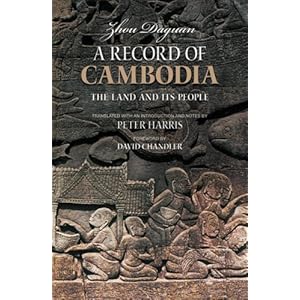
Chinese diplomat Zhou Daguan penned his Record of Cambodia in this era, which still remains the only eyewitness account of the Khmer capital at Angkor.
Simultaneously, Marco Polo was making his unforgettable journeys through China. While Marco ventured into the mountainous regions of Southern China he never visited Cambodia like Zhou Daguan.
With the discovery of Khmer people in China, Cambodian researchers are now interested in exploring the connection with modern descendents of both Tai and Khmer people in Xishuangbanna. H.E. Sum Chhum Bun says that the initial research would take between six months and a year to complete and would be compiled into a book and a documentary film.
Similarities to Khmer Culture in China
In researching this story, we found these interesting photos to share.

Xishuanbanna natives display a greeting instantly familiar to Cambodian and Thai visitors.

Nearby forests reminiscent to those of Angkor.

Colorfully dressed Pi-Nong Dai women at a festival.

Umbrellas, a sign of royalty throughout Southeast Asia and India, are featured in Xishuanbanna dances and festivals.

Of special significance is the Xishuanbanna water festival, coinciding with Khmer, Thai and Lao new year celebrations on April 13-15 each year.

Around a central square featuring an elephant fountain the Xishuanbanna water festival is as wet as in Cambodia, Thailand and Laos.

Far from the Khmer empire, naga dragons still protect sacred places.

Labels: Angkor, Khmer, Khmer Women, Twelve Thousand Rice Fields, Xishuangbanna
» Read more!
Wednesday, 09 March 2011 15:00
Dara Saoyuth
Phnom Penh Post
 People are sitting in a room looking at a large TV screen. They are watching a person on the screen and if they want to speak, they have to get out of their seats and go to a desk and talk in a microphone so that the person on the screen can hear and respond. This is the method employed by Sam Rainsy Party members to communicate with their leader, Sam Rainsy, who is now living in self-exile in France.
Sam Rainsy was convicted in January 2010 of destroying public property and racial incitement with Vietnam by pulling up border posts along the Vietnamese border in Svay Rieng province in 2009. On March 1, 2011, Cambodia’s Supreme Court rejected his appeal and his sentence of two years in jail still stands.
“The court is used as a political tool to shut Sam Rainsy’s mouth or eliminate him from the political arena since he is the leader of the opposition party,” said Yim Sovann, a spokesman for the Sam Rainsy Party.
On the other hand, Cheam Yeap, a senior Cambodian People’s Party lawmaker, said the ruling party did not order Sam Rainsy to remove the border posts. “Our country has law, so Sam Rainsy has to face court because of his wrongdoing, and if one day in the future I do something wrong, of course, I will face the court as well,” said Cheam Yeap.
A press release issued on February 22 by the Cambodian Center for Human Rights stated “the convictions against Sam Rainsy may leave the country’s largest opposition party without a leader at the next general election”.
Sam Rainsy fled the country in early 2009 and will serve 12 years in jail if he returns to Cambodia because in a separate case, the Phnom Penh Municipal Court sentenced him to an additional 10 years in jail on charges of forging public documents and disinformation after convicting him of disinformation and falsifying public documents.
The executive director of the Khmer Institute of Democracy (KID) in Cambodia, Hang Chhaya, said what has concerned him is that Cambodia is a democratic country, so Sam Rainsy’s case should not have reached the level of removing his parliamentary immunity and sentencing him since he had rights as a politician. “What the ruling party want is to make a good leader who people see, love and support, have to stay abroad as long as possible,” said Hang Chhaya.
While Prime Minister Hun Sen can stand and talk to CPP members and his supporters directly, Sam Rainsy needs support from technology to be able to communicate with SRP members and supporters.
However, Yim Sovann said the fact that Sam Rainsy is not in Cambodia is not a problem for the party. “If you want to meet the party leader, we can make a phone call or video conference that you can see the picture and there is no difference in communication by having or not having him present,” said Yim Sovann, adding that Sam Rainsy is still the party leader who leads meetings and keeps communicating between all levels of leaders and members.
While the frog tries harder, the snake also tries harder
To gain more support in the upcoming election, the HRP and SRP have been working on merging their parties. After the 2008 national election, on January 15, 2009, Sam Rainsy and Kem Sokha signed on a joint declaration officially establishing the Democratic Movement for Change. Since then the alliance has not reached 100 percent agreement and recently each party created a working group of five people to discuss the merger.
Mu Sochua, a SRP lawmaker and one of the five people in a merger group on the SRP side, said some conflict of ideas and misunderstandings from the past were the reasons for slowing the merger.
However, she said she believed it would be successful soon. “We are democratic people and we have the same goal,” Mu Sochua said.
Mu Sochua said she was sure of success in the next election when the alliance reaches full agreement. She gave as an example Kampot province, where the SRP needs about 10,000 votes more to get one more parliament seat, however the HRU gets more than 14,000 votes. “Because we were not united at that time, about 14,000 votes were useless because none of us got any seats in parliament,” she said.
“Previously, we didn’t work well on the merger, but now we have a clear objective and we have clear steps to take,” Keat Sukun, a coordinator in merger group on the HRP side, said. He added that both sides had recently found common ground for a lasting unification of the parties.
Keat Sukun said that in Cambodia, each party cannot do everything alone and unification is very important in terms of exchanging human resources.
“It is the right decision to join as an alliance,” said Phnom Penh-based political analyst Chea Vannath, who explained that the seat allocation formula in Cambodia makes small political parties waste a lot of votes if they are not united.
However, she said she’s unsure if this unification can last much longer because, based on her observations, it seems easy to break up.
“To unite successfully, it’s very important to have trust building between the two parties, as wife and husband do,” said Chea Vannath. “We have to think that there will be a lot of obstacles with each step we take, and if we can trust each other, this unification will last forever.”
“While the frog tries harder, the snake also tries harder,” said Cheam Yeap, explaining that the ruling party was also working harder. Cheam Yeap said the ruling party did not fear the union of opposition parties.
However, he added: “All CPP members are not advised to ride a horse with a free hand.” He added that they are not just sitting there happy with their victory, but they are working to keep it.
Labels: Cambodia's Court, Cheam Yeap, Sam Rainsy, Sam Rainsy Party
» Read more!
February/March 2011
Staff | WOMEN IN DEVELOPMENT
USAID FRONTLINE
 The exchange of sex for money remains a major driver of the spread of HIV/AIDS throughout Southeast Asia, but the karaoke bars, massage parlors, beer gardens, and other settings where these transactions are brokered remain some of the most viable employment venues for vulnerable women.
In Cambodia—where more than 10 percent of female entertainment workers are infected with HIV, and more than 25 percent of these women and girls report having no education—USAID programming supported by the U.S. President's Emergency Plan for HIV/AIDS Relief (PEPFAR) is implementing a new approach to reducing HIV risk by focusing on the central principle of the Global Health Initiative: that the health and well-being of women is key to the health of all.
Instead of exclusively focusing on distributing condoms and conducting risk-reduction education for high-risk women, the SmartGirl program aims to improve the sexual and reproductive health of its beneficiaries more broadly through linkages to personal counseling, voluntary family planning services, clinical care, savings schemes, and legal services.
Late last year, the program received a PEPFAR Heroes award from the Office of the U.S. Global AIDS Coordinator for its efforts to reduce the risks associated with entertainment work, while also supporting women in the pursuit of other employment.
"We're committed to having women in the driver's seat," said Michael Cassell, the coordinator of the PEPFAR initiative in Cambodia. "SmartGirl is largely designed and run by entertainment workers to address their own felt needs. And the skills they acquire in the process help many of them to consider and pursue other careers, including ones in HIV and reproductive health service delivery."
Avoiding "Message Fatigue"
Previous HIV/AIDS programs have focused on raising awareness of HIV, and educating people about how to avoid getting infected. But by demonstrating that staying healthy is key to the pursuit of education, wealth, happiness, and other personal objectives, SmartGirl strives to engage beneficiaries while sidestepping some of the "message fatigue" and monotony associated with more didactic approaches. Education sessions are run by peers, cover a broad range of topics that are updated regularly, and offer referrals to free HIV testing, family planning, and other services.
During a recent visit to a SmartGirl club in Phnom Penh, U.S. Rep. Laura Richardson (D-Calif.) was inspired to join program beneficiaries in a rousing karaoke rendition of Gloria Gaynor's "I Will Survive," noting her appreciation for the leadership of club members in providing health education and referrals to health care, vocational training, and legal services to other entertainment workers.
"I am so proud of you," Richardson told the club members.
The SmartGirl program, which is implemented by USAID-partner Family Health International, currently provides services to 12,600 of the estimated 35,000 women working in clubs and night spots in Cambodia. The program is funded by PEPFAR but is consistent with the overarching objectives of the Global Health Initiative, the U.S. government's six-year, $63 billion commitment to help partner countries strengthen their health systems, with a particular focus on improving the health of women, newborns, and children.
"Almost 30 percent of entertainment workers in Cambodia report having an abortion in the past year, suggesting inconsistent condom use and unmet needs for family planning," said Cassell. "By linking these women to sexual and reproductive health services, we stand to prevent new HIV infections while also reducing maternal mortality—the latter arguably being Cambodia's biggest public health challenge."
A Model Approach
Cambodia is home to one of the most renowned national success stories in the fight against HIV/AIDS. Late last year, the country received international recognition in the form of a Millennium Development Goals country award for cutting adult HIV prevalence in half, from 2 percent to 0.9 percent between 1998 and 2006, while extending HIV-related care to more than 70 percent of HIV-infected adults, and HIV treatment to more than 90 percent of eligible individuals.
The estimated proportion of sex workers infected with HIV is down to around 10 percent from over 21 percent in 2003, according to the 2006 HIV Sentinel Surveillance (HSS). However, the maternal mortality ratio in Cambodia remains the second highest in East Asia.
"We're particularly excited about the potential of this program to serve as a model for the scale up of higher quality and more holistic approaches to address the needs of populations at high risk for HIV infection," said Cassell. "Many of the service delivery and referral protocols pioneered through SmartGirl are now being implemented as part of Cambodia's national program with support from the Global Fund to Fight AIDS, Tuberculosis and Malaria."
In the past decade, the U.S. government has invested more than $150 million in HIV/AIDS programs in the Southeast Asian nation, providing almost 40 percent of the resources available to the national response.
Labels: AIDS, HIV, Women
» Read more!
Published: Wednesday, Mar 9, 2011, 14:27 IST
Place: PHNOM PENH | Agency: Reuters
 The World Bank called on the Cambodian government on Wednesday to halt the eviction of another 10,000 people at a controversial real estate development and offered to help those who had lost their homes.
The dispute centres on land around Boeung Kak Lake in the capital, Phnom Penh. Activists say around 2,000 families have already been evicted and forced to accept minimal compensation after the government leased the land to a private developer.
"We are deeply troubled and frustrated about the people who are being forced from their homes," World Bank President Robert Zoellick said in a statement.
He said the World Bank would help those facing eviction and that it had offered the government financing and technical advice.
"We are open to other ways to help these people. We have repeatedly called on the government to end the evictions. We are seeking a positive government response," he added.
Land ownership is a big problem in the Southeast Asian country, where legal documents were destroyed and state institutions collapsed under the Khmer Rouge regime of the 1970s and the civil war that followed.
The World Bank had been helping the authorities with land management and administration but the government pulled out of the project in September 2009 because of rows over evictions.
"We call on the government to stop the evictions and to find a way to help the people. Over the last decade Cambodia has experienced high levels of economic growth, leading to increased pressure on land," said Annette Dixon, the World Bank's country director in Cambodia.
The World Bank statement acknowledged that people evicted from around Boeung Kak Lake had been "displaced in violation of the policies the Bank agreed with the government for handling resettlement" and that the Bank had been slow to respond.
A Cambodian government spokesperson declined to comment. An official working on the case said those who had already left the lake area had gone voluntarily and he denied activists' claims that the remaining families had been given a deadline to leave.
"We have accepted residents' request for talks on this on Friday," said Keut Chhe, deputy cabinet chief of Phnom Penh City Hall.
He said he could not comment on whether the government would renew its work on land management with the World Bank.
Labels: Boeung Kak Lake, eviction, landgrabbing, World Bank
» Read more!

 Cambodia's Curse: The Modern History of a Troubled Land By Joel Brinkley Public Affairs, 416 pages, $27.99In this system, students learn few useful skills except how to survive under a corrupt regime, writes journalist Joel Brinkley. For the lucky few who pay, and sometimes even murder, their way to the top of the government, life is good. But for the ordinary farmers and laborers, kickbacks are simply an expensive roadblock to economic and social advancement.


