Editorial | Articles about Cambodia | Khmer

Friday, June 22, 2007

Global Witness Report To Help Open Hun Sen's Eye to 'Festering' Corruption


SEP20070612045004
Phnom Penh
Sralanh Khmer in Cambodian 02 Jun 07 pp 1, 4
["This Issue's Comment"]

Hun Sen's Cambodian Government has been deeply bogged down in all sorts of corruption pointed out by national and international circles after the prime minister arrogantly asked on Wednesday, "How this corruption looks like? Can anyone tell me where it is?" From now on, the prime minister surely will have a splitting headache reading a mountain of reports on corruption, documents that have piled up as high as Mount Everest because the corruption monitors have prepared them to open the prime minister's eye and make him see what really happens around him.

The forest crime report Global Witness released yesterday shows only the minister of agriculture and the head of the Forest Administration [FA], together with seven generations of the prime minister's relatives, as ringleaders behind the current waves of forest crimes in Cambodia. Although Agriculture Minister Chan Sarun and FA Chairman Ti Sokun softly denied the charges yesterday, this kind of rebuttal is not enough. The government must investigate, for this is an example of corruption that the prime minister has never seen and never thought possible, since he used to observe that corrupt persons never wear collars or bear tattoos on their foreheads for him to recognize them.

For the past few years, the prime minister who used to boast that he could see through everybody has been totally blind to corruption. For instance, he was blind to the recent corruption case in four ministries that caused the World Bank to suspend aid worth several dozen million dollars. Later, we do not know why the prime minister quietly took over $10 million from the national budget with which he paid back to the donors on behalf of the corrupt officials.

The general public has heard the prime minister roar like a Cyclops that if he could not suppress the forest crimes he would cut his own head. There was one time when the prime minister claimed as if he meant it that he would step down if he could not stop illegal logging. The prime minister has made this kind of vociferation for years and on many occasions. But forests continue to be decimated under the blows of the criminals' chainsaws. Just as exposed by Global Witness in its report yesterday, these logging criminals include a maternal cousin of the prime minister, a close friend of Mrs. Bun Rany Hun Sen, Agriculture Minister Chan Sarun, FA chief Ti Sokun, and their father-in-law and many relatives who have operated in a close network to devastate the forests and make money from the timber trade for their own syndicates and families. General Hing Bun-hieng, commander of the prime minister's bodyguard unit, also has his name on the logging criminals' list.

In years past as well as this year economic experts and governance specialists have shown the figures of the loss in national incomes caused by the people close to the prime minister. They have estimated that each year some $400 to $500 million has been lost to illegal logging alone. Last year and this year, the share from corruption and land-grab activities by the powerful people in the group around the prime minister and the Mafia-like money-laundering tycoons has spread far and wide all over Cambodia. Unfortunately, the prime minister has been left in the dark. He cannot see even if he is looking at it.

Those who are monitoring the prime minister's government stewardship say that crimes, murders, and all kinds of corrupt practice of large and medium scales usually are the works of the prime minister's own blood relatives. Several of his cousins have been accused of involvement in land grab. One of his nephews shot and killed people. Close relatives of the prime minister are implicated in logging and oil smuggling, and so on. In other words, the prime minister has become very notorious on the national and international stages since the outset thanks to the exploits of the members of his extended family.

The Cambodian prime minister claims himself to be strong and smart in all departments. Whenever he gets hold of a microphone, he rambles on and on for hours. Most of the time, his speeches include threats and useless nonsense, especially excessive laudatory mentions of his own children and relatives. The incitement, menace, and temperamental outbursts of the prime minister in his frequent speeches give listeners the impression that he really means business. Over the past decade, however, the prime minister has made nothing but empty promises, meaning that whatever he has said is just part of his misleading oratory skill. The prime minister has proved to be politically incompetent and unwilling. Frankly speaking, he does not have a shred of national conscience in him. Such incompetence and obvious ignorance have driven the prime minister deeper into darkness to the point that he can no longer see or understand the widespread corruption tentacles that are constricting the Cambodian society, plunging it into growing darkness.

Nevertheless, the latest Global Witness report, which identifies the criminals behind the destruction of the national forests as being part of the prime minister's family tree, will help to open the prime minister's eye to reality. On the contrary, if the prime minister is not blind but pretends to be so, he will not escape retribution because in the future the parliamentarians will summon the ministers or even the prime minister to answer in person (not in writing) to their questioning at the National Assembly concerning all cases involving corruption that the current prime minister cannot see or grasp.

Anyway, one sentence uttered by the prime minister who pretends to be ignorant goes like this: "There is corruption in every country." This means that the prime minister is not completely unaware of the festering corruption in his government. In making this remark, the prime minister wanted to cover up and protect the corrupt people and criminals of all sorts and in all places who are members of his group or of his family.

Labels: ,


» Read more!

Sunday, June 17, 2007

Lost Temple in the Jungle, Swimming Pool Mural

Lost Temple in the Jungle, Swimming Pool Mural

Design based on Angkor Wat (Tomb Raider)

http://www.sacredart-murals.co.uk/Mural%20Gallery/angkor-wat-pool-mural-1.html

Page 1
Location - Tenterden, Kent
Wow, what an awesome commission this was! My job was to transform a stark and cold feeling swimming pool area into a warm and welcoming haven of relaxation. The work took three months from conception to completion, and included remodelling of the jacuzzi, building a fiberglass tree and covering the whole mural with a protective coating of acrylic matte varnish.
I've never actually been to Cambodia, but I simply have to go to Angkor Wat now!


Labels:


» Read more!

Saturday, June 16, 2007

Still coping with the legacy of the 'killing fields'

Still coping with the legacy of the 'killing fields'
http://www.alertnet.org/db/crisisprofiles/KH_REC.htm?v=timeline

1863 - The Protectorate Treaty is signed between France and Prince Norodom. The Khmer king hands over the conduct of foreign relations to France, which in return recognizes his sovereignty.
1884 - France forces King Norodom to accept direct control from France.
1887 - French administration of Cambodia and Vietnam is joined to form Indochina Union. Laos is included in 1893.
1922 - Prince Norodom Sihanouk is born.
1928 - Sarloth Sar (Pol Pot) is born
1940 - Japanese occupation of Indochina begins after deal is signed between the Vichy Government in France and Japan.
1945 - Japanese occupation ends. France says Indochina will be granted partial self-government.
1946 - France recognizes Cambodia as an autonomous kingdom within the French Union, passing a new constitution allowing Cambodians to form political parties.
1947 - French troops suppress Khmer rebellion
1950 - Norodom Sihanouk becomes Prime Minister
1951 - The Khmer communist movement is founded. It becomes known as the Kampuchean Communist Party (KCP) in 1965.
1953 - Cambodia becomes independent from France.
1954 - France's colonial rule in Vietnam ends at the battle of Dien Bien Phu.
1955 - King Sihanouk abdicates in order to participate in the political arena and becomes Prime Minister. His father, Prince Norodom Suramarit, becomes king.
1960 - Sihanouk's father dies. Sihanouk becomes head of state.
1965-66 - The United States sends ground troops into South Vietnam to fight against the communist north. Sihanouk breaks off relations with the US and allows North Vietnamese guerrillas to set up bases in Cambodia.
1969 - US bombing of Viet Cong positions in Cambodia begins.
1970 - Sihanouk is deposed in a coup while abroad. The prime minister, General Lon Nol, seizes power and proclaims the Khmer Republic and orders his army to fight the North Vietnamese in Cambodia in support of US forces. From exile in Beijing, Sihanouk forms a guerrilla resistance movement, forming the Royal National Union of Kampuchea (GRUNK). US and South Vietnam infiltrate Cambodia and the Viet Cong establish control around the Angkor Wat temples in the north. The Cambodian army begins fighting both the North Vietnamese and the communist Khmer Rouge.
1973 - The Paris Peace Accords signal the withdrawal of Vietnamese troops. The KCP begins widespread recruitment of young peasants.
1975
Apr 17 - Lon Nol is overthrown. The Khmer Rouge led by Pol Pot occupy Phnom Penh. Sihanouk briefly becomes head of state. City dwellers are evacuated to rural work camps. The Khmer Rouge declare "Year Zero".
1976 - Sihanouk resigns as head of state. The country is re-named Democratic Kampuchea with Khieu Samphan as head of state and Pol Pot as prime minister.
1977 - Fighting breaks out with Vietnam as diplomatic relations are broken off.
1978 - Vietnamese forces occupy provinces to the east of the Mekong river following several Khmer incursions into Vietnamese territory.
1979-80 - The Vietnamese take Phnom Penh after a major offensive, proclaiming the People's Republic of Kampuchea. Pol Pot and Khmer Rouge forces flee to the jungle along the border with Thailand.
1980 - Khmer Rouge retain Cambodia's seat at the United Nations.
1981 - The pro-Vietnamese Kampuchean People's Revolutionary Party wins the elections to the National Assembly. The international community refuses to recognise the new government. Prince Norodom Sihanouk, Son Sann and Khieu Samphan announce their agreement to form a coalition to fight against Vietnam's occupation of Cambodia.
1985 - Hun Sen becomes prime minister.
1989 - Formal withdrawal of Vietnamese troops as Soviet support declines. The country is re-named the State of Cambodia.
1991 - An international peace agreement is signed in Paris. A UN Transitional Authority in Cambodia (UNTAC) shares power temporarily with representatives of the various factions. Sihanouk returns home after thirteen years in exile and becomes head of state.
1993 - The royalist Funcinpec party wins the most seats in the general election followed by Hun Sen's Cambodian People's Party (CPP). A three-party coalition is formed with Funcinpec's Prince Norodom Ranariddh as prime minister and Hun Sen as deputy prime minister. Sihanouk becomes king again and the country is re-named the Kingdom of Cambodia. Khmer Rouge continue attacks on government forces.
1994 - Khmer Rouge movement outlawed by Cambodia's National Assembly. Thousands of Khmer Rouge guerrillas surrender in government amnesty.
1996 - Khmer Rouge forces split, with Ieng Sary defecting to the government in return for an amnesty.
1997 - Pol Pot executes Son Sen and is in turn placed under house arrest for life. Hun Sen stages a coup against the prime minister, Prince Ranariddh, and replaces him with Ung Huot. Cambodia's membership of the Association of Southeast Asian Nations (Asean) is delayed.
1998 - Pol Pot dies and the Khmer Rouge finally collapses. Nuon Chea and Khieu Samphan surrender to Hun Sen. Ta Mok remains the last Khmer Rouge leader still at large. General elections return CPP/Funkinpec coalition to power, dominated by Hun Sen. Ranariddh is tried in his absence and found guilty of arms smuggling, but is then pardoned by the king.
1999 - A United Nations Commission of Experts recommends the creation of an international tribunal and truth commission to judge the crimes of the Khmer Rouge period. Mok is captured by Cambodian army and sent before a military tribunal. Former Tuol Sleng prison commander Deuch is also arrested.
2001 - Donor nations conclude a 2-day conference on aid to Cambodia in Tokyo with combined pledges of $560 million.
2002 - First multi-party local elections. The National Electoral Commission (NEC) announces that the CPP has secured a sizeable victory, winning in all but 23 of 1,620 communes.
2003 - Prime Minister Hun Sen's CPP sweeps to victory in general elections, but falls short of the two-thirds majority needed to govern outright.
2004
July - Hun Sen is re-elected after CPP strikes a deal with the royalist Funcinpec party. Hun Sen remains premier and Ranariddh becomes speaker of the National Assembly.
Aug - Parliament ratifies kingdom's entry into World Trade Organisation (WTO).
Oct - King Norodom Sihanouk abdicates. His son Norodom Sihamoni is crowned as his successor. 2005 February - Opposition leader Sam Rainsy leaves Cambodia for exile in France after he is stripped of parliamentary immunity.
2005
Apr - Tribunal to try surviving Khmer Rouge leaders is approved by UN.
Dec - Sam Rainsy is convicted by a Cambodian court of defaming Hun Sen and is sentenced to nine months in prison.
2006
Feb - Sam Rainsy receives a royal pardon and returns to Cambodia. The courtroom and administrative offices of the UN-backed Special Tribunal open in a military complex just outside Phnom Penh.
July - Former Khmer Rouge military chief, Ta Mok, dies in prison aged 82 without ever facing justice.
2007
Jan - Human Rights Watch accuses the Cambodian government of interfering in the tribunal. The courts are yet to launch either an investigation or a prosecution.
June - The trials of surviving Khmer Rouge leaders move a big step closer as international and Cambodian judges agree the rules of the tribunal.

Labels: ,


» Read more!

Wednesday, June 13, 2007

IMF Statement at the Conclusion of the 2007 Article IV Discussions with Cambodia

IMF Statement at the Conclusion of the 2007 Article IV Discussions with Cambodia

Press Release No. 07/128
June 12, 2007

The following statement was issued in Phnom Penh on June 5, 2007 by John Nelmes, International Monetary Fund (IMF) Resident Representative in Cambodia:

"An IMF mission, led by Jeremy Carter, Adviser in the IMF's Asia and Pacific Department visited Cambodia during May 22 - June 5, 2007 to conduct the Article IV consultation1. During the visit, the mission took stock of recent economic and financial developments, and held policy discussions with Prime Minister Hun Sen and Senior Ministers and officials of the Royal Government of Cambodia (RGC) on their macroeconomic and structural policies. The mission also met representatives from the National Assembly and the Senate, Cambodia's development partners, business community, research think-tanks, labor unions, and non-governmental organizations.

"Prudent macroeconomic policy implementation has provided stability, in turn boosting investors' and consumers' confidence, and has underpinned very strong macroeconomic performance: impressive rates of growth have been sustained, inflation remains low, external debt is sustainable, and headway is being made in a number of important structural reforms. The mission noted that the environment provides ideal conditions to re-energize reforms in areas where progress has been less rapid, and to address the key constraints to broader poverty reduction.

"Following estimated 2006 growth of 10¾ percent, real GDP is expected to increase by around 9 percent in 2007, driven by an expansion of agricultural production and continued robust activity in tourism, garment exports, and construction. Services, in particular finance and telecommunications, are increasingly contributing. These broad trends are projected to continue in the near term, and with continued high levels of foreign direct investment, should result in growth of around 7½ to 8 percent in 2008. Risks to the outlook include competitive pressures in the garment sector resulting from Vietnam's WTO accession, the lifting of safeguards on China's garment sector at end-2008, and possible adverse weather conditions that could affect agriculture.

"Inflation ticked up to around 4 percent recently, mainly reflecting rising fish prices and a pass-through of higher international oil prices. Assuming broadly stable international oil prices for the rest of the year, inflation should remain in the low single digits, though the mission and the authorities agreed on the need to be vigilant for signs of underlying demand pressures on inflation should they arise.

"The external current account deficit (excluding official transfers) narrowed to 7¼ percent of GDP in 2006. A slight further improvement in 2007 is projected as a result of strong growth in garment exports and tourism. The riel has remained broadly stable in bilateral and effective terms, and gross international reserves rose to $1.2 billion at end-April 2007.

"Revenue performance in 2006 was strong due to vibrant economic activity and improved administration supported by the Public Financial Management (PFM) reform program. Strong performance continued in 2007 and budgeted revenue targets are expected to be exceeded by large margins. Government expenditure has been slow, due in part to initial difficulties in implementing new spending procedures. The mission urged that these difficulties be resolved quickly, and agreed that delayed expenditure should be accelerated to ensure budget expenditure targets are fully met. On this basis, the overall government deficit is projected at 3¼ percent of GDP in 2007, financed by concessional foreign funds.

"Fiscal policy discussions centered on improving the level and quality of revenue and expenditure, to achieve the development and poverty-reduction goals set out in the National Strategic Development Plan (NSDP). Further sustained revenue increases could be achieved with continued improvements in administration and enforcement, though further consideration should be given to policy measures, including property taxation and a widening of the VAT base. The mission supported the government's policy of steadily raising public sector wages as revenue increases allow, and welcomed commitments to increase productive capital investments, including expediting the implementation of poverty reducing projects funded with the US$82 million received under the IMF's Multilateral Debt Relief Initiative (MDRI).

"The PFM reform program has achieved good progress, including the introduction of new government treasury accounts and budgetary classification to better monitor poverty reducing expenditures. The mission looked forward to implementation of plans to improve cash management and government banking arrangements.

"Oil production could significantly increase national income in the long term, and associated fiscal revenues would provide vital financing for development spending. Given the substantial uncertainty still surrounding the level of reserves and the timing of production, the mission cautioned against undertaking any large oil infrastructure projects, and noted that large commercial borrowing ahead of uncertain oil revenues would be imprudent. The mission encouraged the Government to make early progress on developing the institutional and legislative underpinnings for petroleum taxation and revenue management, including adopting the Extractive Industries Transparency Initiative (EITI).

"The banking sector continues to expand very rapidly, with deposits and lending rising on the order of 40 percent. Growth in the banking system is facilitating economic development, and reflects rising confidence. The fast pace of growth requires strong banking supervision to ensure that banks are weighing all of the lending risks properly.

"Finally, the mission welcomed the authorities' commitment to the ambitious WTO-related trade facilitation reform agenda. Accelerating progress is important, particularly on key elements of the legal framework and in reforming customs valuation."

1 Under the Article IV consultation, IMF staff conduct surveillance and analysis of economic developments and policies of member countries for discussion by the Executive Board. The last Article IV consultation with Cambodia was undertaken in 2006.

IMF EXTERNAL RELATIONS DEPARTMENT

Public Affairs Media Relations
Phone: 202-623-7300 Phone: 202-623-7100
Fax: 202-623-6278 Fax: 202-623-6772

» Read more!

Opening Remarks at the Launch of the Cambodia Equity Report 2007: Sharing Growth

Opening Remarks at the Launch of the Cambodia Equity Report 2007: Sharing Growth

Speech at the Joint Royal Government of Cambodia and World Bank Conference

Opening remarks

by

Nisha Agrawal, Country Manager for Cambodia
Phnom Penh, June 12, 2007

The World Bank

Samdech Prime Minister
Excellencies, Ladies and Gentlemen

Good morning. Today we are most honored to have Samdech Prime Minister Hun Sen here amongst us to deliver a keynote address to this joint conference to launch the Cambodia Equity Report 2007 entitled “Sharing Growth”. On behalf of the World Bank, I would like to extend my warm welcome to the Prime Minister, and to all the other distinguished participants, to this launch of the Cambodia Equity Report, which has been organized jointly with the Royal Government of Cambodia.

Last year, in February 2006, at a similar gathering, also honored by the presence of the Prime Minister, we launched the Poverty Assessment for Cambodia. The Poverty Assessment had very good news for Cambodia. It found that during the past decade, Cambodia had made significant progress in reducing poverty. The proportion of the population living below the national poverty line had fallen from an estimated 47 percent in 1994 to 35 percent a decade later. Poverty had fallen in the countryside as well as in the towns, though progress had been more rapid in urban areas. This improvement in the lives of poor people was also reflected in many other indicators of welfare: for example, schooling and health care had also improved significantly.

The Poverty Report, however, had also highlighted the fact that while poverty had declined, inequality had risen dramatically during the same period. It noted that, during the last decade, while the per capita consumption of the richest 20 percent of the population grew by 45 percent, the consumption of the poorest 20 percent grew by only 8 percent—in other words, the income of the richest group grew by about six times the rate of the poorest. This had led to a rapid rise in inequality in Cambodia. This finding raised concern in the minds of policymakers, and Senior Minister Keat Chhon, on behalf of the Government, requested the World Bank to focus the 2007 Report on equity issues, with a view to understanding what lay behind the rise in inequality in the last decade, and how to prevent further rises in inequality that could be potentially destabilizing.

This is what we have attempted to do in this Equity Report. And again, we have very good news for Cambodia. Drawing on survey and other data, and on research done by Cambodian and international researchers, this report concludes that the rise in inequality occurred primarily in the early part of the decade (circa 1994-97) and primarily within rural areas; and that there was no significant change in inequality during the second half of the period, i.e., between 1997-2004, or within urban areas. The findings suggest, therefore, that the current pattern of growth is not structurally destabilizing. In other words, there is nothing inherent in the current pattern of growth that would suggest that Cambodia could not also follow the same path in the future that has been taken in earlier decades by the East Asia Miracle economies—of high and equitable growth and rapid poverty reduction—provided, of course, that it also makes the same sound policy choices that its neighbors made in earlier decades.

The Report argues that Cambodia’s changing distribution of income and consumption is consistent with the process of transition from a planned to an open market economy and the accompanying growth of incomes. This transformation has promoted better resource allocation, expanded the range of gainful activities, and widened the distribution of earnings. Aided by robust economic growth and improved capacity for implementing public policies, Cambodia has seen most other indicators of welfare—for example, health and education—become more equal over time. While a radical shift of development strategy is not needed, improvements in public policies and public spending could lock in the gains that have been made so far and ensure that these gains are replicated in the future.

The findings of the Report, and the lessons from the East Asia Miracle economies, point to the following sets of Government actions:

First, continuing with the economic reforms necessary for creating high and diversified growth, resulting in expanding opportunities for young Cambodian men and women. The recent IMF Article IV mission confirmed that Cambodia continues to maintain prudent macroeconomic policy and generate high economic growth. The last three years have seen double-digit growth underpinned by an expansion of agricultural production and continued robust activity in tourism, garment exports, and construction. Services, particularly in the financial and telecommunications sector, are also increasingly contributing to growth.

In Cambodia, as in any other country in the world, the creation of well-paying jobs is necessary to move people out of poverty. This is especially important in Cambodia, however, given its very young population—in 2004, almost 40 percent of the population was below the age of 15 years. An estimated 300,000 young men and women are now entering the labor force as a result of the baby boom in the 1980s. This is roughly the same size as total employment in the garment sector. In other words, just to keep pace with the new entrants to the labor force, an entire garment sector needs to be created every year in terms of employment. Measures to improve the investment climate—especially for small and medium enterprises--need to continue to be taken to ensure that the youth do not add to the underemployment in the countryside or lead to even higher rates of urban unemployment, but instead contribute to growth and development through productive employment. In 2004, only 20% of workers in Cambodia were in a paid job (the rest were self-employed), and only half of those were in the formal economy. And despite the rapid growth of the manufacturing sector, in 2004, it still employed only 8% of the labor force of Cambodia.

Second, focusing on the rural economy. Samdech Prime Minister, as you said at the recent Second Cambodia Economic Forum entitled “Development of the Rural Economy is Key to Poverty Reduction”, “improving Cambodia’s rural economy and livelihoods remains a daunting challenge for the Royal Government due to many complex structural constraints and weaknesses of market infrastructure.” We were very pleased that you suggested to the Supreme National Economic Council (SNEC) that the Forum should try to address the challenges facing rural Cambodia and we had a very lively debate and discussion on this topic at that Forum.

This Report focuses on one of the most critical issues raised in the Forum—land management. The Report notes with concern that without off-farm employment or self-employment alternatives, over half a million landless poor find it hard to improve their situation or participate in the economy. Levels of inequality in land ownership are high in Cambodia, and significantly higher than most other countries of Asia. We believe that the necessary policy framework for land management is now in place and needs to be implemented more vigorously: systematic land titling to improve tenure security could be accelerated; the Economic Land Concessions (ELC) Subdecree could be enforced to ensure that ELCs are actually being used for investments, growth and job creation rather than being held idle for speculation; and the Social Land Concessions (SLC) Subdecree could be implemented to improve access to land for poor landless households.

Third, building upon progress to date with further improvements in the quantity, quality and affordability of schooling and healthcare. The Report argues that access for all to basic education and basic healthcare is the best way to ensure shared growth by ensuring that families don’t get stuck in poverty traps for successive generations. In recent years, measures of education and health outcomes have shown a broadly positive trend towards greater equality over time. Gains in education in recent years are notable for their pro-poor, pro-girl bias. Primary enrolment has increased fastest amongst these traditionally under-represented groups, resulting in shrinking urban-rural, male-female, and rich-poor gaps in literacy rates amongst the younger cohorts who have more recently left the (improving) schooling system.

Nevertheless, significant differences remain between urban and rural populations and rich and poor households in access to services and outcomes. While access to primary schools and, to a lesser degree, health centers has become more equal over the last decade, poor households still live significantly further than the rich from secondary schools and hospitals. And despite progress over the past years, access to improved water supply and sanitation facilities is virtually non-existent in most of the countryside. Efforts will need to be made to ensure equitable access to these services.

The Report also argues that while some progress has been made, gender-based inequalities remain significant. Positive trends towards greater equality include increasing girls’ enrolment in primary education (and resulting rise in female literacy rates) and expanded employment opportunities for young women provided, in particular, by the garment sector. However, women lack significant voice in social or political affairs, with limited representation in Government or policy-making processes, from the local to the national. In this context, the recent sharp increase in the proportion of women commune councilors--from 8.7 percent in the 2002 elections to 15 percent in the 2007 elections—is especially welcome and noteworthy. We very much hope to see this success replicated at national levels in the forthcoming National Assembly elections to be held in 2008 and in senior positions in the new Government that is formed subsequently.

Fourth, and finally, underpinning service delivery reforms with stronger and more responsive state institutions will be critical. The experience of East Asia suggests that to establish their legitimacy and win the support of society at large, East Asian leaders established the principle of shared growth, promising that as the economy expanded, all groups would benefit. Explicit mechanisms were used to demonstrate the intent that all would have a share of future wealth. Korea and Taiwan, China, carried out comprehensive land reform programs; Indonesia used rice and fertilizer price policies to raise rural incomes; Malaysia introduced explicit wealth-sharing programs to improve the lot of ethnic Malays relative to the better off ethic Chinese, and so on. Whatever the form, these programs demonstrated that the Government intended for all to share the benefits of growth.

International experience from other regions also suggests that state institutions that reflect the interests of the poor and promote equality of opportunity foster more stable politics and more sustainable long term growth than those which concentrate power and wealth. Building such institutions is often hard in post-conflict states. Cambodia is undertaking important reforms in public financial management that need to be sustained and surveys also indicate that citizens find local governments to be increasingly responsible and responsive. At the same time, however, surveys identify informal fees as a critical burden on firms, and reveal corruption and lack of trust in state institutions as major problems—for example, in a survey carried out for this Report, only 18% of the respondents felt that judges were honest and only 29 percent felt that the police were honest. Reforms in these areas—as well as in building a meritocratic civil service—need to be initiated urgently.

In conclusion, I would like to say that the Poverty Assessment was an important report, which changed widely held perceptions that poverty had not declined in the last decade in Cambodia. This Equity Report is also an important report that we hope will similarly change some widely held perceptions about trends in inequality. Both Reports highlight the importance of basing analysis and policy prescriptions on sound data—both quantitative and qualitative. They highlight, in particular, the important work of the National Institute of Statistics, and the need for producing high quality and regular household surveys in the future that can be used to track progress in poverty and equity issues in the future.

Finally, I would like to say that we are pleased to launch this report today and we would like to thank all those in Government--in particular the SNEC team who gave generously of their time as always--research institutes, NGOs and other donor agencies who have provided excellent inputs and feedback during the drafting process. Once again, I would like to thank you for your participation in this workshop, and I look forward to a stimulating discussion today.


Source: http://web.worldbank.org/WBSITE/EXTERNAL/NEWS/0,,contentMDK:21368954~pagePK:34370~piPK:34424~theSitePK:4607,00.html


» Read more!

Thursday, June 07, 2007

Cambodia: Can't See the Forest for the Thieves

The author, with Global Witness in November 2005, investigating a truck transporting
logs to Phnom Penh. The driver of this truck claimed he was carrying "mango trees"
(Global Witness photo).

Liam Cochrane | Bio | 06 Jun 2007
World Politics Review Exclusive

The latest report by illegal logging watchdog Global Witness has received the highest accolade an investigative NGO's work can receive from the Cambodian Government: It has been banned. The reason? It exposes the country's largest illegal logging syndicate and its links to senior government officials, including the prime minister. Plus, it details the way the army has been used as a log courier service for the secret trade with Vietnam and China. Now, as Cambodia's annual pledge-a-thon approaches, international donors are scrambling to react to accusations they haven't done enough to protect Cambodia's forests. Global Witness, the U.K.-based logging and blood diamond watchdog, cheekily titled its 95-page report "Cambodia's Family Trees" and printed a cover with framed pictures of Prime Minister Hun Sen -- and the logging kingpins related to him by marriage or political ties -- hanging from a barren tree.


The study took Global Witness three years of surveillance and interviews to complete and is perhaps the most extensive exposé of institutionalized corruption and natural resources pillaging to date. Among the main targets are Hun Sen's first cousin, Hun Chouch, Minister of Agriculture, Forestry and Fisheries Chan Sarun, and Forestry Administration boss Ty Sokhun. So it was little surprise the report ruffled some feathers. "If they [Global Witness] come to Cambodia, I will hit them until their heads are broken," was how the prime ,inister's brother and provincial governor, Hun Neng, responded to accusations that he and his wife were involved in the illicit trade.


Cambodia's Ministry of Information released a statement describing the report as "a personal accusation . . . to cause political conflicts in the country" and ordered the confiscation of any copies already in the Southeast Asian nation. But the fallout adheres to a long-running pattern of government behavior that is accurately predicted within the report.

"Hun Sen responds to even muted criticism by declaring that attempts to remove him will cause the country to fall back into conflict and instability," Global Witness wrote about the leader of a country still traumatized by the killing frenzy of the Khmer Rouge in the 1970s and the bitter civil war that followed. It's not the first time Global Witness has raised the ire of Cambodia's government. Global Witness was appointed by the government as the official monitor of illegal logging, but was fired from the job after its reports uncovered the involvement of military and political figures.

In 2004, copies of the group's report "Taking a Cut" were confiscated at the airport and several international staff were refused entry. Global Witness says the issues of illegal logging and political power are intertwined, with logging bankrolling Hun Sen's private armies, which in turn assure political supremacy for the one-eyed former Khmer Rouge leader, nicknamed the "Strongman."

Log Laundering

Cambodia's ruling powers have long used timber to fund their wars and, in more recent times, their political dominance. In the late 1990s, there was pressure from international donors to crack down on the plunder; the transport of logs was banned and illegal cutting slowed. But lucrative profits and lax laws meant that the chainsaws never really stopped. Over the years there have many creative schemes invented to bypass logging regulations.

The funniest involved logging permits given ostensibly for the purpose of building a platform so the country's parachute regiment could practice jumping off. The most shameless would have to be the tricking of monks into signing documents requesting valuable koki logs for building dragon boats to represent their temples in the annual boat racing festival.

The latest Global Witness report focuses on the use of economic land concessions -- usually plantations -- as a cover for illegal logging. In 2001, Hun Sen inaugurated the Tumring Rubber Plantation and the country's biggest logging cartel went to work.

The Seng Keang Import Export company was owned by Hun Sen's Rolex-wearing cousin Hun Chouch, his ex-wife Seng Keangg and Khun Thong, brother-in-law of the minister of forestry, the official ultimately responsible for protecting Cambodia's trees. Their "plantation" area was located inside the Prey Long forest -- the largest lowland evergreen forest still standing in Southeast Asia.

It is home to elephants, tigers and the Asiatic black bear, as well as burial grounds and resin trees tapped by locals for a modest income. But Prey Long's natural blessings are also its curse: The rich flora includes large amounts of commercial-grade and luxury timber. "It is unlikely they could have selected a more suitable location for their activities and Tumring duly became the center of the largest illegal logging operation in Cambodia," said Global Witness. The strategy was simple: harvest the most valuable trees within reach, move the timber inside the plantation's borders and claim it was felled in clearing. This neatly avoided various laws and a ban on the transport of freshly cut logs. The operation was big.

In 2005, community forestry activists counted 131 chainsaws and 12 mobile sawmills in the district. Timber was processed at an illegal sawmill at the appropriately named village of Khaos, or trucked out at night to another factory in the capital of Phnom Penh, most of it eventually heading for China. Between 2003 and 2005, China says it bought $16.2 million worth of plywood from Cambodia, with Seng Keang being the principle manufacturer of ply. Strangely, Cambodia's registered exports, and thus taxes, for that period were zero.

In November 2005, I accompanied Global Witness to Tumring and saw work gangs with chainsaws kilometers outside the plantation boundaries. They told us their boss, a notorious local thug known by his radio call sign "Mr. 95", paid $100 a month to the Forestry Administration in Khaos for each chainsaw in use; just the tip of the corruption iceberg. After dark we followed convoys of trucks heading to Phnom Penh. We reached some that had stopped by the side of the road and we got out to inspect. The owner of the truck told Global Witness the trucks contained "mango trees." I peeked inside and saw neatly cut logs a foot in diameter.

As we talked with the nervous driver, a pickup truck full of armed soldiers escorting the convoy tried to photograph us as they sped past, a dangerous prospect considering the death threats and beatings given out to Global Witness staff in the past. As Global Witness explains in their report, the complicity of corrupt police makes this racket possible, but for the military it's much more -- the profits from transporting illegally cut logs fund a small army, which in turn props up Cambodia's authoritarian rulers.

How to Fund a Private Army

Since an attempted coup against Hun Sen in 1994, Southeast Asia's longest serving premier has maintained an elite Bodyguard Unit of 4,000 well-equipped troops loyal solely to him. In addition, Hun Sen has a backup force of 2,000 soldiers, known as Brigade 70.

Global Witness says that under the leadership of business-turned-soldier Brigadier General Hak Mao, Brigade 70 has developed a lucrative business transporting logs and other contraband across the country. Hak Mao personally owns 16 trucks and has two depots in the capital -- one for commercial grade timber, one for luxury wood, according to Global Witness.

"According to one timber dealer in Phnom Penh, Hak Mao is able to deliver logs of all types according to order," says the report.

The U.K. watchdog estimates that fees from transporting logs and other smuggled goods such as liquor, cigarettes and even ice cream -- amounts to somewhere between $2 million and $2.75 million a year. A cut of this money -- at least $30,000 a month, says Global Witness -- is used to fund Brigade 70 and the Bodyguard Unit. "The Brigade 70 case highlights the direct linkage between Hun Sen's build up of loyalist military units and large-scale organized crime," says the Global Witness report, which was released from the safety of Bangkok on June 1.

Where's the Outrage?

The reaction from the international community has been muted. The U.S. and British embassies have said they share some of the concerns Global Witness has raised, but have not been drawn into the detail of the report. Some of Global Witness' strongest criticisms are directed towards the international donors who last year spent $601 million underwriting half the Cambodian budget, yet apply little real pressure for change.

"The donors have failed. They are basically spineless," Simon Taylor, director of Global Witness, told the Associated Press. "The message that Hun Sen gets from the donors is that they don't really give a damn." Hun Sen, however, does give a damn.

Despite receiving "no-strings-attached" aid money from the Chinese equal to all other donor contributions combined, Cambodia continues to seek the legitimacy that can only come from the support of developed nations.

And despite well-documented corruption and an increasingly one-party state, the international community -- much to the frustration of many NGOs on the ground -- continues to give the Cambodian Government that support. Cambodia's army -- the same force that transports illegal logs -- is receiving military assistance from Australia, China, Vietnam, and the United States.

The U.S. suspended military assistance after the 1997 coup, in which Hun Sen violently unseated his co-Prime Minister Prince Ranariddh. But after Cambodia recently signed the "Article 19" agreement, which promises not to send any U.S. citizens to the International Criminal Court, and began helping out with the "War on Terror" by some dubious arrests of Muslims, the United States is once again providing aid for Cambodia's soldiers.

Ironically, the U.S. embassy says a third of the $1 million military assistance that was earmarked for 2006 went towards trucks, spare parts and training. What makes Global Witness' report on forestry all the more compelling is Cambodia's burgeoning oil industry. Several companies -- including Chevron -- are currently exploring oil fields of considerable size just off the southern coastline.

But many see the sad fate of the forestry industry as a likely precedent for what will happen to the oil bonanza: The ruling elite and their cronies will get richer, the environment will be devastated and the people of Cambodia will receive next to nothing. It's the so called "oil curse" that has afflicted Angola, Chad and Nigeria, among others. To sound a warning to Cambodia's "kleptocracy," Global Witness has recommended international donors link non-humanitarian aid money to reforms and "test cases" to make an example of the powerful.

"There can be little doubt that a handful of competently investigated and prosecuted cases against senior officials, their relatives and associates would have a far greater impact on abuse of power and corruption than new legislation, as important as it is," said the report. The donor community will have to think fast.

The annual meeting at which bilateral donors and the World Bank will pledge next year's aid and discuss the development of the nation is scheduled for June 19-20. No doubt, the issues of illegal logging, corruption and misuse of the military will be somewhere on the agenda. The question is where do they go from there?

Liam Cochrane is a freelance journalist based in Katmandu, Nepal. He was formerly the managing editor of the Phnom Penh Post newspaper in Cambodia.

Labels: ,


» Read more!

Friday, June 01, 2007

Message from Ron Abney for article: Cambodia - an April Fool's democracy

From: Ron Abney
Date: May 30, 2007 8:40 AM
Subject: RE: Cambodia - an April Fool's democracy

Dear Editors,

This is by far the most accurate account of Cambodia's fake democracy and how it came to be that I have ever read. Thank God someone finally got it right.

As someone who was there in !993 and who continues to work for a democratic Cambodia I feel the article describes in stunning honesty Hun Sen's almost complete takeover of the country. What makes it worse is the international community's endorsement of his actions. He now has it boths ways: a totally rigged election system and an almost complete immplementation of a true communist state.

What a tragedy. What a shame. It is heartbreaking.

Ron Abney

Labels:


» Read more!

Wednesday, May 30, 2007

Cambodia - an April Fool's democracy

Cambodia - an April Fool's democracy

In Cambodia, the eve of the election is quietly known as “the night of the barking dogs”. The “dogs”; politicians and their henchmen; make their rounds, dispensing gifts and threats, winning votes through fear and favour.

This year, the night before Cambodia’s April Fool’s Day elections, the dogs barked in unison for Hun Sen’s Cambodian People’s Party (CPP). As the polling booths shut, so did Cambodia’s chance to rid itself of this ex-Khmer Rouge military dictator. Hun Sen and his faction marched to victory with 98 per cent of the vote. The only other “democracy” recorded receiving such compelling voter support for a single party was Iraq, under Saddam Hussein.

The rise and rise of Hun Sen’s Empire marks the fall of the great democratic experiment in Cambodia. The country remains a democracy in name only; a thin shell hiding the power and corruption of the CPP beneath its surface.

Democracy arrived in Cambodia in a blaze of glory in 1992, when 20,000 international soldiers and civilians, under the auspices of the United Nations Transitional Authority in Cambodia (UNTAC), descended upon the small Asian country.

The mission was to be an international symbol of the new world order. The Cold War had ended; America's democracy had won over Soviet communism. Cambodia was the lucky recipient of exported democracy - a poultice to assuage the wounds received from years under the bloody Khmer Rouge.

The 1993 election went smoothly and FUNCINPEC (Front Uni National pour un Cambodge Indépendant, Neutre, Pacifique, et Coopératif, which translates to "National United Front for an Independent, Neutral, Peaceful, and Cooperative Cambodia") under Prince Norodom Ranariddh was victorious, receiving over 45 per cent of the vote. The UN, in a celebratory mood packed up and went home, declaring the whole event a great success.

However, under Khmer law, no party could rule with less than a two-thirds majority. Hun Sen’s CPP, which received less than 38 per cent of the vote, threatened a secession of the eastern provinces of Cambodia if Ranariddh did not share the victory. From the days of the Khmer Rouge a faction in the military and many other friends in influential positions in Cambodian society backed Hun Sen. His threats had clout.

FUNCINPEC submitted to a coalition government with the CPP. Cambodia became the only country which could boast not only one, but two prime ministers: First Prime Minister Ranariddh, and Second Prime Minister Hun Sen.

Hun Sen was later asked to reflect on what UNTAC had brought through their good efforts in Cambodia. He replied simply, “AIDS”. Hun Sen paid no thanks to the UN for their efforts to install democracy in Cambodia.

Since that first election the CPP has tightened its grip on Cambodia. Hun Sen has consolidated his coterie of thugs and villains. Cambodia’s standing army grew and became the largest per capita in the world. Compulsory conscription was introduced for Cambodian men between 18 and 30, and military spending consumed almost half the annual budget. Hun Sen’s faction became an unassailable force inside and outside of Parliament.

With this power, a decade later, Hun Sen set about ironing out the last wrinkles of opposition to his empire.

In 2005 opposition leader Sam Rainsy spoke up in parliament about the CPP’s attempts to assassinate him. The CPP quickly responded by passing a bill retroactively revoking Sam Rainsy’s parliamentary immunity. Hun Sen then issued a $5 million defamation suit against him. Sam Rainsy fled the country, and two of his ministers were imprisoned.

In the months leading up to this election yet another political opponent was forced to flee the country. Prince Ranariddh, the former democratic leader of Cambodia, left the country after charges were brought against him. While married to Princess Marie, Ranariddh had publicly acknowledged a long-term relationship with another woman. With this in mind the CPP pushed legislation through parliament outlawing adultery.

Unofficially, as parliamentarians chatted among themselves, they referred to the law as the “Ranariddh legislation”. Within hours of it being passed by the National Assembly Ranariddh was charged.

The “monogamy law”, in reality, has the potential to see most of the Cambodian male population put behind bars. “Sweet hearts” and prostitutes are a broadly accepted aspect of Khmer male culture. The stooges of the CPP are certainly not exempt from this. All have mistresses. Yet few arrests have taken place since the Prince was charged. The law was merely one more example of how Hun Sen manipulated the law to ensure his own hegemony.

Outside parliament similar CCP plots to manipulate this election process took place. Efforts to monitor and observe the election process were thwarted with the CPP’s devious tricks.

The Committee for Free and Fair Elections (COMFREL) acts as an independent election watchdog. With more than 11,000 polling booths across the country; COMFREL is responsible for mobilising thousands of Khmer and international volunteers to visit the polling booths and report any incidents of violence or perversion of the voting procedures. COMFREL’s monitors report back to COMFREL by sending text messages to a COMFREL number which records all reports on a computer database.

Two days before the election, the National Electoral Commission (NEC) - a body made up almost exclusively of CPP party members - made an announcement. Text message services would be shut down up until the hour the polling booths closed. The NEC stated that this was to stop political parties spamming party propaganda in the “tranquility period” before the election. The real victim however was COMFREL and their monitoring activities. COMFREL had no way to instantaneously record the assessments of their thousands of monitors.

The NEC knew COMFREL’s monitoring strategy many months before. With the monitors muted COMFREL could not quickly dispatch additional observers to polling stations where trouble ensued.

Perversions and disruptions at booths went unrecorded and thwarted COMFREL's efforts to report the election.

Frustrating the efforts of COMFREL’s monitoring strategy was unquestionably an advantage to the CPP. The CPP boasts a long history of employing dubious and illegal methods of influencing results at the polling booth.

Booths with traditional swings against the CPP often receive visits from armed thugs with shady connections to the CPP. They cause disturbances outside the booth, scaring away prospective voters. In some provinces, Khmers have been scared out of voting after CPP candidates told them that the CPP had satellites that could see who they voted for. They were told they would be punished if they voted against CPP.

In a country where roughly 30 per cent of the population are illiterate crafty politicians can easily pull the wool over people’s eyes. Fear is by far the most effective electioneering tool. Cambodians know better than most what a government is capable of doing to its own citizens. The Khmer Rouge period hangs like a darkened shroud over the country still with the Khmer Rouge, 30 years later, still unpunished.

Yet despite the corruption, violence and fear Cambodians do want to vote. Sixty-five per cent of those registered to vote made the long trek to their provinces to make their contribution to democracy. Compared to long-established democracies of the UK and America, this is significantly high.

Each generation of Cambodians chip away at illiteracy levels and grow more politically conscious. Yet at the same time, Hun Sen's power base grows in strength. In a country with absolutely no social welfare system; corruption is a means of survival. It is entrenched at every level. While corruption remains, so will the CPP. While a vote can be still be purchased for roughly 25 cents (US) no change can be expected in Cambodia.

In a country that has known no past other than the reign of emperors, the weighty burden of colonialism and the barbarism of a murderous communist force, perhaps the end result of the democratic experiment is not so surprising. The culture of power and violence entrenched long ago did not dissipate overnight in one expensive UN operation. They merely adapted to a different system. It has happened many times before.

Cambodia bodes ill for the similar experiments of nation building in Iraq, Afghanistan and the Solomon Islands. Perhaps it’s time to acknowledge that polling booths, monitors and peacekeepers are all very well but cannot alone displace embedded hierarchy, powerbrokers and mobsters. These result from far more systemic problems of poverty and instability.

Cultural norms of hierarchy, religion and tradition also contribute to the perpetuation of such power structures. It’s time we abandoned the concept of democracy as a universal band-aid solution, applicable to any country and situation. The reality is far more complex and so should be the response.

First published in The Diplomat on May 28, 2007.

Labels:


» Read more!

Ominous Comrade Sen, The Real Walking Time Bomb


By Kok Sap - US May 24, 2007
In modern management practice, one of the rules, is people who ignore the past are destined to repeat it. Well this seems going on in Phnom Penh presently. All the times, Comrade Sen seems infuriated with the straight shooter reporter especially folks from RFA. This is not normal for a public figure and servant to lash out a reporter who tried to seek truth for the voiceless voters.
Undoubtedly, Comrade Sen is suffering from Post Traumatic Stress Disorder gravely. As a head of a government and public servant, the appearance of instability has repeated quite often. This is serious sign of imbalanced mind that needed chemotherapy and anger management counseling. At moment of his uncontrolled outburst, he thought he was the altruistic son of the gun with entitlement to scold anyone in public. The confusion in degradation as affection toward Keo Nimol was one of the outburst psychotic episodes. At first the majority thought Keo Nimol was a female reporter because the country knows how Comrade Sen is extremely sexist and resentful toward female supremacy. Nevertheless, it did not weigh out Comrade Sen public disorderly conduct any less, after fact, that the reporter was a male.
The on going ethical moral question here is it acceptable for the powerful to violate other rights? As a head of a government and public servant, the appearance of instability has repeated quite often. If this continues, he will endanger anyone in his ways. Soon Idi Amin ghost will consume this very psychotic mind and the whole nation will be subjected to his evil. Many critics kept saying time bomb for Cambodia peace is land grabbing, corruption, and social injustice. Those are remotely but Comrade Sen is the walking time bomb for all.
Another say in management is a person unaware of mistakes made by others is likely to repeat them. This is other aspect of this mental pendulum; Hun Sen sees no replacement and equal in power. If all people in government and voters continue to accept the violent behaviors, soon the regrets will likely reoccur.
Imagine it will not be even a flinch for him to repeat what he has always done in 1985, 1993, 1997, 2004,and 2005. Of course in 2006, we have seen event that commandeered by Comrade Sen to set up goat blame game for the sacrificial General Heng Pov, once his hand picked favorite co conspirator. This was a great psychological warfare to neutralize any rivalry from within CPP. Obviously Comerade Sen seems experiencing paranoia once his ominous leader Pol Pot had during 1975-1978 regime.
In practice the management advises, the wise person studies the past to avoid management pitfalls and benefit from its achievements. This clearly applies to all partisans, public servants, religious personalities, and obviously a country. The resolution rests in all, the opposition folks, the institutions, the legislatives, and importantly the owners of vote. Therefore it appears the bottom line to do the right thing because it is the right thing to do. Now is it to do or not to do for the sake of no more mistakes in one person for the nation goodness?
In conclusion, Cambodia friends like EU, US, China, UK, and Japan may need to gauge out this early symptoms of mental health disorder in a person who has wielded tremendous power over millions. The patterns of same dangerous behavior happened in 1970 when Sihanouk then was engulfed with hatred and mental imbalance to declare to exterminate any one who had lived under Khmer Republic Regime or in the country. The record showed that how's happened to Adolf Hitler, Joseph Stalin, Mao Tse Dung, Idi Amin, Sihanouk, and then Saloth Sar, the Comrade Prime Minister Hun Sen mentor.

Labels:


» Read more!

Cambodia and Women Rights

By Kok Sap
Author and Philosopher Mrs. Ayn Rand of USSR époque rationalized her objectivism theory based on women view," rational being as one who wants to live, and to live with a minimum of pain and suffering. The right goals or actions, therefore, are the ones that ensure survival in real world." Because of life under DK then PRK was no different in USSR regime, we can understand why Cambodia women survivors did what they do to live.
Cambodia recent past and present, the women tears and blood that holds the very government in place. For centuries through kings' eyes, women were objects and properties for the victors. The systems impeded women rights in protection, fundamental education and representation. Worst from 1975 until present women are representing large part in manual workforce to sustain the country.
In term of democracy, Cambodia women are more able than bunches in current government. But because of survival must exist first, instead Cambodia women opted to be minority. They shun own rights to be respected in politic. Consequently chauvinism in men took it for granted. Thus women still have to fight for own equality and protection under the current deceitful systemic politic. Often times, Cambodia women were left to bear the brunt alone.
Almost in every man of intelligence claimed that present Cambodia was originated from maternalistic heritage since before Christian era. Post French subjugate rule, Cambodia had a female ruler namely Sisowath Kossamak from April 1960 to March 1970. Sadly she might have been the Queen but a lifeless effigy through her own son eyes. She was disrespected by her own son who was more chauvinist than anyone else. Had he not belittled but chastised her intervention in nation political crises.
Presently there are at least 50 political parties registered with Ministry of Interior. But NO women rights party. Thus all use women as political decorum, especially, the CPP was cunningly using flying woman as its logo. Also, SRP the so called opposition does no different as it currently uses its President wife who is the product of foreign cultures and absolute amoral feudalism to lure the confused ones. In all due respect, she has always lived in Ivory tower with silver spoon feeding. So in practice besides being a female and a rose in the decorative vase, she has nothing to really offer to the earthly women struggle and survival.
Philosopher Ayn Rand also said, "in the restrictive society personal freedom was paramount." In that case, Cambodia is a suppressive and chauvinist society. Women existence is merely a materialistic pleasure and properties. Therefore women need to set example and discontinue trusting male demagoguery. They have every right to represent their own interests and themselves. They shall no longer behave as let live but to live fully. If anything will happen differently in 2008 election, may be because of women will to demonstrate strength in personal freedom demands. May be it is time for those men stepping aside to assist and honor their maternalistic heritage to reassume long held tradition for a better change.

Labels:


» Read more!

Thursday, May 24, 2007

CPJ troubled by Cambodian prime minister’s remarks to RFA reporter


New York, May 23, 2007 — The Committee to Protect Journalists is troubled by Cambodian Prime Minister Hun Sen’s threatening comments to a Radio Free Asia reporter on Thursday.

Um Sarin, a radio reporter with Radio Free Asia (RFA), told CPJ that Hun Sen referred to him as “insolent” and “rude” after being queried outside the National Assembly compound about a recent government reshuffle. The premier singled out RFA for what he deemed as consistently “insolent” reporting.

I was very afraid because his bodyguards started to circle around me,” Um Sarin told CPJ in a telephone interview. “He pointed his finger in my face and said that in the future I should be afraid to ask those sorts of questions,” he added. The premier’s comments against Um Sarin were later broadcast on several state-affiliated television and radio stations, drawing attention to the confrontation. In news reports, Hun Sen has not commented on the matter.

“In Cambodia’s current climate, the prime minister’s comments are menacing,” said CPJ Executive Director Joel Simon. “We urge the prime minister to clarify his comments and make clear that he did not intend to threaten reporter Um Sarin.”

On May 20, Um Sarin said, he fled to neighboring Thailand due to concerns for his personal safety. Um Sarin’s case marks the latest incident in a troubling trend of government harassment of RFA reporters.

According to a senior RFA editor, reporter Sok Ratha was prevented by Hun Sen’s bodyguards from reporting on a new road project in the remote Ratanakiri province in April. The same reporter had earlier been called to a meeting with the provincial governor, where he was chastised for reporting on alleged illegal logging in the area, according to the RFA editor. Hun Sen’s government has consistently denied that it condones illegal logging despite several independent investigative reports that indicate otherwise.

In December 2006, the editor said, RFA reporter Lem Pich Pisey was prevented by Hun Sen’s bodyguards from covering the opening of a new building in Battambang province last December. The area is a former stronghold of the Khmer Rouge, of which Hun Sen’s government has reached a controversial political accommodation.

And in October 2005, RFA reporter Ath Bunny fled Cambodia for Thailand due to concerns he might be arrested for reports about a controversial border demarcation treaty that Hun Sen had made with Vietnam. Hun Sen’s government had earlier jailed Radio Beehive FM 105 journalist Mam Sonando over critical radio reports he had made about the treaty.

Labels: ,


» Read more!

Wednesday, May 23, 2007

Commentary: Cambodia's war against the powerful brings terror to the powerless

HONG KONG, May. 16
LAO MONG HAY

Land-grabbing has been one of the most serious issues facing Cambodia since it abandoned communist collectivization at the end of the 1980s to embrace a market economy based on private property. In recent years, this problem has become worse as land conflicts have dramatically increased.

A non-governmental organization (NGO) listed 1,551 cases between 1991 and 2004, affecting nearly 160,300 families or almost 7 percent of the population. Another NGO alone received 335 cases in 2005 and 450 in 2006 in which it dispensed legal assistance to victims.

Land-grabbing has affected urban dwellers, rural folks and ethnic minorities alike with the land primarily being grabbed by the powerful and the rich backed by powerful officials. Using their high position and influence, land-grabbers can secure eviction orders and the enforcement of these orders from the state machinery without going through due process of law and without paying fair and just compensation to evictees.

For instance, in 2006, a powerful company got the Ministry of Interior to force 168 families living in Phnom Penh, whose land the government conceded to that company, to accept average compensation of less than US$20 per square meter of land, while the estimated market price was US$200, and then forcibly evict them. Facing such injustices, evictees had no choice but to resist their eviction to demand fair and just compensation. Force and intimidation were then used against them as the police and military police, armed with assault rifles, electric batons and riot shields, were sent to break up the resistance, demolish evictees' dwellings and force occupants to vacate their land.

Frequent forced evictions have not led to the end of land-grabbing, and protests against them and the issue itself have only become worse year after year, to such a degree that Prime Minister Hun Sen has repeatedly warned it could spark a "peasant revolution." In March 2007, Hun Sen secured full support from his party, the Cambodian People's Party (CPP), to declare a "war against land-grabbers," whom he identified as "CPP officials" and "people in power." His remarks were a positive development as the prime minister, known as the "strongman" of Cambodia with all power centralized in his hands, personally addressed the issue.

Critics have said, however, that this high-profile "war," staged just weeks before the commune election on April 1, was simply campaign rhetoric. Perhaps it is too soon to give credence to these critics, but this "war" has not earned Hun Sen many victories as yet, for it has only subdued an army major, an army general and a tycoon for land-grabbing. Furthermore, it has provided no security to victims of some 2,000 land-grabbing cases lodged with the National Authority for the Resolution of Land Disputes.

Moreover, on April 20, Say Hak, the governor of Sihanoukville, a seaport on the Gulf of Thailand, turned this "war" into terror for 107 families by sending armed police and security personnel to forcibly evict them from their 17 hectares of land for the benefit of Sen. Sy Kong Triv, a CPP tycoon. That day Say Hak, together with his deputy, the town prosecutor, the police commissioner and military police commander, led about 100 police and military police officers armed with AK47 assault rifles, electric batons and tear gas to search for illegal weapons in the homes of these families. Although they had a warrant, this search for weapons was merely a legal cloak to cover up the eviction of the families as the security forces failed to find any weapon and instead took their land.

The families resisted and clashes ensued. The security forces fired shots in the air and into the ground and charged the villagers, using their rifle butts, electric batons and water canons to disperse them. Thirteen men among the villagers were seriously beaten, and many women were assaulted. A 75-year-old man in the village was so severely beaten and electrocuted that he required hospital treatment. Three members of the security forces were also injured.

The security forces arrested 13 villagers for "battery with intent" and "wrongful damage to property." These villagers are now detained in the prison in Sihanoukville. The police are also looking for other villagers, and 30 to 40 of them have gone into hiding for fear of being arrested.

Meanwhile, Say Hak has filed a criminal lawsuit against Chhim Savuth, a human rights investigator, for "inciting" the villagers to form a "breakaway zone independent of government rule." Chhim Savuth has thus also gone into hiding as well.

Say Hak's terror against these families and his pursuit of some of their members and a human rights activist are his way to help people in power grab land from powerless people. He once confided that "it is not difficult to settle land disputes: it is a matter of eliminating one or two gang leaders, and these conflicts will be over." He does not care about the plight of these 107 families who found that their homes, crops and other belongings, including motorbikes, bicycles, generators, TVs, VCRs, DVDs, clothes, kitchen utensils and domestic animals, were destroyed by fire, tractors and bulldozers during the eviction. These families have been made destitute and are now camping under plastic shelters or trees under monsoon rains and the tropical hot sun on the roadsides along Highway 4 leading to Phnom Penh. They are surviving on relief handouts from humanitarian organizations.

Say Hak has not stopped with this eviction though. His connivance with land-grabbers continued on May 11 when he issued another order of eviction to 18 families and gave them 20 days to vacate their land. Knowing his way of ending land disputes, these families face the same terror as those previous 107 families if they defy his order. Hun Sen needs to stop Say Hak's abuses before other governors turn his "war against land-grabbers" into terror against powerless people in other towns and provinces if his "war" is to have any meaning.

Labels: ,


» Read more!

Wednesday, May 16, 2007

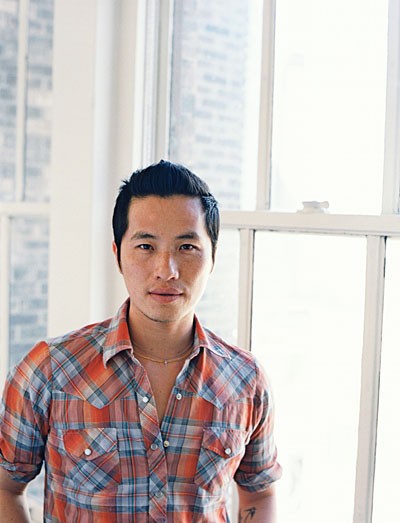
Mom’s approach styles designer’s success


Tue, May. 15, 2007
Mom’s approach styles designer’s success

Lim wants to keep clothes affordable

By Booth Moore
Los Angeles Times


It’s the dress of the spring season: Look No. 2 from Phillip Lim’s runway show. White dresses were everywhere during the collections last September. But the dress Lim co-designed with Koi Suwannagate – a simple T-shirt style with clusters of hand-sculpted rosettes, a bargain at $510 – spawned waiting lists and secured Lim’s status as New York’s newest fashion star.

After just two years in business, Lim’s women’s, men’s and accessories collections are sold in 250 stores worldwide, including, come July, his own boutique in SoHo. He’s been nominated for an award from the Council of Fashion Designers of America, has a slew of celebrity fans (Natalie Portman, Michelle Williams, Amanda Peet), and Vogue won’t stop calling.

His romantic style has been influenced by everything from the perennial fashion film “Grey Gardens,” about the decaying socialite Edith Bouvier Beale, to the elegance of a rosebud, but always with the kind of dressmaker details more typically associated with high-fashion designers such as Alber Elbaz for Lanvin.

So it might be surprising to hear that Lim actually grew up in Orange County, Calif. – not the over-privileged “OC,” but the working-class town of Westminster, where his family moved from Cambodia and where his mother Hannah still lives.

Lim lives and works in New York now, but visits his mother often, most recently last month when we caught up with them. His old bedroom has been converted into a storage space, but from the stack of fashion magazines spilled on the floor next to the couch, you can tell he still bunks there.

Lim has never invited his mom – or any of his family – to his runway shows. Or told them how much his clothes cost. (His line falls in the contemporary category, so most pieces are less than $1,000.) His mother only recently learned that his work has been featured in magazines when a French relative phoned her after seeing his name in Jalouse.

Like so many immigrant children who don’t go into professional fields, Lim thinks he’s disappointed his parents, for whom going into fashion was on par with becoming a small-time seamstress. He’s not estranged from his mom, but they have a mutual understanding. He lives his life in New York, she sends him her famous garlic sauce, and they rarely, if ever, discuss work. But it could be the intersection of her make-do mentality and his more sophisticated, city-wise aesthetic that has made his collection such a hit.

“Vogue magazine doesn’t mean anything to her,” Lim says. “She doesn’t know who Anna Wintour is or what Barneys is. She doesn’t know that it’s all about the little white dress.”

The truth is, Asian designers are making a mark on fashion the likes of which we haven’t seen since the 1980s, when Yohji Yamamoto, Issey Miyake and Rei Kawakubo first landed in Paris from Japan. Except that this second wave is Asian-American. Derek Lam, the new creative director for Italian luxury goods brand Tods, was born in Hong Kong and raised in San Francisco, where he first learned about clothing at his grandparents’ bridal wear factory. Doo Ri Chung, who emigrated from South Korea when she was 4 and started designing out of her parents’ dry-cleaning shop, won the CFDA/Vogue Fashion Fund Award in November and has designed a special collection of white shirts in Gap stores nationwide now. Thakoon Panichgul, of Thai descent, Peter Som, of Chinese descent, and Richard Chai, of Korean descent, also are turning out consistently strong collections on New York runways.

Still, working in fashion, or more specifically sewing clothes, was not the life Hannah wanted for her son.

More than 30 years later, she tears up talking about the summer of 1975 when she and her late husband Pary escaped from Cambodia in the middle of the night, huddled in a boat with their six children who were all under the age of 13. The Lims are Chinese, but their ancestors migrated to Cambodia after Japan invaded. When Pol Pot took over, “I was afraid he was going to draft my boys as children soldiers,” Hannah says, as her daughter Lisa translates.

They escaped to a refugee camp in Thailand, where a Christian organization sponsored their move to San Diego. Pary worked odd jobs while Hannah sewed simple garments at home for 5 to 10 cents apiece.

“To her, clothing was to protect and cover the body and put food on the table,” Phillip Lim says. “It was never about a fantasy where you can get dolled up and change your personality. It wasn’t a luxury; it was a necessity.”

A few years later, the family moved to Westminster, and Hannah began working in a garment factory.

“She would work 10-hour days, cook dinner for us, then go to the sewing machine she saved up money to buy and sew until she fell asleep on the machine,” Lim remembers. “Looking at my work now with the tedious hand stitching, I remember it from the clothes she was making. Somehow it comes through, the respect for the people who put it together.”

Mom and dad always dressed conservatively. Even today, Hannah wears a green twin set and black slacks from Target, along with Tiffany pearls, a birthday gift from Lim.

Not that Lim’s collections are that wild. The trapeze dresses with lattice collars, tiered organza blouses and high-waist trousers from the all-white spring collection were demure with a twist, as were the shadow tartan skirts and bow-front blouses he showed for fall. You could almost see his mom wearing them, if it wasn’t for the prices.

“To her, why would you pay $800 for a suit if you can make it for less?” Lim says. “That’s money you could send back to your relatives, and they could live for a year.”

The family goal was for every child to go to college and, eventually, become a doctor or a lawyer.

“I was afraid of blood – that was my excuse to go into business,” Lim says. It didn’t take. Not long after arriving at California State University, Long Beach, he switched majors to study fashion merchandising.

“My heart broke,” Hannah, 67, says. “I couldn’t believe we sent him to school to do that.”

When Phillip graduated in 1997, he didn’t invite his parents to the ceremony. “I had a degree, but it wasn’t in what they wanted.”

He moved to Los Angeles to be a design assistant for Katyone Adeli. “I just told them I was working. I never told them where or on what because if it hadn’t worked out, they would have said ‘I told you so.’ ”

He launched the clothing label Development with a few friends and received six figures’ worth of orders the first season.

When Lim left in 2004, he was unemployed for only a few hours before his current business partner, Wen Zhou, bought him a plane ticket to New York. “I told my mom I was moving on Tuesday and left on Thursday.”

They named the business 3.1 because they were both 31 years old at the time. And now it’s a $30 million company.

In the realm of runway fashion, his clothes are not expensive. And he plans to keep it that way, even as his profile rises.

“Price is important to me,” he says. “It’s all about where I come from. I’m in a privileged profession now, but I hate the feeling of being spoiled. They are just clothes. They should make you feel good and look good, and I hope you can still pay your bills after you buy them.”

» Read more!
October 1997
January 2005
February 2005
March 2005
April 2005
May 2005
June 2005
July 2005
August 2005
September 2005
October 2005
November 2005
January 2006
February 2006
March 2006
April 2006
May 2006
June 2006
July 2006
August 2006
September 2006
October 2006
November 2006
December 2006
January 2007
February 2007
March 2007
April 2007
May 2007
June 2007
July 2007
August 2007
September 2007
October 2007
November 2007
December 2007
January 2008
February 2008
March 2008
April 2008
May 2008
June 2008
July 2008
August 2008
September 2008
October 2008
November 2008
December 2008
January 2009
February 2009
March 2009
April 2009
May 2009
June 2009
September 2009
October 2009
November 2009
December 2009
January 2010
February 2010
March 2010
April 2010
May 2010
June 2010
July 2010
August 2010
September 2010
October 2010
November 2010
January 2011
February 2011
March 2011
April 2011
May 2011
June 2011
July 2011
August 2011
September 2011
October 2011
November 2011
December 2011
July 2012
August 2012
September 2012
October 2012
November 2012
November 2013
December 2013
January 2014
March 2014
April 2014
May 2014
July 2014
September 2014
January 2015
February 2015
September 2015
October 2015
August 2016
September 2016
March 2018

Subscribe to
Posts [Atom]

Powered by Blogger


 Home   |   About Us   |   Submit URL or Your Company Address First Launched: 08/15/95 - Copyright © 2010 Cambodian Information Center. All rights reserved.