Tribunal Indicts Four in Cambodian Genocide
By By Douglas Gillison / Phnom Penh (TIME)
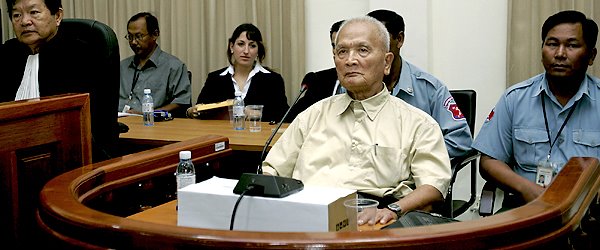
 Former Khmer Rouge deputy prime minister and minister of foreign affairs Ieng Sary stands in the courtroom during a public hearing at the Extraodinary Chambers in the Court of Cambodia on April 30, 2010.
Thirty-one years after the darkest era in Cambodian history, the surviving leaders of the communist Khmer Rouge movement were indicted on Thursday for the deaths of nearly two million people. In an order signed at midnight, judges at a tribunal specially convened to investigate and try the crimes of the Democratic Kampuchea government, which ruled Cambodia from 1975 to 1979, ordered that four aging suspects stand trial for what the court deemed was "an attack on the entire population of Cambodia.
The indictments bring charges of war crimes, crimes against humanity, genocide and, under Cambodian law, murder, torture and religious persecution. Investigators estimate that as many as 800,000 deaths across Cambodia were violent — just under a third of the regime's alleged victims but roughly as many people as were killed during the entire Rwandan genocide in 1994. The majority of those killed by the regime succumbed to starvation, disease and overwork as the government set out to transform Cambodian society and destroy its supposed oppressor classes.
See TIME's photoessay "The Rise and Fall of the Khmer Rouge."
"Some commentators have said, and I believe they were correct, that this matter is the most complex since the Nuremberg tribunal," Judge Marcel Lemonde of France, who also announced his resignation after a tumultuous four years, told reporters gathered at the U.N.-backed court on Thursday. A trial is expected in the first half of next year.
The four accused are former revolutionaries who seized power in 1975 at the end of a civil war with a U.S. client regime. Foremost among them is Nuon Chea, 84, known as Brother Number Two, the communist party's deputy secretary and a member of the inner circle who created the Khmer Rouge's policies of execution. He is joined by the former Foreign Minister Ieng Sary, 84, a public champion of the Khmer Rouge campaign to root out supposed political enemies, and his wife, Ieng Thirith, 78, a former Minister of Social Action. The regime's head of state, Khieu Samphan, 79, who chaired the party's central committee as it planned the deadliest of its purges of government officials, is also to stand trial.
The court's two co-investigating judges dropped the charges against Kaing Guek Eav, better known as Duch, who was sentenced to 35 years in July for the murders of an estimated 14,000 people in his role as commander of the Khmer Rouge secret police. Judges said that in the investigation concluded Thursday they had uncovered no new evidence concerning Duch.
The investigation came to an end in raucous fashion. In addressing the media, Judge Lemonde and his Cambodian counterpart Judge You Bunleng congratulated each other for what they considered personal and professional triumphs. But in the course of three years of inquiry, the two publicly disagreed more than once over politically charged matters, provoking outrage among international judges and the defense, which repeatedly sought the investigating judges' disqualification and removal. In a minority opinion last week, two pretrial judges wrote that the investigating judges had "repeatedly refused to take action on defense claims of government interference in the investigation and that fair trials may now be less likely as a result.
Defense lawyers yesterday said they expected to appeal and reiterated their lack of confidence in the investigation, which Michael Karnavas, an American lawyer who is defending Ieng Sary, the former minister of foreign affairs, has called "a disappointment from the very beginning.
Michiel Pestman, a Dutch lawyer defending Nuon Chea, said the Khmer Rouge had largely been convicted already in the court of public opinion. "I am certainly not defending monsters; I am defending people," he said by telephone after the indictments were announced. "We are used to fighting public perception. That is why it's so important that we have an impartial and fair trial."
In appealing for funding, administrators at the Extraordinary Chambers in the Courts of Cambodia, as the tribunal is officially known, which is facing weak financial support and a $10 million budget shortfall this year, have described the trials likely to begin next year as the most complex ever prosecuted. Hopes of bringing significant numbers of those responsible to justice were always slim: of seven members of the communist party's standing committee in 1975, five were killed by the regime itself during broad purges of suspected enemies in 1978.
In the intervening years, the architects and soldiers of the regime have escaped justice in succession by dying: Pol Pot, the secretive Khmer Rouge prime minister known as Brother Number One, died in 1998 in a remote Khmer Rouge redoubt near the Thai border. A year earlier, he had ordered the assassination of his former Defense Minister, Son Sen, along with his family. Pol Pot's wife, Khieu Ponnary, died in 2003. Ke Pauk, secretary of the Central Zone died in 2002. The feared Southwest Zone secretary Ta Mok died of complications from tuberculosis while in a military prison in 2006 and the former commerce minister Van Rith, suspected of sending staff members to their deaths at the hands of the secret police, died quietly in the countryside outside Phnom Penh in 2008.
Van Rith had been the subject of preliminary inquiries by U.N. prosecutors as part of a separate case that is opposed by the Cambodian government, which maintains that no more than five suspects will be tried. With Thursday's indictments, the court has reached that maximum. Van Rith died as Cambodian prosecutors objected to U.N. prosecutors' plans to open a new case in which he would have been included.
(Comment on this story.)
For Youk Chhang, director of the Documentation Center of Cambodia, a local organization that supplied much of the court's documentary record, the case for which investigation concluded this week is the most important the court will ever conduct, regardless pf what becomes of the additional cases opened by U.N. prosecutors. "The question is, �Why did Cambodians kill Cambodians?' That is the most important question that has been put forward and only Case 002 can do that," Youk says, using the case number for Thursday's indictment. It "would lead us to what is next," he says. "It will trickle down how far you can go."
See TIME's photessay "The Legacy of Pol Pot."
» Read more!
 Former Khmer Rouge deputy prime minister and minister of foreign affairs Ieng Sary stands in the courtroom during a public hearing at the Extraodinary Chambers in the Court of Cambodia on April 30, 2010.
Thirty-one years after the darkest era in Cambodian history, the surviving leaders of the communist Khmer Rouge movement were indicted on Thursday for the deaths of nearly two million people. In an order signed at midnight, judges at a tribunal specially convened to investigate and try the crimes of the Democratic Kampuchea government, which ruled Cambodia from 1975 to 1979, ordered that four aging suspects stand trial for what the court deemed was "an attack on the entire population of Cambodia.
The indictments bring charges of war crimes, crimes against humanity, genocide and, under Cambodian law, murder, torture and religious persecution. Investigators estimate that as many as 800,000 deaths across Cambodia were violent — just under a third of the regime's alleged victims but roughly as many people as were killed during the entire Rwandan genocide in 1994. The majority of those killed by the regime succumbed to starvation, disease and overwork as the government set out to transform Cambodian society and destroy its supposed oppressor classes.
See TIME's photoessay "The Rise and Fall of the Khmer Rouge."
"Some commentators have said, and I believe they were correct, that this matter is the most complex since the Nuremberg tribunal," Judge Marcel Lemonde of France, who also announced his resignation after a tumultuous four years, told reporters gathered at the U.N.-backed court on Thursday. A trial is expected in the first half of next year.
The four accused are former revolutionaries who seized power in 1975 at the end of a civil war with a U.S. client regime. Foremost among them is Nuon Chea, 84, known as Brother Number Two, the communist party's deputy secretary and a member of the inner circle who created the Khmer Rouge's policies of execution. He is joined by the former Foreign Minister Ieng Sary, 84, a public champion of the Khmer Rouge campaign to root out supposed political enemies, and his wife, Ieng Thirith, 78, a former Minister of Social Action. The regime's head of state, Khieu Samphan, 79, who chaired the party's central committee as it planned the deadliest of its purges of government officials, is also to stand trial.
The court's two co-investigating judges dropped the charges against Kaing Guek Eav, better known as Duch, who was sentenced to 35 years in July for the murders of an estimated 14,000 people in his role as commander of the Khmer Rouge secret police. Judges said that in the investigation concluded Thursday they had uncovered no new evidence concerning Duch.
The investigation came to an end in raucous fashion. In addressing the media, Judge Lemonde and his Cambodian counterpart Judge You Bunleng congratulated each other for what they considered personal and professional triumphs. But in the course of three years of inquiry, the two publicly disagreed more than once over politically charged matters, provoking outrage among international judges and the defense, which repeatedly sought the investigating judges' disqualification and removal. In a minority opinion last week, two pretrial judges wrote that the investigating judges had "repeatedly refused to take action on defense claims of government interference in the investigation and that fair trials may now be less likely as a result.
Defense lawyers yesterday said they expected to appeal and reiterated their lack of confidence in the investigation, which Michael Karnavas, an American lawyer who is defending Ieng Sary, the former minister of foreign affairs, has called "a disappointment from the very beginning.
Michiel Pestman, a Dutch lawyer defending Nuon Chea, said the Khmer Rouge had largely been convicted already in the court of public opinion. "I am certainly not defending monsters; I am defending people," he said by telephone after the indictments were announced. "We are used to fighting public perception. That is why it's so important that we have an impartial and fair trial."
In appealing for funding, administrators at the Extraordinary Chambers in the Courts of Cambodia, as the tribunal is officially known, which is facing weak financial support and a $10 million budget shortfall this year, have described the trials likely to begin next year as the most complex ever prosecuted. Hopes of bringing significant numbers of those responsible to justice were always slim: of seven members of the communist party's standing committee in 1975, five were killed by the regime itself during broad purges of suspected enemies in 1978.
In the intervening years, the architects and soldiers of the regime have escaped justice in succession by dying: Pol Pot, the secretive Khmer Rouge prime minister known as Brother Number One, died in 1998 in a remote Khmer Rouge redoubt near the Thai border. A year earlier, he had ordered the assassination of his former Defense Minister, Son Sen, along with his family. Pol Pot's wife, Khieu Ponnary, died in 2003. Ke Pauk, secretary of the Central Zone died in 2002. The feared Southwest Zone secretary Ta Mok died of complications from tuberculosis while in a military prison in 2006 and the former commerce minister Van Rith, suspected of sending staff members to their deaths at the hands of the secret police, died quietly in the countryside outside Phnom Penh in 2008.
Van Rith had been the subject of preliminary inquiries by U.N. prosecutors as part of a separate case that is opposed by the Cambodian government, which maintains that no more than five suspects will be tried. With Thursday's indictments, the court has reached that maximum. Van Rith died as Cambodian prosecutors objected to U.N. prosecutors' plans to open a new case in which he would have been included.
(Comment on this story.)
For Youk Chhang, director of the Documentation Center of Cambodia, a local organization that supplied much of the court's documentary record, the case for which investigation concluded this week is the most important the court will ever conduct, regardless pf what becomes of the additional cases opened by U.N. prosecutors. "The question is, �Why did Cambodians kill Cambodians?' That is the most important question that has been put forward and only Case 002 can do that," Youk says, using the case number for Thursday's indictment. It "would lead us to what is next," he says. "It will trickle down how far you can go."
See TIME's photessay "The Legacy of Pol Pot."
Labels: Comrade Duch, Documentation Center of Cambodia, Duch, Ieng Sary, Judge You Bunleng, Kaing Guek Eav, Khmer Rouge, Khmer Rouge Tribunal, Michiel Pestman, Nuon Chea, Pol Pot, Youk Chhang
» Read more!