Editorial | Articles about Cambodia | Khmer

Friday, July 13, 2007

Cambodia's cowboy capitalism

Prime Minister of Cambodia


ASIA HAND
Cambodia's cowboy capitalism
By Shawn W Crispin

BANGKOK - Despite his rough and ready reputation, Cambodian Prime Minister Hun Sen has presided over an extraordinary transformation of the country's once war-torn, now booming local economy, marking Southeast Asia's latest successful transition from a centrally planned to market-driven economy.

But as Cambodia's capitalist reforms enter a crucial new phase - one where multilateral organization economists say that to sustain fast growth, economic benefits must be more equitably

distributed - it's altogether unclear whether Hun Sen and his Cambodian People's Party-led government are up to the egalitarian task.

Over the past three years, Cambodia's gross domestic product has expanded at double-digit growth rates, averaging a breakneck 11.4% per annum. Garment exports, the economy's top foreign-currency earner, accounting for nearly 14% of total GDP, grew by 20% last year, despite predictions that Cambodian producers would start to lose a substantial market share to China and Vietnam.

Foreign direct investment touched a record high US$475 million last year and, in a show of fiscal confidence last weekend, the government unveiled a new $26 million parliament building, which is about 10 times the size of the previous complex. Meanwhile, hopes are running high that recent discoveries of big new oil and gas deposits will translate into a multibillion-dollar boon and by as early as 2010 transform the country into a net fuel exporter - potentially one of Asia's largest.

Monetary authorities have successfully reined in inflation, which on average galloped well over 50% per annum throughout the 1990s, to less than 3% last year, and policymakers are now feeling emboldened enough to talk about "de-dollarizing" the economy in a nationalistic bid to shore up the local currency, the riel. International credit-rating agencies, including Standard & Poor's and Moody's, recently issued their first sovereign ratings for the country, in anticipation of new stock- and bond-market launches in 2009.

Hun Sen, a former communist guerrilla and currently Southeast Asia's longest-serving elected leader, deserves a fair measure of credit for the progress. In the state-sanctioned press, he's frequently seen presiding over the opening of new roads, bridges and schools, putting his personal populist mark on public-funded investments.

His deputies have recently taken to portraying him as one of the region's vanguard economic reformers, who began dumping communism for capitalism through limited land-ownership reforms in the mid-1980s. In advance of the 1991 Paris Peace Agreement, which ushered in United Nations-sponsored elections and a new power-sharing government, Hun Sen introduced full-scale land reforms, slashed price controls, privatized state enterprises and, to a degree, liberalized foreign investments.

More recently, Hun Sen has in the main stayed the course of a World Bank-designed market-reform strategy, which aims to boost the private sector and move the economy away from its age-old reliance on subsistence agriculture. That has included substantial policy reforms aimed at improving the investment climate and trade facilitation, including recent automation of traditionally corruption-prone customs-related services.

Rich man, poor man
Still, there are contrary indicators that Cambodia's emerging brand of wild and wooly capitalism is unevenly - and in instances perhaps illegally - benefiting the politically connected few at the great expense of the indigent masses.

A recent World Bank research report shows that robust economic growth over the past decade has helped to reduce the national poverty rate from 47% to 35% over the 10-year period spanning 1994-2004. Over that same period, however, average consumption per capita rose a mere 8% for the bottom fifth of the wage-earning population, while rising a whopping 45% for the top tier.

Where land ownership was seen as equitable after the 1989 land reforms, now levels of inequality in landholding and landlessness are among the highest in Asia, due to recent government policies in favor of large-scale land concessions - not to mention increasing state-backed land grabs from the poor. Lightly populated Cambodia, remarkably, now ranks worse than Malthusian dread-ridden India in this category.

The World Bank report also warned that, in general, high levels of inequality contribute to market failures and reduced investment, give rise to institutions that favor the rich over the poor and, over prolonged periods, often result in social and political instability. Those dire predictions are arguably already coming due, seen in the recent rash of land grabbling, where international rights groups such as Human Rights Watch estimate that tens of thousands of people have been forcibly evicted to make way for state projects and big plantation agriculture.

More damaging, however, were the allegations in a recent investigative report titled "Cambodia's Family Trees" issued by UK-based environmental watchdog Global Witness. The globally respected outfit alleged that senior army, police and government officials, many close to Hun Sen, including the head of his personal bodyguard unit, had profited hugely from illegal logging activities.

The report also claimed that a "kleptocratic elite" - including members of Hun Sen's direct family - were complicit in exploiting large swaths of officially protected forest lands. The report notably mentioned by name Hun Sen's wife as benefiting from the alleged illicit trade. For its part, the government banned the publication, issued a blanket denial, and threatened journalists who followed up the allegations.

One Radio Free Asia reporter was forced to flee the country after he received an anonymous death threat related to his reports, which corroborated some of Global Witness' findings. He was the second RFA reporter to flee the country this year because of concerns about possible government reprisals over critical news coverage. Further, Hun Sen refused in May to meet with the UN special representative on human rights for Cambodia, Yash Ghai, who had conducted investigations into allegations of state-backed land grabs.

Such statistical and investigative findings explain why - despite Hun Sen's recent consolidation of political power and his pivotal role in accelerating economic growth - foreign and local observers still have big doubts about his style of governance. For instance, last year international corruption monitoring group Transparency International rated Cambodia 151 out of 163 nations it ranked in its global government corruption index.

A more recent Indochina Research Limited public-opinion poll found that 88% of Cambodians feel that growing inequality in wealth is a pressing issue, while a World Bank survey released this week found that perceptions of Cambodia's government effectiveness, regulatory quality and control of corruption all declined from 2005 to 2006. Cambodia is no doubt growing, and growing fast, but increasingly the perception is that the benefits are only gushing up and not trickling down.

Shawn W Crispin is Asia Times Online's Southeast Asia editor. He may be reached at swcrispin@atimes.com.

Labels:


» Read more!

Thursday, July 12, 2007

Preah Vihear: The border was already settled by The Hague International Court of Justice


Preah Vihear:

The border was already settled by The Hague International Court of Justice

Near the end of June 2007, following Thailand’s reservations, UNESCO decided to “suspend” Cambodia’s request for the protection of the Preah Vihear Temple as a World Heritage site, and the UN body asked the two countries “to quickly resolve the issue of border demarcation at this location.”

In Bangkok, according to the news published on June 29, 2007, Thailand’s Ministry of Foreign Affairs issued the following statement: “In principle, Thailand totally agrees that the Preah Vihear Temple should be listed as a UNESCO World Heritage site, under the reservation that the differences on the site’s joint management and the problems of border demarcation are resolved first.” Immediately after this statement, Thailand sent its “black-clad uniformed” troops to prevent the access to the temple from the Thai side, and to close the border. These actions effectively created unease and excitation on Cambodia’s side.

The action taken by the Thai troops is nothing new when it comes to the Cambodian Preah Vihear Temple. Two years ago, in May 2005, “black-clad” Thai soldiers undertook the same action towards the temple. At the time, Thammarak Isarangura, the Thai Minister of Defense, declared that “Thai troops would remain (there) to assure that there will not be any crossings into the territories in conflict, until the two countries complete their demarcation work.” In Phnom Penh, Thailand’s ambassador to Cambodia declared that Thailand intends to respect the decision of The Hague International Court of Justice which gave the ownership of the Preah Vihear Temple to Cambodia in 1962. “However, the decision concerned the temple only and it did not precise the border delineation … That’s why this problem persists until nowadays.” On July 06, 2007, Viraphand Vacharathit, Thailand’s ambassador in Phnom Penh, implicitly placed the blame on Hun Sen’s government when he declared to the news media that “Cambodia knew very well that UNESCO would suspend this decision on Preah Vihear … because of the absence of the border demarcation line…”

In 2005, Hun Sen’s government promised to “resolve this problem of border delineation as soon as possible.” Now, Khieu Kanharith, the Minister of Information and spokesman of the government, vaguely said that “some small technical problems still remain to be resolved, regarding the new housing constructions, radio [broadcast] towers, irrigation canals, etc…” On the other hand, Va Kim Hong, the government minister in charge of border issues who is even more confused that his ministry of information colleague, let it be known that there would not be “any problem left for anyone, (because) the local authorities, the Preah Vihear provincial authorities, and our local people just have to present to us their problems, and we will resolve them together.”

The issue questioned by UNESCO involves the resolution of the so-called “white zone” located in front of Preah Vihear, a zone which Hun Sen’s government admitted its existence in the past few years to the great satisfaction of Thailand, this in spite of the historical stipulations of treaties recognized by both countries since 1907, and in spite of the irrevocable decision rendered by The Hague International Court of Justice in 1962 regarding this temple. In fact The Hague Court’s decision dated June 15, 1962, clearly indicated the prior existence of a border delineation between Thailand and Cambodia at this location, BEFORE the court issued its decision to hand the ownership of the temple to Cambodia (please read the court decision attached). There was no “white zone” and there is nothing to “negotiate” again on the border demarcation in front of the Preah Vihear temple. All that remain are the reference to the maps retained by The Hague International Court of Justice, and the building of the corresponding border demarcation posts. Such operation would be completed within a few weeks.

However, we recall that the existence of these “white zones” was adopted by Hun Sen and his party, the PRPK-CPP (PRPK is the acronym for the People's Revolutionary Party of Kampuchea which was later rechristened to the Cambodian People Party or CPP), following their conclusions on illegal treaties and agreements with Hanoi in the 80s on Cambodia’s new borders. These illegal treaties and agreements, which are perfidiously put into application, have de facto rejected or made obsolete all or part of other international treaties of Cambodia with respect to her territorial integrity. For example, the agreement of the cession by the PRPK-CPP to Hanoi of the islands of Koh Tral and Koh Krachak Seh, and of the so-called “Historical Waters” (a maritime “white zone”) between Vietnam and the People’s Republic of Kampuchea in July 1982, changed the delimitation of the maritime border between Cambodia and Vietnam, and subsequently, the one between Cambodia and Thailand, and it created “white zones” at sea between the two latter countries also. Obviously, these “white zones” later became conflict zones, zones where the law of jungle and instability prevail, and where the first victims are the defenseless and unprotected Cambodian population, this in spite of the confused and irresponsible assurances given by Hun Sen’s government (1).

The note by UNESCO on the imprecision of the border in front of the Preah Vihear Temple – an imprecision based on Thailand’s reservations which completely ignores the decision handed by the International Court of Justice on June 15, 1962 – is a dangerous precedent on the historical rights of Cambodia’s territorial integrity: it is the UNESCO, a UN institution, which accepts, at this location, the existence of a so-called “white zone” between the two countries. What will become of the other “white zones” which were recognized by the Hun Sen’s regime and by his party with Cambodia’s neighbors? By following this path, the entire Cambodia will soon become a “white zone” for Thailand and Vietnam – if it is not one now already – just as it was 200 years ago.

----

(1) During the 1954 Geneva conference, a 1:100,000-scale map produced and kept in France (latest edition­) was submitted to the International Control Commission (which was later presided by India under the leadership of Mr. K.L. Bindra), as well as a smaller scale map for ease of use under the circumstance.

On the other hand, between 1968 and 1971, France provided help to Cambodia to establish a 1:200,000-scale geologic map with the participation of 8 French geologists and engineers, as well as 20 other Khmer engineers who performed the works and the research under the direction Mr. Sean Pengse.

At the time, there was no “white zone”.

Paris, July 9, 2007

Vice-President, Cambodia's Border Committee

DY Kareth

Labels:


» Read more!

Wednesday, July 11, 2007

A Tale of Three Tribes


Antonio Graceffo
16 July 2007
The dilemma of ethnic minorities lies in the choice between preserving cultures and integrating individuals into a broader society.

“The Chinese chase the Khmer. The Khmer chase the tribal people. The tribal people chase the spirits. And the spirits live in the mountains.” -- Old Cambodian Tampuan saying

In Cambodia’s Ratanakiri province, Chinese and Khmer businessmen get a village headman drunk enough and happy enough to sign a document allowing them to buy the land of a Tampuan family. Strictly speaking, the transaction is illegal, but with the signature of the village headman, no questions will be asked. With the money they get from the land sale, the Tampuan family will buy a used motorcycle, and then starve.

Missionaries convert half of an Akha village in northern Thailand. Now the Christians don’t talk to their animist neighbors. But in the Akha communal system, every member of the tribe must do his traditional job. The healer is called when people are ill. She is paid in food. The shaman, the keeper of traditions and ceremonies, is called when a new house is built or the village is transplanted. He preserves the culture and teaches it to the young. Gaining his permission before making any major changes in the village serves the dual purpose of supporting the shaman and his family, but it also preserves the forest, as the shaman is the one who knows when the resources have been depleted and the village needs to move.

Now the shaman and the healer have no customers, because the Christian villagers won’t patronize them. The villagers don’t know when the village is supposed to move, and the children aren’t being taught their sacred ceremonies.

In the Philippine province of Palawan, a far western archipelago, a remote tribal village lacks both running water and electricity. It is five kilometers from the nearest road and a three- hour drive from the nearest city. Here, a Tagbanua family survives, barely. In the corner of their filthy hut, a family member lies dripping sweat. She has been suffering from malaria for weeks. Edward Hagedorn, the well known mayor of the nearest city, Puerto Princessa, has made a satellite hospital available to the tribal people, but for reasons that are unclear they won’t go there until they are near death. Hagedorn also made free seeds available so that they could diversify their diet and increase their food yield. Once again, no one knows quite why the tribe refuses to take advantage of the program.

The plight of these three ethnic groups mirrors the problems of tribal people in developing countries the world over. Often referred to as living in the Fourth World, they are the marginalized minorities of developing nations. Although each country deals with its ethnic minorities in different ways, none seems to have found a solution. In most cases, if they remain within their shrinking cultures, they are condemned to lives that are nasty, brutish and short, in Thomas Hobbes’ phrase , faced with poverty, ill health, and a bare minimum of education that leaves them functionally illiterate. If they leave to seek education and opportunity away from the village, they contribute to the death of their culture.

Graham Brown, a representative of a non-governmental organization in Cambodia’s Ratanakiri province, believes that the key to tribal survival is land ownership. His group, Community Forestry International, helps tribal people obtain rights to both their traditional forest and farmland.

“In collective cultures, everything is an all-or-nothing proposition. When one goes, they all go. Once people give up hope they will all sell their land.” Once the land is gone, Brown says, the tribes will die out.

While many of the hill tribes in Thailand have traditionally been denied citizenship because of their links to Burma or Laos and their inability to “prove” they are Thai, the indigenous tribes of Cambodia were given full citizenship and land rights by then-Prime Minister Prince Norodom Sihanouk more than 30 years ago. The problem is that many don’t understand the concept of landownership or its importance.

“They were always here,” Graham says. But national boundaries are an unnatural occurrence which hill tribes are barely aware of.

According to Dr. Carlos Fernandez, a Filipino anthropologist and tribal expert, “To call tribal people horticulturists is wrong. They are craftsmen. Agriculture is just one of the many tools available to them in their plan for survival. They also use hunting, fishing, gathering, and farming, transplanting jungle products closer to the tribal villages for use when needed. And with this combination of skills, plus weaving and making handicrafts to sell, the tribal people could exist.”

In the transition to modern society, lowlanders generally force tribal people off the best land, with a typical defense in the face of conflict being to simply push deeper into the forest. Very few tribes in the 21st century are living on the land they once inhabited. With commercial farms and others taking the choice land closest to rivers and oceans, the immediate impact on the tribal diet is they can no longer supplement it through the fishing or river trading.

As their land is squeezed, they also lose their semi-nomadic ways and are forced to remain in one place, where they deplete the soil.

Back in the Philippines, the Tagbanua faced similar difficulty. The land they have inhabited for years, and which provided them with a livelihood, no longer belongs to them. Each year, lowland Filipinos and commercial farming concerns encroach further on their land. Now, under a government program called Ancestral Domain, they can get title to the land they live on, but this means remaining in one place. It also means they are no longer able to forage in the jungle and that they have been cut off from the river.

Migrants originally from southern China like many Southeast Asians, the Akha have long been in the border regions of Laos, Burma and Thailand. Some of those now settled in Thailand were driven off land in Burma by military conflict and forced relocations. Once farmers and hunter- gatherers, many are being forced off the land in Thailand and even their high mountain fields are drying up because the water is being diverted to large-scale commercial farms. The Akha are also easy victims for drug traffickers, who use them as mules, making them convenient targets for police who need to shore up their arrest numbers toward the end of the month.

In Cambodia, most Tampuan are now sedentary farmers, but lowlanders want their land and each year convince them to sell off some of it. Their domain has shrunk until now even their ancestral burial grounds in some cases have been sold. For the Tampuan, this is a great sin. They believe deeply in the spirits and could never imagine being cut off from the spirits of their ancestors.

“It is actually the village which owns the land, but the individual families are given rights by the village headman to farm the land. They do not, however, have the right to sell the land. This respects their traditional concept of communal ownership. The commune chief and village headman, however, are not supposed to approve the sale of the land. But they do. It is all corruption,” Graham explained.

“The villagers who sell their land are referred to as nyat colcot (scoundrels),” Graham added.

“After the first sales the people lose faith in the government and in the system. They lose faith in the law and believe that they have no rights. So they sell their land. They buy a second-hand motorcycle, and the others in the village get jealous. So, they sell also.”

According to Graham, the buyers are mostly those who have made money from illegal logging, much of which is carried out by the Cambodian armed forces. They are generally politically powerful enough to exert pressure on the tribes.

“They are told they are stupid if they don’t sell, and that they are backward if they keep to ancient ways. People with no land have to move out of the village and then the structure begins to deteriorate. When they move, they have to clear new forest which is both backbreaking and illegal. And, the government will just take the land away from them.”

“Using the knowledge acquired by the tribe over centuries, they were able to work out a survival strategy that was fairly accurate,” says Fernandez of traditional life. “The upland people without irrigation may appear poor because they don’t have good houses, but they eat better than the lowland poor, who eat a mono-crop of rice. The uplanders, without irrigation, grow a variety of foods. The poor lowlanders grow only rice and sell the surplus to diversify their diet. If they don’t grow enough rice, they fall into an endless spiral of debt. Eventually, to pay off the debt, they sell land.”

The tribes “started down the slope to financial ruin was because the land wasn’t producing enough to begin with. Now, they are selling the land, and of course, losing part of their future harvest. This will create more debt and lead to selling more land,” Feranandez says.

War and political upheaval also impact the tribes, but they often have no control over those events and no defense. This is certainly true of those Akha who were displaced by the civil war in Burma and now find themselves as unwanted guests in Thailand, with no rights. Other ethnic minorities in Burma have been engaged in combat with the Burmese government for decades, but the Akha are completely passive. In Thailand they are ill-equipped to understand the political events which affect their everyday lives.

In Palawan, the Tagbanua were always conflict avoiders. When Muslim pirates raided coastal villages, the Tagbanua gave up the coast and pushed into the forest. When the Spanish invaded the Philippines, they pushed deeper into the forest. Finally, during their occupation of the Philippines from 1899 to 1945, the Americans built the first college for the Tagbanua and included them in national education programs. But more than 60 years later, the Tagbanua find it difficult to participate in education.

Tribal people everywhere are often faced with having to send their children great distances to attend school. Rainy seasons may make it impossible. During planting and harvest seasons they are also absent, as they are needed to work at home.

For Tampuan parents, like the Tagbanua, the minuscule school fees and the cost of notebooks and pencils are insurmountable hurdles. Since most Akha refugees are not Thai citizens, their children are not permitted to attend school. However, Thailand’s royal family interceded and under a royal foundation has been building schools in refugee villages where non-citizen tribal children can study. In some instances, Akha children have been given permission to attend school but the parents cannot afford the tuition. In others, the distance to the school makes it impossible for the children to attend.

Governments in all three countries have introduced elementary schools into the tribal areas but high schools always seem far away. Parents often can’t afford or don’t want to send the children away. NGOs may come in and pay for kids to leave the village and go to school in the cities, but this introduces yet another dilemma. In order to improve their lives, it children need education, but once educated many do not want to go back to the hardships of village life and this drains the village of its brightest youth.

Marifi Nitor-Pablico, the director of the Tagbalay Tribal Foundation in the Philippines, has spent years trying to understand the tribal people.

“All of the culture is lost,” she said in an interview in her office in Puerto Princesa. “All we can do is go back to the documents recorded by foreign and Filipino researchers. And there is no way to validate any of it. There is no one who can tell us if the customs or beliefs, which appear in the books still exist.

“Among tribal people, there is a memory loss about culture and a failure to find something to replace what they have lost. They are made to feel ashamed of what they are as tribal people, and made to feel they are inadequate to adopt lowland ways. That is the situation that needs to be explored. But, how do we do it? We must flesh out, what did I lose? And what did I fail to gain?”

It won’t be long until the Akha have lost their cultural memory. Although some villages struggle to maintain the culture, it is clearly on a path to destruction as long as children are shipped off to schools, missionaries invade villages, and the villagers are denied land rights. For the Tampuan, as young people move to cities like Phnom Penh in search of work, the tribe will eventually die.

If children are taken away and educated, the culture may be destroyed, but, as Pablico noted, the march of the modern world has already rendered the culture almost extinct.

For policymakers, the question is whether it is more important to preserve the culture or save and improve individual lives. In Thailand tribal people are marginalized by the state and lack citizenship or recourse to the law. In Cambodia, they have citizenship but still fall victim to predators who want to steal their land. And in Puerto Princesa, where local government is willing to help, even the experts aren’t certain what form the help should take.

Graham paints a bleak picture of Cambodia’s Tampuan situation, but it is true of tribal people everywhere.

“Many Tampuan children go to a government school whose focus is to teach Khmer values and ideas. They teach the children values which differ from their tribal beliefs. They become Khmer. And suddenly, they need things that they never needed before. They need cell phones and motorcycles. And the informal education that they get is much more powerful than the formal one. The informal education comes at the hands of officials who push the development paradigm. They are told that their tribal culture is stupid, and that what they have is backward and without value.”

Labels:


» Read more!

Friday, July 06, 2007

Vietnam falsifies the history of Kampuchea Krom (South Vietnam)


04 July 2007
By Kim Pov Sottan
Radio Free Asia

Translated from Khmer by Socheata

Cambodian historians are strongly reacting to a new publication issued by the Vietnamese authority on the history of South Vietnam. The new history publication claims that Kampuchea Krom (South Vietnam) is a land which Vietnam cleared, and that Cambodian people living there are nothing more than refugees fleeing from Cambodia.

Dr Michel Tranet, a Cambodian history researcher, said that this publication is a falsification of history which Cambodia’s neighboring countries undertook in the past 20 years.

Dr Michel Tranet added that Cambodia has numerous stone inscription documents, and that such falsification is unwarranted. Nevertheless, he said that Cambodian historians should hold a meeting to discuss this issue.

Dr Michel Tranet said: “Whatever they say, we don’t care, they write whatever they want to serve the interest of their nation. They don’t write to protect our land, we know this very well, and there’s nothing surprising. Therefore, we must pursue our research based on our stone inscriptions and based on Chinese (historical) documents, so that we learn about the truth. But we must know that they (Viets) are using a subterfuge on Khmer people, we should not be surprised. Therefore, no matter how much more they write, no matter how much they shout out, the most important for us is not to just shout back, we should also organize a meeting (to address this issue).”

The Vietnamese-language document received by RFA, and provided by the Khmer Kampuchea-Krom Federation (KKF) in the world, stated that on 08 March 2007, the Vietnamese Communist Party (VCP) central committee, and the Southwest region headquarters committee have written a new book titled: “The review of South Vietnam’s history for distribution to the Vietnamese population in order to prevent the breakup of the South.”

This book claimed that the culture of the kingdom of Funan, also known as Nokor Phnom (in Cambodian), is not a Cambodian culture, and that this is also goes to the wedding tradition etc… The book went on to say that the Vietnamese presence in the southland (Kampuchea Krom) started since the 16th century AD, and at that time, because of Siamese interference, the Khmer royal family weakened. Vietnamese living in the Tuon Van area then went in to clear the lands in Dong Nai area. Later on Khmer King Chey Chetha II (an ancestor of the current Cambodian royal family) married Ngoc Van, a Vietnamese princess, and he allowed Vietnamese to establish themselves in the south, in the Prey Nokor (Saigon or Ho Chi Minh city) area.

The book went on to say that later on, the Nguyen lords occupied the entire southern area, and became the owners the land, and that later on the Vietnamese fought and won its independence from France in 1975.

The book published by the VCP claimed that Cambodian people living in South Vietnam are refugees fleeing Cambodia after the Chenla kingdom fought and took over the Funan kingdom. These Cambodians were fleeing the genocide perpetrated by the reigning Cambodian king of the time.

The book was rejected by Cambodian historians who said that the Khmer race are part of the Khmer-Mon race which was influenced by the Indian culture. Both the Chenla and the Funan kingdoms were populated by Khmer ancestors and their offsprings until now.

Ros Chantrabot’s history book on Cambodia said that the unification of all Khmer territories took place under the reign of King Pheakveakvarman I, between the 6th and 7th century AD.

Other Khmer history books said that the Cambodian territories during its apogee, extended all the way to China Sea, including the 23 provinces now located in South Vietnam.

Khmer Krom history indicated that the Southern portion of Cambodia was handed by the French colonial regime to the Vietnamese in 1949.

Khieu Kanharith, government spokesman, confirmed that South Vietnam was Cambodia’s territories, and the Cambodian population living there are the rightful owners of the land. He indicated that the Phnom Penh regime is also reviewing this issue.

Khieu Kanharith said: “Whatever document, let us look at it first before we provide an answer. But, to sum it up, even though I did not see (this document yet), Khmer Kampuchea Krom are the owners of the lands and waters there. The entire Kampuchea Krom lands are Khmer lands which the Vietnamese took away because our leaders are mediocre. But, as King-Father recognized it, now that we lost it, he will not demand it back, but he asked that the borders be clearly protected in order to preserve (what is left).”

Ching Ba Kam, an official from the Vietnamese embassy in Cambodia, claimed that his embassy did not known about this history publication yet. “Now, I can’t confirm about this book yet, because I don’t have any information about this issue. But whatever you just said, I don’t know about it, I did not read this book yet, and I don’t know its actual content, I don’t know yet. Therefore, I cannot provide any explanation on this issue.”

RFA attempted to obtain clarifications from the Ministry of Education, and the National Assembly councilor, but so far, we did not receive any answer yet.

Labels:


» Read more!

Thursday, July 05, 2007

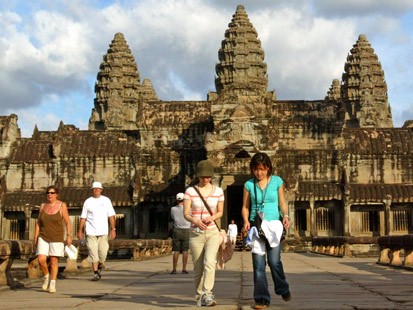
Spectacular Sunset Rush Hour

Tourists inside the Angkor Wat temple complex during sunset in Siem Reap province, 217 miles northwest of Phnom Penh, Cambodia. (Chor Sokunthea / Reuters)

As Tourists Flock to Cambodia's Angkor Temples, Preservations Fear for Its Survival

July 4, 2007 —

Source: ABC - http://abcnews.go.com/WN/story?id=3345597&page=1

Photos: http://abcnews.go.com/International/popup?id=3250294

After years of neglect threatened to destroy the temples of Angkor during the brutal regime of the Khmer Rouge, this wonder of the world is now at threat for a different reason  too much interest.

The temples were built between the ninth and 15th centuries and now face the modern threat of tourism, as millions of visitors arrive to see the more than 100 Hindu and Buddhist monuments spread across 50 square miles in Cambodia.

"The ruins of Angkor are one of the marvels of the world," John Stubbs of the World Monument Fund told ABC's Mark Litke. "There's no doubt about that."

Stubbs is at the forefront of a global effort to preserve and restore Angkor, and has spent 15 years in Cambodia to help piece together a vast archaeological jigsaw puzzle.

Crowding the Ruins

While Stubbs' work has helped to save Angkor and turn it into one of the world's premiere destinations for cultural tourism, the location's salvation may ultimately turn out to be its curse.

There's literally been a tourist invasion. In the 1990s, Angkor attracted just a few thousand visitors a year; by the end of 2007, a total of 2 million are expected to climb up, down and through the ancient ruins.

They arrive by planeload, busload, on motorbikes and even on elephants.

Visitors once had to hack through jungles to reach Angkor. Now, the route to the temples is packed with traffic jams, especially by the end of the day when more than 3,000 people assault the highest temple in the complex to watch the sunset.

In the adjacent town of Siem Reap, there were just two hotels a decade ago  now, there are more than 102, along with shopping malls, pizza joints and massage parlors.

It's hardly the serene Angkor experience some tourists might expect, as one woman told ABC News, "I think it takes away from it, I do."

But, another visitor said, "I don't. I feel that the importance of this place deserves people to watch it, see it, witness it."

Balancing Preservation With Greed

Angkor tourism has brought jobs and millions of dollars to one of the world's poorest countries, but some Cambodians fear greed is now winning out over preservation.

The scenery was even used as an exotic location for Hollywood films including "Lara Croft: Tomb Raider"  not quite what the preservationists had in mind.

Stubbs said there was a need for constant vigilance as interest grew for Angkor. "There's not a minute to waste in looking after this precious place. & Because, without a doubt, it could be ruined by some wrong decisions."

But he's hopeful that Cambodians will eventually strike the right balance.

After all, they were the ones who created this magnificent, majestic site in the first place.


» Read more!

Friday, June 22, 2007

Global Witness Report To Help Open Hun Sen's Eye to 'Festering' Corruption


SEP20070612045004
Phnom Penh
Sralanh Khmer in Cambodian 02 Jun 07 pp 1, 4
["This Issue's Comment"]

Hun Sen's Cambodian Government has been deeply bogged down in all sorts of corruption pointed out by national and international circles after the prime minister arrogantly asked on Wednesday, "How this corruption looks like? Can anyone tell me where it is?" From now on, the prime minister surely will have a splitting headache reading a mountain of reports on corruption, documents that have piled up as high as Mount Everest because the corruption monitors have prepared them to open the prime minister's eye and make him see what really happens around him.

The forest crime report Global Witness released yesterday shows only the minister of agriculture and the head of the Forest Administration [FA], together with seven generations of the prime minister's relatives, as ringleaders behind the current waves of forest crimes in Cambodia. Although Agriculture Minister Chan Sarun and FA Chairman Ti Sokun softly denied the charges yesterday, this kind of rebuttal is not enough. The government must investigate, for this is an example of corruption that the prime minister has never seen and never thought possible, since he used to observe that corrupt persons never wear collars or bear tattoos on their foreheads for him to recognize them.

For the past few years, the prime minister who used to boast that he could see through everybody has been totally blind to corruption. For instance, he was blind to the recent corruption case in four ministries that caused the World Bank to suspend aid worth several dozen million dollars. Later, we do not know why the prime minister quietly took over $10 million from the national budget with which he paid back to the donors on behalf of the corrupt officials.

The general public has heard the prime minister roar like a Cyclops that if he could not suppress the forest crimes he would cut his own head. There was one time when the prime minister claimed as if he meant it that he would step down if he could not stop illegal logging. The prime minister has made this kind of vociferation for years and on many occasions. But forests continue to be decimated under the blows of the criminals' chainsaws. Just as exposed by Global Witness in its report yesterday, these logging criminals include a maternal cousin of the prime minister, a close friend of Mrs. Bun Rany Hun Sen, Agriculture Minister Chan Sarun, FA chief Ti Sokun, and their father-in-law and many relatives who have operated in a close network to devastate the forests and make money from the timber trade for their own syndicates and families. General Hing Bun-hieng, commander of the prime minister's bodyguard unit, also has his name on the logging criminals' list.

In years past as well as this year economic experts and governance specialists have shown the figures of the loss in national incomes caused by the people close to the prime minister. They have estimated that each year some $400 to $500 million has been lost to illegal logging alone. Last year and this year, the share from corruption and land-grab activities by the powerful people in the group around the prime minister and the Mafia-like money-laundering tycoons has spread far and wide all over Cambodia. Unfortunately, the prime minister has been left in the dark. He cannot see even if he is looking at it.

Those who are monitoring the prime minister's government stewardship say that crimes, murders, and all kinds of corrupt practice of large and medium scales usually are the works of the prime minister's own blood relatives. Several of his cousins have been accused of involvement in land grab. One of his nephews shot and killed people. Close relatives of the prime minister are implicated in logging and oil smuggling, and so on. In other words, the prime minister has become very notorious on the national and international stages since the outset thanks to the exploits of the members of his extended family.

The Cambodian prime minister claims himself to be strong and smart in all departments. Whenever he gets hold of a microphone, he rambles on and on for hours. Most of the time, his speeches include threats and useless nonsense, especially excessive laudatory mentions of his own children and relatives. The incitement, menace, and temperamental outbursts of the prime minister in his frequent speeches give listeners the impression that he really means business. Over the past decade, however, the prime minister has made nothing but empty promises, meaning that whatever he has said is just part of his misleading oratory skill. The prime minister has proved to be politically incompetent and unwilling. Frankly speaking, he does not have a shred of national conscience in him. Such incompetence and obvious ignorance have driven the prime minister deeper into darkness to the point that he can no longer see or understand the widespread corruption tentacles that are constricting the Cambodian society, plunging it into growing darkness.

Nevertheless, the latest Global Witness report, which identifies the criminals behind the destruction of the national forests as being part of the prime minister's family tree, will help to open the prime minister's eye to reality. On the contrary, if the prime minister is not blind but pretends to be so, he will not escape retribution because in the future the parliamentarians will summon the ministers or even the prime minister to answer in person (not in writing) to their questioning at the National Assembly concerning all cases involving corruption that the current prime minister cannot see or grasp.

Anyway, one sentence uttered by the prime minister who pretends to be ignorant goes like this: "There is corruption in every country." This means that the prime minister is not completely unaware of the festering corruption in his government. In making this remark, the prime minister wanted to cover up and protect the corrupt people and criminals of all sorts and in all places who are members of his group or of his family.

Labels: ,


» Read more!

Sunday, June 17, 2007

Lost Temple in the Jungle, Swimming Pool Mural

Lost Temple in the Jungle, Swimming Pool Mural

Design based on Angkor Wat (Tomb Raider)

http://www.sacredart-murals.co.uk/Mural%20Gallery/angkor-wat-pool-mural-1.html

Page 1
Location - Tenterden, Kent
Wow, what an awesome commission this was! My job was to transform a stark and cold feeling swimming pool area into a warm and welcoming haven of relaxation. The work took three months from conception to completion, and included remodelling of the jacuzzi, building a fiberglass tree and covering the whole mural with a protective coating of acrylic matte varnish.
I've never actually been to Cambodia, but I simply have to go to Angkor Wat now!


Labels:


» Read more!

Saturday, June 16, 2007

Still coping with the legacy of the 'killing fields'

Still coping with the legacy of the 'killing fields'
http://www.alertnet.org/db/crisisprofiles/KH_REC.htm?v=timeline

1863 - The Protectorate Treaty is signed between France and Prince Norodom. The Khmer king hands over the conduct of foreign relations to France, which in return recognizes his sovereignty.
1884 - France forces King Norodom to accept direct control from France.
1887 - French administration of Cambodia and Vietnam is joined to form Indochina Union. Laos is included in 1893.
1922 - Prince Norodom Sihanouk is born.
1928 - Sarloth Sar (Pol Pot) is born
1940 - Japanese occupation of Indochina begins after deal is signed between the Vichy Government in France and Japan.
1945 - Japanese occupation ends. France says Indochina will be granted partial self-government.
1946 - France recognizes Cambodia as an autonomous kingdom within the French Union, passing a new constitution allowing Cambodians to form political parties.
1947 - French troops suppress Khmer rebellion
1950 - Norodom Sihanouk becomes Prime Minister
1951 - The Khmer communist movement is founded. It becomes known as the Kampuchean Communist Party (KCP) in 1965.
1953 - Cambodia becomes independent from France.
1954 - France's colonial rule in Vietnam ends at the battle of Dien Bien Phu.
1955 - King Sihanouk abdicates in order to participate in the political arena and becomes Prime Minister. His father, Prince Norodom Suramarit, becomes king.
1960 - Sihanouk's father dies. Sihanouk becomes head of state.
1965-66 - The United States sends ground troops into South Vietnam to fight against the communist north. Sihanouk breaks off relations with the US and allows North Vietnamese guerrillas to set up bases in Cambodia.
1969 - US bombing of Viet Cong positions in Cambodia begins.
1970 - Sihanouk is deposed in a coup while abroad. The prime minister, General Lon Nol, seizes power and proclaims the Khmer Republic and orders his army to fight the North Vietnamese in Cambodia in support of US forces. From exile in Beijing, Sihanouk forms a guerrilla resistance movement, forming the Royal National Union of Kampuchea (GRUNK). US and South Vietnam infiltrate Cambodia and the Viet Cong establish control around the Angkor Wat temples in the north. The Cambodian army begins fighting both the North Vietnamese and the communist Khmer Rouge.
1973 - The Paris Peace Accords signal the withdrawal of Vietnamese troops. The KCP begins widespread recruitment of young peasants.
1975
Apr 17 - Lon Nol is overthrown. The Khmer Rouge led by Pol Pot occupy Phnom Penh. Sihanouk briefly becomes head of state. City dwellers are evacuated to rural work camps. The Khmer Rouge declare "Year Zero".
1976 - Sihanouk resigns as head of state. The country is re-named Democratic Kampuchea with Khieu Samphan as head of state and Pol Pot as prime minister.
1977 - Fighting breaks out with Vietnam as diplomatic relations are broken off.
1978 - Vietnamese forces occupy provinces to the east of the Mekong river following several Khmer incursions into Vietnamese territory.
1979-80 - The Vietnamese take Phnom Penh after a major offensive, proclaiming the People's Republic of Kampuchea. Pol Pot and Khmer Rouge forces flee to the jungle along the border with Thailand.
1980 - Khmer Rouge retain Cambodia's seat at the United Nations.
1981 - The pro-Vietnamese Kampuchean People's Revolutionary Party wins the elections to the National Assembly. The international community refuses to recognise the new government. Prince Norodom Sihanouk, Son Sann and Khieu Samphan announce their agreement to form a coalition to fight against Vietnam's occupation of Cambodia.
1985 - Hun Sen becomes prime minister.
1989 - Formal withdrawal of Vietnamese troops as Soviet support declines. The country is re-named the State of Cambodia.
1991 - An international peace agreement is signed in Paris. A UN Transitional Authority in Cambodia (UNTAC) shares power temporarily with representatives of the various factions. Sihanouk returns home after thirteen years in exile and becomes head of state.
1993 - The royalist Funcinpec party wins the most seats in the general election followed by Hun Sen's Cambodian People's Party (CPP). A three-party coalition is formed with Funcinpec's Prince Norodom Ranariddh as prime minister and Hun Sen as deputy prime minister. Sihanouk becomes king again and the country is re-named the Kingdom of Cambodia. Khmer Rouge continue attacks on government forces.
1994 - Khmer Rouge movement outlawed by Cambodia's National Assembly. Thousands of Khmer Rouge guerrillas surrender in government amnesty.
1996 - Khmer Rouge forces split, with Ieng Sary defecting to the government in return for an amnesty.
1997 - Pol Pot executes Son Sen and is in turn placed under house arrest for life. Hun Sen stages a coup against the prime minister, Prince Ranariddh, and replaces him with Ung Huot. Cambodia's membership of the Association of Southeast Asian Nations (Asean) is delayed.
1998 - Pol Pot dies and the Khmer Rouge finally collapses. Nuon Chea and Khieu Samphan surrender to Hun Sen. Ta Mok remains the last Khmer Rouge leader still at large. General elections return CPP/Funkinpec coalition to power, dominated by Hun Sen. Ranariddh is tried in his absence and found guilty of arms smuggling, but is then pardoned by the king.
1999 - A United Nations Commission of Experts recommends the creation of an international tribunal and truth commission to judge the crimes of the Khmer Rouge period. Mok is captured by Cambodian army and sent before a military tribunal. Former Tuol Sleng prison commander Deuch is also arrested.
2001 - Donor nations conclude a 2-day conference on aid to Cambodia in Tokyo with combined pledges of $560 million.
2002 - First multi-party local elections. The National Electoral Commission (NEC) announces that the CPP has secured a sizeable victory, winning in all but 23 of 1,620 communes.
2003 - Prime Minister Hun Sen's CPP sweeps to victory in general elections, but falls short of the two-thirds majority needed to govern outright.
2004
July - Hun Sen is re-elected after CPP strikes a deal with the royalist Funcinpec party. Hun Sen remains premier and Ranariddh becomes speaker of the National Assembly.
Aug - Parliament ratifies kingdom's entry into World Trade Organisation (WTO).
Oct - King Norodom Sihanouk abdicates. His son Norodom Sihamoni is crowned as his successor. 2005 February - Opposition leader Sam Rainsy leaves Cambodia for exile in France after he is stripped of parliamentary immunity.
2005
Apr - Tribunal to try surviving Khmer Rouge leaders is approved by UN.
Dec - Sam Rainsy is convicted by a Cambodian court of defaming Hun Sen and is sentenced to nine months in prison.
2006
Feb - Sam Rainsy receives a royal pardon and returns to Cambodia. The courtroom and administrative offices of the UN-backed Special Tribunal open in a military complex just outside Phnom Penh.
July - Former Khmer Rouge military chief, Ta Mok, dies in prison aged 82 without ever facing justice.
2007
Jan - Human Rights Watch accuses the Cambodian government of interfering in the tribunal. The courts are yet to launch either an investigation or a prosecution.
June - The trials of surviving Khmer Rouge leaders move a big step closer as international and Cambodian judges agree the rules of the tribunal.

Labels: ,


» Read more!

Wednesday, June 13, 2007

IMF Statement at the Conclusion of the 2007 Article IV Discussions with Cambodia

IMF Statement at the Conclusion of the 2007 Article IV Discussions with Cambodia

Press Release No. 07/128
June 12, 2007

The following statement was issued in Phnom Penh on June 5, 2007 by John Nelmes, International Monetary Fund (IMF) Resident Representative in Cambodia:

"An IMF mission, led by Jeremy Carter, Adviser in the IMF's Asia and Pacific Department visited Cambodia during May 22 - June 5, 2007 to conduct the Article IV consultation1. During the visit, the mission took stock of recent economic and financial developments, and held policy discussions with Prime Minister Hun Sen and Senior Ministers and officials of the Royal Government of Cambodia (RGC) on their macroeconomic and structural policies. The mission also met representatives from the National Assembly and the Senate, Cambodia's development partners, business community, research think-tanks, labor unions, and non-governmental organizations.

"Prudent macroeconomic policy implementation has provided stability, in turn boosting investors' and consumers' confidence, and has underpinned very strong macroeconomic performance: impressive rates of growth have been sustained, inflation remains low, external debt is sustainable, and headway is being made in a number of important structural reforms. The mission noted that the environment provides ideal conditions to re-energize reforms in areas where progress has been less rapid, and to address the key constraints to broader poverty reduction.

"Following estimated 2006 growth of 10¾ percent, real GDP is expected to increase by around 9 percent in 2007, driven by an expansion of agricultural production and continued robust activity in tourism, garment exports, and construction. Services, in particular finance and telecommunications, are increasingly contributing. These broad trends are projected to continue in the near term, and with continued high levels of foreign direct investment, should result in growth of around 7½ to 8 percent in 2008. Risks to the outlook include competitive pressures in the garment sector resulting from Vietnam's WTO accession, the lifting of safeguards on China's garment sector at end-2008, and possible adverse weather conditions that could affect agriculture.

"Inflation ticked up to around 4 percent recently, mainly reflecting rising fish prices and a pass-through of higher international oil prices. Assuming broadly stable international oil prices for the rest of the year, inflation should remain in the low single digits, though the mission and the authorities agreed on the need to be vigilant for signs of underlying demand pressures on inflation should they arise.

"The external current account deficit (excluding official transfers) narrowed to 7¼ percent of GDP in 2006. A slight further improvement in 2007 is projected as a result of strong growth in garment exports and tourism. The riel has remained broadly stable in bilateral and effective terms, and gross international reserves rose to $1.2 billion at end-April 2007.

"Revenue performance in 2006 was strong due to vibrant economic activity and improved administration supported by the Public Financial Management (PFM) reform program. Strong performance continued in 2007 and budgeted revenue targets are expected to be exceeded by large margins. Government expenditure has been slow, due in part to initial difficulties in implementing new spending procedures. The mission urged that these difficulties be resolved quickly, and agreed that delayed expenditure should be accelerated to ensure budget expenditure targets are fully met. On this basis, the overall government deficit is projected at 3¼ percent of GDP in 2007, financed by concessional foreign funds.

"Fiscal policy discussions centered on improving the level and quality of revenue and expenditure, to achieve the development and poverty-reduction goals set out in the National Strategic Development Plan (NSDP). Further sustained revenue increases could be achieved with continued improvements in administration and enforcement, though further consideration should be given to policy measures, including property taxation and a widening of the VAT base. The mission supported the government's policy of steadily raising public sector wages as revenue increases allow, and welcomed commitments to increase productive capital investments, including expediting the implementation of poverty reducing projects funded with the US$82 million received under the IMF's Multilateral Debt Relief Initiative (MDRI).

"The PFM reform program has achieved good progress, including the introduction of new government treasury accounts and budgetary classification to better monitor poverty reducing expenditures. The mission looked forward to implementation of plans to improve cash management and government banking arrangements.

"Oil production could significantly increase national income in the long term, and associated fiscal revenues would provide vital financing for development spending. Given the substantial uncertainty still surrounding the level of reserves and the timing of production, the mission cautioned against undertaking any large oil infrastructure projects, and noted that large commercial borrowing ahead of uncertain oil revenues would be imprudent. The mission encouraged the Government to make early progress on developing the institutional and legislative underpinnings for petroleum taxation and revenue management, including adopting the Extractive Industries Transparency Initiative (EITI).

"The banking sector continues to expand very rapidly, with deposits and lending rising on the order of 40 percent. Growth in the banking system is facilitating economic development, and reflects rising confidence. The fast pace of growth requires strong banking supervision to ensure that banks are weighing all of the lending risks properly.

"Finally, the mission welcomed the authorities' commitment to the ambitious WTO-related trade facilitation reform agenda. Accelerating progress is important, particularly on key elements of the legal framework and in reforming customs valuation."

1 Under the Article IV consultation, IMF staff conduct surveillance and analysis of economic developments and policies of member countries for discussion by the Executive Board. The last Article IV consultation with Cambodia was undertaken in 2006.

IMF EXTERNAL RELATIONS DEPARTMENT

Public Affairs Media Relations
Phone: 202-623-7300 Phone: 202-623-7100
Fax: 202-623-6278 Fax: 202-623-6772

» Read more!

Opening Remarks at the Launch of the Cambodia Equity Report 2007: Sharing Growth

Opening Remarks at the Launch of the Cambodia Equity Report 2007: Sharing Growth

Speech at the Joint Royal Government of Cambodia and World Bank Conference

Opening remarks

by

Nisha Agrawal, Country Manager for Cambodia
Phnom Penh, June 12, 2007

The World Bank

Samdech Prime Minister
Excellencies, Ladies and Gentlemen

Good morning. Today we are most honored to have Samdech Prime Minister Hun Sen here amongst us to deliver a keynote address to this joint conference to launch the Cambodia Equity Report 2007 entitled “Sharing Growth”. On behalf of the World Bank, I would like to extend my warm welcome to the Prime Minister, and to all the other distinguished participants, to this launch of the Cambodia Equity Report, which has been organized jointly with the Royal Government of Cambodia.

Last year, in February 2006, at a similar gathering, also honored by the presence of the Prime Minister, we launched the Poverty Assessment for Cambodia. The Poverty Assessment had very good news for Cambodia. It found that during the past decade, Cambodia had made significant progress in reducing poverty. The proportion of the population living below the national poverty line had fallen from an estimated 47 percent in 1994 to 35 percent a decade later. Poverty had fallen in the countryside as well as in the towns, though progress had been more rapid in urban areas. This improvement in the lives of poor people was also reflected in many other indicators of welfare: for example, schooling and health care had also improved significantly.

The Poverty Report, however, had also highlighted the fact that while poverty had declined, inequality had risen dramatically during the same period. It noted that, during the last decade, while the per capita consumption of the richest 20 percent of the population grew by 45 percent, the consumption of the poorest 20 percent grew by only 8 percent—in other words, the income of the richest group grew by about six times the rate of the poorest. This had led to a rapid rise in inequality in Cambodia. This finding raised concern in the minds of policymakers, and Senior Minister Keat Chhon, on behalf of the Government, requested the World Bank to focus the 2007 Report on equity issues, with a view to understanding what lay behind the rise in inequality in the last decade, and how to prevent further rises in inequality that could be potentially destabilizing.

This is what we have attempted to do in this Equity Report. And again, we have very good news for Cambodia. Drawing on survey and other data, and on research done by Cambodian and international researchers, this report concludes that the rise in inequality occurred primarily in the early part of the decade (circa 1994-97) and primarily within rural areas; and that there was no significant change in inequality during the second half of the period, i.e., between 1997-2004, or within urban areas. The findings suggest, therefore, that the current pattern of growth is not structurally destabilizing. In other words, there is nothing inherent in the current pattern of growth that would suggest that Cambodia could not also follow the same path in the future that has been taken in earlier decades by the East Asia Miracle economies—of high and equitable growth and rapid poverty reduction—provided, of course, that it also makes the same sound policy choices that its neighbors made in earlier decades.

The Report argues that Cambodia’s changing distribution of income and consumption is consistent with the process of transition from a planned to an open market economy and the accompanying growth of incomes. This transformation has promoted better resource allocation, expanded the range of gainful activities, and widened the distribution of earnings. Aided by robust economic growth and improved capacity for implementing public policies, Cambodia has seen most other indicators of welfare—for example, health and education—become more equal over time. While a radical shift of development strategy is not needed, improvements in public policies and public spending could lock in the gains that have been made so far and ensure that these gains are replicated in the future.

The findings of the Report, and the lessons from the East Asia Miracle economies, point to the following sets of Government actions:

First, continuing with the economic reforms necessary for creating high and diversified growth, resulting in expanding opportunities for young Cambodian men and women. The recent IMF Article IV mission confirmed that Cambodia continues to maintain prudent macroeconomic policy and generate high economic growth. The last three years have seen double-digit growth underpinned by an expansion of agricultural production and continued robust activity in tourism, garment exports, and construction. Services, particularly in the financial and telecommunications sector, are also increasingly contributing to growth.

In Cambodia, as in any other country in the world, the creation of well-paying jobs is necessary to move people out of poverty. This is especially important in Cambodia, however, given its very young population—in 2004, almost 40 percent of the population was below the age of 15 years. An estimated 300,000 young men and women are now entering the labor force as a result of the baby boom in the 1980s. This is roughly the same size as total employment in the garment sector. In other words, just to keep pace with the new entrants to the labor force, an entire garment sector needs to be created every year in terms of employment. Measures to improve the investment climate—especially for small and medium enterprises--need to continue to be taken to ensure that the youth do not add to the underemployment in the countryside or lead to even higher rates of urban unemployment, but instead contribute to growth and development through productive employment. In 2004, only 20% of workers in Cambodia were in a paid job (the rest were self-employed), and only half of those were in the formal economy. And despite the rapid growth of the manufacturing sector, in 2004, it still employed only 8% of the labor force of Cambodia.

Second, focusing on the rural economy. Samdech Prime Minister, as you said at the recent Second Cambodia Economic Forum entitled “Development of the Rural Economy is Key to Poverty Reduction”, “improving Cambodia’s rural economy and livelihoods remains a daunting challenge for the Royal Government due to many complex structural constraints and weaknesses of market infrastructure.” We were very pleased that you suggested to the Supreme National Economic Council (SNEC) that the Forum should try to address the challenges facing rural Cambodia and we had a very lively debate and discussion on this topic at that Forum.

This Report focuses on one of the most critical issues raised in the Forum—land management. The Report notes with concern that without off-farm employment or self-employment alternatives, over half a million landless poor find it hard to improve their situation or participate in the economy. Levels of inequality in land ownership are high in Cambodia, and significantly higher than most other countries of Asia. We believe that the necessary policy framework for land management is now in place and needs to be implemented more vigorously: systematic land titling to improve tenure security could be accelerated; the Economic Land Concessions (ELC) Subdecree could be enforced to ensure that ELCs are actually being used for investments, growth and job creation rather than being held idle for speculation; and the Social Land Concessions (SLC) Subdecree could be implemented to improve access to land for poor landless households.

Third, building upon progress to date with further improvements in the quantity, quality and affordability of schooling and healthcare. The Report argues that access for all to basic education and basic healthcare is the best way to ensure shared growth by ensuring that families don’t get stuck in poverty traps for successive generations. In recent years, measures of education and health outcomes have shown a broadly positive trend towards greater equality over time. Gains in education in recent years are notable for their pro-poor, pro-girl bias. Primary enrolment has increased fastest amongst these traditionally under-represented groups, resulting in shrinking urban-rural, male-female, and rich-poor gaps in literacy rates amongst the younger cohorts who have more recently left the (improving) schooling system.

Nevertheless, significant differences remain between urban and rural populations and rich and poor households in access to services and outcomes. While access to primary schools and, to a lesser degree, health centers has become more equal over the last decade, poor households still live significantly further than the rich from secondary schools and hospitals. And despite progress over the past years, access to improved water supply and sanitation facilities is virtually non-existent in most of the countryside. Efforts will need to be made to ensure equitable access to these services.

The Report also argues that while some progress has been made, gender-based inequalities remain significant. Positive trends towards greater equality include increasing girls’ enrolment in primary education (and resulting rise in female literacy rates) and expanded employment opportunities for young women provided, in particular, by the garment sector. However, women lack significant voice in social or political affairs, with limited representation in Government or policy-making processes, from the local to the national. In this context, the recent sharp increase in the proportion of women commune councilors--from 8.7 percent in the 2002 elections to 15 percent in the 2007 elections—is especially welcome and noteworthy. We very much hope to see this success replicated at national levels in the forthcoming National Assembly elections to be held in 2008 and in senior positions in the new Government that is formed subsequently.

Fourth, and finally, underpinning service delivery reforms with stronger and more responsive state institutions will be critical. The experience of East Asia suggests that to establish their legitimacy and win the support of society at large, East Asian leaders established the principle of shared growth, promising that as the economy expanded, all groups would benefit. Explicit mechanisms were used to demonstrate the intent that all would have a share of future wealth. Korea and Taiwan, China, carried out comprehensive land reform programs; Indonesia used rice and fertilizer price policies to raise rural incomes; Malaysia introduced explicit wealth-sharing programs to improve the lot of ethnic Malays relative to the better off ethic Chinese, and so on. Whatever the form, these programs demonstrated that the Government intended for all to share the benefits of growth.

International experience from other regions also suggests that state institutions that reflect the interests of the poor and promote equality of opportunity foster more stable politics and more sustainable long term growth than those which concentrate power and wealth. Building such institutions is often hard in post-conflict states. Cambodia is undertaking important reforms in public financial management that need to be sustained and surveys also indicate that citizens find local governments to be increasingly responsible and responsive. At the same time, however, surveys identify informal fees as a critical burden on firms, and reveal corruption and lack of trust in state institutions as major problems—for example, in a survey carried out for this Report, only 18% of the respondents felt that judges were honest and only 29 percent felt that the police were honest. Reforms in these areas—as well as in building a meritocratic civil service—need to be initiated urgently.

In conclusion, I would like to say that the Poverty Assessment was an important report, which changed widely held perceptions that poverty had not declined in the last decade in Cambodia. This Equity Report is also an important report that we hope will similarly change some widely held perceptions about trends in inequality. Both Reports highlight the importance of basing analysis and policy prescriptions on sound data—both quantitative and qualitative. They highlight, in particular, the important work of the National Institute of Statistics, and the need for producing high quality and regular household surveys in the future that can be used to track progress in poverty and equity issues in the future.

Finally, I would like to say that we are pleased to launch this report today and we would like to thank all those in Government--in particular the SNEC team who gave generously of their time as always--research institutes, NGOs and other donor agencies who have provided excellent inputs and feedback during the drafting process. Once again, I would like to thank you for your participation in this workshop, and I look forward to a stimulating discussion today.


Source: http://web.worldbank.org/WBSITE/EXTERNAL/NEWS/0,,contentMDK:21368954~pagePK:34370~piPK:34424~theSitePK:4607,00.html


» Read more!

Thursday, June 07, 2007

Cambodia: Can't See the Forest for the Thieves

The author, with Global Witness in November 2005, investigating a truck transporting
logs to Phnom Penh. The driver of this truck claimed he was carrying "mango trees"
(Global Witness photo).

Liam Cochrane | Bio | 06 Jun 2007
World Politics Review Exclusive

The latest report by illegal logging watchdog Global Witness has received the highest accolade an investigative NGO's work can receive from the Cambodian Government: It has been banned. The reason? It exposes the country's largest illegal logging syndicate and its links to senior government officials, including the prime minister. Plus, it details the way the army has been used as a log courier service for the secret trade with Vietnam and China. Now, as Cambodia's annual pledge-a-thon approaches, international donors are scrambling to react to accusations they haven't done enough to protect Cambodia's forests. Global Witness, the U.K.-based logging and blood diamond watchdog, cheekily titled its 95-page report "Cambodia's Family Trees" and printed a cover with framed pictures of Prime Minister Hun Sen -- and the logging kingpins related to him by marriage or political ties -- hanging from a barren tree.


The study took Global Witness three years of surveillance and interviews to complete and is perhaps the most extensive exposé of institutionalized corruption and natural resources pillaging to date. Among the main targets are Hun Sen's first cousin, Hun Chouch, Minister of Agriculture, Forestry and Fisheries Chan Sarun, and Forestry Administration boss Ty Sokhun. So it was little surprise the report ruffled some feathers. "If they [Global Witness] come to Cambodia, I will hit them until their heads are broken," was how the prime ,inister's brother and provincial governor, Hun Neng, responded to accusations that he and his wife were involved in the illicit trade.


Cambodia's Ministry of Information released a statement describing the report as "a personal accusation . . . to cause political conflicts in the country" and ordered the confiscation of any copies already in the Southeast Asian nation. But the fallout adheres to a long-running pattern of government behavior that is accurately predicted within the report.

"Hun Sen responds to even muted criticism by declaring that attempts to remove him will cause the country to fall back into conflict and instability," Global Witness wrote about the leader of a country still traumatized by the killing frenzy of the Khmer Rouge in the 1970s and the bitter civil war that followed. It's not the first time Global Witness has raised the ire of Cambodia's government. Global Witness was appointed by the government as the official monitor of illegal logging, but was fired from the job after its reports uncovered the involvement of military and political figures.

In 2004, copies of the group's report "Taking a Cut" were confiscated at the airport and several international staff were refused entry. Global Witness says the issues of illegal logging and political power are intertwined, with logging bankrolling Hun Sen's private armies, which in turn assure political supremacy for the one-eyed former Khmer Rouge leader, nicknamed the "Strongman."

Log Laundering

Cambodia's ruling powers have long used timber to fund their wars and, in more recent times, their political dominance. In the late 1990s, there was pressure from international donors to crack down on the plunder; the transport of logs was banned and illegal cutting slowed. But lucrative profits and lax laws meant that the chainsaws never really stopped. Over the years there have many creative schemes invented to bypass logging regulations.

The funniest involved logging permits given ostensibly for the purpose of building a platform so the country's parachute regiment could practice jumping off. The most shameless would have to be the tricking of monks into signing documents requesting valuable koki logs for building dragon boats to represent their temples in the annual boat racing festival.

The latest Global Witness report focuses on the use of economic land concessions -- usually plantations -- as a cover for illegal logging. In 2001, Hun Sen inaugurated the Tumring Rubber Plantation and the country's biggest logging cartel went to work.

The Seng Keang Import Export company was owned by Hun Sen's Rolex-wearing cousin Hun Chouch, his ex-wife Seng Keangg and Khun Thong, brother-in-law of the minister of forestry, the official ultimately responsible for protecting Cambodia's trees. Their "plantation" area was located inside the Prey Long forest -- the largest lowland evergreen forest still standing in Southeast Asia.

It is home to elephants, tigers and the Asiatic black bear, as well as burial grounds and resin trees tapped by locals for a modest income. But Prey Long's natural blessings are also its curse: The rich flora includes large amounts of commercial-grade and luxury timber. "It is unlikely they could have selected a more suitable location for their activities and Tumring duly became the center of the largest illegal logging operation in Cambodia," said Global Witness. The strategy was simple: harvest the most valuable trees within reach, move the timber inside the plantation's borders and claim it was felled in clearing. This neatly avoided various laws and a ban on the transport of freshly cut logs. The operation was big.

In 2005, community forestry activists counted 131 chainsaws and 12 mobile sawmills in the district. Timber was processed at an illegal sawmill at the appropriately named village of Khaos, or trucked out at night to another factory in the capital of Phnom Penh, most of it eventually heading for China. Between 2003 and 2005, China says it bought $16.2 million worth of plywood from Cambodia, with Seng Keang being the principle manufacturer of ply. Strangely, Cambodia's registered exports, and thus taxes, for that period were zero.

In November 2005, I accompanied Global Witness to Tumring and saw work gangs with chainsaws kilometers outside the plantation boundaries. They told us their boss, a notorious local thug known by his radio call sign "Mr. 95", paid $100 a month to the Forestry Administration in Khaos for each chainsaw in use; just the tip of the corruption iceberg. After dark we followed convoys of trucks heading to Phnom Penh. We reached some that had stopped by the side of the road and we got out to inspect. The owner of the truck told Global Witness the trucks contained "mango trees." I peeked inside and saw neatly cut logs a foot in diameter.

As we talked with the nervous driver, a pickup truck full of armed soldiers escorting the convoy tried to photograph us as they sped past, a dangerous prospect considering the death threats and beatings given out to Global Witness staff in the past. As Global Witness explains in their report, the complicity of corrupt police makes this racket possible, but for the military it's much more -- the profits from transporting illegally cut logs fund a small army, which in turn props up Cambodia's authoritarian rulers.

How to Fund a Private Army

Since an attempted coup against Hun Sen in 1994, Southeast Asia's longest serving premier has maintained an elite Bodyguard Unit of 4,000 well-equipped troops loyal solely to him. In addition, Hun Sen has a backup force of 2,000 soldiers, known as Brigade 70.

Global Witness says that under the leadership of business-turned-soldier Brigadier General Hak Mao, Brigade 70 has developed a lucrative business transporting logs and other contraband across the country. Hak Mao personally owns 16 trucks and has two depots in the capital -- one for commercial grade timber, one for luxury wood, according to Global Witness.

"According to one timber dealer in Phnom Penh, Hak Mao is able to deliver logs of all types according to order," says the report.

The U.K. watchdog estimates that fees from transporting logs and other smuggled goods such as liquor, cigarettes and even ice cream -- amounts to somewhere between $2 million and $2.75 million a year. A cut of this money -- at least $30,000 a month, says Global Witness -- is used to fund Brigade 70 and the Bodyguard Unit. "The Brigade 70 case highlights the direct linkage between Hun Sen's build up of loyalist military units and large-scale organized crime," says the Global Witness report, which was released from the safety of Bangkok on June 1.

Where's the Outrage?

The reaction from the international community has been muted. The U.S. and British embassies have said they share some of the concerns Global Witness has raised, but have not been drawn into the detail of the report. Some of Global Witness' strongest criticisms are directed towards the international donors who last year spent $601 million underwriting half the Cambodian budget, yet apply little real pressure for change.

"The donors have failed. They are basically spineless," Simon Taylor, director of Global Witness, told the Associated Press. "The message that Hun Sen gets from the donors is that they don't really give a damn." Hun Sen, however, does give a damn.

Despite receiving "no-strings-attached" aid money from the Chinese equal to all other donor contributions combined, Cambodia continues to seek the legitimacy that can only come from the support of developed nations.

And despite well-documented corruption and an increasingly one-party state, the international community -- much to the frustration of many NGOs on the ground -- continues to give the Cambodian Government that support. Cambodia's army -- the same force that transports illegal logs -- is receiving military assistance from Australia, China, Vietnam, and the United States.

The U.S. suspended military assistance after the 1997 coup, in which Hun Sen violently unseated his co-Prime Minister Prince Ranariddh. But after Cambodia recently signed the "Article 19" agreement, which promises not to send any U.S. citizens to the International Criminal Court, and began helping out with the "War on Terror" by some dubious arrests of Muslims, the United States is once again providing aid for Cambodia's soldiers.

Ironically, the U.S. embassy says a third of the $1 million military assistance that was earmarked for 2006 went towards trucks, spare parts and training. What makes Global Witness' report on forestry all the more compelling is Cambodia's burgeoning oil industry. Several companies -- including Chevron -- are currently exploring oil fields of considerable size just off the southern coastline.

But many see the sad fate of the forestry industry as a likely precedent for what will happen to the oil bonanza: The ruling elite and their cronies will get richer, the environment will be devastated and the people of Cambodia will receive next to nothing. It's the so called "oil curse" that has afflicted Angola, Chad and Nigeria, among others. To sound a warning to Cambodia's "kleptocracy," Global Witness has recommended international donors link non-humanitarian aid money to reforms and "test cases" to make an example of the powerful.

"There can be little doubt that a handful of competently investigated and prosecuted cases against senior officials, their relatives and associates would have a far greater impact on abuse of power and corruption than new legislation, as important as it is," said the report. The donor community will have to think fast.

The annual meeting at which bilateral donors and the World Bank will pledge next year's aid and discuss the development of the nation is scheduled for June 19-20. No doubt, the issues of illegal logging, corruption and misuse of the military will be somewhere on the agenda. The question is where do they go from there?

Liam Cochrane is a freelance journalist based in Katmandu, Nepal. He was formerly the managing editor of the Phnom Penh Post newspaper in Cambodia.

Labels: ,


» Read more!

Friday, June 01, 2007

Message from Ron Abney for article: Cambodia - an April Fool's democracy

From: Ron Abney
Date: May 30, 2007 8:40 AM
Subject: RE: Cambodia - an April Fool's democracy

Dear Editors,

This is by far the most accurate account of Cambodia's fake democracy and how it came to be that I have ever read. Thank God someone finally got it right.

As someone who was there in !993 and who continues to work for a democratic Cambodia I feel the article describes in stunning honesty Hun Sen's almost complete takeover of the country. What makes it worse is the international community's endorsement of his actions. He now has it boths ways: a totally rigged election system and an almost complete immplementation of a true communist state.

What a tragedy. What a shame. It is heartbreaking.

Ron Abney

Labels:


» Read more!
October 1997
January 2005
February 2005
March 2005
April 2005
May 2005
June 2005
July 2005
August 2005
September 2005
October 2005
November 2005
January 2006
February 2006
March 2006
April 2006
May 2006
June 2006
July 2006
August 2006
September 2006
October 2006
November 2006
December 2006
January 2007
February 2007
March 2007
April 2007
May 2007
June 2007
July 2007
August 2007
September 2007
October 2007
November 2007
December 2007
January 2008
February 2008
March 2008
April 2008
May 2008
June 2008
July 2008
August 2008
September 2008
October 2008
November 2008
December 2008
January 2009
February 2009
March 2009
April 2009
May 2009
June 2009
September 2009
October 2009
November 2009
December 2009
January 2010
February 2010
March 2010
April 2010
May 2010
June 2010
July 2010
August 2010
September 2010
October 2010
November 2010
January 2011
February 2011
March 2011
April 2011
May 2011
June 2011
July 2011
August 2011
September 2011
October 2011
November 2011
December 2011
July 2012
August 2012
September 2012
October 2012
November 2012
November 2013
December 2013
January 2014
March 2014
April 2014
May 2014
July 2014
September 2014
January 2015
February 2015
September 2015
October 2015
August 2016
September 2016
March 2018

Subscribe to
Posts [Atom]

Powered by Blogger


 Home   |   About Us   |   Submit URL or Your Company Address First Launched: 08/15/95 - Copyright © 2010 Cambodian Information Center. All rights reserved.